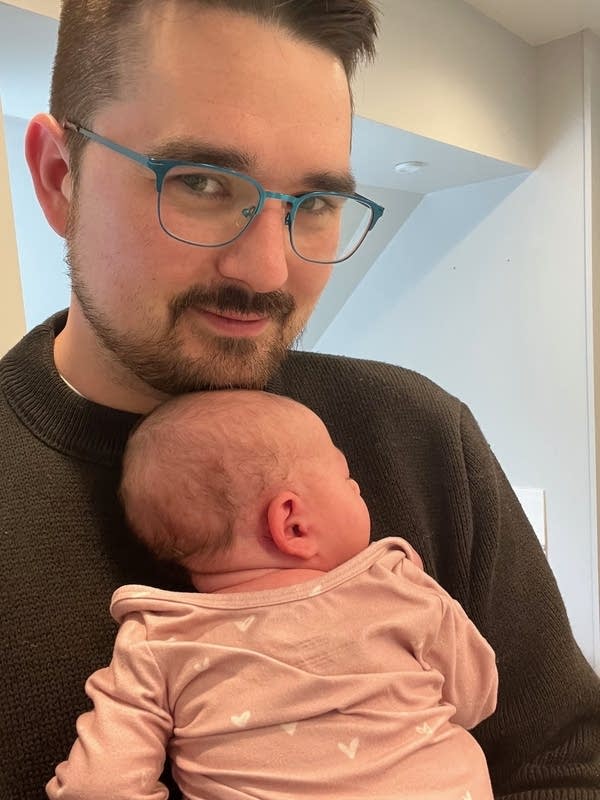
After Sage Conway gave birth to her second child last summer, she dreaded the thought of returning to work right away. So took unpaid family leave so she could spend 12 weeks at home her newborn son, Theo. But after that was up, the dental hygienist from Cottage Grove had to go back to work.
“Especially being a new mom, it's so hard to go back to work,” Conway, 38, said. “You don't want to leave your baby at 12 weeks.”
Conway said her mom was able to care for Theo while she was working, though that didn’t stop her from worrying.
“I'm a breastfeeding mother, and that was really difficult,” Conway told MPR News. “You know, a lot of babies struggle, even taking a bottle if they're used to breastfeeding.”
Now, with the new Minnesota Paid Leave Act in place as of Jan. 1, she was able to take another six weeks off, this time with partial pay, to bond with and care for her child.
“I had no issues at all. It's been going great,” Conway said.
She says the process to apply for paid leave was simple and straightforward. She’s glad that it's available to other new mothers too.
“I think it's really important, you know, just for society, for new moms, to be able to take that time with their baby,” Conway said.
Since launching in January, nearly 65,000 Minnesotans have applied for paid time off through the state’s Paid Leave Act, according to data from the Minnesota Department of Employment and Economic Development. So far, about 34,000 of them have been approved.
The program provides most Minnesota workers with up to 12 weeks of paid time off per year, although expecting mothers can take up to 20 weeks, combining medical and bonding leave to recover and spend time with their newborn child.
About 87 percent of applications the state has received have been for medical or bonding claims according to Evan Rowe, a deputy commissioner for Minnesota’s Department of Employment and Economic Development (DEED).
Claims for medical leave can include illness, injury, as well as mental health conditions and recovering from pregnancy. Bonding leave is available to both parents and doesn’t have to be taken at the same time, as long as the leave is taken before the child’s first birthday.
Minnesota’s paid leave plan is funded by a payroll tax of 0.88 percent of employees’ wages, which is split evenly between employee and employer, though business owners can choose to cover more of the employee’s tax burden if they would like.
Small businesses with 30 or fewer employees are taxed at a reduced rate of 0.66 percent.
What do other workers say?
While The Paid Leave Act has worked well for some who have taken advantage of it, others complain that they’ve been held up by complications, delays and red tape.
Kim Haskins Dehn of Maple Grove took time off to recover after foot surgery and said the application process was aggravating. It took her over a month to receive her pay from the state even though she started the application process before her surgery in February.
“I'm just real frustrated and irritated about it all, but there's nothing you can do. I mean, I just wait, you know?” Haskins Dehn said.
The nurse for Fairview Health Services said she had to apply four different times, and it took over a month for her to be approved for back pay, after she said several administrative errors and miscommunications from DEED derailed the process.
At one point, Haskins Dehn said had two separate applications open, which is not allowed, causing her to have to start over and reapply yet again.
“I was like, almost crying on the phone,” Haskins Dehn, 59, said.
Haskins Dehn said while her experience was exasperating, she was not in dire need of money.
But she worries about people in a worse financial situation who can’t wait a month to be paid.
“I'm thinking of these people that are out there that are sole supporters that have to pay a mortgage,” she said.
Dylan Wyatt, 33, is a physician at St. Luke's Hospital in Duluth. He said it took him three tries to get his back pay approved for the time he took off from work to care for and bond with his newborn daughter, Artemis.
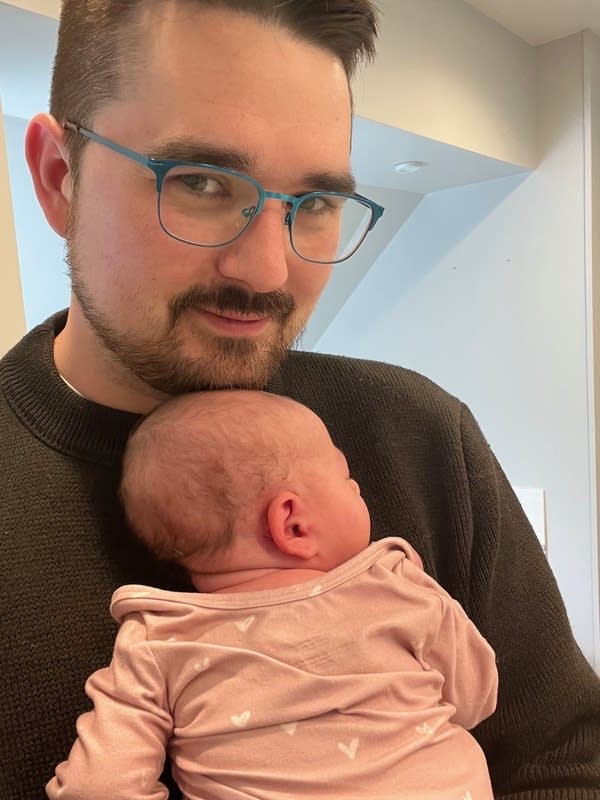
After the first few denied applications, he said the process could have been simpler. Specifically, he says it was difficult to figure out which forms he needed to submit.
“It's just fiddly, right? You got to make sure all the numbers are in a row,” said Wyatt.
Despite his complaints, Wyatt dismisses the “fiddly” paperwork as growing pains from a new system, and he praises the program at its core.
“It makes sure that people can take time to bond with their infants or new adopted little ones, to make sure that strong family connections are made,” said Wyatt. “The protected leave with the pay is just such a fantastic thing that I'm so proud of our state for doing.”
While paid leave seems to be a strong benefit for many Minnesota workers, small business owners across the state say it is adding more stress to their lives.
A small employer perspective
Jeff Backer owns a grocery story and a hardware store in Browns Valley. He’s also the Republican state representative for the area in west central Minnesota.
“This program is very impersonal,” Backer said. “I don't believe government should get involved with this.”
He criticizes the program as being “one-size-fits-all,” and not addressing the needs of businesses that have only a handful of employees across the state. He says not only is the additional tax for the program burdensome, but it can create problematic staffing shortages.
Backer says that many small business owners are already willing to work with their staff to give them time off when they need it.
“Small businesses don't keep their staff people if they don't figure out a way to work with them,” Backer said.
According to a recent report from the Minnesota Chamber of Commerce, about 80 percent of the chamber’s 6,300 members already offered paid leave to their employees in some form prior to the passage of the Paid Leave Act.
Additionally, Rep. Backer said the act will make it difficult for businesses with very few employees to cover shifts for those who are out on leave. And he said it creates more administrative work for small business owners who are often their own human resources staff.
“The administrative tasks are difficult for small companies that don't have an HR department,” Backer said. “We don't have no HR department, and a lot of small businesses in Minnesota (don't)."
The Chamber of Commerce’s report said that administrative work is a “major concern” for businesses without a dedicated HR department.
A solution?
Backer argues that businesses should be allowed to opt out of the program, as they are in Delaware, which has a similar paid leave program.
Delaware began offering paid leave this January too, and the state allows small businesses who employ nine or fewer people to opt out of paying into the program and receiving paid leave benefits.
“So opt in, opt out, let the small businesses work with their staff to figure it out,” Rep. Backer said.