Mapping ICE's expanding footprint, and the communities fighting back


The Trump administration's unprecedented expansion of migrant detention facilities is igniting fierce opposition in communities across the political and geographic spectrum, as the administration moves to scale up its detention footprint to fuel its campaign to arrest, detain and deport the largest number of immigrants in modern U.S. history.

Flush with new cash — $85 billion in new funding, with around $45 billion specifically to expand immigration detention over four years — Immigration and Customs Enforcement (ICE) is moving fast to lease and acquire warehouses and buildings across the United States with the aim of retrofitting them into detention spaces. ICE is also expanding contracts with local jails and private prison facilities as it builds out its sprawling detention footprint. ICE is now the highest-funded law enforcement agency in the nation.

An Immigration and Customs Enforcement worker stands outside a warehouse in Williamsport, Md., that's being converted into an immigration detention center with plans to hold 1,500 people, on March 9.
for NPR/Wesley Lapointe for NPR

ICE detainees have been held at more than 220 detention sites around the country, according to government data provided by ICE in response to a Freedom of Information Act request from the Deportation Data Project and analyzed by NPR. These sites range from dedicated ICE facilities and private prisons to county jails, military bases and newly converted warehouses. Detainees are also being held temporarily in staging areas, hospitals and holding sites. The number of sites continues to grow.

ICE's biggest detention operations are largely clustered in the southern United States. Just five states — Texas, Florida, Louisiana, Arizona and Georgia — account for just over 60% of the nation's more than 750,000 ICE detention book-ins. (In the Deportation Data Project's dataset, these book-ins are referred to as "stints." Most individuals have only one book-in per stay in detention, but some are transferred between multiple detention centers.) Texas had more than 200,000 book-ins across 115 facilities between President Trump taking office in January 2025 and mid-October 2025, the most book-ins of any state in the country.

A year ago, around 37,000 people were being held in immigration detention across the nation, according to ICE data. That number had jumped to more than 72,000 by the end of January 2026. The administration's goal is to keep expanding detention space to keep up with arrests. Ultimately, the Department of Homeland Security (DHS) aims to build bed space for 100,000 immigrants alleged to be in the country illegally. On average, detention facilities daily now hold nearly 70,000 immigrants, a scale of mass detention not seen since the mass incarceration of Japanese Americans and nationals during World War II.

And most detained noncitizens are clustered at a handful of centers. Of the more than 60,000 book-ins across Arizona, nearly half were at the Florence Staging Facility. Forty-five percent of the 93,105 book-ins across Louisiana were at the Alexandria Staging Facility.

DHS documents reveal ambitious growth plans scaled up around a "Hub and Spoke Model" in which eight large detention centers holding between 7,500 and 10,000 people each are fed by 16 smaller regional processing centers holding 500 to 1,500 immigrants each. The proposed facility in Social Circle, Ga., for example, is one of the eight proposed "mega centers" positioned strategically across the nation. The new center would effectively double the town's population of roughly 5,000.

Growing frustration, local backlash

But there's growing grassroots opposition — across political and geographic lines — to ICE's detention expansion. And communities are winning. From Georgia to Texas to Arizona and in scores of towns across the U.S., residents are pushing back, citing costs and infrastructure worries, as well as zoning, political and even moral concerns.

"They're getting the wrong people," says Donnie Dagenhart, who lives not far from a proposed ICE detention center near Williamsport, Md. Dagenhart, who owns a local construction company, says he supported Trump for years but has now soured on the president largely over how immigration is being enforced. "Let's get the bad ones out. That's what we should be doing, but we're not. I just think we're living in a police state and it's getting worse," he says. "Did you see the building?" he asks of the new detention site. "It's huge."

Two people on a motorcycle ride down a road in Williamsport, Maryland, on March 9. Two- and three-story buildings line the street behind them.
Motorcyclists ride through Williamsport, Md., on March 9.
Wesley Lapointe for NPR/‎

Polling shows that the public has largely turned against Trump's aggressive mass deportation agenda. Sixty-five percent of Americans said ICE has "gone too far" in enforcing immigration laws, according to the latest NPR/PBS News/Marist poll. That's an 11-point increase since last summer.

In New Hampshire, a "purple"' swing state that holds the nation's first presidential primary, community uproar recently forced the halt of a planned ICE detention facility in the town of Merrimack.

New Hampshire state Rep. Bill Boyd, a Republican from Merrimack who had previously reached out to DHS voicing his opposition to the facility, called it a big win.

"This community has fought giants and has come out victorious," he told NPR member station NHPR. "And it's just a testament to my neighbors and local leadership and the state leaders for taking a stand.

Backlash erupted, too, in Oklahoma City in deep-red Oklahoma when local residents learned of plans to convert a vacant warehouse into a facility to process and temporarily house immigrants. Faced with strong opposition, DHS and ICE backed away from that proposed detention site too.

Mississippi's senior U.S. senator, Roger Wicker, a Republican, has strongly opposed a proposed immigration detention center near Byhalia, Miss. "I am all for immigration enforcement, but this site was meant for economic development and job creation. We cannot suddenly flood Byhalia with an influx of up to 10,000 detainees," Wicker wrote on X last month.

Public outcry also stopped a planned detention facility in conservative Texas. The federal government planned to buy a 1 million-square-foot warehouse from Majestic Realty in Hutchins, Texas, and turn it into a holding center. But following weeks of pushback from community members and city leaders, the company decided not to sell or lease the facility to DHS.

"We're grateful for the long-term relationship we have with Mayor Mario Vasquez and the City of Hutchins and look forward to continuing our work to find a buyer or lease tenant that will help drive economic growth," a Majestic Realty spokesperson told Texas Public Radio in a statement.

The largest detention facilities in the country are run by two for-profit, private companies, Geo Group and CoreCivic. Both companies reported more than $2 billion in revenue in 2025, an 8% and 18% increase, respectively, in growth year over year. A handful of other companies also have big DHS and ICE contracts to help guard, run and support ICE detention operations, including Akima Global Services and its sister company Akima Infrastructure Protection. The Project on Government Oversight reports that CoreCivic's ICE awards have increased 45% since Trump took office for his second term.

‘A majority of these locations wouldn't pass for any other venue’

In Surprise, Ariz., where DHS recently purchased a 400,000-square-foot warehouse for $70 million, NPR member station KJZZ reported that the move sparked frequent protests and community pushback. Hundreds of people swarmed Surprise's City Council meetings demanding that the city pass a resolution to make DHS and ICE publicly disclose operational plans.

These concerns are heightened as reports of overcrowding and lack of food in detention centers across the nation have proliferated. ICE is investigating numerous detainee deaths. Since October, 26 people have died in ICE custody, putting immigration detention on track for its deadliest fiscal year since the agency was founded.

A protester standing along a street holds up a sign that says in all capital letters: "NO ICE IN ROXBURY."
Protesters gather with signs condemning Immigration and Customs Enforcement's purchase of a warehouse in Roxbury, N.J., for use as an immigrant processing facility, on March 10.
José A. Alvarado Jr. for NPR

Advocates say reduced oversight and record numbers of detainees are a recipe for more sickness and death in custody. "The abhorrent and worsening conditions in detention centers, gross negligence and a complete lack of oversight have contributed to yet another grim record for deaths in ICE custody," said Jennifer Ibañez Whitlock, senior policy counsel at the National Immigration Law Center, an immigrant rights defense organization.

While there have been few to no oversight moves on the federal level, local leaders are taking action. The U.S. Conference of Mayors, a nonpartisan organization representing the more than 1,400 mayors of cities with populations over 30,000, recently passed two emergency resolutions calling for the administration to rein in ICE tactics, expand transparency and put guardrails on detention expansion.

"A majority of these locations wouldn't pass for any other venue, even possibly for a homeless shelter," the Republican mayor of Columbia, S.C., Daniel Rickenmann, told NPR. The conference called for federal immigration agencies to "assure all those detained have access to legal assistance required by law; require all buildings where people are detained to meet local health and safety standards; [and] obtain appropriate local zoning and building permit approvals to convert warehouses and other buildings to detention or deportation facilities."

Rickenmann says he and fellow mayors have grave concerns about the rapidly expanding ICE detention system: "Are they sanitary? Do they have the beds? Do they have the facilities for restrooms? Do they have places that they can provide meals that are to standards that we would require anybody, including jails, to keep up with?"

In a statement to NPR, ICE said new facilities would bring jobs, additional tax revenue and security to communities. On recently purchased warehouses in Roxbury, N.J., and Hagerstown, Md., the agency wrote: "These will not be warehouses — they will be very well-structured detention facilities meeting our regular detention standards. These sites have undergone community impact studies and a rigorous due diligence process to make sure there is no hardship on local utilities or infrastructure prior to purchase."

Local officials NPR spoke with dispute the existence of any rigorous community impact studies for new ICE facilities.
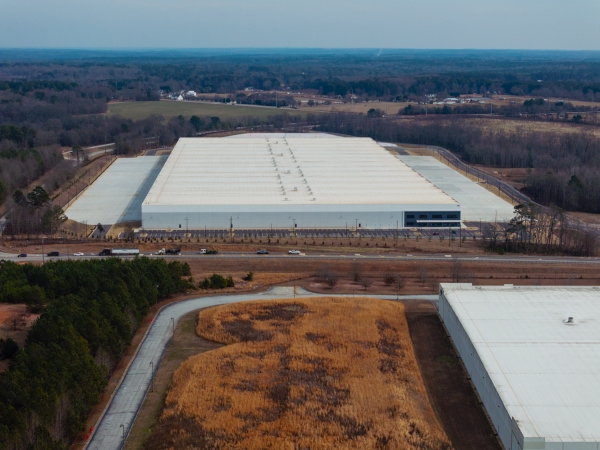
An industrial warehouse recently purchased by Immigration and Customs Enforcement (ICE) for use as a detention center is seen on February 10, 2026 in Social Circle, Georgia. Local officials have expressed frustration over the planned ICE detention facility.
Elijah Nouvelage/Getty Images

DHS secrecy leaves local officials in the dark

A through-line complaint across communities is lack of transparency. Representatives at all levels of government, from city councils to the U.S. Congress, complain they have been largely kept in the dark about DHS' plans. Local representatives in Oakwood, Ga., Baytown, Texas, and Highland Park, Mich., told NPR that they received no response from DHS when they inquired about facilities slated to be built in their communities.

In Social Circle, Ga., local frustrations rose so high that city leaders barred water use by ICE's planned facility until the agency provides more clarity on its plans.

"There is a lock on the meter," Eric Taylor, the city manager for Social Circle, said in a statement to NPR member station Georgia Public Broadcasting. "The lock is there until ICE indicates how water and sewer will be served without exceeding our limited infrastructure capacity."

In Merrillville, Ind., reports that ICE intended to convert a vacant 275,000-square-foot warehouse into a detention facility caught local officials completely off guard. The town quickly passed a forceful resolution opposing the conversion and publicly criticized ICE for failing to inform local officials of the move.

"We want to be clear that we've received no communication from any federal agency regarding the use of this property as a processing or detention facility, and the town has not approved or authorized any such use," Merrillville Town Council President Rick Bella said in an emailed statement to NPR.

San Diego Mayor Todd Gloria said that the lack of communication from ICE, as well as from the private-sector companies, is especially concerning when coupled with reports of mistreatment and abuse.

"Here in San Diego, our members of Congress are not permitted to access these facilities," Gloria said. "Our local public health officials have also been turned away. And so when you look at what's happening in public with these detention efforts, they often become extremely chaotic. It makes you wonder what's happening behind closed doors and without, you know, transparency and accountability."

In Oakwood, Ga., the mayor and City Council posted that while they support ICE's mission, they were concerned that the local government was not involved in the process of green-lighting the detention center or selecting its location. The sale was recently finalized, and Georgia Public Broadcasting reported that ICE paid $68 million for the space, which had an assessed value of around $7.2 million.

Oakwood City Manager B.R. White strongly criticized the detention center's placement next to two residential areas, an established subdivision and a building under construction, and warned that taxpayers would likely have to foot the bill, including an estimated $2.6 million in added sewer expenses alone.

"I would have liked to see [ICE representatives] come in, sit down, tell us what their plans are and discuss with us how to resolve the issues and the tax losses to the community," White told NPR.

He says the city has not received any communication from the federal government, so the city is left to deal with these issues on their own. "It was an egregious overstep by the federal government," White said. "'Get the ox and the cart out of the ditch service' is what we're having to do right now."

Some places that aren't slated to have a facility have preemptively taken action. After reports that DHS was scoping out locations for new facilities in Missouri, the Jackson County Legislature approved a plan to ban immigration detention facilities. Legislator Manny Abarca told NPR member station KCUR that it puts the county on the record as being against "the caging of people" even if the county doesn't legally have the authority to stop DHS.

A handful of communities have embraced new facilities, however warily, with an eye on the economic boost and local jobs that these detention centers bring.

In Georgia, Charlton County Administrator Glenn Hull says the county will make about $230,000 this year from the detention center contract between GEO Group and the federal government — enough to pay the salaries of 20% of the county's employees.

Hull says GEO Group has been a "great partner," providing about a dozen college scholarships and funding for holiday festivals and events, even as he acknowledges the ethical and moral costs of profiting from people being forcefully separated from their loved ones, locked away and deported.

"I hate to say it, but if not here, then somewhere else," Hull admits. "So you take advantage of what you have on your table. I hate to simplify it like that 'cause these are lives and families, but that's the reality of it."

To determine where people detained by ICE were held, NPR analyzed data provided by ICE in response to a FOIA request by the Deportation Data Project. In the Deportation Data Project's original dataset, a book-in is referred to as a "stint." Most noncitizens have only one book-in per stay in detention, but some are transferred between multiple facilities. Each transfer to a new facility counts as a separate book-in, as does a return to a facility where the person had previously been booked. Facilities range from dedicated ICE centers to local jails and hospitals.

Sergio Martinez-Beltran, Jasmine Garsd, Ximena Bustillo, Alyson Hurt, and Preeti Aroon contributed to this story.

Copyright 2026, NPR


Source link

Leave a Reply

Subscribe to Our Newsletter

Get our latest articles delivered straight to your inbox. No spam, we promise.

Recent Reviews


Azure IoT Hub – Table of Content

What is Azure IoT Hub?

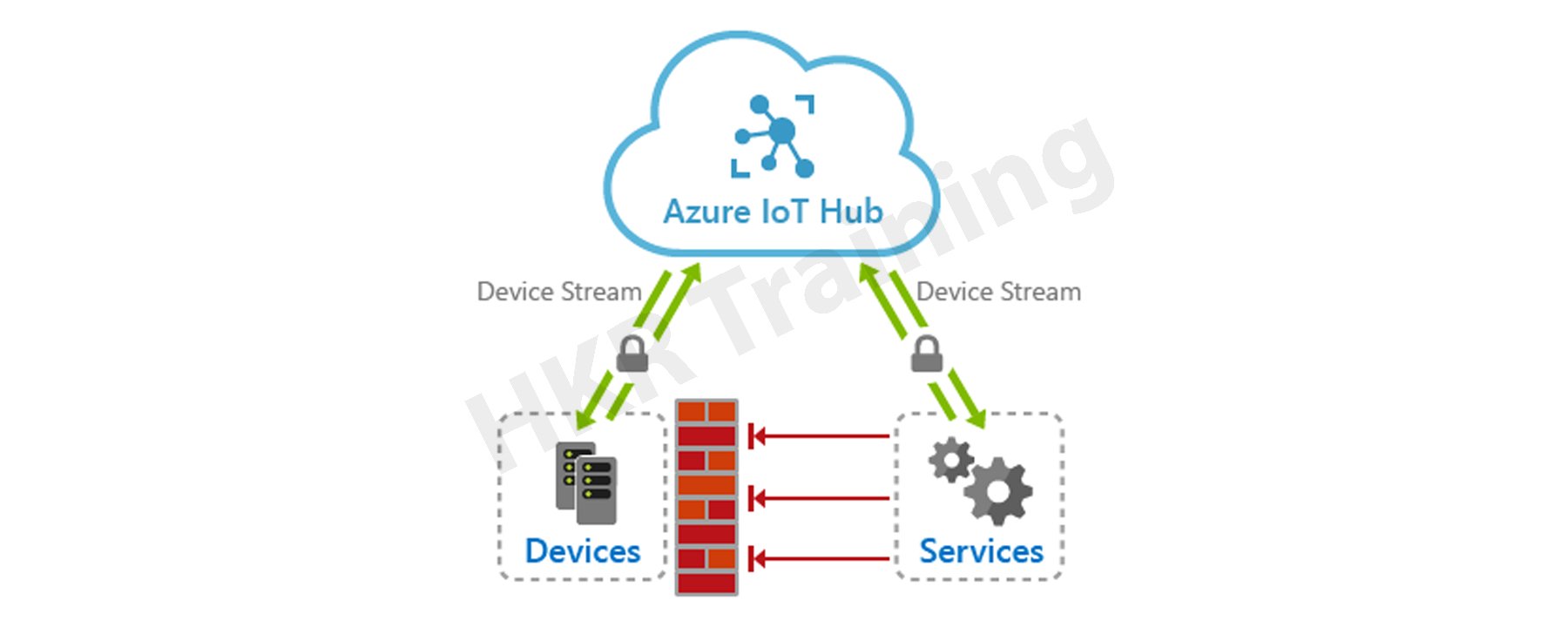
Microsoft’s Azure IoT Hub is a cloud-hosted manageable IoT service that acts as a central hub for messages. It provides bi-directional communication between the millions of devices it manages and the IoT apps. Further, it enables completely scalable IoT solutions, and virtually, we can connect multiple devices with Azure IoT Hub. It supports various messaging patterns like telemetry data from Device-to-cloud, file uploading from the device, and request-to-reply methods to control devices through the cloud. Moreover, through hybrid communication, it can connect from cloud to device and device to cloud. This feature makes IoT Hub more popular in the market. 

Azure IOT HUB

Azure IoT Hub helps to track and monitor multiple events like development, failurr, and connecting devices. It supports various IoT workloads for the users by scaling to millions of devices concurrently. Also, it rises to millions of events quickly, enhancing productivity. It enables the building of completely scalable IoT solutions such as tracking and monitoring valuable healthcare assets, managing various manufacturing equipment, etc. Further, Azure IoT Hub also offers a secure communication channel with enhanced security. However, Azure IoT Hub provides reliable and safe solutions to various businesses by connecting millions of devices and applications. 

Become a master of IoT by going through this HKR IoT Online Training!

Azure IoT Hub offers

  • Device library professionals are available for most commonly used systems and languages, allowing for simple device connectivity.
  • Stable communication with various device-to-cloud and cloud-to-device hyper-scale communication channels.
  • Processing of per-device state data as well as meta-data that can be queried.

IoT Hub device management:

The needs and priorities of IoT operators vary markedly across industries, from transportation to manufactured goods to agriculture to utilities. There is also a wide range of different devices used by IoT operators. IoT Hub can provide developers with the abilities, patterns, and code libraries they need to create management tools which can manage large amounts of data.

Related Article: IoT Solutions Architect

Microsoft Azure Certification Training

  • Master Your Craft
  • Lifetime LMS & Faculty Access
  • 24/7 online expert support
  • Real-world & Project Based Learning

Device configuration and control

Devices that are connected to the IoT Hub can be handled using a variety of built-in features. That is to say-

  • All of your devices’ metadata and state data can be saved, synchronized, and queried.
  • Device states can be set per-device or in groups based on common power devices.
  • Using message routing integration, a device’s state change can be instantly reacted to.

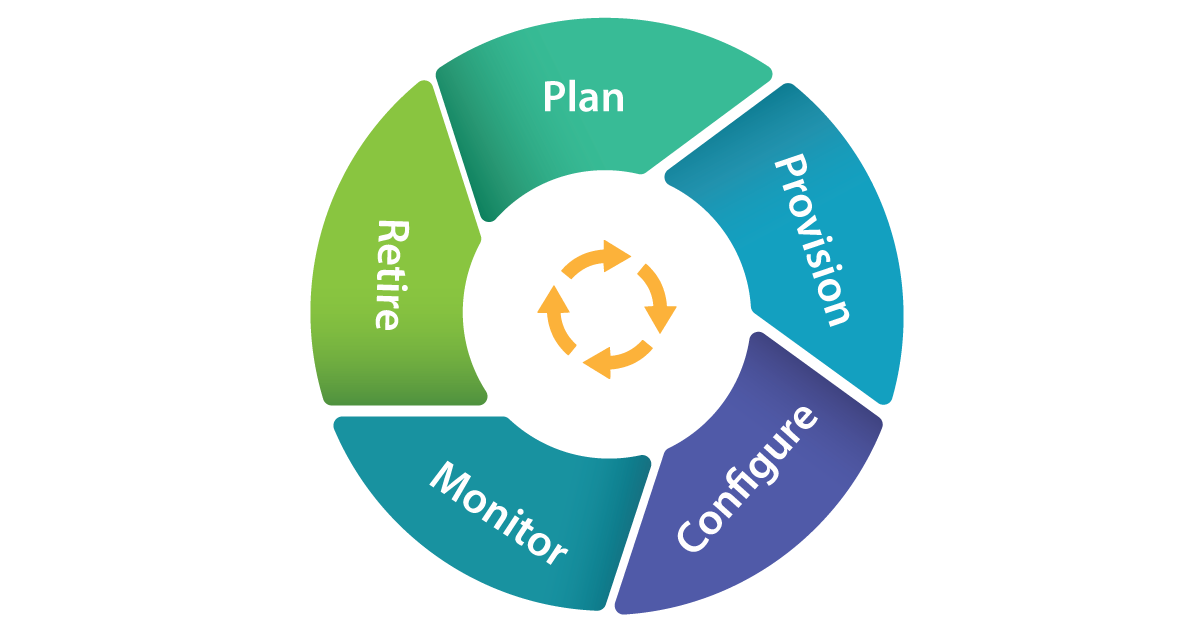
The LifeCycle of Devices with IOT Hub:

lifecycle of devices with IOT Hub

Plan Operators could really generate a device metadata scheme which really aims to facilitate bulk risk management with ease.

Provision

  • New devices can indeed be safely added to IoT Hub, and operators could indeed soon realize about mobile applications. Device identifications and credentials are created using the IoT Hub identity registry.
  • Configure Data management activities, including such configuration changes and software installations, can be performed in bulk or directly while maintaining system security.
  • Monitor Operators could be quickly notified to any problems that arise, while also monitoring the device collection’s wellbeing and the position of every continuing operation.
  • Devices must be substituted, retired, or dismantled. To withdraw device identifications and qualifications, the IoT Hub identity registry is used.

Plan

It enables operators with a plan to build a device metadata scheme that allows them to easily and accurately perform bulk management activities. You can use the device twin to save device metadata in the style of properties and tags. 

Configure

Azure IoT Hub allows device management activities such as configuration changes in bulk and firmware updates. You can do these operations either in bulk or by direct methods. 

Monitor

Using IoT Hub, we can alert operators on the occurrence of issues by monitoring device collection health. Also, we can check the status of multiple ongoing activities. Here, we can apply a device twin that enables devices to report the conditions of real-time operations and update operations status.

Retire

At the end of the lifetime of service, the devices need replacement or deactivation after a failure or cycle update. Here, we can use the IoT Hub identity registry to rescind the credentials and identities of devices securely.

Device Management Operators:

  • IoT Hub contains a range of device management patterns, such as,
  • Factory Reset Reboot
  • Firmware update for configuration
  • Progress and status updates
  • These patterns can be tailored to your specific situation. Alternatively, these templates can be used to create new patterns.

Connecting Devices:

By using Azure IoT device SDK, you can create applications that run on your devices and interact with IoT Hub. Platforms supported include Windows, Linux distributions, and real-time operating systems. Currently supported languages includes C,C#,Java ,Python, and Node.js.IoT Hub is a key component of the solution accelerators and can be used to address IoT challenges in the implementation such as:

  • Device connectivity and management at a high volume.
  • Ingestion of large amounts of telemetry.
  • Device command and control
  • Enforcing device security.

Integrating with Other Devices:

IoT Hub can be combined with other Azure services to create complete, end-to-end solutions. As an example, use:

  • Azure Event Grid enables your company to respond quickly to critical events while remaining reliable, scalable, and secure.
  • To streamline business operations, use Azure Logic Apps.
  • Azure Machine Learning can be used to incorporate machine learning and AI models into your solution.
  • Using Azure Stream Analytics, you can perform real-time analytic calculations on information broadcasting from one’s devices.

frequently asked IoT Interview questions and Answers !!

HKR Trainings Logo

Subscribe to our YouTube channel to get new updates..!

Messaging Patterns:

Azure IoT Hub includes a variety of messaging patterns, such as,

  • Telemetry from a device to the cloud
  • Device-based file upload
  • Methods of request-response that allow devices to be monitored from the cloud.

Related Article: Future Scope of IoT

Messaging routing and event grid

Streaming data from your connected devices is possible thanks to IoT Hub message routing and IoT Hub integration with Event Grid. There are, however, distinctions.Message routing lets customers to route device-to-cloud messages to the a variety of endorsed service endpoints, including Event Hubs and Azure Storage containers, whereas IoT Hub assimilation with Event Grid is a highly scalable routing service that can be increased in to the third-party enterprise applications.

Routing the device data:

The message routing capabilities are built into Azure IoT Hub. This enables you to automate message fan-out based on rules. Message routing allows you to direct at which your hub sends telemetry from your devices. Routing messages to seamless access is free of charge.

Building end to end solutions:

Incorporating IoT Hub with other Azure services allows for the creation of end-to-end solutions. As an example,

  • Azure Logic Apps can be used to optimize business operations.
  • Using Azure Stream Analytics, you can perform real-time analytic computations on data from your devices.Azure Machine Learning could be used to add AI models and machine learning.
  • With Azure Event Grid, you can react promptly to important incidents.

Azure IoT Hub and Azure Event Hub

Azure IoT Hub and Azure Event Hub both are cloud services capable of ingesting, processing, and storing large amounts of data. They were, however, created for distinct purposes.Event Hub was created for big data streaming, whereas IoT Hub was created to connect IoT devices at scale to the Azure Cloud. As a result, which one you use will be determined by the needs of your company.

Security:

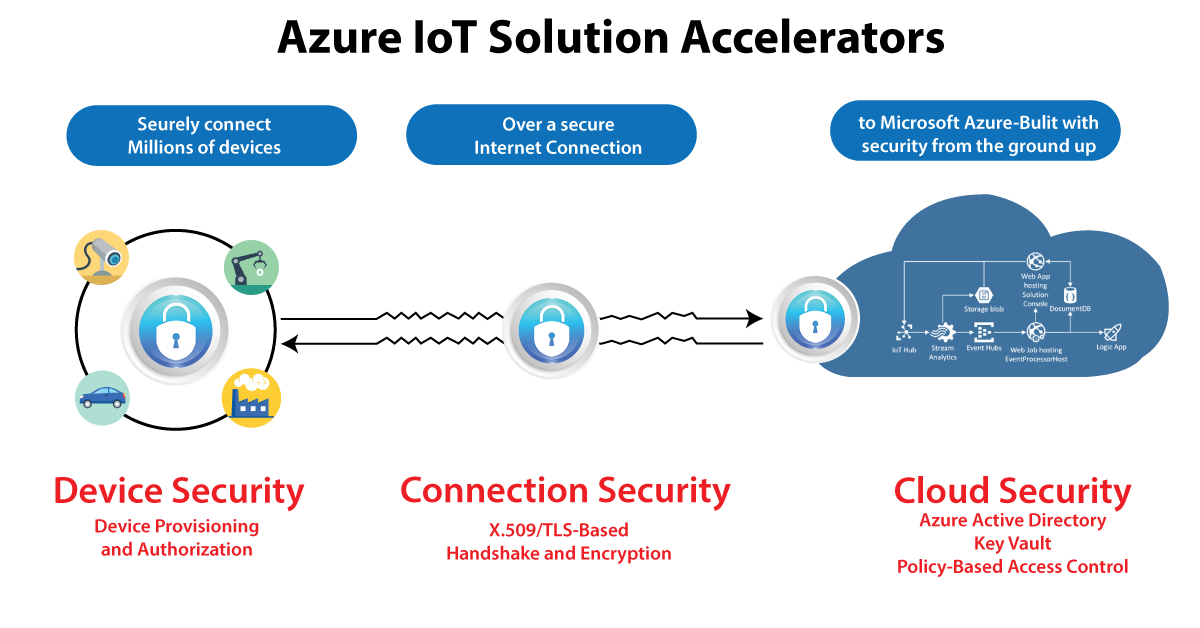
Businesses face new security, confidentiality, and compliance challenges as a result of the Internet of Things. Security for IoT solutions entails securely provisioning devices, step is implementation among devices and the cloud, and ensure security data security in the cloud all through handling and preparation.

Azure-IoT-Hub-2

IoT Hub enables information to be processed over secure channels of communication. So every device securely connects to a hub and can be handled securely. You could indeed gain access on a per-device basis, and devices are made available to the appropriate hub when they first boot up.

There are also a variety of authentication methods available depending on mobile applications, such as SAS SAS token-based authentication, individual X.509 certificate authentication for secure, standards-based authentication, and X.509 CA authentication.

HA and disaster recovery

The goals for uptime differ from one company to the next. Azure IoT Hub provides three main High Availability (HA) and Disaster Recovery (DR) features, which are as follows:

  • Intra-region HA: The IoT Hub provider implements layoffs with almost all layers of the service to provide intra-region HA. The SLA published by the IoT Hub service is achieved through the use of these redundancies, which are made available to developers automatically. However, while using cloud computing, transient faults must be anticipated; thus, appropriate retry regulations must be built into components that can be interacted with the cloud services.
  • DR across borders
  • Issues may occur when a datacenter experiences prolonged outages or other physical inability. It is rare, but intra-region HA capability will be unable to assist in these circumstances.IoT Hub, on the other hand, has a range of potential solutions for regaining from elongated outages or physical failures. In these cases, a consumer can choose between a Microsoft-initiated failover and a manual failover.

Obtaining cross-region HA

If the RTOs supplied either by the Microsoft initiated failover or manual failover are insufficient to meet your throughput goals, you can incorporate a per-device automatic cross-region failover component. The IoT solution in this framework operates in two separate data centers, one primary and one secondary.If the primary region experiences an outage or a lost opportunity of network connectivity, the technologies could use the secondary location.

Selecting the Best IoT Hub Tier

Azure IoT hub is divided into two tiers: basic and standard. If data is to be collected from devices and analyzed centrally, the basic tier, which is unidirectional from devices to the cloud, is preferable.However, when you require bi-directional interaction, such as the ability to control connected devices, the standard tier is preferable. The security and authentication features are the same in both tiers.

Azure IoT Hub Benefits:

There are multiple benefits of using Azure IoT Hub in real-time.:

  • Azure IoT offers different shortcuts for fast prototyping and deployment of code. It allows less coding to develop app templates, SDKs, plug-and-play device connections, etc. However, Microsoft has developed the best and simple IoT platform for multiple users.
  • Each Azure IoT service provides perks such as pre-built app templates with desired use cases within Azure IoT Central. In this regard, Azure Maps is the best example that enriches your IoT App with geospatial data. 
  • Each service in this platform has a flexible pricing model based on its particular feature sets. Its simple approach and transparency help to separate the Azure IoT Hub. 
  • Azure IoT has a strong support of partner networks similar to AWS. These include manufacturers of IoT hardware and solution developers. 
  • Moreover, the major benefit of Azure IoT Hub is its strongest security feature. Further, Microsoft invests billions of dollars in Cybersecurity solutions every year. 

What are the Microsoft Azure IoT Hub features?

Scaling your solution

  • Azure IoT Hub helps scale concurrently connected millions of devices and events/second. 
  • It supports multiple IoT workloads easily. Thus, it gives you a highly scalable solution to ease your workload.

Securing your communications

Azure IoT Hub offers a safe and secure connectivity channel for smart devices to send and receive data. 

  • It provides complete control over device access and connections with each device. 
  • Each device authentication allows them to connect with IoT Hub securely, and they are securely managed. 
  • Further, it supplies devices and appliances to the right IoT Hub upon booting the device. 

Routing device data

IoT Hub offers an in-built message routing functionality with the flexibility to set up an automatic rule-based message expansion.

  • At first, use message routing to manage where your hub sends device telemetry. 
  • There will be no extra cost for routing messages to various endpoints. 
  • Further, no-code routing protocols will take the place of unique message dispatcher codes. 

Integrating with other services

Azure IoT Hub provides integration with other Azure services to develop full-fledged solutions. The following integrations it supports:-

  • Azure Event Grid integration helps your business respond securely and reliably to important events. 
  • Moreover, Azure Logic App integration will help automate various business processes
  • Azure Stream Analytics is useful for real-time analysis of data streams in your device. 
  • Further, the Azure Machine Learning combination will add ML and AI models to the solutions. 

Configuring and controlling your devices

Using an order of various in-built functions, you can easily control your devices linked with IoT Hub. 

  • At first, it needs storing, syncing, and inquiring about device metadata and the status of all the devices.
  • Next, device condition setting, whether per-device or based on common features of devices. 
  • Finally, through message routing combination, it automatically responds to a device-reported condition change. 

Connect your devices

To create applications that run on your devices and interact with IoT Hub through Azure IoT device SDK libraries. It supports various languages, such as:-

  • C, C#, Python, Java, Node.js, etc.

Also, there are some protocols that IoT Hub and the device SDKs support to link devices. These include:-

  • HTTPS
  • MQTT
  • AMQP
  • MQTT over WebSockets
  • AMQP over WebSockets

Organizing bidirectional communication with millions of IoT devices

  • Utilize device-to-cloud measuring data to know the condition of your devices and define message routes to other Azure services without putting down the code. 
  • Further, in the cloud-to-device messages, send commands and notifications to the linked devices and track message delivery with the approval of receipts.

Developing and running hybrid IoT apps throughout data centers

  • Azure Stack Hub is an extension of Azure helpful to offer a path to run apps in an on-premises ecosystem. And it delivers Azure services within your data centers. 
  • Additionally, partners & customers will have the flexibility to create hybrid IoT apps that run wholly or partially on-premises. It is possible with Azure IoT Hub’s availability on Azure Stack Hub.

Create An Azure IoT Hub

Developing an Azure IoT Hub needs to follow the below steps.

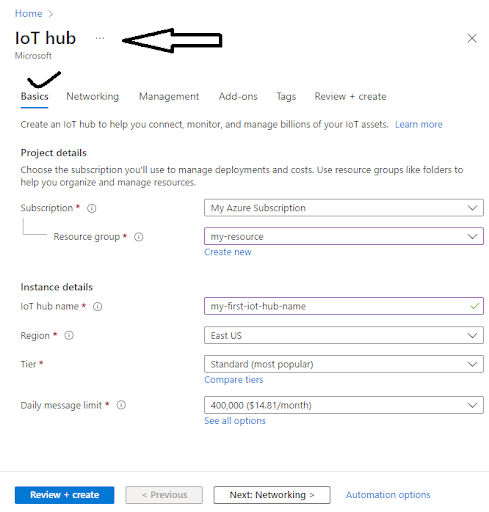
  1. Creating Azure IoT Hub
  • First, you must register and sign in to the Azure portal using credentials.
  • Then, you have to select the “Create a Resource” tab. After thiss, you need to enter “IoT Hub” within the search marketplace field.
  • Then, choose “IoT Hub” from the search outcomes and select the “Create” option.

Now, navigate to the Basics tab and complete the fields given:

  • Subscription: Choose the appropriate subscription to use within the IoT Hub.
  • Resource Group: Select the required “Resource Group.” Although, to build a new group, select “Create New” and enter the name you wish to use for it. 
  • Region: Select the exact region/place for the IoT Hub location.
  • IoT Hub Name: Enter a unique/uncommon Azure IoT Hub name.

Creating IOT HUB

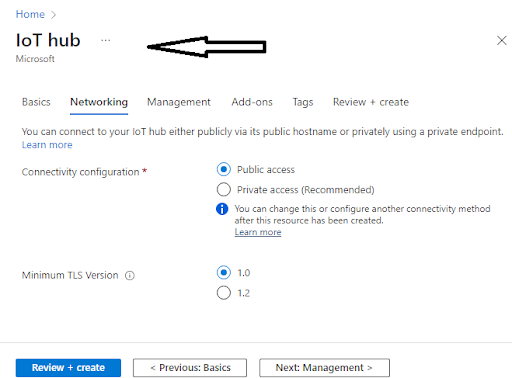
Then select “Next: Networking>” to continue Hub creation.

  • Here, you can choose the endpoints to connect to your IoT Hub. Further, you can select the default setting as Public EndPoint & Private EndPoint. 

Next Networking

Now, go to Next: Management> to continue the process of IoT Hub creation. 

Here, you will be given the option to accept the default settings. 

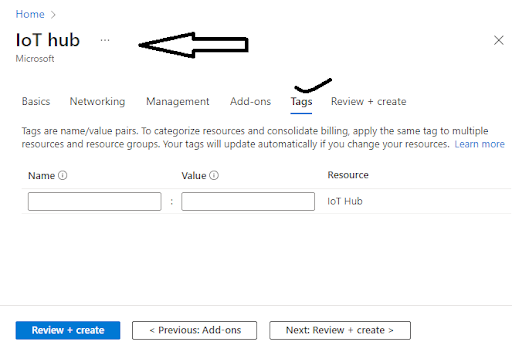
Then, to move to the next screen, you need to select the “Next: Tags” choice. 

  • Here, Tags include name/value pairs where you can assign the same tag to different resources and their groups to divide them and combine billing.

IOT HUB Tags

After completing the above, choose the “Next: Review + Create” tab to review/check your choices. Then go to the “Create” option to build your new IoT Hub.

  1. Changing/Updating the IoT Hub

Here, you can modify the settings of your current IoT Hub that you built from the Azure IoT Hub pane. Below are the various properties that you8 can set for the IoT Hub.:-

  • Scale & Pricing: This property will be helpful to migrate to a new tier or to set the number of IoT Hub Units. 
  • IP Filter: This property is useful to set the range of IP addresses the Azure IoT Hub can accept or reject. 
  • Properties: It consists of various properties like resource ID, group, resource location, etc., available for copying and use anywhere else.

Shared Access Policies

Go to Settings and click on the “Shared Access Policies” option to view or change the list of various Shared Access Policies. Further, these policies mention the necessary consent to connect the devices and services with the IoT Hub. 

Click the button Add and you will see a window “Add Shared Access Policies” opens. Here, it allows you to insert the new policy name and the permissions list that you wish to link with this policy. The permissions include the following:-

  • Registry Read and Write Policy
  • Service Connect Policy
  • Device Connect Policy

After this, click on the “Create” tab to add this new policy to the current list of guidelines.

  1. Registration of New Devices to the IoT Hub

To register a new device-

  • Go to the IoT Hub navigation menu and open IoT devices.
  • Then insert a name for the new device within Create Device. After giving the device name, choose the “Save” option to create the device identity of the Azure IoT Hub.
  • Finally, go to the IoT Devices pane after device creation and open the device from the list. Then to connect with the IoT Hub, you need to copy the Primary Connection String. 
  1. Message Routing for Azure IoT Hub
  • For this, click on the “Message Routing” option within the “Messaging” section to see the Message Routing pane. 
  • Then you have to mention the custom endpoints and routes for the IoT Hub.  
  • Further, Message Routing is useful to manage how data is sent to your endpoints from the IoT devices. 
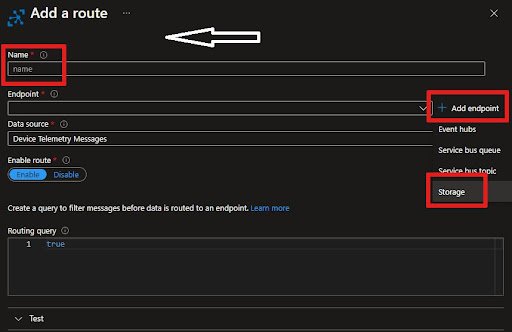
  • Here, the first and foremost step is to add a new route. Then it allows you to add an existing endpoint to the Route or build a new one of the various types that supports it—for example, Blob storage.

Routes

  • You will find “Routes” as the first tab on the Message Routing Pane. Then click the +Add, to add a new route.
  • Then insert a Name for the Route.
  • After that, you will see Endpoint, from which you will have a dropdown list, or you can add a new one. To add it, click +Add Next to the Endpoint list and choose Blob Storage.
  • Then, after adding the Endpoint name, click on “Pick a Container” to select the Storage Account and the container.
  • For the “Data Source,” choose the Device Telemetry Messages. 
  • Further, you need to add a Routing Query. In this instance, the messages with an Application property with the name “Level” equal to “Critical” are directed to the storage account.  
  • Finally, you have to save the Routing file. Then you can go back to the Message Routing Pane and see a new “Routing Rule” appear.

Routes

Custom Endpoints 

Go to the “Custom Endpoints” option, where many are already built. 

  • Here, you can easily build new or remove the existing Endpoints. 
  • Moreover, you can only specify up to 10 Custom Endpoints for the Azure IoT Hub.
  1. Finding a particular IoT Hub

First Step:-

  • Go to the homepage in Microsoft Azure and choose the IoT Hub from the given list.
  • You click on the “Resource Groups” if you already know the resource group to which the Azure IoT Hub belongs.
  • Now select the option- “Resource Group,” and the drop down list will display.
  • Then the “Resource Group” screen presents all that group’s resources along with the Azure IoT Hubs. 
  • After that, you choose your IoT Hub. 

Second Step-

  • Click on the “All Resources” tab. You will find a dropdown list over there.
  • Then click on the Drop Down list and uncheck the Select All option.
  • After that, find “IoT Hub” and check the same.
  • Finally, click on the appearing “Drop Down” list to close it. It filters all the entries and displays them on your IoT Hubs.
  1. Deleting/Removing the IoT Hub

You can also delete your IoT Hub in the following way.:-

  • Go to the Azure Portal.
  • Select the “Delete” option to remove the IoT Hub.

Microsoft Azure Certification Training

Weekday / Weekend Batches

Conclusion

In the above blog post we discussed the Azure IOT hub, configuration, integrations,routing, communication and security in a more detailed way. Had any doubts please drop your queries in the comments section. 

Related Article:

Azure IoT Edge Overview


Source link