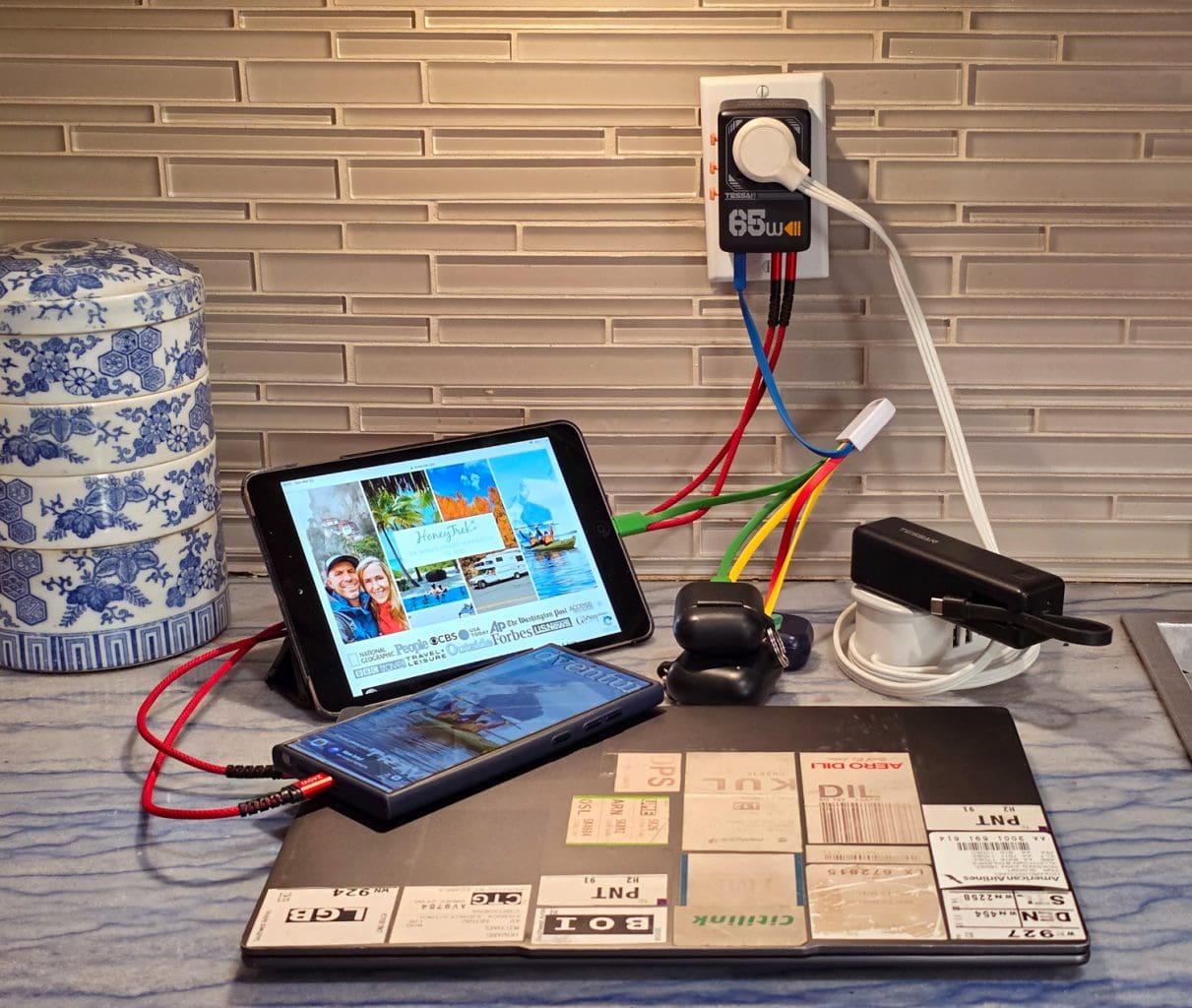
Travel Tech: Staying Charged Abroad: TESSAN Travel Adapter


What tech should I pack

Whatever you pack for travel tech (laptops, earbuds, action cameras, drones, smart-watches, etc)…none of it matters if you don’t have a way to safely charge these devices abroad. Traveling for 14 years across 91 countries, we’ve tried all sorts of adapters, surge protectors, and chargers, and we have dialed in the perfect power setup. Using that knowledge, we are going to help you lighten the load in your pack, reduce the volume of cords, and supercharge your devices so you can focus on what matters–experiencing the wonders of the world!

Travel Adapter: Where Power Begins

At the heart of every charging station is a solid universal travel adapter–if the country you are in has different plugs, nothing will charge without one. If you have a faulty outlet, you risk frying your devices. This is why, of all the tech we are going to dive into in this article, this gadget deserves extra explanation…especially since there is so much junk on the market!

We have tried over a dozen different adapters over the years. We’ve heard the terrifying sizzle of a bad electrical connection in Angola. We’ve created make-shift scaffolding to keep our adapters from sagging out of the socket in Malaysia. Then we found our Tessan Travel Adapter…the gold standard, and the example we will use in this article on how a travel adapter should work.

Tessan Travel Adapter

What is a travel adapter?

Adapters have more and more bells and whistles these days, but at its most basic level, this piece of hardware allows you to plug your devices into a power outlet in the country you are visiting. Your plug is shaped like X, and the outlet is shaped like Y, and a travel adapter bridges that gap for a seamless connection. To be so versatile, it offers inlets and outlets for the world’s four major plug types (C, G, I, A) in a single device. It doesn’t change the voltage; it simply lets you charge your device in the socket of your new favorite country.

Why do I need a (good) travel adapter?

Simply said, you can’t charge your devices if your plug doesn’t fit the wall socket. If you don’t have one with additional USB charging ports, you won’t be able to charge all your devices at once. And most importantly, if you buy a cheap one, you could create a faulty connection and fry your hard-to-replace tech (certainly not worth the $15 you will save with a low-quality adapter).

What to look for in a travel adapter

  • Countries Covered: A good adapter should have the four major plug types, allowing it to work across North America, South America, Europe, Africa, Asia, and Oceania. There will always be a few anomalies and quirky countries (looking at you, South Africa, lol) that have unique configurations…but the way we solve that is by going to the local hardware store in that country and getting a basic converter (they are tiny and inexpensive), then we plug our travel adapter into that small converter. This way, you don’t need to buy a whole new travel adapter for those few fringe countries.
  • Multiple Ports: Between you and your travel partner, what needs to be charged regularly? Laptops, cellphones, earbuds, watches…? Do they charge by USB-A, USB-C, or a three-prong plug? With lots of devices and plug types, a good adapter should have one main three-prong plug, and multiple USB-A and USB-C ports.
  • High Wattage: You want a travel adapter that can handle the combined wattage of all your devices plugged in at once. So head over to Google, and search “[YOUR DEVICE NAME] charging speed specifications”. I just did it on my Galaxy S25 Ultra, and it wants 45 watts. Our iPad needs 30W. And just repeat that for all your devices, and you will find out how many watts your optimal travel adapter should handle.
    Note: This calculation only applies to devices plugged into the USB ports; the standard outlet on the travel adapter can handle hundreds of watts, so you can exclude your laptop from the calculation.
  • Rapid Charging: Once you’ve had a taste of speed-charging (like your phone going from 0% to 100% in an hour), you won’t want to settle for the trickle charge of yore. You want an adapter with GaN Fast Charging (Type-C/G/A/I), ideally two of them, to make sure you aren’t waiting around for devices to charge!
  • Protective Fuse: This feature is a crucial safety mechanism that breaks the electrical circuit if the outlet sends too much current (which could fry your device), protecting your tech and preventing potential fires. A fuse serves as the first line of defense against overheating and will blow if an overload occurs, shutting off the power to prevent damage to your device.

Our Favorite Travel Adapter: Tessan Universal Travel Adapter 65W

After trying so many different adapters, we can say the Tessan line of travel adapters is so solidly made and offers the versatility and power we need for our travel tech. While some people only need the power of the TESSAN 35W, and their 140W version can certainly satisfy even the biggest tech users, the 65W hits our sweet spot.

  • Works in 180+ Countries: It is ready to plug and power your devices, virtually anywhere you go in Europe, Asia, Oceania, South America, North America, and Africa.
  • Multi-Charging: It can charge 5 devices at once with a main socket for pronged devices, 2 classic USB ports, and 2 USB-C ports to accommodate a variety of tech.
  • It’s powerful: In addition to the main plug’s unlimited power, 65W is more than enough to quickly charge our USB devices, charge our laptop in a pinch, and with two GaN speed-charging ports, it gets the job done in a jiff! 
  • Safety Fuse & Backup: We feel confident plugging in high-powered devices because the built-in fuse will blow first, preventing harmful surges from reaching our tech. Plus, the TESSAN 65W comes with a backup fuse, so if this happens while we are in a remote location, we can replace the blown fuse, find a new outlet, and get right back to charging safely.
  • Small but Durable. Weighing only 7 ounces and measuring 3 x 2 x 2 inches, we barely notice it in our bag, yet it’s sturdy enough to get banged around and support multiple cords hanging off it.
  • Affordable: At only $36, it has incredible value for the versatility and power.

Essential Charging Accessories for Your Travels:

COPYRIGHT HoneyTrek 20260124 150756 2

With the Tessan travel adapter as the backbone of our charging station, here are the four other items that complete our setup.

Power Strip w/ Surge Protection

As you know from your home power strip, this extension cord with multiple outlets lets you power multiple devices and provides additional surge protection. Though abroad, a power strip, like this Tessan Power Strip, is even more important because:

  • You can’t use the other outlets in a room abroad without a travel adapter, and even the biggest adapter won’t have enough outlets for all your devices. You need something that can share the power from your adapter and distribute it to the rest of your devices that require a pronged plug.
  • It extends the range of places you can work in a room, so you don’t have to be a wall-hugger at the airport or bus station, tethered to a short cord. The Tessan power strip lets you be 5 feet away from the power source, helping you set up a good workspace.
  • Surge protection matters tenfold when you aren’t sure of the quality and consistency of the power you’re getting from random outlets (e.g., a bus station or a sketchy guesthouse). In addition to the fuse in your travel adapter, this power strip surge protector is another line of defense against frying valuable tech.
  • In addition to the 4 traditional AC outlets, it adds 3 more USB ports.
Best Travel Adapter TESSAN

Multi-Device Splitter

We use this 5-in-1 device to reduce the number of cords we need to carry on a trip. It has 2 Lightning plugs for Apple devices like our headphones and tablet, 2 USB-C plugs for smaller devices that don’t need much power, and 1 micro-USB plug for those old-school devices still hanging around. It’s a great piece of mind to know we can always charge any small items, even if this is the only cord we remember to pack.

Power Bank with a Built-in Wall Plug & Cord

I can’t tell you how many times we have thrown a power bank in our bag, only to find out it’s dead when we need it. This Tessan power bank not only has a built-in plug (it flips down to be hidden when not needed) but also a built-in USB-C cable, so you aren’t hunting for one as you run out the door. Plus, with 20,000mAh (just under the TSA-allowed limit), it’s super fast-charging and has enough power to get your devices to 100%.

High-powered USB-C cables

No traveler wants to wait for their phone to charge or be tethered to a power bank while on the go. To power up your devices faster without exceeding their maximum charging rate, we recommend these nylon-braded USB-C cables, which support up to 100 watts and feature an LED display so you can see how much juice is flowing. For larger devices like your laptop, these 240W cables do the job and let us leave the clunky manufacturer’s charger back at home.

We hope this deep dive into the best charging solutions for travelers has helped you understand what you need to power up safely and efficiently abroad! With this tech in your bag, you won’t need to worry about charging up at a crowded guesthouse in Patagonia or a sketchy bus station in Nepal. These options give you versatility and peace of mind so you get what you came for–an awesome journey! 

COPYRIGHT HoneyTrek 20230518 195252 1

Huge thank you to Tessan for partnering up with HoneyTrek and inviting us to join their Tessan 100 Travelers Program; we’re honored you selected us among your elite group of world explorers, and we’re proud to be ambassadors for a company like yours!

For more gear tips, see this video with our Top 10 Travel Tech Essentials:

@honeytrek Traveling around the world for the last 14 years, we have streamlined our packing to the things that matter most. Travel tech can add up fast (in both space & money), so we want to share the 10 essentials we carry with us on every trip…including our most important gadget! #TravelTech #Tessan #Partner @Tessan Shop US #PackingTips ♬ original sound – HoneyTrek


Source link

Leave a Reply

Subscribe to Our Newsletter

Get our latest articles delivered straight to your inbox. No spam, we promise.

Recent Reviews


Last updated on
Jan 19, 2024

Cyber Security VS Software Engineering – Table of Content

What is Cyber Security?

The cyber security industry is a fascinating field in the IT sector and apt for those who are ready to accept the challenges. The term cyber security can be defined as it is a type of IT application that designs and implements secure network solutions specially designed to act as a shield against hackers, persistence attacks, and any cyber-attacks.

Cyber security engineers are those who involve in designing and implementing security solutions to defend against various threats, cyber-attacks, and malware attacks. They are also involved in testing and monitoring the system devices to make us assure that all the system devices are up-to-date and ready to defend against any type of attack.

Wish to make a career in the world of Cyber Security? Start with Cyber Security Training!

What is Software Engineering?

Software engineering is also known as a Software architect or programming engineer, which involves analyzing the specific needs and creating the tools that are required to build software-related applications as per your or your client’s requirement.  The software engineer should have knowledge of software design, computer programming skills, such as python, Java, JS, Ruby, and other operating system knowledge like UNIX, and LINUX.  

Software developers are those who create software applications from already existing software applications whereas Software engineers are those who create the frameworks on the new software product which you are going to build.

Cyber Security Training

  • Master Your Craft
  • Lifetime LMS & Faculty Access
  • 24/7 online expert support
  • Real-world & Project Based Learning

Cyber security VS Software Engineering:

In this section, we explain the major differences between cyber security and software engineer as per a few categories. Let’s start;

1. Cyber security VS software engineering: Roles and responsibilities

 First, start with knowing the roles and responsibilities of aby cyber security engineer:

  •   Cyber security engineers or we can call them cyber security analysts they involve in implementing and creating plans, security portals to protect the computer network integrity, mobile devices from any kind of malware attacks or ransom attacks.
  • They are responsible for creating software and updating the computer hardware devices to implement security-related plans.
  • The information security analyst must involve in the constant monitoring of the networking devices to have a security breach.
  • They must involve in creating security incident responses to help minimize the damage caused by any type of malware attack.
  • Experienced cyber security professionals involved in communicating the plans or protocols to work enough to detect the intruders.
Software engineering roles and responsibilities:
  • Software engineers are responsible for building, maintaining, evaluating, and testing the new software.
  • They should have a deep understanding of information systems,  information technology, and programming. 
  • Sometimes they involve in developing the applications and should have a piece of knowledge in mathematics, and algorithms.

2. Cyber security and software engineering skills and qualifications:

Cyber Security Skills and qualifications:

  • Candidates must hold a bachelor’s degree in computer science, and IT system engineering.
  • They should possess a minimum of two years of work experience in cybersecurity-related roles such as incident detection, responses, and forensics. 
  • Should have experience with the functionalities, operations, and maintenance of firewalls and various forms of endpoint system device security.
  • Must have proficiency in languages and tools such as C++, Java, Node, Python, Go, Power shells, and Go.
  • They should have the ability to work in fast-paced work environments, often under some work pressure.
  • Posses the right eye for details and must have outstanding problem-solving skills.
  • Must have a piece of up-to-date knowledge of cyber security industries, trends, and hacker tactics.
Software engineers skills and qualifications:
  • Strong knowledge in engineering, computer science, and mathematics.
  • Should have strong experience in software development.
  • Should have proven programming experience (various programming language skills).
  • Experience in using different kinds of tools and techniques the software development.
  • Creative and adaptive at problem-solving.
  • Deep knowledge of concepts and algorithms.
  • Strong coding knowledge is a plus.

3. Cyber security and software engineers salary:

Cyber security engineer salary:

According to ziprecruiters.com, an average salary for any cyber security engineer earns $49, 750 and a software security architect earns $135,800.

Software engineer salary:

According to indeed.com, an average salary for any software engineer earns $50, 000 and an experienced software architect earns $111, 430.

If you have any doubts on Cyber Security, then get them clarified from Industry experts on our Cyber Security Tutorial !

HKR Trainings Logo

Subscribe to our YouTube channel to get new updates..!

4. Cyber security and software engineers: career path

Cyber Security Career path

In the cyber security field, you will get to see various kinds of specializations. Let us know them;

  • Cyber security analyst: should have a piece of strong knowledge of analytical and thinking. They must be creative problem solvers.
  • Cyber security engineers: they should have experience in different operating systems and strong experience in various database platforms.
  • Cyber security managers or administrators: should have a strong experience with firewalls, and a basic understanding of proxy servers, packet shapers, and load balancers.\
  • Cyber security consultants: must have an in-depth knowledge of IT security measures and protocols, and methods to detect intruders. Must have experience in finding and repairing the damages. 
  • Information security Analyst: Experience in providing IT support, and have an organized or in-depth knowledge of intrusion detection systems. Effective problem solver, organized, and detail-oriented.
Software engineer career path:

Below are the few niches where you can get specialized;

  • System engineers: should have a basic understanding of principles and techniques. They must be able to use databases and MYSQL.
  • Full-stack engineer: must have a strong coding knowledge, able to manage both front-end and back-end development tasks. Understanding of system protocols and techniques. 
  • Software engineers: a deep understanding of the developments, coding, building, and deploying applications. Should be proficient with various and multiple coding knowledge. Must have hands-on experience in software-oriented architecture. Able to work independently and must involve in team building. 
  • IT security specialists: must have an in-depth knowledge of IT security tools, anti-virus software management, content filtering, and firewalls. Should have experience with coding, and be able to identify any malicious attacks.
  • Cloud engineers: able to create roadmaps that take you into the storage capacity, and should be a problem solver. Should be able to communicate with all the levels of employees.
  • Take your career to next level in Cyber Security. Enroll now to get Cyber Security Training In London!

5. Cyber security and software engineers: Certification lists

Cyber security engineer certification lists:

Below is the list of major cyber security engineer certifications:

  • COBIT 5 control objectives for information and related technologies.
  • COBIT 5 Professional certification.
  • CompTIA security+certification -SYO-601.
  • CISA certification and training
  • CND – certified network defender
  • CHFI – Computer hacking forensic investigator certification
    CISSP certification
Software engineer certification lists:

Below is the list of major software engineer certification lists:

  • Certified secure software lifecycle professionals.
  • Certified software development professionals
  • Certified software engineer
  • CIW web development professionals
  • C programmer certification
  • C++ certified associate
  • MYSQL Oracle certification
  • Microsoft fundamental certifications 
  • aws associate certification
  • Salesforce fundamental certifications

Which career is best for you?

Here we are going to list out a few reasons to choose the best career;

You should consider cyber security if;

  • You intend to get a 4-years of degree
  • You can handle anxiety or work pressure
  • You can communicate verbally and orally.
  • You enjoy solving puzzles
  • You can multi-task 

You should consider software engineer if;

  • You like to learn things hands-on (real-time).
  • You have a genuine interest in programs or coding
  • You are a self-learner 
  • You are a good team handler 
  • You are unique, creative, and innovative.

frequently asked Cyber security Interview questions and Answers !!

Cyber Security Training

Weekday / Weekend Batches

Final words:

It is very difficult to say which one is the best without determining the parameters for that. If you are someone who has a desire to get a college degree, then we must say the cyber security profession is the easy choice for you. Suppose if you are more interested in self-learning, then cyber security would be a difficult field for you. If you are someone who has a desire to learn to code, then you can choose the software engineering field. But both careers require mathematical knowledge, and how the algorithm works. So our advice is to choose the right profession based on your priority, and educational background. We must say it’s a wise decision to take! In this Cybersecurity VS software engineer post, we have mentioned important differentiations based on a few parameters. Hope you found this information helpful.

Related Articles:

  1. 1.Cyber Security VS Data Science
  2. 2.Cyber security Technologies
  3. Quickbooks Interview Questions


Source link