The Real Reason Behind Why Max Verstappen is Considering an F1 Exit | F1, formula 1, Max Verstappen | Celebrity News and Gossip | Entertainment, Photos and Videos
Max Verstappen is opening up about his future in Formula 1 and it sounds like he’s seriously considering walking away.
Following his eighth-place finish at the Japanese Grand Prix, the 28-year-old Red Bull driver admitted he’s questioning his long-term commitment to the sport amid major rule changes this season.
When asked by BBC Sport if he was thinking of leaving F1 at the end of the year, he said, “That’s what I’m saying. I’m thinking about everything inside this paddock. Privately I’m very happy. You also wait for 24 races. This time it’s 22. But normally 24. And then you just think about is it worth it? Or do I enjoy being more at home with my family? Seeing my friends more when you’re not enjoying your sport?”
Keep reading to find out more…
Max welcomed daughter Lily with girlfriend Kelly Piquet last April.
He clarified that his frustration had nothing to do with Red Bull’s start-of-season issues and more so with the big regulation changes.
“I can easily accept to be in P7 or P8 where I am,” he said. “Because I also know that you can’t be dominating or be first or second or whatever, fighting for a podium every time. I’m very realistic in that and I’ve been there before. I’ve not only been winning in F1.”
He went on to say, “But at the same time when you are in P7 or P8 and you are not enjoying the whole formula behind it, it doesn’t feel natural to a racing driver.”
Max called the current style “anti driving,” adding, “Then at one point, yeah, it’s just not what I want to do.”
Still, he insists he has not checked out.
“I see it like this: You hear it from a lot of sports people when you speak to them about how are you successful. It all starts with actually enjoying what you’re doing before you can actually commit to it 100%,” he said. “Now I think I’m committing 100% and I’m still trying, but the way that I am telling myself to give it 100% I think is not very healthy at the moment because I am not enjoying what I’m doing.”
He added, “And now people can easily say, ‘Yeah, well, you’ve won so many championships and races and now just because the car is not good you are complaining.’ Maybe you can see it like that, but I see it different.”
While he is exploring other passions like GT3 racing, Max made it clear he is not looking for sympathy.
“It’s not like if I would stop here that I’m not going to do anything. I’m always going to have fun. And also I will have fun in a lot of other things in my life,” he shared.
He continued, “But it’s a bit sad to be honest that we’re even talking about this. It is what it is. You don’t need to feel sorry for me. I’ll be fine.”
Vlocity (Salesforce Sectors) provides pre-built Salesforce solutions to meet the needs of specific industries which require CRMs that are significantly customized beyond Salesforce’s out-of-the-box state. Vlocity, which was founded in 2014, swiftly established itself as an “industrial cloud” pioneer, receiving 3 Forbes Cloud 100 honors in 2017, 2018, & 2019. What factors aided them in achieving such quick success?
Vlocity applications (based on the Salesforce platform) provide multichannel sales, advertising, servicing, and CPQ solutions to specific industries like Communications, Health coverage, Energy and Utilities, Financial Services, Multimedia, Healthcare, and Public Sector. The secret to success is straightforward. Companies profit from pre-built flows and procedures that would otherwise take several months (& millions) to construct custom. Salesforce purchased Vlocity in 2020. Salesforce has been able to include Vlocity’s industry-specific CRM systems in its current Salesforce Industries offerings as a result of the acquisition. Vlocity’s creator David Schmaier maintained his position as CEO of Salesforce Enterprises, a corporate unit in charge of establishing clouds for new verticals, following the rebranding.
What is Salesforce Industries, and what does it do?
Salesforce had a step up on the latest vertical solutions after acquiring Vlocity. In general, the 12 existing industry clouds are making progress inside the Vlocity apps. These add to Salesforce’s existing data model and give out-of-the-box services which reflect their industry’s language.
Two often used “clouds” are, for example:
Organizations gain all the tools and apps they need to develop subscription services, handle orders, quotations, and contracts in an agile manner with Media and Communications Clouds.
Financial Services Cloud: Provides a consolidated system with a unified customer’s perspective of their policy, financial information, and claims to support the banking, financial advisory, and insurance markets.
Marketing, sales, commercial agility, and also operating efficiency, are all enhanced by these clouds, which reduce time to value.
What is Salesforce Vlocity, and how does it work?
Salesforce Vlocity is the hottest innovation on the Salesforce platform, which is the industry’s leading provider of industry-specific solutions and software. It stands out as a worldwide forerunner in Customer Relationship Marketing, transforming the total customer experience (CX) (CRM). Vlocity also aids in the comprehension of the CMT, healthcare, and insurance realms. Salesforce Vlocity also has a lot more to offer, such as Lightning Web Omnichannel processes, Integration processes, Vlocity Actions, Tracking services, Data Migration, and so on. Salesforce Vlocity also improves CPQ and guided selling. Salesforce Vlocity is a trailblazer, enabling a slew of top and up-and-coming businesses to achieve their goals through its Omnichannel processes.
What are the different Salesforce Vlocity components?
Vlocity Insurance– To process all components of the insurance, Vlocity employs Microservice Architecture. Financial Service Cloud is intended to function with Vlocity Insurance.
Vlocity Media& Entertainment– This section contains a comprehensive industry solution for ad sales and subscriber sales in order to strengthen consumer and owner relationships.
Industry Cloud for Communications in Vlocity Communications aids in providing a consistent and individualized client experience.
Vlocity Health– Companies could use a Vlocity specialized device called Vlocity Health to run all of the sections relating to the health industry.
Vlocity Energy & Utilities is responsible for a number of industry-specific apps that allow the sale & service of a wide range of commodities and non-commodities.
Vlocity Benefits Salesforce in What Ways?
As a result of this collaboration, industry-specific solutions have become a key component of the platform’s capabilities. Salesforce has improved its adaptability over time, seeking to meet any industry issue. Nonetheless, one stumbling block remains unsolved: IT complexity. Consider a company with a complex IT stack, including some in-house applications. It will take a long time and a lot of money to replace it with a centralized platform. To enable end-to-end business processes, consultants and developers must customize the system, align, and merge apps.
This is where Vlocity comes in. Vlocity adds enterprise product catalogs (EPCs), customer relationship management (CRM), order processing, and digital commerce to Salesforce, and also pre-built methods and new models. The software is developed in strict accordance with industry standards established by organizations such as the TM Forum as well as the MAF. As a result, businesses are able to go live more quickly. They teach their employees and may eventually be self-sufficient, saving money on consultants and developers.
Subscribe to our YouTube channel to get new updates..!
Overview of OmniStudio
OmniStudio is a modular framework that allows you to easily develop Salesforce flows and solutions using standard click-based components.
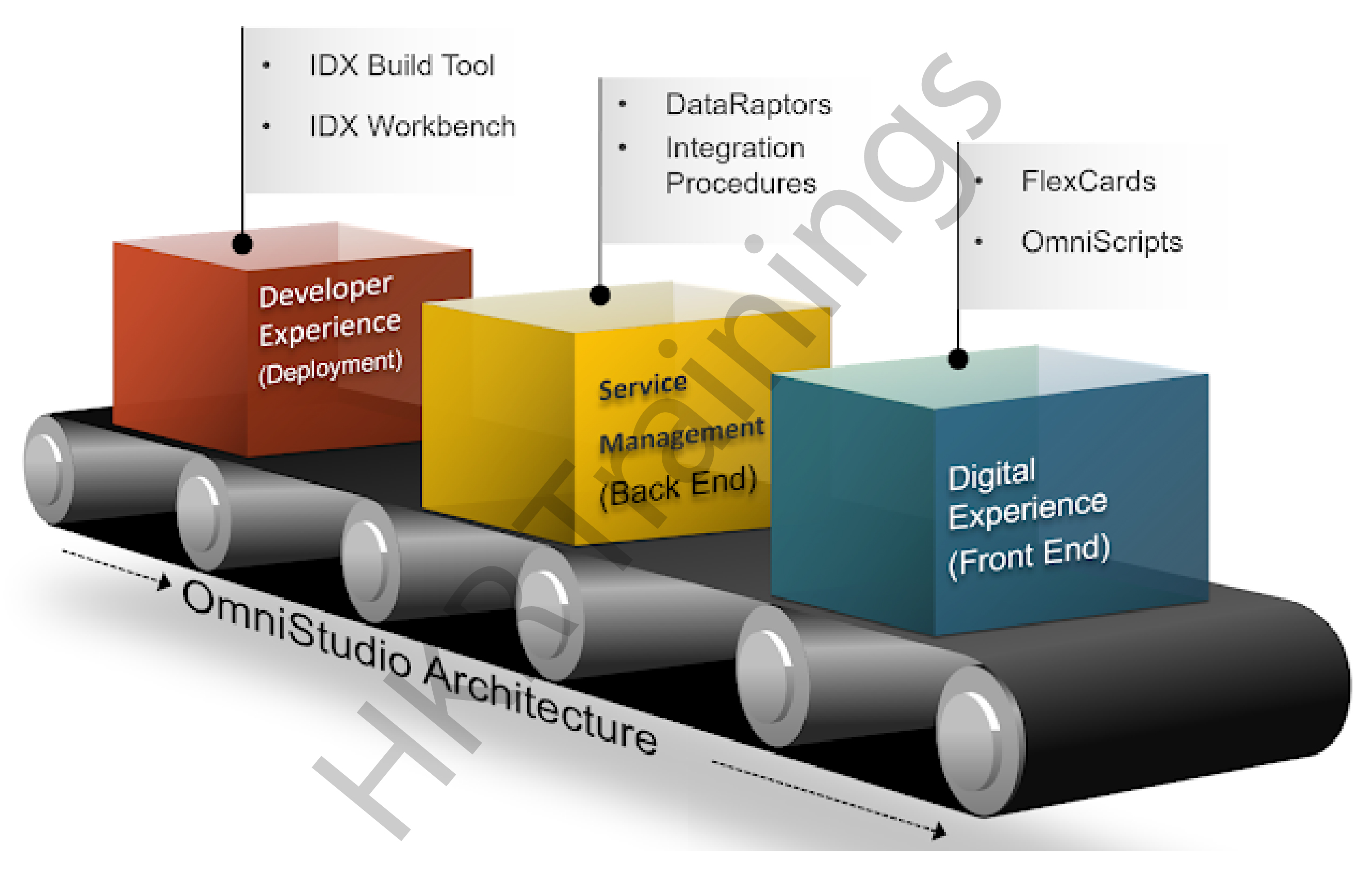
The architecture of OmniStudio is made up of three layers:
Digital Experimentation :
This is the User Interface Engine. It contains all of the user interface elements that can be selected and dragged toward the action area. We must choose the appropriate component depending on business requirements. The back-end layer’s entry point is this layer. To conduct any operation, simply connect the back-end components to the components. This UI Engine gets separated into two categories once more:
FlexCards :
Flexcard is an alternative if you really want to display multiple data in less space. Flex cards have been used to display data at a glance. This is a drag-and-drop tool that allows you to quickly configure, preview, and troubleshoot a screen. FlexCards present and summarise contextual information and actions from Salesforce and third-party platforms.
Omniscripts :
OmniScript is being used to give users a guided path through the business processes. That implies you can show multiple screens in a row. We may create pages quickly and effortlessly with the assistance of OmniScript, which is a drag-and-drop application. This is also entirely programmable, allowing it to be tailored to specific requirements. Another omniscript can be called from one omniscript. You may use OmniScripts to create sales, service pathways, and other business operations.
Service Management :
Backend logic & data are handled by this layer. By using integrations, Service Management may read and write data via Salesforce and other external sources.
It is divided into two sections:
1. OmniStudio Dataraptors :
DataRaptors are used to retrieve, transform, and update information. They are used to perform data-related operations such as reading, writing, and transforming data from external sources. There are four parts to Dataraptors
DataRaptor Turbo Extract: As the name implies, this program is used to extract information from a data object. This component has the most efficient data retrieval speed. This option should be used if the need on your page would be to return just a single item.
DataRaptor Extract: Most of the time, we need to work with several objects on a page; in this situation, vlocity gives us this alternative. Use DataRaptor Extract to return many objects.
DataRaptor Load: This component is used to update the information in Salesforce.
DataRaptor Transform: Whenever your data isn’t solely in Salesforce and you’d like to retrieve it and display it in Omniscript/flex cards, use DataRaptor Transform.
2. OmniStudio Integration Procedures :
To carry out such tasks, this instrument is quick and dependable. You can use Integration Procedures to retrieve data from third-party services.
Developer Experience :
OmniStudio Data packs can be managed with the IDX Build Tool. IDX Workbench seems to be a desktop program for transferring Salesforce information and Data packs. In conclusion, like custom programming, OmniStudio provides simple shortcuts and greater reuse chances for adapting the industry-oriented solution to your specific needs.
However, there are several disadvantages to be aware of right now:
Many clouds are combined within one common functionality by industries. As a result, it’s difficult to tell if a certain feature is part of the current implementation.
Since all clouds & APIs receive information in one bundle, updates do not even have a defined structure.
Errors and platform constraints have limited support.
Vlocity’s data model and functionalities are best suited for enterprises at the enterprise level. Some argue that it’s inappropriate again for the SMB market, because not only does it need a greater budget, but it also leaves small-medium firms with capabilities they don’t want and won’t utilize.
Do you want to learn more about Salesforce Vlocity? Watch this Demo video now:
What are FlexCard Actions?
FlexCard Actions can be used to start or modify an OmniScript, connect to a website page or app, show a flyout, launch an event, or change the values of data fields. FlexCards can do the following actions:
Card — Load, modify data source, or erase cards at the card level.
Event Custom — To alert the main FlexCard of an occurrence, fire a Custom Event. PubSub — To alert another element on a website or app of an event, fire a PubSub Event.
Flyout – In a modal or popover, show extra details from such a child card, OmniScript, as well as a custom Lightning web component (LWC).
Navigate — Choose a targeted URL or a PageReference type that allows you to navigate inside Lightning Experience, across Communities, to another website.
OmniScript — Use the FlexCard to launch an OmniScript.
Update OmniScript – Update an OmniScript from a FlexCard incorporated as a customized Lightning web component inside an OmniScript.
OmniScript Action – Update any OmniScript from a FlexCard integrated as a customized Lightning web component in an OmniScript A reusable OmniStudio Action can be used to launch OmniScripts, elements, websites, or external programs. The same OmniScript can be launched from numerous FlexCards using an OmniStudio Action.
Salesforce Vlocity Training
Weekday / Weekend Batches
Conclusion
To summarise, Vlocity achieved a breakthrough by offering businesses such an architectural foundation tailored to their industry. Salesforce’s acquisition signaled the company’s transition to industry-specific products that are easier to tailor and onboard users. For such a quicker digital transformation journey, firms can use the current Salesforce Industry clouds, which offer a configurable data model and a reliable version with reusable solutions.
To provide the best experiences, we use technologies like cookies to store and/or access device information. Consenting to these technologies will allow us to process data such as browsing behavior or unique IDs on this site. Not consenting or withdrawing consent, may adversely affect certain features and functions.
Functional
Always active
The technical storage or access is strictly necessary for the legitimate purpose of enabling the use of a specific service explicitly requested by the subscriber or user, or for the sole purpose of carrying out the transmission of a communication over an electronic communications network.
Preferences
The technical storage or access is necessary for the legitimate purpose of storing preferences that are not requested by the subscriber or user.
Statistics
The technical storage or access that is used exclusively for statistical purposes.The technical storage or access that is used exclusively for anonymous statistical purposes. Without a subpoena, voluntary compliance on the part of your Internet Service Provider, or additional records from a third party, information stored or retrieved for this purpose alone cannot usually be used to identify you.
Marketing
The technical storage or access is required to create user profiles to send advertising, or to track the user on a website or across several websites for similar marketing purposes.