Stopgap measures aren't enough to halt rising gas prices as the world scrambles for more oil


Global leaders have been scrambling to contain the rising cost of oil and gasoline since the start of the Iran war, which took a record amount of oil off the market when tankers full of crude were stranded in the Persian Gulf and military strikes damaged refineries, pipelines and export terminals.

Hoping to ease some pain for consumers, President Donald Trump and other heads of state have been pulling on various levers, launching more oil on the market in a bid to calm the chaos.

A group of 32 nations that are members of the International Energy Agency began releasing the largest volume of emergency oil reserves in its history: 400 million barrels. Trump is tapping into oil from the Strategic Petroleum Reserve while lifting sanctions on Russian and Iranian crude and temporarily waiving the Jones Act, a maritime law that requires ships carrying goods between U.S. ports to be U.S.-flagged.

But despite those maneuvers, crude oil surpassed $100 a barrel and gasoline is selling for $4.06 a gallon on average in the U.S. While the stopgaps are helping, they're not adding up to enough oil to replace what's stranded, experts say.

“They're all incremental,” said Mark Barteau, professor of chemical engineering and chemistry at Texas A&M University. "You’re talking about these different patches being at the level of maybe 1 to 2 million barrels a day each, and you’ve got to get to 20, so it’s hard to see those actually adding up to the numbers that are needed. And then the question is, how long can you sustain those?”

Trapped oil

Before the war began, roughly 15 million barrels of crude oil and 5 million barrels of oil products passed daily through the Strait of Hormuz, the narrow mouth of the Persian Gulf, amounting to about 20 percent of global oil consumption, according to the International Energy Agency.

In addition to that loss, some oil producing nations in the Middle East have halted oil production because they can't ship fuel out of the Gulf and their storage tanks are full. That's taken about 10 million more barrels per day off the market, the IEA said.

Then there are the eight countries around the Persian Gulf that together hold about 50 percent of global oil reserves. Under normal circumstances, they coordinate closely to raise or lower their output to keep prices steady, said Jim Krane, energy research fellow at Rice University’s Baker Institute. Usually Saudi Arabia steps in to bring spare oil to market and calm things down, he said.

“But all of that spare capacity is also bottled up inside the Persian Gulf right now and it can’t get to market either,” Krane said. “So the main emergency response system that we have is also blocked.”

The IEA said in its recent report that “the resumption of transit through the Strait of Hormuz is the single most important action to return to stable oil and gas flows and reduce the strains on markets and prices.”

Barring that, world leaders are grasping for ways to free up more oil.

Limitations of short-term fixes

Some nations have found workarounds to move oil out of the Gulf. Saudi Arabia is using its East-West pipeline, which stretches from the Persian Gulf to the Red Sea, to transfer about 5 million barrels per day out of the Gulf, said Michael Lynch, distinguished fellow at Energy Policy Research Foundation, a non-partisan institution focused on energy and economics. But the nation was already using that pipeline to transport oil, so it doesn’t have a lot of spare room to move oil from stranded tankers.

Trump also temporarily lifted sanctions on approximately 140 million barrels of Iranian oil that was already in transit. But that didn’t add oil to the market — it just widened the pool of potential buyers, said Daniel Sternoff, senior fellow at the Columbia Center on Global Energy Policy.

Typically, most Iranian oil was bought by private refiners in China, who purchased it at a steep discount, Sternoff said. But with sanctions lifted, others could scramble to buy the oil, which in turn raises its price to the benefit of Iran, he said.

“As soon as you are moving to waive sanctions on your adversary with whom you’re fighting a military conflict, to do something in their benefit, it just shows you that you are running out of options to try to prevent a rise in the price of oil,” Sternoff said.

The decision to lift sanctions on Russian oil could have more impact, because Russia had been storing unpurchased oil in tankers, Sternoff said. “By waiving sanctions, it will allow those barrels to clear.”

Trump’s temporary waiver of the Jones Act to allow foreign ships to temporarily transport goods between U.S. ports could potentially help ease natural gas prices by enabling companies to more efficiently ship liquefied natural gas from the Gulf Coast to New England.

But experts don’t expect the waiver to significantly impact the price of oil or gasoline. “It’s helpful, but not a game changer,” Lynch said.

Why U.S. oil production can’t solve the problem

The U.S. is a major oil producer, and exports more oil than it imports. But like any other oil producing nation, it can't just ramp up production instantly to fill the void.

“If the U.S. were to try to make up the global shortfall, we would need to nearly double our production,” Barteau said. “We couldn’t drill wells that fast even if we wanted to.”

Increasing domestic production by even 1 million barrels per day, a feat the U.S. accomplished during the shale boom, would be hard to duplicate, Lynch said.

“If we run every drilling rig right now, what happens a week from now when the war is over and the price goes back down $20?” Lynch asked. “People don’t want to develop long-term production based on a short-term price spike.”

Halting exports and using that oil within the U.S. wouldn't bring down gasoline prices either, experts say.

For one, oil is traded on a global market, so events happening halfway around the globe impact prices for everyone.

In addition, the U.S. doesn't produce enough of the type of oil its refineries process. It produced about 13.7 million barrels per day of oil at the end of 2025, according to the Energy Information Administration. And refineries processed about 16.3 million barrels per day that year, relying on imports to fill in the gaps, according to the American Fuel and Petrochemical Manufacturers (AFPM), a trade association.

That's because nearly 70 percent of U.S. refineries are set up to process heavy, sour crude, according to AFPM. But much of the oil produced in the U.S. is light, sweet crude, which was unlocked during the shale revolution.

“They need different crudes than the ones that are being produced right next to them now,” Krane said.

As a result, just 60 percent of the crude oil processed in U.S. refineries is extracted domestically, according to the AFPM. And retooling domestic refineries would cost billions of dollars, the group said. It also would require shutting down the refinery for a period of time, which generally raises gasoline prices.

“A lot of people like the IEA are making the point that this is the biggest oil crisis ever, which is partly true, partly an exaggeration, depending on how you count things,” Lynch said. “A lot of it has to do with how long does this last … if it goes on for another six weeks we get to be in some serious trouble.”




Source link

Leave a Reply

Subscribe to Our Newsletter

Get our latest articles delivered straight to your inbox. No spam, we promise.

Recent Reviews


What is Cloud FinOps?

A functioning structure and informational flux that gathers businesses, finance, and technological operations alongside each other to drive up the businesses through cloud transformation.

It promotes data-powered decision-making in due time and results in financial responsibility. The collaboration of finance, operations, and business teams makes it possible to achieve it.

FinOps is a field that integrates principles of financial management with cloud engineering and operations to give organizations an analysis of their cloud expenditure. It also allows them to make well-versed decisions on the allocation of their cloud budget and costs. Its goal is to increase the revenue or the business value with the help of the cloud. It also helps organizations control their cloud expenditure while still maintaining the performance level, dependability, and security required to assist their business operations.

Principles of Cloud FinOps

Accountability

With a set of pre-defined KPIs and benchmarks, the teams responsible for value realization reporting and costing amendment can be held accountable. This makes decision-making a process with standards.

Business Value Realization

Decisions taken from the perspective of business make Cloud FinOps successful.

Flexibility

Encourage constant budget allocation, IT spending, and forecasting to push ahead with agile budgeting and planning procedures in the IT industry.

Clarity of Costs

All organizational levels have access to instantaneous cost and billing data.

Partnerships

For cloud finance management, collaborate with departments like IT, finance, app development, and architecture.

Fluctuating nature of the cloud

Accept the pay-as-you-go aspect of cloud and gain from providing dynamic customer service to meet their ever-changing requirements.

Five Key Elements that Make Cloud FinOps

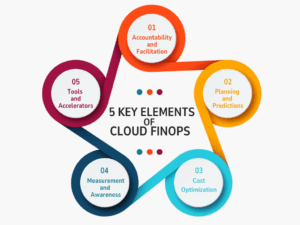
5 Key Elements of Cloud FinOps

1. Accountability and Facilitation

This element centers on setting up centralized, multi-functional teams that include engineering, finance, operations, architecture, and app developers, while also setting up governance and benchmarks for cloud expenditure.

2. Planning and Predictions

For cloud planning and predictions to be effective, an organization must allocate resources, benchmark efficacy, and gain a deeper understanding of the cost drivers.

3. Cost Optimization

This element, which is an ongoing, repetitive process that focuses on identifying key cost-optimization drivers, offers a consistent methodology to manage cloud consumption in the most economical way.

4. Measurement & Awareness

This key element focuses on building a key set of KPIs and business-value metrics to calculate the transformation’s success. Customers frequently begin with a set of cost-optimization metrics before switching to unit economics or business value metrics, like cost per transaction or cost per customer served.

5. Tools and Accelerators

To sum up, using the right tools and accelerators is crucial for efficiently managing and monitoring cloud spending. It comprises:

  1. Using Google Cloud cost-management tools to examine cost and billing data in real time
  2. Creating a reporting dashboard for tracking values and managing cloud spending
  3. Putting automation scripts into place to create budget alerts and account guardrails

Benefits That Cloud FinOps Offer

Business Value Realization

Initial focus on cloud migration often leaves the business goal of infrastructure in the rear. Proper cooperation between various departments makes FinOps effective and a success. This allows the reconsideration of business values while lifting cloud management to new heights.

Better Decision Making

Making decisions to make business better than today is the whole point here. Using the insights from cloud data and financial analytics, the FinOps team is able to make informed decisions regarding the business’s cloud computing commodities. This also makes them focus on the business goals.

Art of Predictions and Cloud Reporting

FinOps teams analyze cloud spend and set standards for future cloud costs using analytics, reporting, and forecasting cloud FinOps tools. They can create budgets fittingly and evade unplanned surplus costs thanks to the jacked-up cost visibility.

Accountability for Clear Cloud Use

By providing clarity into resource ownership and cloud spending, FinOps promotes accountability while leveling the time and effort needed for research and change implementation.

Challenges That FinOps Come With

Before Cloud FinOps begins to show results, you must surpass many predicaments. These may include issues with organizational processes, technical implementation, or how the teams as a whole perceive the changes.

Governance

Incorporating new methods, tools, and challenges requires all the things to be in place and well-governed. The processes to be incorporated ought to adhere to existing laws, rules, and compliance standards. It can be challenging to describe these approaches, create policies, and implement them.

Technical Glitches

There might be considerable technical glitches in putting the suggested modifications into practice, from planning effective cost data collection and processing to putting per-instance optimizations, element migration, and access management into practice.

All of the alterations should certainly be based on practicality, as well as administering the right balance between cost-effectiveness and effort, while taking into account the gross solution’s business value.

Cultural Alterations

As the FinOps framework requires processes to be established at every level of an organization, an actual cultural transformation must take place for FinOps methodologies to be implemented successfully. This entails setting up a culture of financial responsibility and accountability while maintaining the requirements of the company and the objectives of the other players in mind.

It could be challenging to bring in this culture, as it needs not only the establishment of appropriate processes but also a shift in the team’s mentalities. So, it is a task!

From Chaos of Cloud to Clarity: An Imperative for Businesses

Cloud FinOps is the way of the future for businesses, but excessive cloud spending can undermine the very advantages that companies are trying to achieve. Cloud FinOps management transforms from a standalone finance function into a vital business capability with FinOps.

Businesses that adopt Cloud FinOps not only reduce cloud expenses but also acquire the flexibility to change course more quickly, the assurance to make more intelligent investments, and the transparency to match IT with business value.

The ability to forecast precisely, budget dynamically, and optimize continuously is not a luxury in a world where cloud usage is only increasing; rather, it is a competitive necessity.

To learn more, visit KnowledgeNile!


FAQs for Cloud FinOps

1. What is another name for FinOps?
Answer: FinOps is the blend of “Finance” and “DevOps”. It shows the collaboration between business and engineering groups. It is also known by terms like Cloud Financial Management and Cloud Financial Optimization.

2. When did FinOps start?
Answer: It began in 2019 as an open community comprising individuals and organizations where knowledge of cloud financial management could be shared.

3. What is the future of FinOps?
Answer: FinOps’s future depends on comprehensive innovation and teamwork. FinOps and ITAM combination will be essential as cloud infrastructure develops to trim the financial waste, promote sustainability, and improve AI-powered optimization.


Also Read:
Cloud Migration Process Explained in Easy Steps
Edge and Cloud Computing for IoT and Their Key Roles
What is The Distributed Cloud: Advantages and Disadvantages


Source link