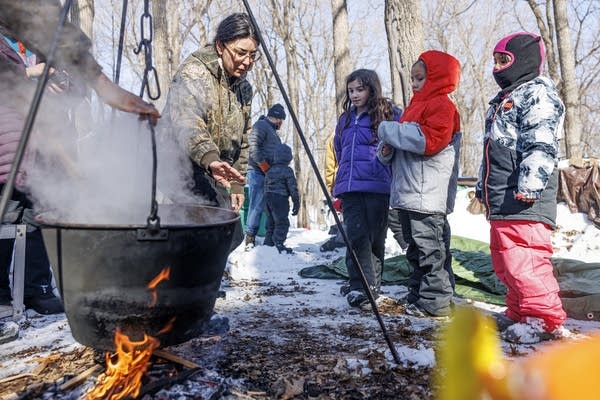
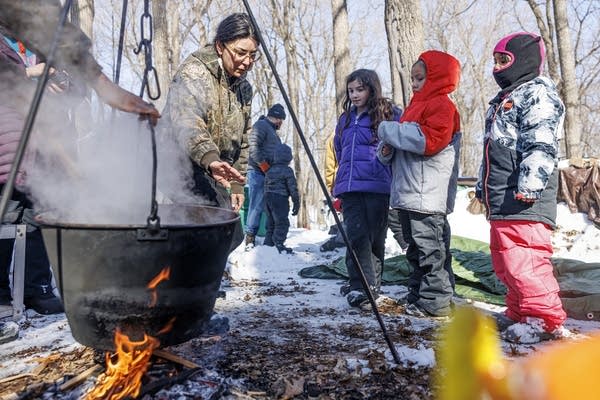
Liz Zoongwegiizhigook Zinsli led a field trip to Porky's Sugarbush Camp, a camp west of Minneapolis that specializes in maple tapping and processing.
She is a teacher at Wicoie Nandagikendan, an early childhood immersion program that teaches its curriculum in the Ojibwe and Dakota languages. Wicoie means “language” in the Dakota language and Nandagikendan means “I seek to know it” in the Ojibwe language.
Zinsli leads the Ojibwe classroom and teaches only in the language.
“I've never spoken English to them,” Zinsli said. “Even if I see them around the community, as you do, I don't speak English to them. It helps them with their development.”
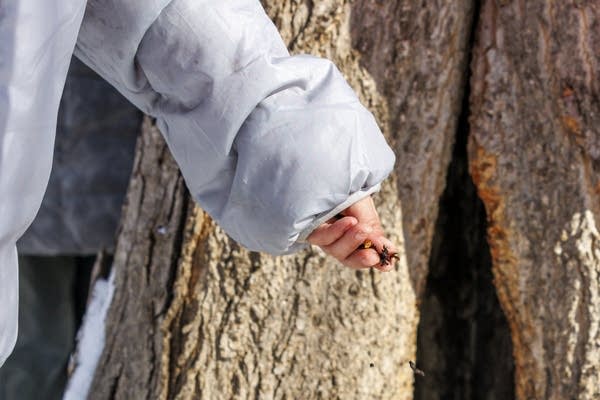
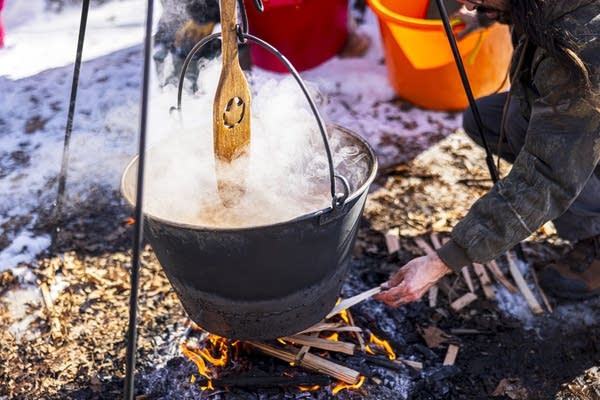
Students and their parents gathered to sugarbush, or maple tap – a springtime tradition in many Native communities. The group explored the wooded area and helped stir the already boiled maple syrup into sugar and sugar cakes.
Zinsli says in addition to language, the program’s curriculum includes cultural teachings.
“We do hit all the state standards, but it's like hitting all those early childhood indicators progress and more,” Zinsli said. Other cultural activities in the curriculum include learning how to cook dishes with rabbit or duck and learning about the process of harvesting wild rice.
The program also encourages family engagement.
“These kinds of meaningful experiences make [the immersion] real,” she said.
According to the University of Minnesota and language advocates, it’s estimated that there are fewer than 1,000 fluent Ojibwe speakers in Minnesota and far fewer Dakota first language speakers. The decline of Indigenous languages came with the boarding school era, when speaking the languages was discouraged and often punished.
“The goal is to grow the next generation of speakers,” said executive director Fawn Youngbear-Tibbetts. She said many fluent speakers of Indigenous languages are now elders.
‘We’re still going to be here’
At the beginning of the year, the program faced funding freezes. Wicoie Nandagikendan is funded completely by grants, including federal. Youngbear-Tibbetts says there was a time when staff took reduced paychecks.
“About half of them said, ‘Okay, I can take half a check,’ or ‘I don't need a check, I can wait,’” Youngbear-Tibbetts said.
At the same time as funding freezes, Youngbear-Tibbetts says there were also scares with the immigration enforcement surge in the Twin Cities. She says the young students witnessed ICE activity from their classrooms in south Minneapolis.
“The more consistency we have, the less impact that trauma will have. So, if you're in there reassuring them instead of, ‘Oh, close down the building, run away and hide at home’ — no, we're still going to be here, and you're safe,” she said.
Youngbear-Tibbetts says the program has since received funding to keep its doors open and to pay staff. She shares that funding was provided by local organizations, like the Minneapolis Foundation.
“The only reason we made it through that is because of philanthropy,” Youngbear-Tibbetts said.
And despite hardships, the school is continuing to advance its offerings. Starting in the fall, a Dakota immersion classroom will start again after being on pause for a few years.
Elder Carol Charging Thunder has been building the curriculum. As a Lakota first language speaker, she did not begin to speak English until she was in kindergarten.
“I'm all excited to start teaching, to start teaching the little ones, and we'll have visuals and things [for] them to do. So, I'm very excited. Children learn fast,” Charging Thunder said.
For her, incorporating activities that bring students out of the classroom goes hand-in-hand with language learning.
“This is how we live. Our children would get to experience all that and come up respecting our way of life,” she said.
For parents like Christian Swor, the program provides his son and his family the opportunity to connect with Indigenous language and culture. Swor, who is non-Native, adopted his son Quentin from a friend, who is Ojibwe.
“It's great from an academic standpoint,” Swor said. “It's great culturally, that he knows the language of his family, and we're learning the language of his family.”
‘It’s happening strong’
As the field trip finished at Porky's Sugarbush Camp, Zinsli reflected on how the program is a place where students can live in their Indigenous language.
“Here's a place that it's happening, it's happening strong. We just want support to continue, so that we can keep doing this awesome work,” Zinsli said.
Parent Cassie Benjamin attended the field trip with her three children and niece. She currently has one child enrolled in Wicoie Nandagikendan’s program.
“They understand so much, even just being here and people are speaking to them in Ojibwe. It's amazing to hear how much they are understanding,” Benjamin said. “Their language use is helping me with my language use. I'm trying to keep up with them.”
Chandra Colvin covers Native American communities in Minnesota for MPR News via Report for America, a national service program that places journalists into local newsrooms to report on undercovered issues and communities.