Chase’s Pay Yourself Back: How to maximize your rewards


If Chase’s Pay Yourself Back hasn’t been on your radar in a while, it may be worth brushing up on it.

Not only does this potentially lucrative option expand to a broad list of Chase cards, but some redemption rates are eye-catching.

Chase offers its Pay Yourself Back benefit on some cobranded credit cards, including Southwest Airlines cards, United Airlines cards, the Aeroplan® Credit Card (see rates and fees) and the Marriott Bonvoy Bold® Credit Card (see rates and fees).

Many of these current offers are valid now through June 30.

Here’s everything you need to know about using Chase Pay Yourself Back.

What is Chase Pay Yourself Back?

Pay Yourself Back is a unique redemption option within Chase’s Ultimate Rewards program, offering cardmembers an alternative to redeeming points for travel.

The categories have evolved over time, and it’s worth checking up on them each quarter to see if it’s a good use of your rewards.

couple holding credit card
JLCO-JULIA AMARAL/GETTY IMAGES

In short, the Pay Yourself Back option allows many Chase cardholders to redeem rewards at a value similar to booking travel. This won’t typically yield the same maximum value for your Ultimate Rewards points as strategic use of transfer partners can, but it can get pretty close.

And, it could be a good choice if you’re looking for a simple redemption or have a pile of points that you cannot immediately use.

Reward your inbox with the TPG Daily newsletter

Join over 700,000 readers for breaking news, in-depth guides and exclusive deals from TPG’s experts

Some Chase-cobranded airline cards (and a Marriott card) are also eligible for Pay Yourself Back. The rate at which you can redeem for some categories with these cards’ rewards is over the average return you’ll likely get when using your rewards to book travel.

Related: The best time to apply for Chase credit cards based on offer history

What purchases are eligible for Pay Yourself Back?

Here are the current categories eligible for Pay Yourself Back:

Card Redemption value Current end date
Qualifying charities: 1.5 cents per point

Grocery stores, pet supply stores, veterinary services and cardholder annual fee: 1.25 cents per point

June 30

Qualifying charities: 1.25 cents per point

Pet supply stores, veterinary services and cardholder annual fee: 1.1 cents per point

June 30

Qualifying charities: 1.25 cents per point

June 30

Travel purchases (up to 200,000 points or $2,500 annually) and cardholder annual fee (only purchases made at select merchants within 90 days before the redemption request date are eligible): 1.25 cents per point

Dining at restaurants, gas stations, grocery stores (excluding Target, Walmart and wholesale clubs): 0.8 cents per point

These are persistent categories for 2026

United Airlines personal and business credit cards
Cardholder annual fee: 1.35 to 1.5 cents per mile (based on which card you have)

United airfare purchases made directly with the airline of at least $50: 1 cent per mile

Ongoing perk

Southwest Airlines personal and business credit cards

Cardholder annual fee within 90 days of transaction date

Ongoing perk

Travel purchases made directly with airlines or Marriott Bonvoy hotels (up to $750 total per year)

Ongoing perk

Purchases made at select U.S. Disney locations in Disney Parks and Resorts, Disney store and outlet locations in the U.S., DisneyStore.com, DisneyPlus.com, Hulu.com and Plus.ESPN.com in the past 90 days: 1 Disney Rewards Dollar per dollar

Those with a Disney® Inspire Visa® Card (see rates and fees) or a Disney® Premier Visa® Card (see rates and fees) can redeem Disney Rewards Dollars toward airline purchases in the past 90 days with any airline at the rate of 1 Disney Rewards Dollar per dollar

Ongoing perk

The information for the J.P. Morgan Reserve, Chase Freedom and Ink Business Premier has been collected independently by The Points Guy. The card details on this page have not been reviewed or provided by the card issuer.

The list of charities for Pay Yourself Back includes:

  • American Heart Association
  • American Red Cross
  • Equal Justice Initiative
  • Feeding America
  • GLSEN
  • Habitat for Humanity
  • International Medical Corps
  • International Rescue Committee
  • Leadership Conference Education Fund
  • Make-A-Wish America
  • NAACP Legal Defense and Education Fund
  • National Urban League
  • Out and Equal Workplace Advocates
  • SAGE
  • Thurgood Marshall College Fund
  • United Negro College Fund
  • UNICEF USA
  • United Way
  • World Central Kitchen

Let’s say you wanted to redeem 10,000 points on your Chase Sapphire Reserve. For most purchases, you’ll get a $100 statement credit when redeeming 10,000 points.

But for those same 10,000 points, you’ll get a credit of $150 when you redeem them for an eligible charity donation.

Related: How much are Chase Ultimate Rewards points worth?

Requesting a credit

Requesting a credit through Chase’s Pay Yourself Back program is relatively straightforward. Log in to your eligible Chase account via the mobile app or desktop and select the “Pay Yourself Back” option in the redemption menu.

Next, you’ll see a list of eligible purchases for which you can redeem points. Points can be redeemed for purchases as far back as 90 days.

You can offset the full purchase amount, assuming you have enough points to cover it.

From there, you can confirm the redemption value and amount of points required and then choose to complete the transaction. Your statement credit should post within three business days.

Related: How to use Shop Through Chase to earn more points

Statement credit options on other purchases

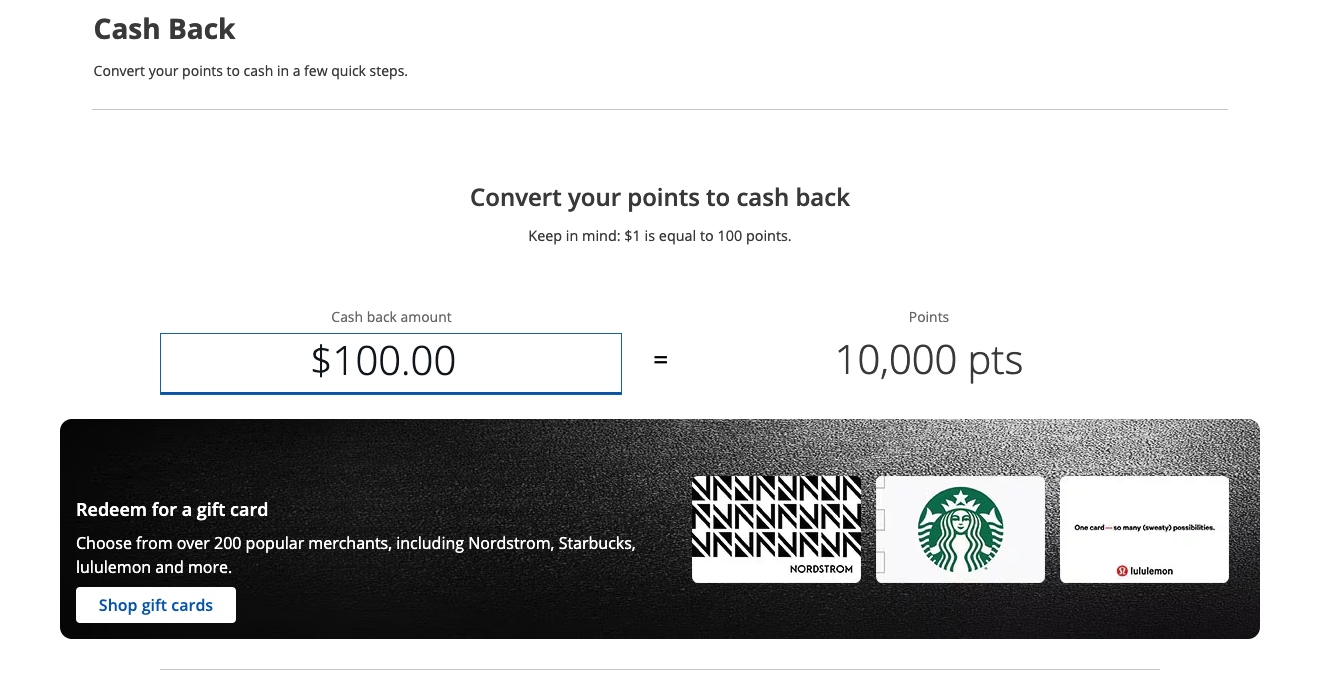
Chase has long offered the option to redeem points for a statement credit. To do this, log into your Ultimate Rewards account, hit the drop-down menu and select “Cash Back.”

You’ll be given an option to enter the amount you’d like to redeem and where you’d like your rewards deposited. All cash-back redemptions are fixed at 1 cent per point, which is a little less than half of TPG’s April 2026 valuation of Ultimate Rewards at 2.05 cents per point.

That redemption value is also lower than many of the above Pay Yourself Back options.
Chase Pay Yourself Back screenshot
CHASE

Even so, Chase’s traditional cash-back option is more generous than what you can expect from some other issuers.

Related: If I cash out my points and miles, do I have to claim it on my taxes?

Bottom line

Chase’s Pay Yourself Back feature provides valuable flexibility for many cardholders.

Ultimately, whether you should redeem your balance in this way depends on how you plan to use your points, how many you currently have and whether or not you’d benefit significantly from the statement credits.

If the categories for the second quarter of 2026 don’t work out for you, be sure to check back in for the third quarter to see if you should use this benefit then.

Related: Supercharge your Chase Ultimate Rewards balance with these top 5 cards


Source link

Leave a Reply

Subscribe to Our Newsletter

Get our latest articles delivered straight to your inbox. No spam, we promise.

Recent Reviews


SAP R/3 has been one of SAP’s main products, where R stands for RealTime and 3 refers to three-tier application architecture (Database,Application Server and Client).

In the modern environment, the SAP R/3 system powers the majority of businesses.

This software was used by approximately 80% of the businesses.

SAP Ariba Training

  • Master Your Craft
  • Lifetime LMS & Faculty Access
  • 24/7 online expert support
  • Real-world & Project Based Learning

Why SAP R3 architecture?

The primary goal of R/3 Architecture is to provide a set of tightly coupled, major business applications. The typical range of hypotheses for any R/3 process is as follows:

  • Production Planning
  • Materials Management
  • Sales and Distribution
  • Financial Accounting
  • Controlling, Etc

SAP R3 Architecture:

SAP R/3 Architecture simplifies and connects all of an organization’s business transactions through real-time integration. Real-time integration ensures that any change or upgrade in one application causes the data in the other applications to be automatically modified or updated.

We are aware of the SAP R/3 Architecture, specifically the client-server software. This ensures that the R/3 system’s groups and layers are designed to run concurrently on a number of different computing devices. When a business wants to install SAP software, each component is stored, regulated, and filtered using the equipment of completely separate and specialized computer systems.

Each layer has the ability to call on all of the other layers built to complete the task. Clients are components/layers that request services, while servers are components/layers that deliver services. This is referred to as “client/server.”

, others, sap-r3-architecture-description-0, others, sap-r3-architecture-description-0, others, sap-r3-architecture-description-0, , others, sap-r3-architecture-description-0, others, sap-r3-architecture-description-0, , others, sap-r3-architecture-description-0, , others, sap-r3-architecture-description-1, others, sap-r3-architecture-description-1, others, sap-r3-architecture-description-1

Subscribe to our YouTube channel to get new updates..!

This R/3 Architecture’s three Conceptual Layers are… The R/3 Framework’s classic configuration includes the following software layers:

  • Presentation layer
  • Application layer and 
  • Database layer

Presentation layer:

Receives user input and produces a method request. The Presentation Layer is a user interface that can use a variety of different graphical user interfaces ( GUIs). SAPGUI is SAP’s proprietary user interface program over 20 languages.

The presentation or GUI layer includes collaborating keyboard and mouse information from the device and submits it to the application layer inside the form of workflow requests for the further computation. When the layer receives application layer outcome, it recopy it and exhibits text and graphical data on the user’s PC screen.

Application layer:

Receives and processes a process request using the Software Logic Application.

The application layer is made up of R/3’s core components. The application server layer is where the majority of R/3 business logic processing takes place. The dispatcher is in charge of the job procedures here.

The comprehensive logic of R/3 implementations for business operations is provided by the database server. A system may well be connected to a range of different application servers that are geographically distributed.

Database Layer:

All data is saved and recovered. The Database Layer is in charge of both the R/3 Framework’s application elements and the enterprise’s working data. As needed, applications are downloaded from the database, loaded into the application layer, and executed from there.

The database component contains an engine whose sole purpose is to retrieve the data on the application layer’s behalf. SAP R/3 interfaces with its supporting databases using the industry-standard database access language SQL.


SAP Ariba Training

Weekday / Weekend Batches

Components of SAP R3 architecture:

In the application layer there are several elements or components that carry out different operations. Now we will check one after the other.

  • Message Server: In an ABAP system, it handles communication between distributed dispatchers.
  • Dispatcher Queue: This queue stores various types of work processes.
  • Dispatcher: This component distributes requests to work processes.
  • Gateway: It allows collaboration between some of the SAP systems and external systems.
  • ABAP-Work processes: It implements dialog steps in R/3 applications separately.
  • Memory-pipes: It allows ICM and ABAP work processes to communicate with one another.
  • Message Server: It is in charge of java dispatchers and server processes.
  • It allows for communication within the Java runtime environment.
  • Enqueue Server: It manages logical locks set by a Java application program in a server process.
  • Central Services: A specific example of the central services is required by Java cluster for managing locks and transmitting messages and data. A Java cluster is a
  • collection of processes that collaborate to create a dependable system. An instance is a collection of resources such as memory and work processes.
  • Java Dispatcher: This process receives client requests and routes them to the server process.
  • J2EE components are installed using SDM: Software Deployment Manager.
  • Java Server Processes: It can handle a large number of requests at the same time.
  • Threading: When different tasks execute independently in the background, this is referred to as threading.
  • ICM: It facilitates communication between the SAP system and the HTTP, HTTPS, and SMTP protocols. This means that by entering the system URL into the browser, you can also access SAP from the browser.

How does SAP R3 architecture work?

SAP R/3 Processes are being used to successfully manage os resource requirements for the software program. The technique is inextricably linked to the software application. Memory, as well as system support for renewable energy, are accessible for any operation. The on request is determined by the type of work performed in the application server.

The SAP DISPATCHER, SAP’s proprietary control agent, is located in the R/3 Basis kernel. The deploying device, in collaboration with the respective operating system, manages the facilities used by R/3 systems to control their operational activities. The exact number of activities varies depending on the configuration. The dispatcher’s main function is to filter the working process that has been submitted.

There are specific work process models for:

  • Online work process dialogue -Interactive SAPGUI screen processing request
  • Updating the database as part of the work process
  • Background Work Process -used for background processing, such as batch jobs.
  • Spool work procedure-Spooling/Printing procedure
  • Work process-lock management should be enqueued.

Conclusion:

In this blog post we had clearly disused all the points related to the SAP R3 architecture in a clear cut manner. If you have any queries please drop your comments to get them resolved. Happy learning at HKR trainings.


Source link