Devils on the Moon brings the score-chasing of pinball to the Playdate


Pinball video games have been around for years — I cut my teeth on Space Cadet 3D Pinball, which was pre-loaded on Windows 95. They range from realistic recreations of pinball tables you’ll find at arcades to games that could never exist in real life like 2019’s Demon’s Tilt or older ones like Metroid Prime Pinball for the Nintendo DS or Pokémon Pinball for the Game Boy Color.

I didn’t expect to find a detailed pinball game for the humble and delightful Playdate, but a pair of developers working under the name Amano pulled it off with Devils on the Moon Pinball, which arrived last week. It’s the developer’s third game for the Playdate, and Mario and JP (who make up Amano) pointed directly to Pokemon Pinball as the inspiration for this game. “I think one of my most-played games is Pokemon Pinball,” JP said. “But the idea to make a pinball game came from Mario… he came to me and say ‘JP, I want to make a custom engine for Playdate and we should make a pinball game.’”

I love playing pinball in real life, but owning a full-size table is extremely expensive and takes up a ton of room. But Devils on the Moon completely scratches the itch. The controls are extremely simple: pressing left on the d-pad flips the left fipper, A flips the right flipper, and pressing down on the d-pad launches the ball. Amano also included tilt controls; pressing right or up on the d-pad or the B button shakes the table in a particular direction so you can try and save the ball. Sadly, the crank doesn’t come into play, but I can’t say I have a good idea for how it would be used.

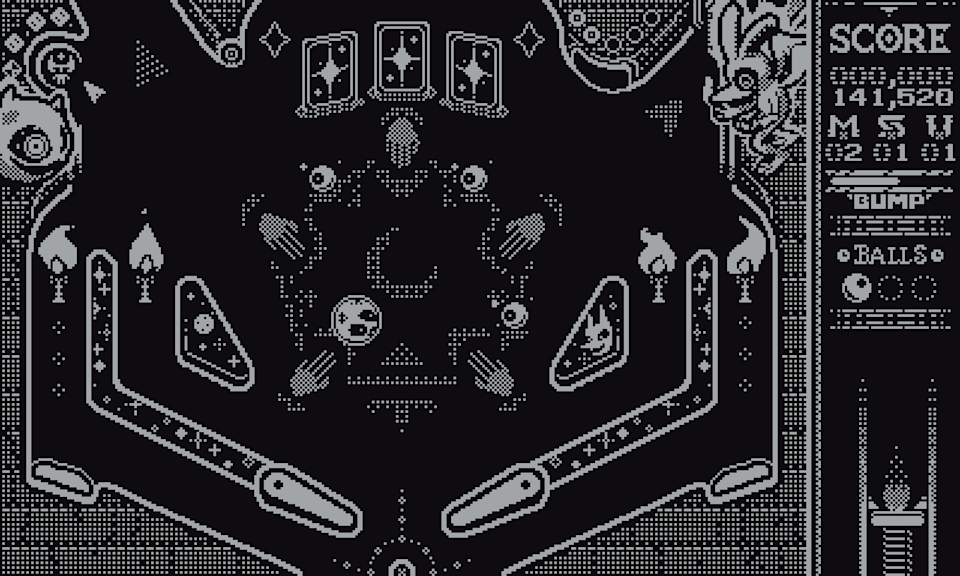
A screenshot from Devils on the Moon Pinball.

A screenshot from Devils on the Moon Pinball. (Amano)

I was impressed with both the physics and table design of Devils on the Moon after playing for just a few minutes. Despite not having analog control, the way the ball reacted when I hit the flippers felt consistent and smooth, and while I was often surprised at some of the bounces it took, it never felt unfair. When I drained a ball, it was almost always something I could have avoided if I knew the game better or had faster reflexes — just like a good, real-life pinball table.

JP and Mario described the game as using “stylized physics” rather than it being fully realistic. “It may not necessarily be accurate to real life,” JP said. “But since the screen is wider than it is tall unlike actual pinball, we needed the ball to feel a little bit floaty and not fall as fast because then it would just zoom straight down the screen.”

The table design feels both grounded in reality while also taking advantage of its virtual nature. There are three vertical “levels,” each with its own set of flippers. The 2D nature of the game means there aren’t any true ramps like you’ll on most pinball tables, but having three separate sections of the game to get used to makes up for that. And provided you complete various modes in the game, you can reach boss battles where you’re tasked with whacking a giant enemy repeatedly to drain away their health bar. Physical pinball tables often have similar encounters, but they have to be worked into the design of the game — in this case, your ball essentially ports to an entirely different space when you battle a boss.

The full three-stage board layout for Devils on the Moon pinball.

The full three-stage board layout for Devils on the Moon pinball. (Amano)

“It’s kind of playing like the old pinball machines where the rules are really simple,” Mario said.”. “You just have a few things to do. In our case, it ended up going beyond our original scope, but it’s still quite simple compared to an actual pinball machine in terms of rules.” He said the design intent was to make the game friendlier to people who might try it out without a lot of pinball experience while still putting enough challenge into it.

The audio and visual presentation is top-notch for a Playdate game, too. Perhaps most crucially for a pinball game, there’s no lag or stuttering. The game also has a distinct visual identity, something that’s always important for pinball to draw you into the world of the playfield as much as possible. The game’s page cheekily promises “ at least (1) songs” and it delivers on that with a solid theme for the main game that serves well as background music that doesn’t get old if you’re playing for a while, and the beeps and boops the table makes as you play feel well-suited to the game. It doesn’t “sound” like a real pinball table — but it isn’t one, so that’s okay.

A screenshot of Devils on the Moon Pinball.

A screenshot of Devils on the Moon Pinball. (Amano)

I haven’t played a video pinball game in a long time, but the Playdate feels like an ideal platform for this. I can bring it with me anywhere and play a round or two (provided there’s decent light) or settle in for a longer play session. The game is challenging enough that you’ll need to practice a lot to get the hang of it, but there’s enough variety to the three-tiered table to keep players interested for the long haul. After all, the fun of pinball isn’t necessarily playing a table for the first time — it’s learning it inside out so you can maximize your score. I’m looking forward to getting to that point with Devils on the Moon.


Source link

Leave a Reply

Subscribe to Our Newsletter

Get our latest articles delivered straight to your inbox. No spam, we promise.

Recent Reviews


SAP R/3 has been one of SAP’s main products, where R stands for RealTime and 3 refers to three-tier application architecture (Database,Application Server and Client).

In the modern environment, the SAP R/3 system powers the majority of businesses.

This software was used by approximately 80% of the businesses.

SAP Ariba Training

  • Master Your Craft
  • Lifetime LMS & Faculty Access
  • 24/7 online expert support
  • Real-world & Project Based Learning

Why SAP R3 architecture?

The primary goal of R/3 Architecture is to provide a set of tightly coupled, major business applications. The typical range of hypotheses for any R/3 process is as follows:

  • Production Planning
  • Materials Management
  • Sales and Distribution
  • Financial Accounting
  • Controlling, Etc

SAP R3 Architecture:

SAP R/3 Architecture simplifies and connects all of an organization’s business transactions through real-time integration. Real-time integration ensures that any change or upgrade in one application causes the data in the other applications to be automatically modified or updated.

We are aware of the SAP R/3 Architecture, specifically the client-server software. This ensures that the R/3 system’s groups and layers are designed to run concurrently on a number of different computing devices. When a business wants to install SAP software, each component is stored, regulated, and filtered using the equipment of completely separate and specialized computer systems.

Each layer has the ability to call on all of the other layers built to complete the task. Clients are components/layers that request services, while servers are components/layers that deliver services. This is referred to as “client/server.”

, others, sap-r3-architecture-description-0, others, sap-r3-architecture-description-0, others, sap-r3-architecture-description-0, , others, sap-r3-architecture-description-0, others, sap-r3-architecture-description-0, , others, sap-r3-architecture-description-0, , others, sap-r3-architecture-description-1, others, sap-r3-architecture-description-1, others, sap-r3-architecture-description-1

Subscribe to our YouTube channel to get new updates..!

This R/3 Architecture’s three Conceptual Layers are… The R/3 Framework’s classic configuration includes the following software layers:

  • Presentation layer
  • Application layer and 
  • Database layer

Presentation layer:

Receives user input and produces a method request. The Presentation Layer is a user interface that can use a variety of different graphical user interfaces ( GUIs). SAPGUI is SAP’s proprietary user interface program over 20 languages.

The presentation or GUI layer includes collaborating keyboard and mouse information from the device and submits it to the application layer inside the form of workflow requests for the further computation. When the layer receives application layer outcome, it recopy it and exhibits text and graphical data on the user’s PC screen.

Application layer:

Receives and processes a process request using the Software Logic Application.

The application layer is made up of R/3’s core components. The application server layer is where the majority of R/3 business logic processing takes place. The dispatcher is in charge of the job procedures here.

The comprehensive logic of R/3 implementations for business operations is provided by the database server. A system may well be connected to a range of different application servers that are geographically distributed.

Database Layer:

All data is saved and recovered. The Database Layer is in charge of both the R/3 Framework’s application elements and the enterprise’s working data. As needed, applications are downloaded from the database, loaded into the application layer, and executed from there.

The database component contains an engine whose sole purpose is to retrieve the data on the application layer’s behalf. SAP R/3 interfaces with its supporting databases using the industry-standard database access language SQL.


SAP Ariba Training

Weekday / Weekend Batches

Components of SAP R3 architecture:

In the application layer there are several elements or components that carry out different operations. Now we will check one after the other.

  • Message Server: In an ABAP system, it handles communication between distributed dispatchers.
  • Dispatcher Queue: This queue stores various types of work processes.
  • Dispatcher: This component distributes requests to work processes.
  • Gateway: It allows collaboration between some of the SAP systems and external systems.
  • ABAP-Work processes: It implements dialog steps in R/3 applications separately.
  • Memory-pipes: It allows ICM and ABAP work processes to communicate with one another.
  • Message Server: It is in charge of java dispatchers and server processes.
  • It allows for communication within the Java runtime environment.
  • Enqueue Server: It manages logical locks set by a Java application program in a server process.
  • Central Services: A specific example of the central services is required by Java cluster for managing locks and transmitting messages and data. A Java cluster is a
  • collection of processes that collaborate to create a dependable system. An instance is a collection of resources such as memory and work processes.
  • Java Dispatcher: This process receives client requests and routes them to the server process.
  • J2EE components are installed using SDM: Software Deployment Manager.
  • Java Server Processes: It can handle a large number of requests at the same time.
  • Threading: When different tasks execute independently in the background, this is referred to as threading.
  • ICM: It facilitates communication between the SAP system and the HTTP, HTTPS, and SMTP protocols. This means that by entering the system URL into the browser, you can also access SAP from the browser.

How does SAP R3 architecture work?

SAP R/3 Processes are being used to successfully manage os resource requirements for the software program. The technique is inextricably linked to the software application. Memory, as well as system support for renewable energy, are accessible for any operation. The on request is determined by the type of work performed in the application server.

The SAP DISPATCHER, SAP’s proprietary control agent, is located in the R/3 Basis kernel. The deploying device, in collaboration with the respective operating system, manages the facilities used by R/3 systems to control their operational activities. The exact number of activities varies depending on the configuration. The dispatcher’s main function is to filter the working process that has been submitted.

There are specific work process models for:

  • Online work process dialogue -Interactive SAPGUI screen processing request
  • Updating the database as part of the work process
  • Background Work Process -used for background processing, such as batch jobs.
  • Spool work procedure-Spooling/Printing procedure
  • Work process-lock management should be enqueued.

Conclusion:

In this blog post we had clearly disused all the points related to the SAP R3 architecture in a clear cut manner. If you have any queries please drop your comments to get them resolved. Happy learning at HKR trainings.


Source link