Astronauts return home. What’s next?


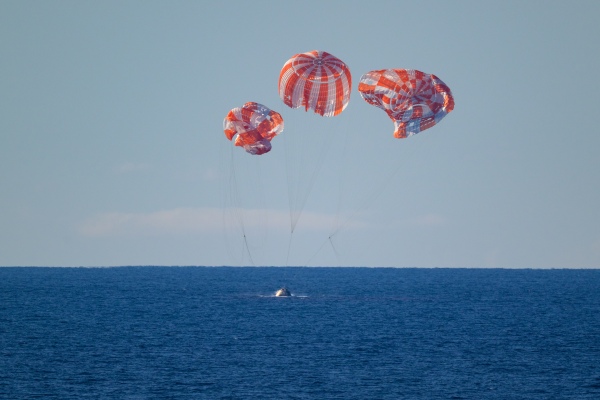
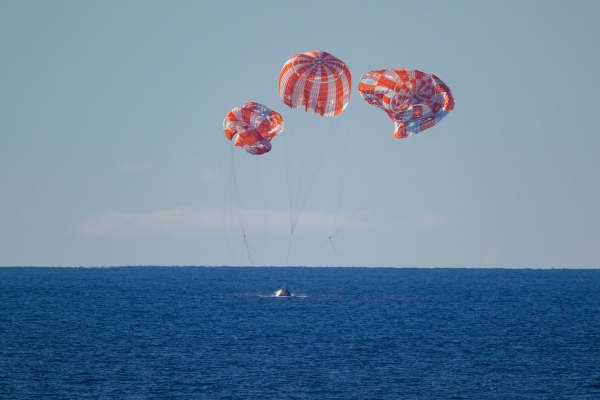
The Artemis II crew — NASA astronauts Reid Wiseman, Victor Glover, and Christina Koch as well as Canadian Space Agency astronaut Jeremy Hansen — splashed down in an Orion space capsule Friday after a 9-day mission to the moon and back.
Bill Ingalls | NASA

The crew of NASA's Artemis II mission are safely back on Earth after a nine-day mission took them on a trip around the moon and back, sending humans deeper into space than ever before.

To come home safely, the crew — NASA's Reid Wiseman, Victor Glover, Christina Koch, and Canadian Space Agency astronaut Jeremy Hansen — and its capsule had to endure near-record-breaking entry speeds and temperatures up to 5,000 degrees Fahrenheit.

The Orion spacecraft spent 13 and a half minutes falling through the atmosphere, hitting a top speed of more than 30 times the speed of sound.

Orion performed as designed. The capsule's heat shield protected the crew, and a series of parachutes helped the capsule gently splash down in the Pacific Ocean off the coast of San Diego.

With that landing, the mission came to a close, clocking more than 700,237 statute miles, said Artemis II entry flight director Rick Henfling.

Four members of the U.S. Navy Dive team pulled the crew from the capsule. Helicopters plucked them from a raft outside their spacecraft — called the porch — and within 24 hours of splashdown, they'll arrive at the Johnson Space Center in Houston.

"We did it. We sent four amazing people to the moon and safely returned them to Earth for the first time in more than 50 years," said NASA's Lori Glaze, who leads the Artemis programs. "To the generation that now knows what we're capable of: Welcome to our moonshot."

The crew's flight path took them around the far side of the moon at around 4,000 miles above the surface.

The crew made a number of geological observations and took thousands of photos to help scientists better understand what the moon is made of – and where it might have come from.

But perhaps the most profound vantage point came from looking back at home.

"Trust me, you are special, in all of this emptiness," said Glover, "This is a whole bunch of nothing, this thing we call The Universe. You have this oasis, this beautiful place that we get to exist together."

The Artemis II mission was a critical test flight for the Orion spacecraft, which will carry future Artemis astronauts, including those that will venture to the lunar surface.

The crew tested key systems of the spacecraft — its life support system, maneuverability, its heat shield, the toilet. What NASA learns from this flight will set future lunar missions up for success.

"Part of our ethos as a crew, and our values from the very beginning were that this is a relay race," said Koch "In fact, we have batons that we bought to symbolize physically, that we plan to hand them to the next crew, and every single thing that we do is with them in mind."

That next crew will come soon. NASA administrator Jared Isaacman accelerated the Artemis program, charging the agency with launching an Artemis mission each year.

Even before the Artemis II crew splashed down, work had begun at the Kennedy Space Center in Florida to prepare for the next mission.

NASA engineering operations manager John Giles oversees the Crawler-Transporter, the massive vehicle that moves the mobile launch pad, and the SLS rocket that launches Orion, from the Vehicle Assembly Building to the launch site. His team is preparing to move the launch platform for Artemis II back into the Vehicle Assembly Building next week to begin putting together the rocket for Artemis III.

"We really haven't had too much time to relax and reflect on Artemis II, other than thinking what a perfect accomplishment it was," said Giles. "Moving right into Artemis III. No rest for the weary. It's moving on."

A key part of the Artemis III SLS rocket — the core stage fuel tank — is heading to Kennedy Space Center later this month. Parts of the solid rocket motors are already there.

Artemis III aims to launch next year. It'll stay in Earth orbit while testing spacecraft that are designed to land humans on the moon. The following mission, Artemis IV, could bring humans to the lunar surface, for the first time since 1972.

Copyright 2026, NPR


Source link

Leave a Reply

Subscribe to Our Newsletter

Get our latest articles delivered straight to your inbox. No spam, we promise.

Recent Reviews


SAP R/3 has been one of SAP’s main products, where R stands for RealTime and 3 refers to three-tier application architecture (Database,Application Server and Client).

In the modern environment, the SAP R/3 system powers the majority of businesses.

This software was used by approximately 80% of the businesses.

SAP Ariba Training

  • Master Your Craft
  • Lifetime LMS & Faculty Access
  • 24/7 online expert support
  • Real-world & Project Based Learning

Why SAP R3 architecture?

The primary goal of R/3 Architecture is to provide a set of tightly coupled, major business applications. The typical range of hypotheses for any R/3 process is as follows:

  • Production Planning
  • Materials Management
  • Sales and Distribution
  • Financial Accounting
  • Controlling, Etc

SAP R3 Architecture:

SAP R/3 Architecture simplifies and connects all of an organization’s business transactions through real-time integration. Real-time integration ensures that any change or upgrade in one application causes the data in the other applications to be automatically modified or updated.

We are aware of the SAP R/3 Architecture, specifically the client-server software. This ensures that the R/3 system’s groups and layers are designed to run concurrently on a number of different computing devices. When a business wants to install SAP software, each component is stored, regulated, and filtered using the equipment of completely separate and specialized computer systems.

Each layer has the ability to call on all of the other layers built to complete the task. Clients are components/layers that request services, while servers are components/layers that deliver services. This is referred to as “client/server.”

, others, sap-r3-architecture-description-0, others, sap-r3-architecture-description-0, others, sap-r3-architecture-description-0, , others, sap-r3-architecture-description-0, others, sap-r3-architecture-description-0, , others, sap-r3-architecture-description-0, , others, sap-r3-architecture-description-1, others, sap-r3-architecture-description-1, others, sap-r3-architecture-description-1

Subscribe to our YouTube channel to get new updates..!

This R/3 Architecture’s three Conceptual Layers are… The R/3 Framework’s classic configuration includes the following software layers:

  • Presentation layer
  • Application layer and 
  • Database layer

Presentation layer:

Receives user input and produces a method request. The Presentation Layer is a user interface that can use a variety of different graphical user interfaces ( GUIs). SAPGUI is SAP’s proprietary user interface program over 20 languages.

The presentation or GUI layer includes collaborating keyboard and mouse information from the device and submits it to the application layer inside the form of workflow requests for the further computation. When the layer receives application layer outcome, it recopy it and exhibits text and graphical data on the user’s PC screen.

Application layer:

Receives and processes a process request using the Software Logic Application.

The application layer is made up of R/3’s core components. The application server layer is where the majority of R/3 business logic processing takes place. The dispatcher is in charge of the job procedures here.

The comprehensive logic of R/3 implementations for business operations is provided by the database server. A system may well be connected to a range of different application servers that are geographically distributed.

Database Layer:

All data is saved and recovered. The Database Layer is in charge of both the R/3 Framework’s application elements and the enterprise’s working data. As needed, applications are downloaded from the database, loaded into the application layer, and executed from there.

The database component contains an engine whose sole purpose is to retrieve the data on the application layer’s behalf. SAP R/3 interfaces with its supporting databases using the industry-standard database access language SQL.


SAP Ariba Training

Weekday / Weekend Batches

Components of SAP R3 architecture:

In the application layer there are several elements or components that carry out different operations. Now we will check one after the other.

  • Message Server: In an ABAP system, it handles communication between distributed dispatchers.
  • Dispatcher Queue: This queue stores various types of work processes.
  • Dispatcher: This component distributes requests to work processes.
  • Gateway: It allows collaboration between some of the SAP systems and external systems.
  • ABAP-Work processes: It implements dialog steps in R/3 applications separately.
  • Memory-pipes: It allows ICM and ABAP work processes to communicate with one another.
  • Message Server: It is in charge of java dispatchers and server processes.
  • It allows for communication within the Java runtime environment.
  • Enqueue Server: It manages logical locks set by a Java application program in a server process.
  • Central Services: A specific example of the central services is required by Java cluster for managing locks and transmitting messages and data. A Java cluster is a
  • collection of processes that collaborate to create a dependable system. An instance is a collection of resources such as memory and work processes.
  • Java Dispatcher: This process receives client requests and routes them to the server process.
  • J2EE components are installed using SDM: Software Deployment Manager.
  • Java Server Processes: It can handle a large number of requests at the same time.
  • Threading: When different tasks execute independently in the background, this is referred to as threading.
  • ICM: It facilitates communication between the SAP system and the HTTP, HTTPS, and SMTP protocols. This means that by entering the system URL into the browser, you can also access SAP from the browser.

How does SAP R3 architecture work?

SAP R/3 Processes are being used to successfully manage os resource requirements for the software program. The technique is inextricably linked to the software application. Memory, as well as system support for renewable energy, are accessible for any operation. The on request is determined by the type of work performed in the application server.

The SAP DISPATCHER, SAP’s proprietary control agent, is located in the R/3 Basis kernel. The deploying device, in collaboration with the respective operating system, manages the facilities used by R/3 systems to control their operational activities. The exact number of activities varies depending on the configuration. The dispatcher’s main function is to filter the working process that has been submitted.

There are specific work process models for:

  • Online work process dialogue -Interactive SAPGUI screen processing request
  • Updating the database as part of the work process
  • Background Work Process -used for background processing, such as batch jobs.
  • Spool work procedure-Spooling/Printing procedure
  • Work process-lock management should be enqueued.

Conclusion:

In this blog post we had clearly disused all the points related to the SAP R3 architecture in a clear cut manner. If you have any queries please drop your comments to get them resolved. Happy learning at HKR trainings.


Source link