Joy Harmon ‘Cool Hand Luke’ Car Wash Scene Actress Dead at 87
Published
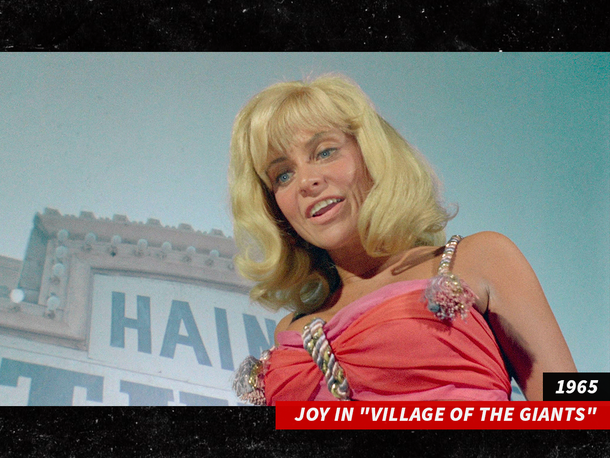
Joy Harmon — the blonde actress known for her brief but iconic car wash scene in the classic 1960s film “Cool Hand Luke” — has died, TMZ has learned.
A family member tells TMZ … Joy passed away at her Los Angeles-area home Tuesday surrounded by family, after getting sick with pneumonia several weeks earlier. We’re told she fought until the end and fully expected to recover and get back to work at her beloved Burbank bakery, Aunt Joy’s Cakes.
Joy was working at Aunt Joy’s until the very end … we’re told she was working the day before she went to the hospital to receive medical care.
According to her family member, she spent 1 to 2 weeks in the hospital, followed by a several-week stint at a rehabilitation center, and then returned home to spend her final days on hospice care and with her loved ones.
Her role as Lucille in the famous car-wash scene was an image that stuck in cinema culture for decades to come. But, she had been honing her craft long before — she kicked off her career as a child model and pageant queen, becoming a finalist in the Miss Connecticut pageant.
She had several on and off-Broadway stints before breaking into Hollywood as a contestant on the “You Bet Your Life” quiz show. From there, she became a regular on the “Tell It To Groucho” comedy show.
She appeared in classic films such as “Village of the Giants,” “One Way Wahine,” “Under the Yum Yum Tree” and “Angel in My Pocket” and landed several roles on the small screen, appearing in “Batman,” “The Monkeys,” “Bewitched,” and more.
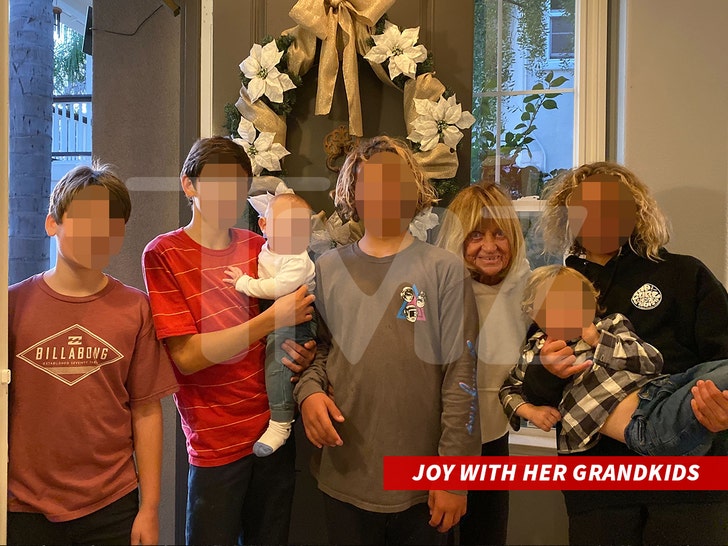
She stepped away from Hollywood to focus on raising her family — she had 3 children, Jason, Julie and Jamie — with her ex-husband, film editor Jeff Gourson. The pair were married between 1968 and 2001. She had 9 grandchildren, some of whom she’s seen smiling with in the photo above.
She founded her bakery in 2003 and it quickly became a local favorite. We’re told fans always knew to find her there, and she would happily hand out autographs when asked.
Her family tells TMZ Joy was a positive thinker full of life and vibrancy, and certainly had no problem spreading joy throughout her life.
A GoFundMe has been set up to help with her medical costs.
Amazon Virtual Private Cloud or Amazon VPC is an AWS service that provides you with a separate area of the cloud. Having this separate area, you can launch your own defined AWS services in a virtual network.
Here, in VPC you have complete control of your virtual environment which includes IP address range, the configuration of route tables, the creation of subnets, and network gateways. Also, the network configurations can be easily customised for the Amazon VPC.
Like all the other AWS services, Amazon VPC provides top-notch security. It has multiple layers of security which include network access control lists and security groups to manage the Amazon EC2 instances’ access in each subnet.
We have the perfect professional AWS Training course for you. Enroll now!
Now to understand the entire scenario of VPC, even better, let’s have a look at the architecture of VPC.
Architecture of VPC
The above picture shows the architecture of VPC, so there’s an outer region and inside that outer region there’s an Internet Gateway and Virtual Private Gateway.
Internet Gateway and Virtual Private Gateway are what help in the connection with the VPC. These connections pass through the router which directs the coming traffic to the router table.
The two Router Tables then direct the traffic to Network ACL, which is like a firewall for security purposes.
The Network ACLs can either accept or deny the roles. Also, the IP Address can be blocked on the Network ACL.
The respective Network ACL signals to their respective security groups to access lines against the EC2 Instance.
Now, there are two subnets – Public Subnet and Private Subnet. As the name suggests, in the public subnet internet can be accessed by the EC2, while in the private subnet EC2 instance cannot be accessed through the internet.
There’s also a process called “Jump Boxes” which enables you to connect the EC2 Instances (the public subnet can be connected to the private subnet’s instance).
Now, when we know about the architecture of VPC, it’s time to understand the different elements of VPC.
VPC IP addresses use CIDR (Classless Interdomain Routing) IPv6 and IPv4 blocks to define their ranges. Primary and secondary CIDR blocks can be added to the VPC if the secondary Classless Interdomain Routing block comes from a similar address range as the primary block.
Subnet Creation
The EC2 Instance that is launched runs inside a specific VPC subnet. And, each subnet’s CIDR as a subset of the VPC Classless Interdomain Routing block. Every subnet separates its respective traffic from all the other VPC subnet traffic. It must be noted that a subnet can only have one CIDR block and different subnets are to be designated to handle diverse traffic types.
Route Tables
Route Tables are actually the rule book that decides how much network traffic must be directed inside the VPC and subnets. A default route table is created by the VPC called the main route table. And, this main route table has an automatic association with other VPC subnets.
There are two options – either the main route table can be updated and used to direct network traffic OR a new route table can be created for individual subnet traffic.
Internet Connectivity
Each VPC configuration is able to host one Internet Gateway and hence provide NAT or the Network Address Translation services using a NAT Gateway or NAT instances.
Elastic IP Addresses (EIPs)
Elastic IP Addresses or EIPs are IPv4 addresses permanently allocated to the user’s AWS account. The EIPs enable public internet access to the following:
An instance
Elastic Network Interface or ENI
Miscellaneous services that require a public IP address.
Network/Subnet Security
In the VPC architecture, you had seen there’s something called the “security group,” so VPCs use those security groups to give protection for instances. These security groups are referred to as firewalls by AWS.
Additional Networking Services
There are several more services provided by a VPC. The VPC can also be used to configure the following:
Virtual Private Networks or VPNs
Direct connectivity between VPCs or VPC peering
Gateways
Mirror sessions
Now, when you are well versed with the basics of Amazon VPC, let’s have a look at what you can do with a VPC.
Subscribe to our YouTube channel to get new updates..!
What can you do with a VPC?
Instances can be launched in a subnet that you choose.
Custom IP address ranges can be assigned in each subnet
Route Tables can be configured between subnets.
An internet gateway can be created and attached to your VPC.
You get excellent security over your AWS resources.
Security groups can be assigned to individual instances.
Conclusion By now you would be well versed with everything you need to begin with Amazon Virtual Cloud. In the beginning, we learnt the basics of Amazon VPC and continued to learn its architecture. While at the architecture of VPC, we saw different parts of it and saw each of them briefly.
Once you knew all the architectural parts, you saw the elements of VPC and studied them in brief. Finally, after learning about different elements and several other basics of Amazon Virtual Cloud, we saw the applicability of the same.
To provide the best experiences, we use technologies like cookies to store and/or access device information. Consenting to these technologies will allow us to process data such as browsing behavior or unique IDs on this site. Not consenting or withdrawing consent, may adversely affect certain features and functions.
Functional
Always active
The technical storage or access is strictly necessary for the legitimate purpose of enabling the use of a specific service explicitly requested by the subscriber or user, or for the sole purpose of carrying out the transmission of a communication over an electronic communications network.
Preferences
The technical storage or access is necessary for the legitimate purpose of storing preferences that are not requested by the subscriber or user.
Statistics
The technical storage or access that is used exclusively for statistical purposes.The technical storage or access that is used exclusively for anonymous statistical purposes. Without a subpoena, voluntary compliance on the part of your Internet Service Provider, or additional records from a third party, information stored or retrieved for this purpose alone cannot usually be used to identify you.
Marketing
The technical storage or access is required to create user profiles to send advertising, or to track the user on a website or across several websites for similar marketing purposes.