SAP business workflows:

Business Workflows are used in SAP systems to execute business processes in applications. Workflows are an important component of the SAP system because they aid in the design of business processes, which can range from a simple release to a complex repeated business process such as creating a material master, among other things.

SAP Business Workflows are predefined in the SAP R/3 system, but users can also create their own. The workflow enables users to manage business processes efficiently and in accordance with compliance.

Workflows ensure that the correct information is sent to the correct person at the correct time and in the correct sequence. 

To complete a complex task in the SAP system, such as invoice approval or purchase request, several steps must be taken. These steps can be carried out manually or through formal communication channels such as email, notes, and so on. When tasks are performed manually, there are some common issues that arise, such as 

  • Tracking the task status is difficult.
  • Managing Inefficiency
  • Tracking formal communications is difficult. 
  • Keeping a deadline 

SAP workflow

The image above depicts the SAP Workflow process. It is a business process automation tool that works consistently across all applications. As you can see, it is appropriate for business processes that involve multiple people or groups of people.

Business workflows could be seamlessly implemented with Organization Management and SAP NetWeaver BI for analysis purposes, allowing you to quickly identify the business processes that are best suited to your organization.

 Become a SAP Certified professional by learning this HKR SAP Certification Training !

Why do we need sap workflows in business processes?

Workflow is required in business processes in SAP for a variety of reasons. Wait time is the longest duration in any business process.

Raising a Purchase Order, an Invoice, and a Sales Order all require approval from specific stakeholders and involve multiple steps. As a result, a significant amount of time is added to the cycle.
Auditing and Compliance – Areas at which auditing is needed or specific compliance must be based on court rules, SOX, and so on. They are difficult to manage with manual business processes.
Processes that require regular repeated steps and adhere to specific business rules are referred to as specific processes. For example, when you create a new BP, you must specify contact information, a credit limit, and other details to help you manage the process. SAP Workflow is recommended for managing these specific processes.

Companies can easily address these issues by utilizing SAP Workflows, as well as perform detailed reporting such as implementing time, wait time, and so on.

Benefits of workflow:

The workflow inside a SAP system ensures the right data is sent to the right people at the right time. SAP Workflows can be used with SAP applications such as ERP, CRM, and others. Users can easily map business processes using these workflows, which can also be edited using the workflow builder.

  • Workflow automates business processes that are composed of a series of tasks, activities, and steps.
  • Workflows make it simple to manage task dependencies and send notifications about pending actions to SAP mailboxes.
  • The use of SAP Workflows makes it simple for users to understand what tasks must be completed. Work items are delivered to the user in the form of notifications, and with a single click, it invokes the appropriate T-code and navigates to the appropriate screen in the application.
  • SAP applications include ready-to-use workflows. Users can also edit the predefined business workflows to map them to the processes of the organization.
  • Users can create a particular part of Business workflows by using different workflow wizards. The workflow builder can be used to display and modify existing workflows.
  • Workflows are not restricted to specific SAP applications and can be tailored to meet the needs of the user.
  • One of the primary advantages of using SAP Workflow is that it is consistent across all SAP applications.
  • Workflows are useful for processes involving multiple people or groups of people, a sequence of tasks, and coordination between various objects. 

SAP workflow layers:

The SAP Workflow architecture in the SAP Application system is made up of the following layers:

  • Business Object
  • Business Process
  • Organization Model 

In SAP Business Workflow, a Business Object is a collection of methods or events for an entity in the business process. Customer, Material, and Vendor are some of the most common Business Objects in the SAP system.

Business processes in SAP Workflow are defined in the Workflow Builder. Each work process is referred to as an activity, and it consists of a single step task or workflow template. Business logic is defined in Business Objects using ABAP code.

People or groups of people are responsible for taking actions in a Business Workflow in the organization model. People who are in charge of taking action are referred to as actual agents, and they are defined in the workflow activity in the Business Workflow.

Each object in the SAP system comes with a standard set of events and methods for performing actions on that object. The most common methods and events are as follows:

  • Change, Display, Get Details, and Create are all methods.
  • Created and Modified Events 

Business Objects are known in SAP systems to reduce the complexity of the SAP system by dividing it into smaller units. These properties are shared by all business objects.

  • Object Type ID It is used to identify the business object internally.
  • Object Name It is used to externally identify the business object. The external system can interact with the SAP system by using this property.
  • Super Type It is the parent object from which all of the BO’s components are inherited.
  • Name:It is a descriptive name for the BO.
  • DescriptionIt is a brief description of the type of business object.
  • Application:The application component to which the BO is assigned.
  • Program:The ABAP code of the BO is contained in the Program. 

SAP workflow Architecture:

SAP Workflow is built on a three-tiered architecture. The three layers of SAP Workflow architecture are as follows:

  • Business Object
  • Business Process
  • Organization Model 

SAP workflow Architecture

 Become a SAP FICO Certified professional by learning this HKR SAP FICO Training IN Chennai !

SAP Certification Training

  • Master Your Craft
  • Lifetime LMS & Faculty Access
  • 24/7 online expert support
  • Real-world & Project Based Learning

The lowest level in SAP Workflow architecture seems to be the business object, which is located at the bottom level. In SAP Business Workflow, a Business Object is defined as a collection of methods or events for an entity in a business process. Customer, Material, and Vendor are some of the most common Business Objects in a SAP system. All services are provided in the form of executable methods when Business Objects are used.

A Business Object Repository is an object-oriented approach for modeling Business Objects and Processes. It is a collection of Business Object and Interface types, as well as their associated attributes, methods, and events.

Business processes are at the middle level of the Workflow architecture, defining the steps to be performed as part of the Workflow. The Workflow Builder is used to define business processes.Each work process is referred to as an activity, and it consists of a single step task or the workflow template. Business logic is defined in Business Objects using ABAP code.

The top layer of the SAP Workflow architecture is the organization model. People or groups of people are responsible for taking actions in a Business Workflow in an organizational model. People who are in charge of taking action are referred to as actual agents, and they are defined in the Business Workflows workflow activity.

Using Business Object Builder, you can develop new Business Objects. Events in Business Objects are in charge of both the initial start and the termination of the workflow.Events are also used to trigger the execution of subsequent tasks in the workflow. All tasks defined in the Workflow will be executed in the order specified in the Workflow definition.

Examples of common tasks include

  • Release Document
  • After Invoice 
  • Approval Absence
  • Run the Change Material
  • Call
  • Check the report and Work 

The image below depicts how a task is carried out in SAP Workflow and how it interacts with object types and object methods, organization models, events, and texts.

SAP Workflow

Components of sap workflow:

Business processes in SAP Workflow are defined in the Workflow Builder. Each step is defined as an activity in the Workflow builder. Each activity defines a single-step task or workflow template.

  • Organizational plan
  • Workflow builder
  • Standard task and events triggering 

Each step throughout the workflow definition can be a task that points to a SAP transaction or decision. A decision may include agent specifications and deadline monitoring for a step. The workflow is initiated either manually or automatically by the system at runtime. In order for the system to initiate a workflow, the workflow definition must include a triggering event.

Whenever an event occurs, the appropriate workflow is initiated automatically. Tasks or work items describe the activities involved and can refer to methods that can be executed automatically or methods that must be executed by a user . Tasks are business objects that are coded in ABAP.

Events are activities that initiate a workflow – one or more workflows at the same time. When the workflow is triggered, the definition flowchart determines when and how work is completed. After that, work items are received and executed in MS Outlook, Lotus Notes, mySAP Workflow MiniApp, or the SAP integrated inbox.

Conversely, the workflow system will send e-mail alerts to any mail system, informing the user that they must log in to the SAP system in order to complete the task. Every work item is assigned to one or more users. When the task is completed, the work item is removed from the inboxes of the other users.

Integration to email systems:

Workflow inboxes are typically populated with executable work items. However, casual SAP users, particularly managers, may forget to check their inbox on a regular basis, so it’s a good idea to set up reminder emails, informing people via a batch job that they have work items in their inbox. Alternatively, an email with a hotlink to the Workflow can be sent directly to their Lotus Notes / Outlook account.All emails are sent out of SAP through SAPConnect, whether they are Workflow notifications, Workflow Workitems, or just a standard SAP Office memo. This provides a one-stop shop for connecting SAP and the mail server.

Transporting workflow items between SAPConnect and the mail server (whether Lotus Notes or Microsoft Outlook) has been made easier by SAP-supplied add-ons that are fully optimized for the different protocols required by each server. Lotus Notes, for example, makes use of a “pipe” known as the MTA, or Message Transfer Agent. This was created in collaboration between SAP and Lotus to provide full integration.

It is important to note that the type of transport medium used is determined by the mail server, not the mail client. In other words, if an employee uses Outlook on their computer but the mail server is a Lotus Domino server, the MTA will be used as a mail gateway. Each workflow background user’s user profile must include an email address.It is important to note that no approval or reply notification from an external mail system will be permitted in other words, external email systems will be unable to respond back to SAP for security reasons.

Creating the sap workflow:

The following are the steps in order to create the workflow. They are:

1.Define Organization Plan  (T-code PPOCE)

This transaction is the most straightforward way to define an organizational plan in the SAP system. You must enter the start date of the Organization unit and then click the Green tick mark, as shown in the screenshot below.

Creating the sap workflow

Want to gain knowledge in SAP FICO? Then visit here to learn SAP FICO Training in Marathahalli!

HKR Trainings Logo

Subscribe to our YouTube channel to get new updates..!

2. Create Workflow template: (T-code PFTC_INS) to create a basic template of workflow,

(T-code SWDD) to build the workflow in the workflow builder

Create Workflow template

Select the Workflow template in the Task type field. To create tasks: Select Standard Task from the Task type drop-down menu and click Create.

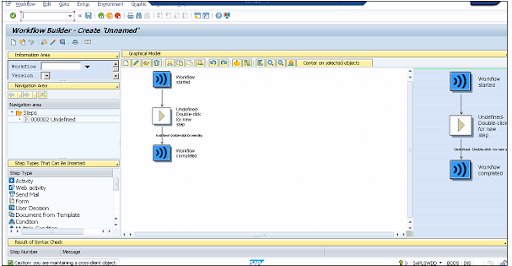
Navigate to T-Code: SWDD to begin building the workflow in the workflow builder.
Navigate to T-Code

Step types are different options in the Workflow Builder that you can drag and drop and insert into the Workflow.

3. Define 1st task  (T-code PFTC_INS) (Create notification of absence)

To define the first task, navigate to T-Code: PFTC_INS

Select Standard Task in the Task type field.

Enter the following values and Save the task. Once you save the task, you will get code ID in number 93XXX989

  • In the Name field, select Form_created
  • In Abbr, select create_form
  • In Workitem text, select vik_notif_absence-create
  • In Object Type, select FORMABSENC
  • In Method field, select CREATE
  • Checkbox Synchronous object method, Object method with dialog checked 

4. Add activity > first task in the workflow

You must add an activity to your workflow in place of the undefined step in the Workflow.

 Add activity

As seen in the following screenshot, using T-Code: PFTC_INS, a Task TS99500654 has been created separately.

using T-Code

SAP Certification Training

Weekday / Weekend Batches

Step Properties allows you to select various options based on your needs. Select the checkbox – Advance with dialog, as shown in the screenshot above. It demonstrates that the workflow work item is immediately available for processing.

Because we entered WF INITIATOR in Expression under Agents, the person who will initiate the workflow is one of the workitem recipients. There is also a binding option defined that confirms absence notification is not only in this task but also in the workflow – _WI ObjectId &ABSENCEFORM&.

In graphical mode, the Workflow Builder now looks like this:

Workflow Builder

5. 1st Test in SAP Inbox (T-code SBWP)

Now that the workflow has been executed, workitems such as e-mails are created in the SAP Inbox. When it is executed, it invokes the corresponding task or transaction screen. When you run this workflow, the notification of absence form appears.

1st Test in SAP Inbox

To cancel the processing of the first notification, click Cancel. The workflow inbox contains one item for processing – creating an absence notification. Select the workitem and press the Execute button (F8). This will take you back to the “Create notification of absence screen,” where the notification of absence form will be displayed. Fill out the form with your information and save it. The Workitem will be removed from the inbox as a result of this action.

Create notification of absence screen

6. Define 2nd task  (Check notification of absence)

Using the object formabsenc-approve, the created form will be sent to the supervisor for approval. Next, use T-Code: PFTC INS to create a new task.

Define 2nd task

7. Add activity > second task in workflow

Using the task code generated in the previous step, add Task “Check Notification of Absence in the Workflow.”

Define the binding properties as well, as shown in the screenshot below.

Add activity

8. 2nd Test

The workflow will then be executed, and you will be directed to the workitem for creating notification of absence for processing. This is due to the Advancing with immediate dialog option being selected when creating a task.

Navigate to Business Workplace using the approver’s user-id to see the workitem to process and other attributes to include in the Workitem. Choose Execute after selecting the workitem for checking the notification of absence.

Reject or approve the request. Take note of the two buttons: Accept and Reject.

9. Integrate User Decision for Re-submit

If the approver rejects the leave request, you can also add the user decision to the rejected output. This gives the requester the opportunity to make changes and resubmit the request for approval.

10. 3rd Test

When a request is denied, the next step is for the user to make a decision. Because we specified (&WF INITIATOR&) as the step’s agent, the request will be sent back to us for a decision. You have two choices. Requests should be revised or withdrawn.

11. Define 3rd task  (Revise notification of absence)

For this you need to revise the notification.

12. Add activity > third task to the workflow

To add this step, you have to make the following entries −

Use FORMABSENC-UPDATE as an object.

In the binding option, enter _WI_Object_ID <= &ABSENCEFORM&

In the Agents → add &_WF_INITIATOR& in the expression field

FORMABSENC-UPDATE

13. Add 4th Customer Task (Send Notification for approval of leave)

To send a notification, you must add a new step called “Send mail.” You must drag this step to the Undefined Step – following the result of the step “Check notification of absence.”

To add this step, you have to make the following entries −

  • Select the Recipient type − Enter the Organizational object
  • Select Agents → Choose the Expression &_WF_INITIATOR&.
  • Enter the subject line as <“Leave Approved”>
  • Enter the email text as <“Approved”>

When you press the Enter key, you will be prompted to enter the task’s name and abbreviation. 

Conclusion:

In the above blog post we had clearly explained the in depth of sap workflows, architecture, features and benefits and why to choose the sap workflows. Had any doubts related to this concept drop your queries in the comment section to get them clarified. 

Related Articles

1. SAP Installation

2. SAP cyber security

3. SAP Logistic Execution

4. SAP Master Data


Source link

Leave a Reply

Subscribe to Our Newsletter

Get our latest articles delivered straight to your inbox. No spam, we promise.

Recent Reviews


Qlik sense is a data analytical tool, It is introduced as the latest technology in the business intelligence tools market. It is user friendly and filled with the latest visual services and trendy data analysis; it is a visualization and data analyst software. It controls the associative engine of QIX, which provides the link to users and associated information from various sources. It brings out the selection and dynamic searching; Qlik sense works as a data analyst platform for the users. Controversial to Qlik’s view, it is best in data visualization as the graphics of augmentation. We prepared most frequently asked Qliksense interview questions, which helps you to crack Qlik Sense interview.

Frequently Asked Questions Qlik Sense Interview Questions and Answers

What is Qlik Sense?

Ans: Qlik sense works like a self-provider for the utility of visualization records, which empower us to search and identify huge amounts of facts for employer’s insights identification. It helps discovery and analytics utilization, with experts of Qlik sense organizations may design interactive visualization, elastic, and to make significant decisions.

  • It is simple to use.
  • It shows the right way for insight, proportion, and creation.
  • It takes less time for perception on any tool.

To gain in-depth knowledge with practical experience, then explore Qlik Sense Training

What is the datatype’s Qlik sense?

Ans: The experience of Qlik sense includes most effective currencies, times, numbers, dates, and strings. They may be implemented in exclusive methods for the functions of calculations, that represent the above-mentioned parameters such as time and date. They may be transferred or removed from each other.

Describe the charts of Qlik sense?

Ans: The Charts in Qlik Sense is a Qlik service offered in the format of SaaS (Software-as-a-Service). The way of data visualization has fully changed with the usage of charts. Also, they enable sharing charts across social media channels without much effort. Further, they provide a restricted interaction and allow users to explore and identify the overall tool.

What is the associative data model of Qlik sense?

Ans: This model includes data tables association, which leads to the formation of logical links between data fields and data values. It provides a logical structure for the data. We can gain interactive nature through the data model selection. It is the place where software responds in the proper way to make selections.

Explain Qlik sense Hub?

Ans: It is the platform that permits users to perform various operations on the data, to design applications with proper visualizations and charts. It offers the functionality of simple drag and drop, data model association, visualization ranges such as tables, maps, box plots, distribution plots, and KPIs.

Define QIX engine?

Ans: It is considered the main interactive engine, which offers the essential functionalities of Qlik sense. They are like as given below.

  • The indexing and calculations of in-memory data.
  • Speed searching.
  • Interactions of self-services.
  • Schedule correspondence of applications.

Explain the functioning of QSS?

Ans: The Qlik Sense Scheduler, or QSS, is the function that plans to load and unload apps.

What are the architectural components of Qlik sense?

Ans: The architecture of Qlik sense is designed with five essential components. They are as given below.

  • QSP- Qlik sense proxy
  • QIX- Qlik sense engine
  • QSS- Qlik sense schedule
  • QSR- Qlik sense respiratory
  • QVF- Qlik sense applications

Define streams in the Qlik sense ?

Ans: The applications are designed by users of Qlik sense in a centralized Hub. These applications are parts of a stream. These streams are the place for a particular number of authorized users to share and analyze the work of published applications. It represents that only particular users of the group gain the applications accessible for the specific stream. When we have authorized access for stream one apps, then we gain authorized access for stream two apps. But we have no access to the streams of each other.

. What is the importance of histogram visualization in the Qlik sense?

Ans: It is also called a frequency plot, which explores the dimension of the point at particular intervals, and exposes the frequency of every distributive bar and bin. It provides the values range at similar intervals randomly, with the help of a histogram. We can observe the intervals range, mostly used bins, minimal bins, etc. It is proved that this histogram visualization helps us when we require to analyze entity’s performance as it displays the patch’s data frequency.

. What are the benefits of text and image visualizations in Qlik sense applications ?

Ans: Image and text visualizations benefit other kinds of visualizations, such as tables and charts used in Qlik sense. They look like visualization data centers, as they are displayed on given sheets with relevant meaning. With the help of image and text visualization, we may add text, images, logos, hyperlinks, and dynamic graph and chart visuals.

. Where to use treemap charts ?

Ans: It is the best option to display the large data loads with less space on sheets. They are used to save huge space on sheets and include various data values as it is in small box forms. Particular features like scheming of color and grading of the size used to display the situation highs and lows that inform us the working of the product and their strategies along with its requirements. At the same time, it also has one disadvantage, as it does not display negative values.

If you want to Explore more about Qlik Sense? then read our updated article – Qlik Sense Tutorial

. Describe various ways to add data tables in Qlik sense?

Ans: We have three ways as given below, to add data tables in Qlik sense.

  • In-app: with this process, we may submit data in Excel in the form of entry columns manually.
  • Data connections: By using this, administrators and users are permitted to define the data sources that are presented within our system.
  • Data content: This works like the database for the Qlik data market

. What is the advantage of Qlik sense filter panes?

Ans: As the existence of associations is takes place between values of the data table and data fields, a particular data set may be examined through selection making in proper ways. Qlik sense filter panes are used for those selections and get an idea of the entire data set’s entire story.

. List out some data sources which connect with Qlik sense?

Ans: Qlik sense connects with various sources. They are as listed below.

  • Redshift of amazon
  • Drill of apache
  • Apache Hive
  • Beta- phoenix
  • Beta- apache-spark
  • SQL of azure
  • Impala of Cloudera
  • BigQuery of Google
  • IBM DB2
  • The server of Microsoft SQL
  • Beta- MongoDB
  • Enterprise of MySQL
  • Oracle
  • Presto
  • Teradata
  • Salesforce
  • ODBC

. How to access a restricted file system in the Qlik sense?

Ans: We must disable the standard model as we enable the legacy mode to utilize the restricted file system and variables in the data load script of Qlik sense. It is also essential to keep in mind that this standard mode disabling takes the files to risks.

Qlik Sense Training

  • Master Your Craft
  • Lifetime LMS & Faculty Access
  • 24/7 online expert support
  • Real-world & Project Based Learning

. How to edit the Qlik sense-data table?

Ans: We can edit the data table in the data manager. The following are the step we need to follow.

  • Choose the table which we need to edit.
  • Click on the edit icon.
  • Add the new field in the editor.
  • Rename the existing field.
  • By clicking on the delete icon, we can delete the table if we want.
  • We can also concreate both tables by reloading the table.

Qlik Sense Interview Questions for Intermediates

Qlik Sense Interview Questions for Intermediates

. How to connect R with Qlik sense?

Ans: It is an easy task to use Qlik sense with R. The information behind it is R incarnation and respective folder transformation with which Qlik sense can load and read the data. First, we are required to download R and then select analysis, later give the script which is prescribed, and place it for results storage. After that, for continuous running, we are required to refresh our analysis and then design an a.exe file. That code needs to be added with the given paths

  •  R And R
  • VERSION binR.exe
  • CMD BATCH
  • -labor -rahul
  • Add a path to tekslatescripttekslatescript.R
  • Add path over heretekslatereporttekslaterreport.txt

. Describe the working of Qlik sense ?

Ans: With the help of graph search, Qlik sense easily summarizes the massive amount of complex data. With that, each Qlik updates the data immediately. It maintains high insights of visual data, which help for security and governance along with rules.

. Differentiate between traditional and associate index ?

Ans: 

  • Traditional index: it maintains specific order while preparing the index. For example, it is like a Region-state-product-sales person. The given below is a kind of traditional index.
    • IT-driven
    • predefined, Linear thinking
    • Deep insight not followed
    • Many days to change
    • Info storing
  • Associative index: It is in an unorganized manner. There is no need for 1 to 1 relation while preparing the index. For example, it is like a product-state-region-salesperson. The given below is a kind of Associative index.
    • User-driven
    • Follows user
    • All data, always visible
    • Minutes to change
    • Insights driven

. Is there any chance to design, edit, Apps augment in Qlik Sense Cloud ?

Ans: Yes, there is a chance for Apps designing and editions to all users. They are permitted to upload the data of flat files and Qlikdatamarket connection. Then they allow customers to design, edit and augment their Apps. There is no permission to augment or access for edit for the apps designed by others.

. Briefly explain the synthetic keys under logical tables ?

Ans: There is a chance for a composite key relationship when multiple fields in data fields are similar. Qlik sense made it through offering automatic synthetic keys. Those keys are anonymous, which symbolizes the entire combination of composite keys. Even some synthetic keys are concerning the wrong data but not compulsory.

. Mention any five essential abilities of Qlik sense?

Ans: The following are the five essential abilities of Qlik sense.

  1. Qlik sense maintains an associative model and smart exploration.
  2. Visualization augmentation and the analytics of advanced geographics.
  3. Interactive analysis.
  4. The report and storytelling of data.
  5. Integration and sharing of centralized data.

. List out the services managed by the Qlik management console?

Ans: The given below are the services managed by the Qlik management console.

  • Connectivity of data
  • Management of applications
  • Management of tasks
  • Administrative security
  • Monitoring of data
  • Auditing

. Briefly explain the process for application creation in the Qlik sense?

Ans: For new application creation in Qlik Sense, given below are the steps for that process.

  • We need to begin with software signing in through authorized credentials. 
  • Then provide a name for that new app.
  • Add the data for that application.
  • Choose the file path.
  • Then load the data.
  • Design the visualization through that loaded data.
  • Fix the dashboard’s visualizations.
  • Finally, our app is ready to use.

. In what way Qlik converter uses for users of Qlik sense?

Ans: It is beneficial for data load script copying from Qlik sense. We can utilize this qlik converter between Qlik Sense and Qlik view.

. Describe some essential extinctions we use in the Qlik’s sense ?

Ans: The given below are some essential extensions, which we can use for Qlik sense.

  • Wheel chart dependency
  • Picker data range
  • Sunbrust quadrant of CVL
  • Two-dimensional heatmap

. Briefly discuss the Qlik sense collaboration feature?

Ans: In Qlik Sense, the data collaboration feature between the apps and users is essential. This feature helps publish apps in Streams, data storytelling, print apps and sheets, export apps, etc.

. How to save a selection state for future use?

Ans: We need to design a bookmark for saving the selection done in the application of Qlik sense for future use. We may design multiple bookmarks as per our requirement with our selection choice, description, and titles we need.

. How to deal with data tables when they are not showing in the data manager?

Ans: When the data tables are not identified in the data manager, even though they are already loaded into the script. To solve this problem, we need to go into data manager, then click on the options of load data. This step helps us to reload the data table and shows the tables in the data manager.

. Share your knowledge about Qlik sense map visualization?

Ans: Maps are helped to display the loaded data geographically in Qlik sense. That data is related to the region, states, cities, countries, etc. may display with the help of map visualizations. There are various layers like area layer, point layer, line layer, destiny layer, and background layer. Every layer exposes the data geographically in a particular manner. 

HKR Trainings Logo

Subscribe to our YouTube channel to get new updates..!

. Describe the importance of warehousing ?

Ans: It is the data storming process in data warehouses that is based on the model of a relational database. We can choose data from various data sources, which may manage and organize to offer meaningful insights into data queries. It is the best approach to deal with and manage the huge amount of data, which we utilize at the enterprise levels.

. How data warehousing benefits BI tools?

Ans: Data warehousing is a central repository for multiple BI tools, such as Tableau, Looker, etc. However, these BI tools use data warehousing for data mining, analytics, and report querying. 

. Describe the procedure of records managing inside the applications through the fact supervisor?

Ans: The fact supervisor used to copy and add facts from the randomly used folder of the Qlik data market when we load records in the application through fact supervisor, that exposes every table as a subject, supply, calls, automatically.

Qlik Sense Interview Questions for Advanced

. How to design a cyclic group in the Qlik sense?

Ans: 

For solutions, we need to fix the basic settings mentioned below.

  • Sample table structure: The branch state location of Id sample name
    • Sample 1 branch 1 state 1 India
    • Sample 2 branch 2 state 2 us

For designing cyclic drill, including 

Creating and loading the information in order

Drill_below:

load * inline

[

SampleName, SampleName_Label

Branch, Branch Name

State, State Name

Location, Location Name

];

After the data is loaded it has two ways to view the drill. It is nice, but unable to get the default value. It enables multiple selections and suits our criteria. Now we have chosen a drill for chart connection for the drill. It includes two ways as given below.

  • User if condition
  • Use pic match

These two are obvious, when the data is huge the lag takes place in chart reloads. And that approach utilizes the functional abilities in size and dimension creation, which may look like as given below.

$(=if(GetSelectedCount(SampleName_Label)=0,’Location’,only(SampleName)))

Finally, design the measure as per our needs; provide the cyclic group.

. How to add a new data table?

Ans: We may add a data table from the data manager or by different data sources as given below.

By connections: choose from the data that were described through the administrator and selected folders.

Connect my data: with this, we can choose it from the latest data sources, such as ODBC, OLE, connectors, data files, web files, etc.

Qlikdatamarket: In this, we may choose from the commercial databases of normal and public.

Attaching file: We can upload the file from an app or computer.

. How to deal with synthetic keys ?

Ans: To remove synthetic keys in load-scripts of data, the given below are some ways to solve the issues of those synthetic keys.

  • We need to ensure our keys link with 2 tables logically, some fields like comment, remark, description, etc. they may present in some tables without any link but we can’t utilize them as keys.
  • Particular data such as name, date, company may obtain in some tables, the different values. When it comes to related cases, we can’t use them as keys.
  • We are required to note redundant fields that are not utilized to connect essential fields. It is like when a date is used as a key that makes sure it cant load a month, a year, or the day of the date in an internal table.

. How to publish a sheet?

Ans: Sheet publication used for us to view other users. We can publish them with the help of previously published apps only.

  • Select the View tab to view sheets in the app
  • Give a right-click to the sheets we require, then click on publish.
  • The dialogue of publish sheet came, then click on that publish button.

Then automatically, they move and published from by us, in the community section other users also permitted to view our published sheets.

. What is the Qlik sense cloud functioning?

Ans: 

  • With the help of this cloud, we can design and share our apps.
  • By using this we may view or refer users to follow and monitor the Apps, and also have the chance to produce and share the visualization content links in the Apps.
  • The browser is classified into three parts when we signed in. They are workspace area, tab panel, and toolbar.

. How can we deploy Qlik sense?

Ans: It maintains the site concept-based architecture, as it is the result of multiple node combinations that are connected to the central node. We can deploy Qlik sense in various ways, as given below.

  • With single node site: In this process, the services run with a single node, this type of Qlik sense deployment is helpful for a single time zone.
  • With multi-node sites: In this process, its site spread across multiple nodes that are dedicated to the proper set of data and license keys. The given below are the steps for multimode site deployment. 
    • Download the primary node that works as a central node, which includes all required apps. 
    • Then for the rim node, download the additional node.
    • Then add the new node to the site on the central nodes QMC.
    • Sync the initial node before new nodes testing.
    • In the same way, add additional nodes one by one to complete the multi node site.

. Discuss the desktop operations of Qlik sense?

Ans: The desktop of Qlik sense maintains various options, which help us to perform data analysis. The following are some essential operations of the Qlik Sense desktop.

  • We may view the entire application in-app overview.
  • From the app overview, we can edit the applications.
  • In sheets overview, we can view and edit the individual sheets within the applications.
  • By using edit mode, we can adjust and edit the visualizations.
  • With the help of a data manager, we are permitted to manage and view the data tables.
  • Data load editor used to add databases.
  • We are allowed to view and design the stories from the storytelling view.

. Share your idea about Qlik view data?

Ans: It is a kind of respiratory file, which is used in speed reloading and it is essential for incremental data loading.

. What is the process of finding memory reduction usage by a document?

Ans: We can find the reduction of memory usage through documents, in the ways given below.

  • Items of dropping redundant
  • Data time fields through dropping time
  • Through fields splitting

. Mention the optimization types done for data simulating?

Ans: We can optimize the simulating data, in the following ways.

  • Through joins reducing. 
  • Merging tables at run time.
  • By designing a flat structure at load time.

. How apple map statement use?

Ans: This statement of apple is flexible, which is utilized for data mapping between load data addition and source.

. Describe the advantage of the scheming condition.

Ans: It is used to restrict the available position of high control and display and helps in expression checking efficiently.

Qlik Sense Training

Weekday / Weekend Batches

. Why do we use variables?

Ans: We need to use variables for various reasons, as given below.

  • With variables, we can store the reusable code snippets.
  • By using variables we can estimate the global sense values.
  • They are used to manage the state of objects.

. Mention the services managed by QMC ?

Ans: The given below are some services, that are managed by QMC.

  • Data connectivity 
  • Application management 
  • Management of task
  • Security administration
  • Monitoring of data
  • Work auditing

. Why is the QSS essential?

Ans: Qlik sense scheduler is used for reloading of applications and loading of data that are scheduled and managed with the help of QSS.

. Share your idea on the Trellis chart.

Ans: Generally, it is a chart grid. With that, we may create multiple charts on one dimension. Simply we can say it as chart repetition.

Conlusion:

In this blog of frequently asked Qlik sense interview questions, we have covered 50 frequently asked Qlik sense interview questions and answers. This blog post helps you alot to prepare for qlik sense interviews, as we covered most frequently asked Qliksense interview questions. If you have any queries feel free to ask through comments, our experts help you with solutions as early as possible.

Related blogs:

About Author

author-image

As a senior Technical Content Writer for HKR Trainings, Gayathri has a good comprehension of the present technical innovations, which incorporates perspectives like Business Intelligence and Analytics. She conveys advanced technical ideas precisely and vividly, as conceivable to the target group, guaranteeing that the content is available to clients. She writes qualitative content in the field of Data Warehousing & ETL, Big Data Analytics, and ERP Tools. Connect me on LinkedIn.

Upcoming Qlik Sense Training Online classes

Batch starts on
21st Apr 2026
Mon & Tue (5 Days)
Weekday
Timings – 08:30 AM IST
Batch starts on
25th Apr 2026
Mon – Fri (18 Days)
Weekend
Timings – 10:30 AM IST
Batch starts on
29th Apr 2026
Mon & Tue (5 Days)
Weekday
Timings – 08:30 AM IST


Source link