Top 15 Agile PLM Interview Questions and Answers Updated


With the change in the advancements, we see a profound difference in the working procedures, process and management of the aspects related to the organization. The business organizations are focussing more on the solutions that help in managing the product chains. Many platforms and tools help in providing their immense support to the organizations. Agile PLM (Product Lifecycle Management) is an integrated framework that allows the business teams to work collectively during the development of the product. 

In this article, you can go through the set of Agile PLM interview questions most frequently asked in the interview panel. And these lists will help you to crack the interview as the topmost industry experts curate these at HKR training.

Most Frequently Asked  Agile PLM  Interview Questions

Give a brief idea about the testing principles of Agile testing?

Ans: The following are the principles of Agile testing: 

1. Customer satisfaction 

2. Developing a work environment where the business people and developers work together as a team. 

3. The primary focus should be on the essence rather than lengthy documentation. 

4. Customers would focus on welcoming the changes or developments or enhancements. 

5. Promotion of sustainable development 

6. A big free clean mode 

7. Face to face conversation is encouraged and appreciated. 

Get ahead in your career by learning Agile PLM Course through hkrtrainings Agile PLM Certification Training

List out a few agile frameworks?

Ans: Below mentioned are the few frameworks of Agile.

  1. Feature-driven development
  2. Test-driven development
  3. Kanban

Give a brief idea about sprint retrospective meetings and release candidate?

Ans: Sprint retrospective meeting: Sprint retrospective meeting is referred to the last part of the sprint. The sprint retrospective meeting is usually done after the review meeting of the sprint. All the teams, along with the scrum master, will join the discussion. The meeting duration would go around 2 to 3 hours.

Release candidate: When developing the applications or the software, there must be no errors or problems behind the work done. Hence, the release candidate is a code or version or a build that is released to ensure that there are no errors in the development stage.

Give a brief idea about the main roles in Scrum?

Ans: There are three main roles in the scrum. They are:

  1. Scrum team: The scrum team includes the individual who is involved in working collectively to complete the set of tasks involved.
  2. Scrum Master: The scrum master is the individual who is responsible for paper execution of the result obtained from the scrum team.
  3. Product owner: The product owner is the individual who is involved in delivering the concept to be built and convey the same idea to the team members.

Describe about zero sprints in Agile?

Ans: A zero sprint in Agile is referred to as the pre-step to be performed before the first sprint. You will need to set up the set of activities that have to be performed before the start of the initial sprint which can be treated as Zero sprint. The activities include backlog preparation, set up the environment to develop, etc.

Agile PLM Training

  • Master Your Craft
  • Lifetime LMS & Faculty Access
  • 24/7 online expert support
  • Real-world & Project Based Learning


Do you think it is possible to apply agile methodology to any other testing apart from development testing and software testing?

Ans: Yes, it is possible to apply agile methodology with any other testing apart from development testing and software testing. The methodology of file testing is applicable in terms of biophysics, biomedical, biochemistry and also in the places that do not have sufficient data. You need to ensure that the project has to be completed within a small team.

If you want to Explore more about Agile PLM? then read our updated article – Agile PLM Tutorial

Give a brief idea about the most important agile matrices?

Ans: The most agile matrices are listed below:

Velocity: Velocity is the attribute measured by adding all the estimates of the stories that are approved. This is one of the important attributes that give you a clear idea about the progress, capacity and keeps track of the different aspects.

Work strategy allocation: This attribute gives you a clear idea on the aspect or where exactly you are investing your time and also about the priority of your work.

Defect removal awareness: This attribute allows active members to produce quality products.

Cumulative flow diagram: It allows you to check the uniform workflow, which is represented in the form of a diagram. In the graphical representation, the X-axis represents time, and the Y-axis represents the number of efforts.

Sprint burndown metric: The sprint burndown metric helps in keeping track of the work done with the sprint.

Business value delivered: This is an attribute that is related to the work efficiency of the team involved in the work assigned. It helps in measuring the efficiency and work done with 100 percent as a total mark associated with every project.

Time coverage: The time coverage is referred to as the amount of time given to the code during the testing phase. The time coverage attribute is measured based on the number of lines of code in a ratio format, by the number of relative lines of code.

Defect resolution rate: Defect resolution time is the term that is related to the process in which the team members detect the errors, bugs and fix them.

Describe the build breaker and Kanban?

Ans: Build breaker: There will be some scenarios where the developer will commit a bug accidentally in the software. This accidental bug might cause a problem and interrupt the execution or compilation or with a warning. In such scenarios, it is identified that the build is broken. The main task of the tester is to clear the bug immediately.

Kanban: Kanban is a tool that is designed and developed to help the team in reviewing the work-related aspects, especially the progress of the workflow. The Kanban board is used to describe the status of the current development story.

List out the disadvantages of agile models?

Ans: There are some disadvantages to agile models. They are listed below:

1.The agile models are not easy to predict. If a large project is assigned, then it is not flexible in calculating or getting an understanding of the efforts to be made to work on the project within the given deadline.

2.The product developed will not be a good satisfactory product to the customers, if the client requirements are not understood, analysed and met.

3. Using the agile models, the higher authorities will be able to make precise decisions, which would not be understood by the fresher with a little knowledge.

. Give an idea about test-driven development in Agile?

Ans: Test-Driven environment or often called TDD is a method in which the developer writes an automated test case describing the new addon or function and creates small codes to pass the test.

HKR Trainings Logo

Subscribe to our YouTube channel to get new updates..!


. List out the challenges involved in developing Agile Software?

Ans: There are many challenges involved in developing agile software. The most important ones are listed below:

  1. Shows impact on the management rather than the developers.
  2. Each feature has to be completed before moving to the next one.
  3. All the coding part has to be clear and correct to ensure that the application is working as expected.
  4. Much planning is needed while developing agile software.
  5. It requires more testing and involvement of the customers.

. When should you not use Agile?

Ans: You must think of the below aspects before deciding to choose Agile:

  1. Customer availability
  2. Requirements flexibility
  3. Team skills and abilities
  4. Functionality split ability
  5. Time constraint

. What is the product burndown chart, sprint burndown chart, release burndown chart, defect burndown chart?

Ans: Product burndown chart: The product burndown chart is referred to as the descriptive that is represented in the form of a graph showing the implemented product backlog.

Sprint burndown chart: The sprint burndown chart represents the number of implemented sprints and non implemented sprints in the scrum cycle.

Release burndown chart: The release burndown chart is used to depict the pending release.

Defect burndown chart: The defect burndown charr is used to represent the number of defects identified and removed.

Related Article: Agile VS Scrum

. List out the agile quality strategies and project management tools used in Agile?

Ans: The following are the strategies and project management tools used in Agile.

Quality strategies:

  1. Iterations
  2. Dynamic code analysis
  3. Re-factoring
  4. Small feedback cycles                                                                                                                                                                                                                                                                                                                                                                                                                                                                      

project management tools:

1. Agilo

2. Icescrum

3. Version one

4. Agilefant

5. X-Planner

6. Rally software

. What is pair programming and list out its benefits?

Ans: The pair programming is a process in which two programmers work together as a team. One programmer is involved in writing the code and the other programmer reviews the code.

The benefits of pair programming are listed below:

  1. Code quality: The second programmer is involved in reviewing the code, which will help in minimizing the coding errors.
  2. Smooth transfer of knowledge: The experienced individual can teach the other partner about the techniques and codes.

Agile PLM Training

Weekday / Weekend Batches

Conclusion:

Agile PLM is a platform that is used by most of the organizations providing multiple opportunities to the business organizations. It has become popular because of the benefits and frameworks that are helping business organizations achieve their success in a short period. I hope the above information is helpful to you. The above interview questions will help you to crack the interview easily. It is recommended to dep-dive more on the topic so that you will be able to answer any question raised by the interviewer. I wish you all the best for the interview and your excellent career ahead.

About Author

author-image

As a Senior Writer for HKR Trainings, Sai Manikanth has a great understanding of today’s data-driven environment, which includes key aspects such as Business Intelligence and data management. He manages the task of creating great content in the areas of Digital Marketing, Content Management, Project Management & Methodologies, Product Lifecycle Management Tools. Connect with him on LinkedIn and Twitter.

Upcoming Agile PLM Training Online classes

Batch starts on
22nd Apr 2026
Mon & Tue (5 Days)
Weekday
Timings – 08:30 AM IST
Batch starts on
26th Apr 2026
Mon – Fri (18 Days)
Weekend
Timings – 10:30 AM IST
Batch starts on
30th Apr 2026
Mon & Tue (5 Days)
Weekday
Timings – 08:30 AM IST


Source link

Leave a Reply

Subscribe to Our Newsletter

Get our latest articles delivered straight to your inbox. No spam, we promise.

Recent Reviews


Salesforce Vlocity Tutorial – Table of Content

What exactly is Vlocity?

Vlocity (Salesforce Sectors) provides pre-built Salesforce solutions to meet the needs of specific industries which require CRMs that are significantly customized beyond Salesforce’s out-of-the-box state. Vlocity, which was founded in 2014, swiftly established itself as an “industrial cloud” pioneer, receiving 3 Forbes Cloud 100 honors in 2017, 2018, & 2019. What factors aided them in achieving such quick success?

What is Vlocity

Vlocity applications (based on the Salesforce platform) provide multichannel sales, advertising, servicing, and CPQ solutions to specific industries like Communications, Health coverage, Energy and Utilities, Financial Services, Multimedia, Healthcare, and Public Sector.  The secret to success is straightforward. Companies profit from pre-built flows and procedures that would otherwise take several months (& millions) to construct custom.  Salesforce purchased Vlocity in 2020. Salesforce has been able to include Vlocity’s industry-specific CRM systems in its current Salesforce Industries offerings as a result of the acquisition. Vlocity’s creator David Schmaier maintained his position as CEO of Salesforce Enterprises, a corporate unit in charge of establishing clouds for new verticals, following the rebranding.

What is Salesforce Industries, and what does it do?

Salesforce had a step up on the latest vertical solutions after acquiring Vlocity. In general, the 12 existing industry clouds are making progress inside the Vlocity apps. These add to Salesforce’s existing data model and give out-of-the-box services which reflect their industry’s language.

Two often used “clouds” are, for example:

Organizations gain all the tools and apps they need to develop subscription services, handle orders, quotations, and contracts in an agile manner with Media and Communications Clouds.

Financial Services Cloud: Provides a consolidated system with a unified customer’s perspective of their policy, financial information, and claims to support the banking, financial advisory, and insurance markets.

Marketing, sales, commercial agility, and also operating efficiency, are all enhanced by these clouds, which reduce time to value.

Salesforce Industries

What is Salesforce Vlocity, and how does it work?

Salesforce Vlocity is the hottest innovation on the Salesforce platform, which is the industry’s leading provider of industry-specific solutions and software. It stands out as a worldwide forerunner in Customer Relationship Marketing, transforming the total customer experience (CX) (CRM). Vlocity also aids in the comprehension of the CMT, healthcare, and insurance realms. Salesforce Vlocity also has a lot more to offer, such as Lightning Web Omnichannel processes, Integration processes, Vlocity Actions,  Tracking services, Data Migration, and so on. Salesforce Vlocity also improves CPQ and guided selling. Salesforce Vlocity is a trailblazer, enabling a slew of top and up-and-coming businesses to achieve their goals through its Omnichannel processes.

Become a Salesforce Vlocity Certified professional by learning this HKR Salesforce vlocity training !
 

Salesforce Vlocity Training

  • Master Your Craft
  • Lifetime LMS & Faculty Access
  • 24/7 online expert support
  • Real-world & Project Based Learning

What are the different Salesforce Vlocity components?

  • Vlocity Insurance– To process all components of the insurance, Vlocity employs Microservice Architecture. Financial Service Cloud is intended to function with Vlocity Insurance.
  • Vlocity Media& Entertainment– This section contains a comprehensive industry solution for ad sales and subscriber sales in order to strengthen consumer and owner relationships.
  • Industry Cloud for Communications in Vlocity Communications aids in providing a consistent and individualized client experience.
  • Vlocity Health– Companies could use a Vlocity specialized device called Vlocity Health to run all of the sections relating to the health industry.
  • Vlocity Energy & Utilities is responsible for a number of industry-specific apps that allow the sale & service of a wide range of commodities and non-commodities.

Vlocity Benefits Salesforce in What Ways?

As a result of this collaboration, industry-specific solutions have become a key component of the platform’s capabilities. Salesforce has improved its adaptability over time, seeking to meet any industry issue. Nonetheless, one stumbling block remains unsolved: IT complexity. Consider a company with a complex IT stack, including some in-house applications. It will take a long time and a lot of money to replace it with a centralized platform. To enable end-to-end business processes, consultants and developers must customize the system, align, and merge apps. 

This is where Vlocity comes in. Vlocity adds enterprise product catalogs (EPCs), customer relationship management (CRM), order processing, and digital commerce to Salesforce, and also pre-built methods and new models. The software is developed in strict accordance with industry standards established by organizations such as the TM Forum as well as the MAF. As a result, businesses are able to go live more quickly. They teach their employees and may eventually be self-sufficient, saving money on consultants and developers.

Top 30 salesforce Vlocity Interview questions & answers for freshers & experienced professionals

Cloud Technologies, salesforce-vlocity-tutorial-description-2, Cloud Technologies, salesforce-vlocity-tutorial-description-3

Subscribe to our YouTube channel to get new updates..!

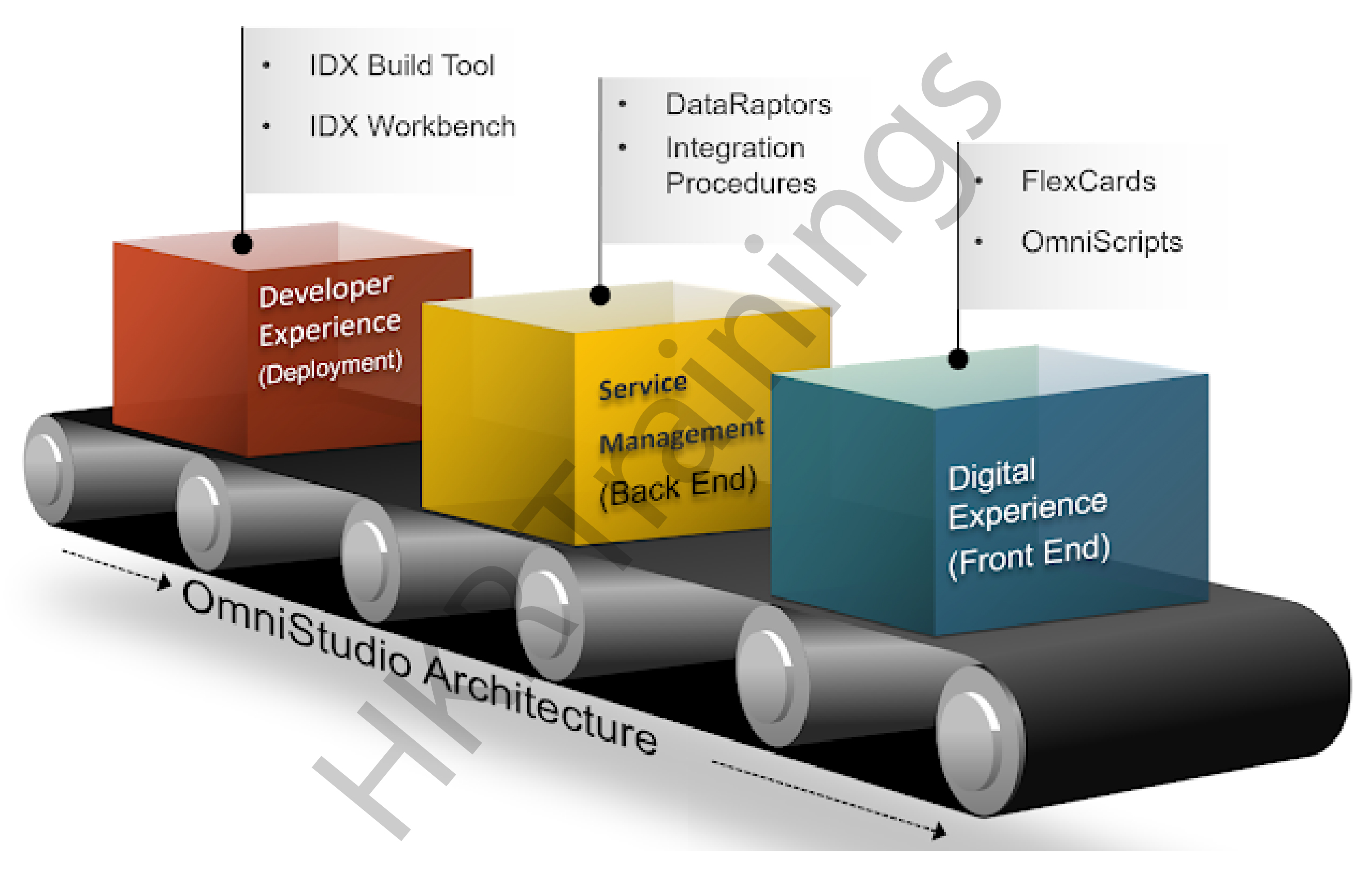
Overview of OmniStudio

OmniStudio is a modular framework that allows you to easily develop Salesforce flows and solutions using standard click-based components. 

OmniStudio

The architecture of OmniStudio is made up of three layers:

Digital Experimentation : 

This is the User Interface Engine. It contains all of the user interface elements that can be selected and dragged toward the action area. We must choose the appropriate component depending on business requirements. The back-end layer’s entry point is this layer. To conduct any operation, simply connect the back-end components to the components. This UI Engine gets separated into two categories once more:

FlexCards :

Flexcard is an alternative if you really want to display multiple data in less space. Flex cards have been used to display data at a glance. This is a drag-and-drop tool that allows you to quickly configure, preview, and troubleshoot a screen. FlexCards present and summarise contextual information and actions from Salesforce and third-party platforms.

Omniscripts : 

OmniScript is being used to give users a guided path through the business processes. That implies you can show multiple screens in a row. We may create pages quickly and effortlessly with the assistance of OmniScript, which is a drag-and-drop application. This is also entirely programmable, allowing it to be tailored to specific requirements. Another omniscript can be called from one omniscript. You may use OmniScripts to create sales, service pathways, and other business operations.

Service Management : 

Backend logic & data are handled by this layer. By using integrations, Service Management may read and write data via Salesforce and other external sources.

It is divided into two sections:

1. OmniStudio Dataraptors :

DataRaptors are used to retrieve, transform, and update information. They are used to perform data-related operations such as reading, writing, and transforming data from external sources. There are four parts to DataraptorsOmniStudio Dataraptors

  • DataRaptor Turbo Extract: As the name implies, this program is used to extract information from a data object. This component has the most efficient data retrieval speed. This option should be used if the need on your page would be to return just a single item.
  • DataRaptor Extract: Most of the time, we need to work with several objects on a page; in this situation, vlocity gives us this alternative. Use DataRaptor Extract to return many objects.
  • DataRaptor Load: This component is used to update the information in Salesforce.
  • DataRaptor Transform: Whenever your data isn’t solely in Salesforce and you’d like to retrieve it and display it in Omniscript/flex cards, use DataRaptor Transform.

2. OmniStudio Integration Procedures

To carry out such tasks, this instrument is quick and dependable. You can use Integration Procedures to retrieve data from third-party services.

Developer Experience

OmniStudio Data packs can be managed with the IDX Build Tool. IDX Workbench seems to be a desktop program for transferring Salesforce information and Data packs. In conclusion, like custom programming, OmniStudio provides simple shortcuts and greater reuse chances for adapting the industry-oriented solution to your specific needs.

However, there are several disadvantages to be aware of right now:

  • Many clouds are combined within one common functionality by industries. As a result, it’s difficult to tell if a certain feature is part of the current implementation.
  • Since all clouds & APIs receive information in one bundle, updates do not even have a defined structure.
  • Errors and platform constraints have limited support.
  • Vlocity’s data model and functionalities are best suited for enterprises at the enterprise level. Some argue that it’s inappropriate again for the SMB market, because not only does it need a greater budget, but it also leaves small-medium firms with capabilities they don’t want and won’t utilize.

Do you want to learn more about Salesforce Vlocity? Watch this Demo video now:


What are FlexCard Actions?

FlexCard Actions can be used to start or modify an OmniScript, connect to a website page or app, show a flyout, launch an event, or change the values of data fields. FlexCards can do the following actions:

  • Card — Load, modify data source, or erase cards at the card level. 
  • Event
    Custom — To alert the main FlexCard of an occurrence, fire a Custom Event.
    PubSub — To alert another element on a website or app of an event, fire a PubSub Event.
  • Flyout – In a modal or popover, show extra details from such a child card, OmniScript, as well as a custom Lightning web component (LWC).
  • Navigate — Choose a targeted URL or a PageReference type that allows you to navigate inside Lightning Experience, across Communities, to another website.
  • OmniScript — Use the FlexCard to launch an OmniScript.
  • Update OmniScript – Update an OmniScript from a FlexCard incorporated as a customized Lightning web component inside an OmniScript.
  • OmniScript Action – Update any OmniScript from a FlexCard integrated as a customized Lightning web component in an OmniScript A reusable OmniStudio Action can be used to launch OmniScripts, elements, websites, or external programs. The same OmniScript can be launched from numerous FlexCards using an OmniStudio Action.

Salesforce Vlocity Training

Weekday / Weekend Batches

Conclusion

To summarise, Vlocity achieved a breakthrough by offering businesses such an architectural foundation tailored to their industry. Salesforce’s acquisition signaled the company’s transition to industry-specific products that are easier to tailor and onboard users. For such a quicker digital transformation journey, firms can use the current Salesforce Industry clouds, which offer a configurable data model and a reliable version with reusable solutions. 


Source link