Health tech company Ultrahuman, makers of the Ultrahuman Ring Air and Ring Pro, launched a partnership with group workout brand Les Mills on Wednesday. Together, the companies created the Les Mills PowerPlug in the Ultrahuman app, which recommends workouts based on data collected by its smart rings, like sleep, recovery and cycle phase.
Traditionally, when your smartwatch or ring tells you that your body is fatigued and that you should take it easy during your workout, it doesn’t provide the workout. With this new integration, the Les Mills PowerPlug offers expert-led, on-demand workout videos that take your current health status into account and help prevent overtraining.
“With Les Mills, we’re closing the loop — your ring doesn’t just tell you how recovered you are, it tells you what to do about it. The right workout, at the right intensity, every day. That’s what training smarter actually looks like,” Mohit Kumar, CEO of Ultrahuman, said in a press release.
How the PowerPlug works
Upon downloading the Les Mills PowerPlug, Ultrahuman Ring users will be asked to choose their ideal training days, session length and a fitness goal from the following: cardio, strength, flexibility or general fitness. Going forward, the app’s home screen will then recommend two to three daily workouts based on your health data, along with a quick workout shortcut.
You’ll also have access to Les Mills’s entire workout catalog, which you can sort by goal, program or duration. Yoga, strength, HIIT and stretching are just a few examples of the type of exercises you can perform.
If you have accumulated sleep debt and your body is showing signs of fatigue, the Less Mills PowerPlug will likely suggest a recovery-forward yoga session.
Ultrahuman x Less Mills
To select your workout recommendation, Ultrahuman uses its Dynamic Recovery score, a percentage from zero to 100 that symbolizes how prepared your body is to take on the day. It takes into account your sleep, temperature, stress rhythm, resting heart rate and heart rate variability and can change throughout the day with movement, naps and non-sleep deep rest like breathwork.
The Les Mills PowerPlug will also adapt its selections based on a user’s menstrual cycle. If they’re in a phase with more energy, such as the follicular or ovulatory phases, they’ll be advised to try a more intense workout. Low-energy luteal and menstrual phases will correlate with workouts that prioritize recovery, like yoga. During menstruation, high-impact workouts that are tough on the pelvic floor will be avoided.
Once you complete your workout, you can then view your workout stats (duration, heart rate zones and calories), movement score, muscle group radar chart, daily goal progress and a post-workout recovery prediction that estimates your readiness for the next day.
The Les Mills PowerPlug price
Global Ultrahuman Ring Air and Ring Pro users can now purchase the Les Mills PowerPlug for $12 per month or $100 per year.
Due to a patent lawsuit with Oura, makers of the Oura Ring, the Ultrahuman Ring Air was previously banned in the US. However, in March, Ultrahuman launched its Ring Pro, which the US Customs and Border Protection approved for sale in the US. It is currently available for preorder and will start shipping on May 15. With a charging case, it costs $479.
A functioning structure and informational flux that gathers businesses, finance, and technological operations alongside each other to drive up the businesses through cloud transformation.
It promotes data-powered decision-making in due time and results in financial responsibility. The collaboration of finance, operations, and business teams makes it possible to achieve it.
FinOps is a field that integrates principles of financial management with cloud engineering and operations to give organizations an analysis of their cloud expenditure. It also allows them to make well-versed decisions on the allocation of their cloud budget and costs. Its goal is to increase the revenue or the business value with the help of the cloud. It also helps organizations control their cloud expenditure while still maintaining the performance level, dependability, and security required to assist their business operations.
Principles of Cloud FinOps
Accountability
With a set of pre-defined KPIs and benchmarks, the teams responsible for value realization reporting and costing amendment can be held accountable. This makes decision-making a process with standards.
Business Value Realization
Decisions taken from the perspective of business make Cloud FinOps successful.
Flexibility
Encourage constant budget allocation, IT spending, and forecasting to push ahead with agile budgeting and planning procedures in the IT industry.
Clarity of Costs
All organizational levels have access to instantaneous cost and billing data.
Partnerships
For cloud finance management, collaborate with departments like IT, finance, app development, and architecture.
Fluctuating nature of the cloud
Accept the pay-as-you-go aspect of cloud and gain from providing dynamic customer service to meet their ever-changing requirements.
Five Key Elements that Make Cloud FinOps
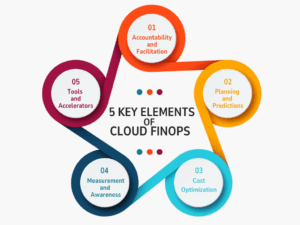
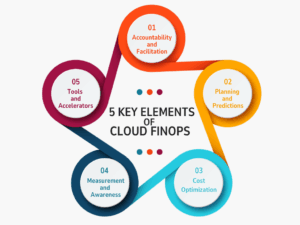
1. Accountability and Facilitation
This element centers on setting up centralized, multi-functional teams that include engineering, finance, operations, architecture, and app developers, while also setting up governance and benchmarks for cloud expenditure.
2. Planning and Predictions
For cloud planning and predictions to be effective, an organization must allocate resources, benchmark efficacy, and gain a deeper understanding of the cost drivers.
3. Cost Optimization
This element, which is an ongoing, repetitive process that focuses on identifying key cost-optimization drivers, offers a consistent methodology to manage cloud consumption in the most economical way.
4. Measurement & Awareness
This key element focuses on building a key set of KPIs and business-value metrics to calculate the transformation’s success. Customers frequently begin with a set of cost-optimization metrics before switching to unit economics or business value metrics, like cost per transaction or cost per customer served.
5. Tools and Accelerators
To sum up, using the right tools and accelerators is crucial for efficiently managing and monitoring cloud spending. It comprises:
Using Google Cloud cost-management tools to examine cost and billing data in real time
Creating a reporting dashboard for tracking values and managing cloud spending
Putting automation scripts into place to create budget alerts and account guardrails
Benefits That Cloud FinOps Offer
Business Value Realization
Initial focus on cloud migration often leaves the business goal of infrastructure in the rear. Proper cooperation between various departments makes FinOps effective and a success. This allows the reconsideration of business values while lifting cloud management to new heights.
Better Decision Making
Making decisions to make business better than today is the whole point here. Using the insights from cloud data and financial analytics, the FinOps team is able to make informed decisions regarding the business’s cloud computing commodities. This also makes them focus on the business goals.
Art of Predictions and Cloud Reporting
FinOps teams analyze cloud spend and set standards for future cloud costs using analytics, reporting, and forecasting cloud FinOps tools. They can create budgets fittingly and evade unplanned surplus costs thanks to the jacked-up cost visibility.
Accountability for Clear Cloud Use
By providing clarity into resource ownership and cloud spending, FinOps promotes accountability while leveling the time and effort needed for research and change implementation.
Challenges That FinOps Come With
Before Cloud FinOps begins to show results, you must surpass many predicaments. These may include issues with organizational processes, technical implementation, or how the teams as a whole perceive the changes.
Governance
Incorporating new methods, tools, and challenges requires all the things to be in place and well-governed. The processes to be incorporated ought to adhere to existing laws, rules, and compliance standards. It can be challenging to describe these approaches, create policies, and implement them.
Technical Glitches
There might be considerable technical glitches in putting the suggested modifications into practice, from planning effective cost data collection and processing to putting per-instance optimizations, element migration, and access management into practice.
All of the alterations should certainly be based on practicality, as well as administering the right balance between cost-effectiveness and effort, while taking into account the gross solution’s business value.
Cultural Alterations
As the FinOps framework requires processes to be established at every level of an organization, an actual cultural transformation must take place for FinOps methodologies to be implemented successfully. This entails setting up a culture of financial responsibility and accountability while maintaining the requirements of the company and the objectives of the other players in mind.
It could be challenging to bring in this culture, as it needs not only the establishment of appropriate processes but also a shift in the team’s mentalities. So, it is a task!
From Chaos of Cloud to Clarity: An Imperative for Businesses
Cloud FinOps is the way of the future for businesses, but excessive cloud spending can undermine the very advantages that companies are trying to achieve. Cloud FinOps management transforms from a standalone finance function into a vital business capability with FinOps.
Businesses that adopt Cloud FinOps not only reduce cloud expenses but also acquire the flexibility to change course more quickly, the assurance to make more intelligent investments, and the transparency to match IT with business value.
The ability to forecast precisely, budget dynamically, and optimize continuously is not a luxury in a world where cloud usage is only increasing; rather, it is a competitive necessity.
1. What is another name for FinOps? Answer: FinOps is the blend of “Finance” and “DevOps”. It shows the collaboration between business and engineering groups. It is also known by terms like Cloud Financial Management and Cloud Financial Optimization.
2. When did FinOps start? Answer: It began in 2019 as an open community comprising individuals and organizations where knowledge of cloud financial management could be shared.
3. What is the future of FinOps? Answer: FinOps’s future depends on comprehensive innovation and teamwork. FinOps and ITAM combination will be essential as cloud infrastructure develops to trim the financial waste, promote sustainability, and improve AI-powered optimization.
To provide the best experiences, we use technologies like cookies to store and/or access device information. Consenting to these technologies will allow us to process data such as browsing behavior or unique IDs on this site. Not consenting or withdrawing consent, may adversely affect certain features and functions.
Functional
Always active
The technical storage or access is strictly necessary for the legitimate purpose of enabling the use of a specific service explicitly requested by the subscriber or user, or for the sole purpose of carrying out the transmission of a communication over an electronic communications network.
Preferences
The technical storage or access is necessary for the legitimate purpose of storing preferences that are not requested by the subscriber or user.
Statistics
The technical storage or access that is used exclusively for statistical purposes.The technical storage or access that is used exclusively for anonymous statistical purposes. Without a subpoena, voluntary compliance on the part of your Internet Service Provider, or additional records from a third party, information stored or retrieved for this purpose alone cannot usually be used to identify you.
Marketing
The technical storage or access is required to create user profiles to send advertising, or to track the user on a website or across several websites for similar marketing purposes.