How AI Is Transforming the Way Retailers Set Prices


There was a time when pricing a product was mostly guesswork. You’d look at your costs, tack on a margin, maybe peek at what a competitor was doing, and then hope it all worked out. That approach feels almost quaint now.

The reality is, shoppers today are sharper and faster than ever. They can compare your price with half a dozen competitors in the time it takes to open an app. Competitors themselves change their prices constantly. Stock levels rise and fall by the hour. In that kind of environment, the old “set it and forget it” model simply can’t keep up.

This is where AI-driven pricing solutions come in. Instead of relying on gut feelings or periodic reviews, algorithms crunch mountains of data in real time—things like customer behavior, market demand, and even the weather—to recommend smarter prices.

From Static Prices to Something More Fluid

If you’re still managing prices manually, you’re already behind. AI doesn’t get tired, it doesn’t forget to check competitor websites, and it doesn’t need weeks of reports to react. It can spot a sudden surge in demand or a dip in inventory and adjust instantly.

Some of the ways it works are pretty straightforward:

  • It can see demand spikes before they overwhelm supply.
  • It balances margins with what customers are likely to accept.
  • It notices when competitors change prices and helps you react.
  • It prevents over-discounting, so you’re not just slashing prices unnecessarily.

Restaurants, brick-and-mortar shops, service businesses—anyone selling products or services can plug into these tools.

How It Fits into the Rest of the Business

AI pricing doesn’t run in isolation. It works best when tied into the systems you already use:

  • Electronic shelf labels. Those digital price tags you’ve probably seen in supermarkets can change automatically when the algorithm says it’s time. No more scrambling to swap paper tags during a sale.
  • Inventory systems. Got products collecting dust? AI can nudge you to discount them. On the flip side, if something’s flying off the shelves, it may suggest a price bump to protect margin.
  • Competitor monitoring. Instead of spending hours checking other sites, AI can scrape competitor data in the background and adjust your numbers accordingly.
  • Promotions. Not only does it tell you when to run a discount, it can help you figure out how deep the cut should be, and for how long, while showing you the likely outcome beforehand.
  • Customer behavior. If someone keeps coming back to look at an item but hasn’t purchased, the system might push out a small discount to tip them over the edge.

What’s in It for Retailers?

The obvious draw is better profit margins. Many retailers report increases of 8–12% once they stop over-discounting and start pricing with precision. But there are other wins too:

  • Prices that update when they need to, not once a month.
  • Stock that moves more quickly, which frees up cash and space.
  • Consistency across channels, so online and in-store aren’t out of sync.
  • Less time spent wrestling with spreadsheets and more time thinking strategically.
  • Customers who feel prices are fairer, which builds trust.

What Shoppers Think About It

From the buyer’s side, the experience is a mixed bag. On the plus side, they often get deals that reflect real demand. If there’s plenty of stock, they may see lower prices. If an item is scarce, the price nudges up, which can create urgency to buy sooner.

On the downside, fast-changing prices can feel unfair. Nobody likes paying more today for something that was cheaper yesterday. That’s why communication matters. If shoppers can see why prices have shifted—through shelf labels, app messages, or clear notes online—they tend to be more accepting. In fact, some even like the game of “catching” the price at the right time.

So, Why Choose AI Pricing Solutions?

AI is already shaping how retailers compete. The companies sticking with static pricing models are quietly handing ground to those who can adjust quickly and intelligently.

If you’re considering it, you don’t need to overhaul your entire business at once. Start with one product line, test it, and expand as you learn. The important thing is to begin. Because in retail today, the “right price at the right moment” is crucial, and it’s the outcome of smarter systems working behind the scenes.


Also Read: 5 Ways Artificial Intelligence Helps in Personalized Marketing


Source link

Leave a Reply

Subscribe to Our Newsletter

Get our latest articles delivered straight to your inbox. No spam, we promise.

Recent Reviews


What is Cloud FinOps?

A functioning structure and informational flux that gathers businesses, finance, and technological operations alongside each other to drive up the businesses through cloud transformation.

It promotes data-powered decision-making in due time and results in financial responsibility. The collaboration of finance, operations, and business teams makes it possible to achieve it.

FinOps is a field that integrates principles of financial management with cloud engineering and operations to give organizations an analysis of their cloud expenditure. It also allows them to make well-versed decisions on the allocation of their cloud budget and costs. Its goal is to increase the revenue or the business value with the help of the cloud. It also helps organizations control their cloud expenditure while still maintaining the performance level, dependability, and security required to assist their business operations.

Principles of Cloud FinOps

Accountability

With a set of pre-defined KPIs and benchmarks, the teams responsible for value realization reporting and costing amendment can be held accountable. This makes decision-making a process with standards.

Business Value Realization

Decisions taken from the perspective of business make Cloud FinOps successful.

Flexibility

Encourage constant budget allocation, IT spending, and forecasting to push ahead with agile budgeting and planning procedures in the IT industry.

Clarity of Costs

All organizational levels have access to instantaneous cost and billing data.

Partnerships

For cloud finance management, collaborate with departments like IT, finance, app development, and architecture.

Fluctuating nature of the cloud

Accept the pay-as-you-go aspect of cloud and gain from providing dynamic customer service to meet their ever-changing requirements.

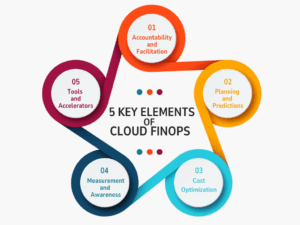
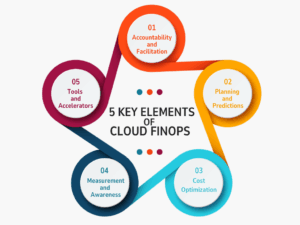
Five Key Elements that Make Cloud FinOps

5 Key Elements of Cloud FinOps

1. Accountability and Facilitation

This element centers on setting up centralized, multi-functional teams that include engineering, finance, operations, architecture, and app developers, while also setting up governance and benchmarks for cloud expenditure.

2. Planning and Predictions

For cloud planning and predictions to be effective, an organization must allocate resources, benchmark efficacy, and gain a deeper understanding of the cost drivers.

3. Cost Optimization

This element, which is an ongoing, repetitive process that focuses on identifying key cost-optimization drivers, offers a consistent methodology to manage cloud consumption in the most economical way.

4. Measurement & Awareness

This key element focuses on building a key set of KPIs and business-value metrics to calculate the transformation’s success. Customers frequently begin with a set of cost-optimization metrics before switching to unit economics or business value metrics, like cost per transaction or cost per customer served.

5. Tools and Accelerators

To sum up, using the right tools and accelerators is crucial for efficiently managing and monitoring cloud spending. It comprises:

  1. Using Google Cloud cost-management tools to examine cost and billing data in real time
  2. Creating a reporting dashboard for tracking values and managing cloud spending
  3. Putting automation scripts into place to create budget alerts and account guardrails

Benefits That Cloud FinOps Offer

Business Value Realization

Initial focus on cloud migration often leaves the business goal of infrastructure in the rear. Proper cooperation between various departments makes FinOps effective and a success. This allows the reconsideration of business values while lifting cloud management to new heights.

Better Decision Making

Making decisions to make business better than today is the whole point here. Using the insights from cloud data and financial analytics, the FinOps team is able to make informed decisions regarding the business’s cloud computing commodities. This also makes them focus on the business goals.

Art of Predictions and Cloud Reporting

FinOps teams analyze cloud spend and set standards for future cloud costs using analytics, reporting, and forecasting cloud FinOps tools. They can create budgets fittingly and evade unplanned surplus costs thanks to the jacked-up cost visibility.

Accountability for Clear Cloud Use

By providing clarity into resource ownership and cloud spending, FinOps promotes accountability while leveling the time and effort needed for research and change implementation.

Challenges That FinOps Come With

Before Cloud FinOps begins to show results, you must surpass many predicaments. These may include issues with organizational processes, technical implementation, or how the teams as a whole perceive the changes.

Governance

Incorporating new methods, tools, and challenges requires all the things to be in place and well-governed. The processes to be incorporated ought to adhere to existing laws, rules, and compliance standards. It can be challenging to describe these approaches, create policies, and implement them.

Technical Glitches

There might be considerable technical glitches in putting the suggested modifications into practice, from planning effective cost data collection and processing to putting per-instance optimizations, element migration, and access management into practice.

All of the alterations should certainly be based on practicality, as well as administering the right balance between cost-effectiveness and effort, while taking into account the gross solution’s business value.

Cultural Alterations

As the FinOps framework requires processes to be established at every level of an organization, an actual cultural transformation must take place for FinOps methodologies to be implemented successfully. This entails setting up a culture of financial responsibility and accountability while maintaining the requirements of the company and the objectives of the other players in mind.

It could be challenging to bring in this culture, as it needs not only the establishment of appropriate processes but also a shift in the team’s mentalities. So, it is a task!

From Chaos of Cloud to Clarity: An Imperative for Businesses

Cloud FinOps is the way of the future for businesses, but excessive cloud spending can undermine the very advantages that companies are trying to achieve. Cloud FinOps management transforms from a standalone finance function into a vital business capability with FinOps.

Businesses that adopt Cloud FinOps not only reduce cloud expenses but also acquire the flexibility to change course more quickly, the assurance to make more intelligent investments, and the transparency to match IT with business value.

The ability to forecast precisely, budget dynamically, and optimize continuously is not a luxury in a world where cloud usage is only increasing; rather, it is a competitive necessity.

To learn more, visit KnowledgeNile!


FAQs for Cloud FinOps

1. What is another name for FinOps?
Answer: FinOps is the blend of “Finance” and “DevOps”. It shows the collaboration between business and engineering groups. It is also known by terms like Cloud Financial Management and Cloud Financial Optimization.

2. When did FinOps start?
Answer: It began in 2019 as an open community comprising individuals and organizations where knowledge of cloud financial management could be shared.

3. What is the future of FinOps?
Answer: FinOps’s future depends on comprehensive innovation and teamwork. FinOps and ITAM combination will be essential as cloud infrastructure develops to trim the financial waste, promote sustainability, and improve AI-powered optimization.


Also Read:
Cloud Migration Process Explained in Easy Steps
Edge and Cloud Computing for IoT and Their Key Roles
What is The Distributed Cloud: Advantages and Disadvantages


Source link