A few years ago, I developed some pain on the top right side of my right foot that wouldn’t go away, so I went to a podiatrist. While he said it was nothing serious, he suggested I get a pair of Oofos recovery slides and recommended not only wearing them instead of my shoes as much as possible but also wearing them around the house instead of going barefoot.
“All these people working from home don’t realize your feet need more support than you think, especially as you get older,” he told me. “It was a big problem during the [part of the] pandemic when everybody was at home all the time.”
Wearing the Oofos helped cure my foot pain in a matter of weeks, and I’ve since become sort of a connoisseur of recovery slides, many of which are made out of high-tech foam and other cushiony materials. Ostensibly, they were developed for both recreational and more serious athletes for before and after activities, whether that’s running, soccer, basketball, tennis or any sport that causes foot fatigue. However, they’re also recommended to help get rid of plantar fasciitis.
What are the best recovery slides?
While I’m still a fan of Oofos slides, I’m a little more partial to a pair of slides from Oka Recovery that I got last year. People have different-shaped feet, though, and different preferences for how firm or soft they like their recovery slides, so my preference might not be yours. Also, admittedly, I haven’t tried every recovery slide out there — dozens, if not hundreds of models, are out there, and some are quite similar to others as copycats overrun the market. The most recent models added to the list are the Velous Hoya and Kane Revive OB slides.
Some slides I tested fit true to size. However, some fit larger than their size would indicate, requiring you to size down, while others fit smaller, perhaps requiring you to size up. (I’ve noted for each pick whether they fit true to size or not.) Unless otherwise noted, all the models on this list are unisex, offering both men’s and women’s sizes for the slide. I’ll add more picks as I come across new top recovery slides.
Best recovery slides of 2026
Not to be confused with Hoka (which also makes a good pair of recovery slides on this list), Oka slides tend to be very cushiony and comfortable. Available in multiple colors, the Oka slides are slightly firmer than my Oofos Oohha slides and are also better with water. They have 35 millimeters of “buoyant foam,” 12 cooling vents and “a wide upper that cradles without squeezing.”
The company also touts the slides’ “stabilizing deep heel cup that locks your foot in place.”
But it’s worth noting that most people should probably order a size down to get the best fit. I’m usually a size 10, but the slide that fit me well was the men’s 9/women’s 11. They had good arch support, too. Read my full review.
Oofos is one of the best-known recovery slide brands — I appreciate how well they cushion my feet. (They’re a bit softer than some slides.)
Its Oohha model is made out of the company’s patented footbed and Oofoam technology, which it says absorbs 37% more impact than traditional footwear foams. The closed-cell foam is machine washable and “designed to minimize odor.”
I wore these Oofos for several months and was able to alleviate some foot pain on the top of my right foot that I was experiencing. They’ve held up well, even with plenty of outdoor use. My only gripe is that they get slick when water gets on them, so they’re not great in the rain or walking through shallow water. (My feet slide around in slides.)
They do run a bit large, so I sized down from my usual 10 to a men’s 9/women’s 11. The slides available in multiple colors.
Velous makes a variety of recovery footwear, including slip-on shoes and “active” sandals with two straps. Arguably, the best slide option if you’re looking for some adjustability in the fit is its Hoya Adjustable Recovery Slide, which works as an everyday slide and a recovery slide. Neither super soft or super firm (I’d call it a medium cushion slide), it uses Velour’s Tri-Motion Technology, which the company says, “supports the natural foot movement and alignment to ease foot fatigue and reduces joint stress to promote faster recovery.”
The Hoya is the company’s most expensive slide at $80, but it’s similar to its Active Adjustable Slide that costs $10 less. Though the material of their forefoot instep straps is different, both models give you a secure, customized fit, thanks to those velcro-equipped straps. Not only are the Hoya slides lightweight, but I also find them quite comfortable. They’re available in multiple color options.
Vktry made a name for itself with its performance insoles, made with carbon fiber. But more recently, it’s ventured into recovery footwear with a set of recovery clogs and recovery slides, both of which retail for $99.
These slides feel a little firmer than the Oka and Oofos, and they have a bit more of an arch and a deeper heel cup. Both the clogs and slides have a layer of cushiony foam on top of Vktry’s signature carbon fiber plate. While you can wipe them down with soap and water to clean, you’re not supposed to fully submerge them in water, so that’s a small downside.
They do run pretty true to size, so start with whatever size you’d normally wear.
A lot of people swear by Hoka’s running shoes, and I liked its Ora Recovery Slide 3 slides, though my kids didn’t like the color I selected. (The company offers plenty of color options, but I already had a few darker colored slides, so I decided to go with a lighter color.)
The Ora Slide 3 is a bit firmer than the Oka and Oofos and has good traction on its soles, which look pretty similar to a running shoe’s soles. They also have a little bit of arch support and run wide and fairly large.
I sized down to a men’s 9/women’s 11, and it fit pretty well, but I still had some room to spare.
Kane made a name for itself in football and other sports locker rooms with its Revive footwear. These shoes are injection-molded recovery shoes that you can easily slip in and out of.
Still, some players didn’t want a full shoe with a full heal cup and ended up cutting out part of the back of the shoe. That became the basis the Revive OB (OB stands for “open-back”), which looks more like a recovery clog. While many recovery slides leave your toes exposed, the Revive OB covers the top of your foot, though it’s well ventilated with perforations. As an athlete, it’s always a good idea to protect your feet and toes to prevent avoidable nonplaying injuries.
Based on its medical-based research, the company determined that most recovery footwear that athletes were wearing was too loose and overly-cushioned. As a result, the Revive OB are among the firmest recovery slides.
These slides do offer good support and a decent amount of cushioning. (Kane’s dual-density RestoreFoam is made from Brazilian sugarcane.) I did find them comfortable to wear, though it took a little time to get used to them after wearing generally softer slides. The Revive OB are also fully waterproof, and their soles offer good traction. Note that they run a tad big but mostly true to size.
Fleks make several styles of recovery slides, sandals and clogs. One of its slides defining attributes is that they’re all made from 85% recycled materials, including performance foam waste (which is all those extra scraps of foam from factories making athletic shoes).
Crafted with nonslip Blumaka technology, the company says its footwear is “designed to reduce fatigue and support muscle recovery,” with each style offering “cushioned comfort and foot-cradling ergonomics to ease stress on your feet, legs and body.” Their grippy surface is a nice plus, and they had just the right amount of arch support and depth to their heel cup. They also do well with water.
Note that they run true to size and have a medium width.
Roll Recovery, which makes some interesting rollers for muscle recovery, moved into the recovery footwear market fairly recently. I tried its new SuperPlush Solace, which the company bills as its “most premium, most luxurious recovery footwear ever created.”
A pair does run a little expensive at $110. However, the slides have some natural suede as part of the construction (with an adjustable Velcro strap that I appreciated), along with Roll Recovery’s patented Cradle-Design footbed, which did cradle my feet nicely. Available in a few different color options, these slides are springy but a little firmer than the Oofos’ Oohha slides and not as thick.
I decided to size down for these, and indeed, they run slightly big. Note that the SuperPlus Solace appears to be unisex, but Roll Recovery has separate product pages on its website for men’s and women’s versions.
If you’ve been trading anything other than cash over the past eighteen months, you’ve noticed something peculiar: periods of calm tend to persist, but so do periods of chaos. A quiet Tuesday in January rarely suddenly explodes into volatility on Wednesday—market turbulence comes in clusters. This isn’t market inefficiency; it’s a fundamental stylized fact of financial markets, one that most quant models fail to properly account for.
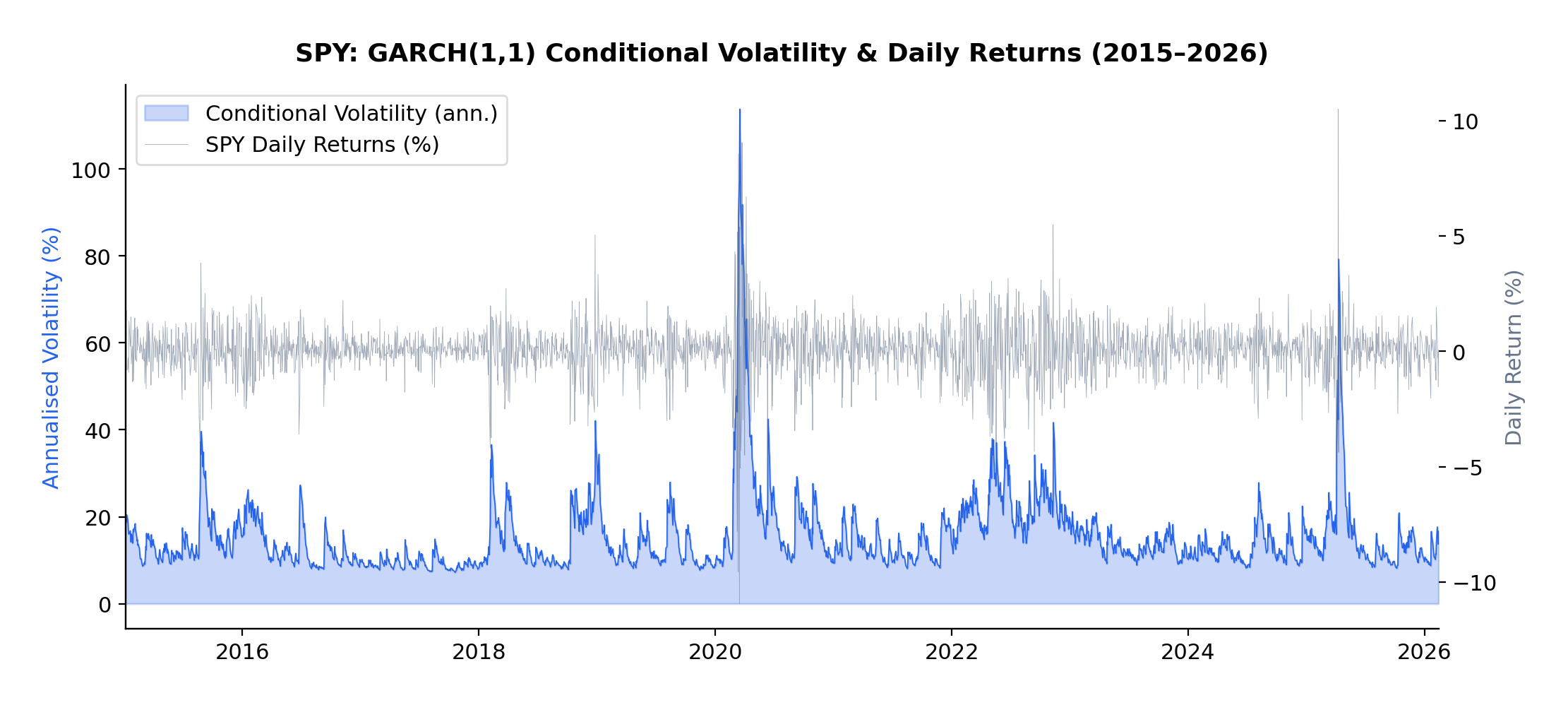
The current volatility regime we’re navigating in early 2026 provides a perfect case study. Following the Federal Reserve’s policy pivot late in 2025, equity markets experienced a sharp correction, with the VIX spiking from around 15 to above 30 in a matter of weeks. But here’s what interests me as a researcher: that elevated volatility didn’t dissipate overnight. It lingered, exhibiting the characteristic “slow decay” that the GARCH framework was designed to capture.
In this article, I present an empirical analysis of volatility dynamics across five major asset classes—the S&P 500 (SPY), US Treasuries (TLT), Gold (GLD), Oil (USO), and Bitcoin (BTC-USD)—over the ten-year period from January 2015 to February 2026. Using both GARCH(1,1) and EGARCH(1,1,1) models, I characterize volatility persistence and leverage effects, revealing striking differences across asset classes that have direct implications for risk management and trading strategy design.
This extends my earlier work on VIX derivatives and correlation trading, where understanding the time-varying nature of volatility is essential for pricing complex derivatives and managing portfolio risk through volatile regimes.
Understanding Volatility Clustering
Before diving into the results, let’s build some intuition about what GARCH actually captures—and why it matters.
Volatility clustering refers to the empirical observation that large price changes tend to be followed by large price changes, and small changes tend to follow small changes. If the market experiences a turbulent day, don’t expect immediate tranquility the next day. Conversely, a period of quiet trading often continues uninterrupted.
This phenomenon was formally modeled by Robert Engle in his landmark 1982 paper, “Autoregressive Conditional Heteroskedasticity with Estimates of the Variance of United Kingdom Inflation,” which introduced the ARCH (Autoregressive Conditional Heteroskedasticity) model. Engle’s insight was revolutionary: rather than assuming constant variance (homoskedasticity), he modeled variance itself as a time-varying process that depends on past shocks.
Tim Bollerslev extended this work in 1986 with the GARCH (Generalized ARCH) model, which proved more parsimonious and flexible. Then, in 1991, Daniel Nelson introduced the EGARCH (Exponential GARCH) model, which could capture the asymmetric response of volatility to positive versus negative returns—the famous “leverage effect” where negative shocks tend to increase volatility more than positive shocks of equal magnitude.
The Mathematics
The standard GARCH(1,1) model specifies:
where:
σt2 is the conditional variance at time t
rt-12 is the squared return from the previous period (the “shock”)
σt-12 is the previous period’s conditional variance
α measures how quickly volatility responds to new shocks
β measures the persistence of volatility shocks
The sum α + β represents overall volatility persistence
The key parameter here is α + β. If this sum is close to 1 (as it typically is for financial assets), volatility shocks decay slowly—a phenomenon I observed firsthand during the 2025-2026 correction. We can calculate the “half-life” of a volatility shock as:
For example, with α + β = 0.97, a volatility shock takes approximately ln(0.5)/ln(0.97) ≈ 23 days to decay by half.
The EGARCH model modifies this framework to capture asymmetry:
The parameter γ (gamma) captures the leverage effect. A negative γ means that negative returns generate more volatility than positive returns of equal magnitude—which is precisely what we observe in equity markets and, as we’ll see, in Bitcoin.
For each asset in the sample, I computed daily log returns as:
The multiplication by 100 converts returns to percentage terms, which improves numerical convergence when estimating the models.
I then fitted two volatility models to each asset’s return series:
GARCH(1,1): The workhorse model that captures volatility clustering through the autoregressive structure of conditional variance
EGARCH(1,1,1): The exponential GARCH model that additionally captures leverage effects through the asymmetric term
All models were estimated using Python’s arch package with normally distributed innovations. The sample period spans January 2015 to February 2026, encompassing multiple distinct volatility regimes including:
The 2015-2016 oil price collapse
The 2018 Q4 correction
The COVID-19 volatility spike of March 2020
The 2022 rate-hike cycle
The 2025-2026 post-pivot correction
This rich variety of regimes makes the sample ideal for studying volatility dynamics across different market conditions.
GARCH(1,1) Estimates
The GARCH(1,1) model reveals substantial variation in volatility dynamics across asset classes:
Asset
α (alpha)
β (beta)
Persistence (α+β)
Half-life (days)
AIC
S&P 500
0.1810
0.7878
0.9688
~23
7130.4
US Treasuries
0.0683
0.9140
0.9823
~38
7062.7
Gold
0.0631
0.9110
0.9741
~27
7171.9
Oil
0.1271
0.8305
0.9576
~16
11999.4
Bitcoin
0.1228
0.8470
0.9699
~24
20789.6
EGARCH(1,1,1) Estimates
The EGARCH model additionally captures leverage effects:
Asset
α (alpha)
β (beta)
γ (gamma)
Persistence
AIC
S&P 500
0.2398
0.9484
-0.1654
1.1882
7022.6
US Treasuries
0.1501
0.9806
0.0084
1.1307
7063.5
Gold
0.1205
0.9721
0.0452
1.0926
7146.9
Oil
0.2171
0.9564
-0.0668
1.1735
12002.8
Bitcoin
0.2505
0.9377
-0.0383
1.1882
20773.9
Volatility Persistence
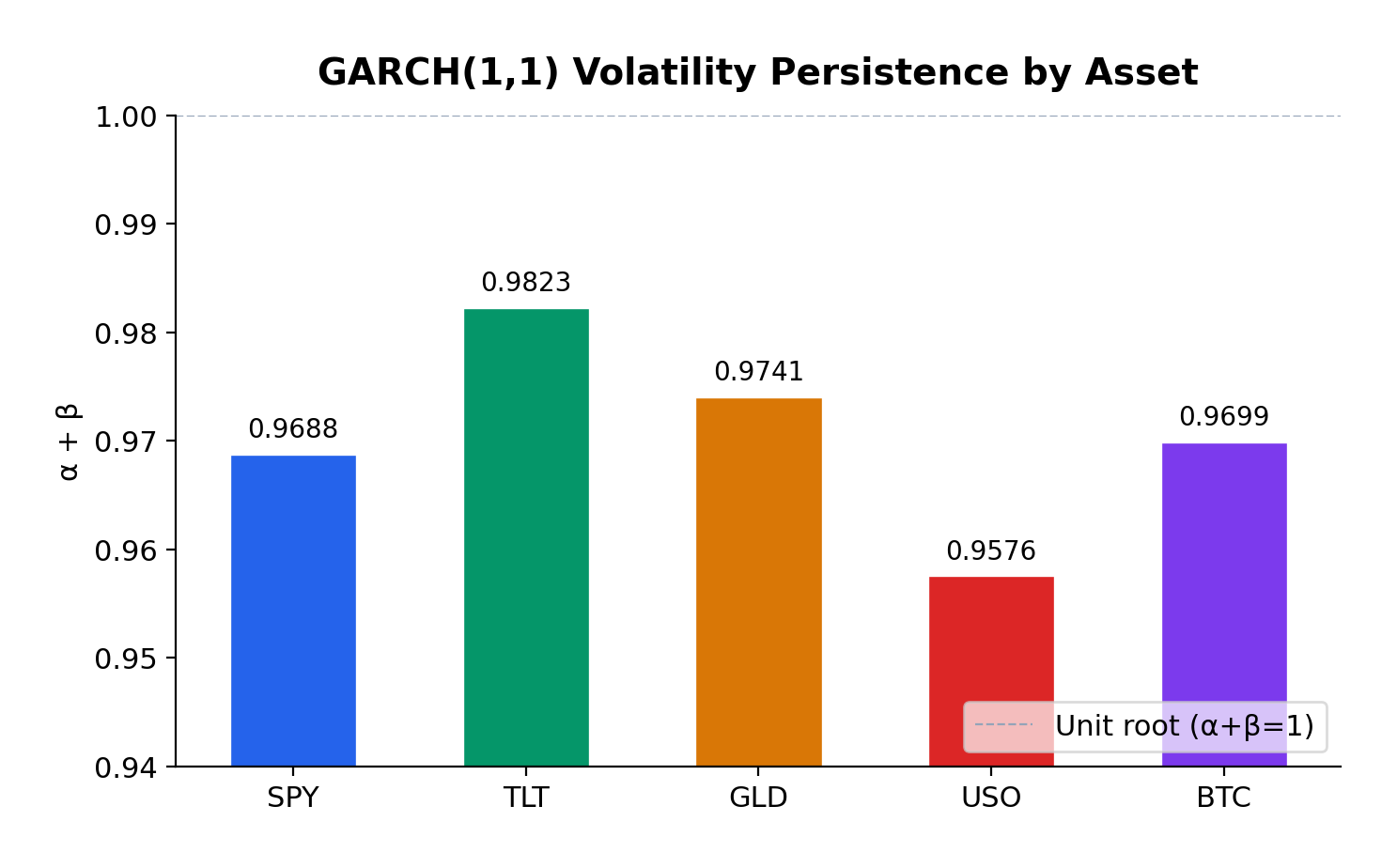
All five assets exhibit high volatility persistence, with α + β ranging from 0.9576 (Oil) to 0.9823 (US Treasuries). These values are remarkably consistent with the classic empirical findings from Engle (1982) and Bollerslev (1986), who first documented this phenomenon in inflation and stock market data respectively.
US Treasuries show the highest persistence (0.9823), meaning volatility shocks in the bond market take longer to decay—approximately 38 days to half-life. This makes intuitive sense: Federal Reserve policy changes, which are the primary drivers of Treasury volatility, tend to have lasting effects that persist through subsequent meetings and economic data releases.
Gold exhibits the second-highest persistence (0.9741), consistent with its role as a long-term store of value. Macroeconomic uncertainties—geopolitical tensions, currency debasement fears, inflation scares—don’t resolve quickly, and neither does the associated volatility.
S&P 500 and Bitcoin show similar persistence (~0.97), with half-lives of approximately 23-24 days. This suggests that equity market volatility shocks, despite their reputation for sudden spikes, actually decay at a moderate pace.
Oil has the lowest persistence (0.9576), which makes sense given the more mean-reverting nature of commodity prices. Oil markets can experience rapid shifts in sentiment based on supply disruptions or demand changes, but these shocks tend to resolve more quickly than in financial assets.
Leverage Effects
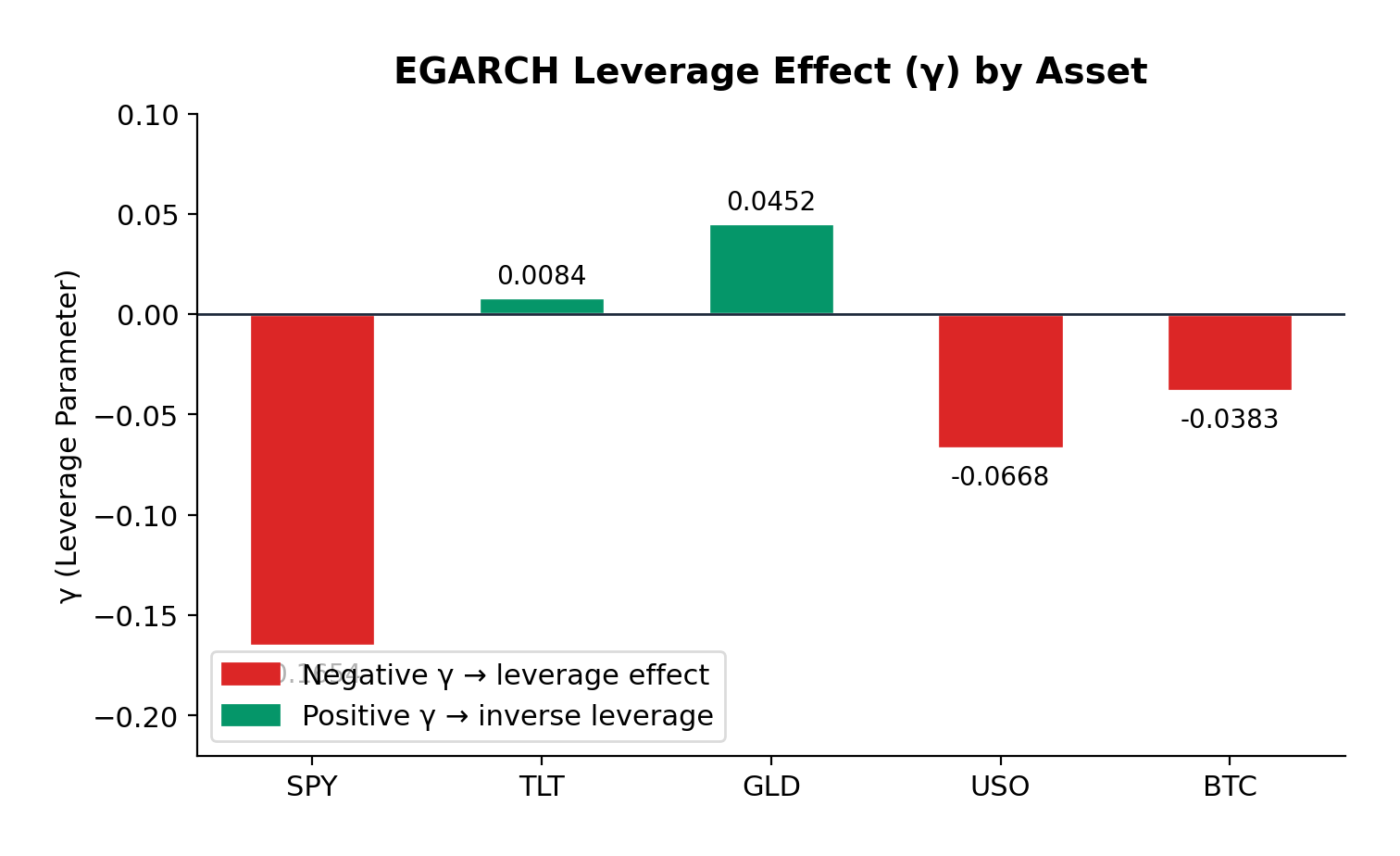
The EGARCH γ parameter reveals asymmetric volatility responses—the leverage effect that Nelson (1991) formalized:
S&P 500 (γ = -0.1654): The strongest negative leverage effect in the sample. A 1% drop in equities increases volatility significantly more than a 1% rise. This is the classic equity pattern: bad news is “stickier” than good news. For options traders, this means that protective puts are more expensive than equivalent out-of-the-money calls during volatile periods—a direct consequence of this asymmetry.
Bitcoin (γ = -0.0383): Moderate negative leverage, weaker than equities but still significant. The cryptocurrency market shows asymmetric reactions to price movements, with downside moves generating more volatility than upside moves. This is somewhat surprising given Bitcoin’s retail-dominated nature, but consistent with the hypothesis that large institutional players are increasingly active in crypto markets.
Oil (γ = -0.0668): Moderate negative leverage, similar to Bitcoin. The energy market’s reaction to geopolitical events (which tend to be negative supply shocks) contributes to this asymmetry.
Gold (γ = +0.0452): Here’s where it gets interesting. Gold exhibits a slight positive gamma—the opposite of the equity pattern. Positive returns slightly increase volatility more than negative returns. This is consistent with gold’s safe-haven role: when risk assets sell off and investors flee to gold, the resulting price spike in gold can be accompanied by increased trading activity and volatility. Conversely, gradual gold price increases during calm markets occur with declining volatility.
US Treasuries (γ = +0.0084): Essentially symmetric. Treasury volatility doesn’t distinguish between positive and negative returns—which makes sense, since Treasuries are priced primarily on interest rate expectations rather than “good” or “bad” news in the equity sense.
Model Fit
The AIC (Akaike Information Criterion) comparison shows that EGARCH provides a materially better fit for the S&P 500 (7022.6 vs 7130.4) and Bitcoin (20773.9 vs 20789.6), where significant leverage effects are present. For Gold and Treasuries, GARCH performs comparably or slightly better, consistent with the absence of significant leverage asymmetry.
1. Volatility Forecasting and Position Sizing
The high persistence values across all assets have direct implications for position sizing during volatile regimes. If you’re trading options or managing a portfolio, the GARCH framework tells you that elevated volatility will likely persist for weeks, not days. This suggests:
Don’t reduce risk too quickly after a volatility spike. The half-life analysis shows that it takes 2-4 weeks for half of a volatility shock to dissipate. Cutting exposure immediately after a correction means you’re selling low vol into the spike.
Expect re-leveraging opportunities. Once vol peaks and begins decaying, there’s a window of several weeks where volatility is still elevated but declining—potentially favorable for selling vol (e.g., writing covered calls or selling volatility swaps).
2. Options Pricing
The leverage effects have material implications for option pricing:
Equity options (S&P 500) should price in significant skew—put options are relatively more expensive than calls. If you’re buying protection (e.g., buying SPY puts for portfolio hedge), you’re paying a premium for this asymmetry.
Bitcoin options show similar but weaker asymmetry. The market is still relatively young, and the vol surface may not fully price in the leverage effect—potentially an edge for sophisticated options traders.
Gold options exhibit the opposite pattern. Call options may be relatively cheaper than puts, reflecting gold’s tendency to experience vol spikes on rallies (as opposed to selloffs).
3. Portfolio Construction
For multi-asset portfolios, the differing persistence and leverage characteristics suggest tactical allocation shifts:
During risk-on regimes: Low persistence in oil suggests faster mean reversion—commodity exposure might be appropriate for shorter time horizons.
During risk-off regimes: High persistence in Treasuries means bond market volatility decays slowly. Duration hedges need to account for this extended volatility window.
Diversification benefits: The low correlation between equity and Treasury volatility dynamics supports the case for mixed-asset portfolios—but the high persistence in both suggests that when one asset class enters a high-vol regime, it likely persists for weeks.
4. Trading Volatility Directly
For traders who express views on volatility itself (VIX futures, variance swaps, volatility ETFs):
The persistence framework suggests that VIX spikes should be traded as mean-reverting (which they are), but with the expectation that complete normalization takes 30-60 days.
The leverage effect in equities means that vol strategies should be positioned for asymmetric payoffs—long vol positions benefit more from downside moves than equivalent upside moves.
At the bottom of the post is the complete Python code used to generate these results. The code uses yfinance for data download and the arch package for model estimation. It’s designed to be easily extensible—you can add additional assets, change the date range, or experiment with different GARCH variants (GARCH-M, TGARCH, GJR-GARCH) to capture different aspects of the volatility dynamics.
This analysis confirms that volatility clustering is a universal phenomenon across asset classes, but the specific characteristics vary meaningfully:
Volatility persistence is universally high (α + β ≈ 0.95–0.98), meaning volatility shocks take weeks to months to decay. This has important implications for position sizing and risk management.
Leverage effects vary dramatically across asset classes. Equities show strong negative leverage (bad news increases vol more than good news), while gold shows slight positive leverage (opposite pattern), and Treasuries show no meaningful asymmetry.
The half-life of volatility shocks ranges from approximately 16 days (oil) to 38 days (Treasuries), providing a quantitative guide for expected duration of volatile regimes.
These findings extend naturally to my ongoing work on volatility derivatives and correlation trading. Understanding the persistence and asymmetry of volatility is essential for pricing VIX options, variance swaps, and other vol-sensitive products—as well as for managing the tail risk that inevitably accompanies high-volatility regimes like the one we’re navigating in early 2026.
References
Engle, R.F. (1982). “Autoregressive Conditional Heteroskedasticity with Estimates of the Variance of United Kingdom Inflation.” Econometrica, 50(4), 987-1007.
Bollerslev, T. (1986). “Generalized Autoregressive Conditional Heteroskedasticity.” Journal of Econometrics, 31(3), 307-327.
Nelson, D.B. (1991). “Conditional Heteroskedasticity in Asset Returns: A New Approach.” Econometrica, 59(2), 347-370.
All models estimated using Python’s arch package with normal innovations. Data source: Yahoo Finance. The analysis covers the period January 2015 through February 2026, comprising approximately 2,800 trading days.
To provide the best experiences, we use technologies like cookies to store and/or access device information. Consenting to these technologies will allow us to process data such as browsing behavior or unique IDs on this site. Not consenting or withdrawing consent, may adversely affect certain features and functions.
Functional
Always active
The technical storage or access is strictly necessary for the legitimate purpose of enabling the use of a specific service explicitly requested by the subscriber or user, or for the sole purpose of carrying out the transmission of a communication over an electronic communications network.
Preferences
The technical storage or access is necessary for the legitimate purpose of storing preferences that are not requested by the subscriber or user.
Statistics
The technical storage or access that is used exclusively for statistical purposes.The technical storage or access that is used exclusively for anonymous statistical purposes. Without a subpoena, voluntary compliance on the part of your Internet Service Provider, or additional records from a third party, information stored or retrieved for this purpose alone cannot usually be used to identify you.
Marketing
The technical storage or access is required to create user profiles to send advertising, or to track the user on a website or across several websites for similar marketing purposes.