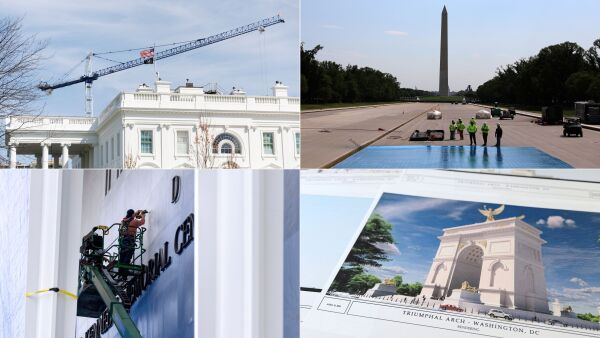
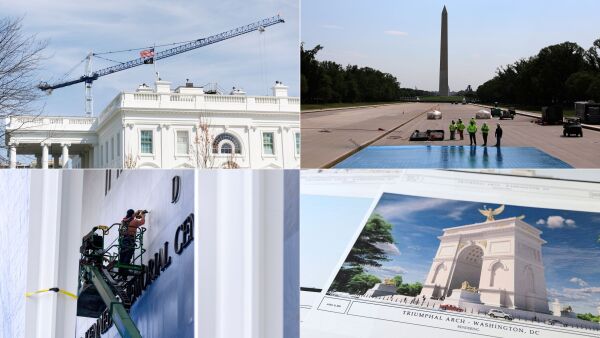
President Trump is looking to make his mark on the White House and Washington, D.C., and not just politically.
The longtime real estate developer has either announced or embarked on a number of construction and renovation projects across the nation's capital.
"I have two jobs," Trump said in late 2025, the presidency being just one of them. "I have a construction job, which is really like relaxation for me because I have been doing it my entire life."
Some of those changes are seemingly temporary, like the huge banners of Trump's face hanging from the Justice Department, Department of Agriculture and other federal buildings. Several concern the decor and aesthetics of the White House, like the paved-over Rose Garden and gilded Oval Office. Others are matters of nomenclature, like the addition of Trump's name to the signs on the Kennedy Center and U.S. Institute of Peace buildings.
But many of the efforts in progress could reshape D.C.'s architectural landscape for decades to come.
Neil Flanagan, an architect and public historian in D.C., says while Trump had aesthetic ambitions during his first term, his "insistence on making it so much about his own style and his own brand and wearing this glory of America's past is distinct to this term." Many of his initiatives are connected to the country's upcoming 250th anniversary in July.
"They all sort of declare the glory of America rather than actually building any kind of growth or future for America," Flanagan says. "If you're trying to slash the science budget … at the same [as you're] building these grand monuments, you're not building a creative America, you're wearing a great American past as a costume."
Flanagan says that compared to previous presidents, Trump is displaying less "deference to producing an outcome that matched with … previous plans and then also some level of subjective expertise."
Many of Trump's proposals have sparked backlash and legal challenges, even as federal planning agencies packed with administration allies move them forward. Congress could intervene, Flanagan says, but is unlikely to do so as long as both chambers are controlled by Republicans.
Scroll or click on an item below to see Trump's wide range of D.C. projects.
Reflecting pool | Golf courses | Sculpture garden | Statues | Arch | Ballroom | Kennedy Center | Executive Office Building| Lafayette Square | Federal architecture | Beautification
Reflecting pool

Trump is resurfacing the Lincoln Memorial Reflecting Pool, coating its gray bottom with a shade he described to reporters as "American flag blue."
The 2,030-foot-long reflecting pool has been the backdrop of marches, speeches and inaugurations for a century.
It last underwent a major renovation from 2010 to 2012, both for structural fixes (to address decades of leaking and sinking) and aesthetic improvements (it was intentionally made shallower). But the Department of Interior says the wrong-size pipes were installed, resulting in the continued need for expensive refills (71 million additional gallons, exceeding $1 million, in 2019 alone).
Trump has been talking publicly about fixing the pool since at least November 2025, but ramped up his efforts in April after what he described as complaints about the state of the landmark. He told reporters that he is working with one of his best "pool builders" from his real estate days, who talked him out of a turquoise shade "like in the Bahamas."
Flanagan says Trump is treating the pool, and the city itself, "like it's his personal country club."
"You get some pool guys and then they refinish it in a way that is more suitable to, basically, a swimming pool at Mar-a-Lago," he adds.
Trump said the project would cost less than $2 million — a fraction of what he said he had been quoted previously — and take one to two weeks. But the Department of the Interior told NPR it expects work to be completed "by the end of May."
Golf courses

The Trump administration is also fighting to take control of the district's three public golf courses, with a particular focus on the busiest one: East Potomac Golf Links in East Potomac Park.
Trump has floated the idea of redoing the courses to bring them up to championship level, telling the Wall Street Journal in December that "if we do them, we'll do it really beautifully." That's worrying local golfers, some of whom sued the administration in February. The Interior Department has told NPR that Trump is committed to keeping the course accessible, and affordability remains a priority.
All three municipal courses had been managed by the nonprofit National Links Trust. The Department of the Interior terminated the trust's 50-year lease in December, accusing the nonprofit of failing to fulfill all the terms of its lease, which it denies.
"Our commitment remains unchanged and we will continue to pursue our mission with the support of our community for as long as we are allowed," National Links Trust said at the time. "While the golf courses will remain open for now, unfortunately our long-term renovation projects will cease."
In the months since, White House ballroom crews have proceeded to dump dirt at the nearby century-old East Potomac Park course, piled high enough that it now obstructs views of the Washington Monument.
Over the weekend, the political publication NOTUS reported, citing unnamed sources, that the Trump administration planned to officially take over the East Potomac course on Sunday and begin renovations — including tree-clearing and landscaping — that could potentially shut it down.
National Links Trust said in a statement that the report "was a complete surprise to us," adding that it hadn't heard from the Department of the Interior or the National Park Service to that effect.
A fundraising brochure from an entity called the "National Garden of American Heroes Foundation," obtained by the Washington Post and Democracy Forward over the weekend, says the foundation will lead "the comprehensive redevelopment and restoration" of East Potomac, "reimagining it as a world-class public asset."
Citing that document and NOTUS' reporting, the nonprofit legal organization Democracy Forward filed an emergency request on Sunday for a court to block the administration from closing East Potomac or "undertaking any steps toward implementing the plan other than routine maintenance, and from dumping any additional fill from the East Wing project within East Potomac Park."
At a Monday hearing, a federal judge said the Trump administration must get court approval if it intends to cut down more than 10 trees. The National Links Trust told NPR over email that the golf course remains open for now, adding "we have made all of our short-term improvements while the facility has remained open for the last five years."
NPR has reached out to the Department of the Interior and White House for more information, but has not heard back.
National Garden of American Heroes
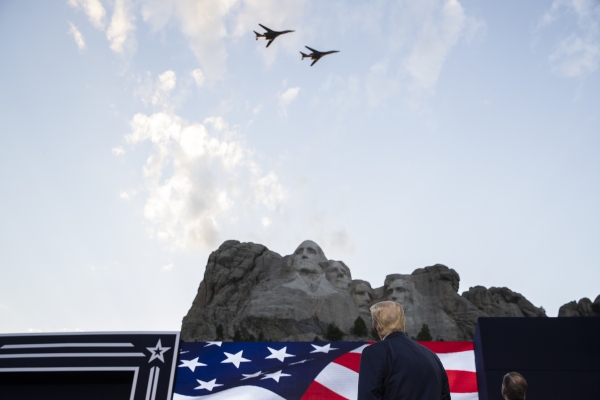
Trump first proposed the idea of a sculpture garden to "depict historically significant Americans" during a campaign rally at Mount Rushmore in July 2020, during the height of the widespread protests against racial injustice.
Those protests ushered in the removal of Confederate monuments across the country, something Trump pushed back against from the White House.
"When the forces of anti-Americanism have sought to burn, tear down, and destroy, patriots have built, rebuilt, and lifted up," read Trump's original executive order, which targeted a public opening date of July 4, 2026.
Just two days before leaving office in 2021, Trump released a list of nearly 250 names for inclusion, spanning a wide range of politicians, philosophers, musicians, artists, astronauts, movie stars, athletes and other historical figures. Among them: Kobe Bryant, Andrew Carnegie, Julia Child, Walt Disney, Frederick Douglass, Amelia Earhart, Ruth Bader Ginsburg, Whitney Houston, Ronald Reagan, Paul Revere, and Alex Trebek.
But Trump's first term ended without any congressional funding for the garden, and President Joe Biden quickly rescinded his orders.
Trump resurrected the project when he returned to office, though his January 2025 executive order changes its deadline from the U.S. semiquincentennial to "as expeditiously as possible." It's not clear when or where the garden will be erected, though signs point to the National Mall. The White House and Department of the Interior did not respond to a request for comment about its status.
South Dakota Republican Gov. Larry Rhoden offered Trump a plot of land last March within sight of Mount Rushmore. But Trump told the New York Times earlier this year that he was eyeing a spot in D.C., "right on the Potomac River … touching the golf course."
And the National Garden of American Heroes Foundation document obtained in early May says the garden will be located at West Potomac Park. It connects the golf course renovation and sculpture garden, calling them a pair of "landmark initiatives that embody its mission to honor America's 250th anniversary through lasting national investment."
The status of the statues themselves is also unclear. In April 2025, the National Endowment for the Humanities announced a grant program for sculptors totaling $30 million for some 150 recipients.
"Recipients will create lifelike statues in marble, granite, bronze, copper, or brass depicting specific historical figures tied to the accomplishments of the United States," the application reads. It says statues must be delivered by June 1, 2026, giving artists less than a year to finish.
Controversial statues

Trump has already added some new statues to D.C., honoring historical figures with controversial legacies.
A renovated statue of the Confederate Gen. Albert Pike was reinstalled in D.C.'s Judiciary Square in October, years after it was toppled during 2020 Black Lives Matter protests. His statue — the only outdoor monument honoring a Confederate general in D.C. — debuted in 1901 and has been contentious for years: D.C. Council members have called for its removal since 1992.
The National Park Service had previously announced plans to bring back the statue in line with Trump's 2025 executive order on "Restoring Truth and Sanity to American History." Among other things, it tasked the Department of the Interior with reinstating monuments that it found had been improperly removed since 2020 and making sure their descriptions do not "inappropriately disparage Americans past or living."
Pike, who was pardoned by President Andrew Johnson, has been identified by historians as possibly having been involved with the development of the Ku Klux Klan in the period after the Civil War. The plaque on the new statue doesn't mention that or even his military history, instead calling him an "author, poet, scholar, soldier, jurist, orator, philanthropist and philosopher."
In March, the Trump administration added a statue of Christopher Columbus to White House grounds, just outside the Eisenhower Executive Office Building. It's Trump's latest effort to honor the 15th-century explorer, whose legacy has tarnished due to the colonization, enslavement and violence against Indigenous people associated with his arrival in the Americas.
"In this White House, Christopher Columbus is a hero, and President Trump will ensure he's honored as such for generations to come," White House spokesperson Davis Ingle told NPR at the time. The statue is on loan to the White House through the end of Trump's term.

In late April, a statue of a man riding a horse, which had sat in storage in Delaware for years, appeared near the White House in Freedom Plaza.
That man is Caesar Rodney, a Delaware statesman best known for riding nearly 80 miles overnight, through thunderstorms, from Dover to Philadelphia on July 1, 1776, to cast a tie-breaking vote in favor of signing the Declaration of Independence. He did so despite being "gravely ill with a long-standing cancerous condition affecting his face and jaw that caused him chronic pain," according to the National Park Service.
"Rodney's journey has long stood as a symbol of personal sacrifice in service to the ideals of liberty," it says.
But Rodney's legacy is sullied by the fact that he enslaved more than 200 people on his family's plantation (though the National Park Service said he took "public action to abolish slave trading" within Delaware and freed some in his will). That's why his century-old statue was removed from downtown Wilmington, Del., in 2020.
The Washington Post reports his statue will remain on display for up to six months as part of the country's 250th birthday celebrations. When asked to confirm that timeline, a spokesperson for the Department of the Interior told NPR that "as we approach America's 250th anniversary, the Trump administration has been committed to celebrating and acknowledging the full breadth of our nation's history, including the story of Caesar Rodney and his pivotal ride in July 1776."
Triumphal arch

Trump is also moving ahead with plans for a 250-foot "victory arch" — in honor of the nation's 250th birthday — directly across the Potomac River from the Lincoln Memorial (of which it is more than double the height).
Renderings of the white-and-gold structure bear a striking resemblance to the Arc de Triomphe in Paris, if it were 100 feet taller and topped with two golden eagles and a winged, crowned figure.
Flanagan says the arch would be equivalent to 19 stories tall, whereas the typical building in D.C. is about 13 stories (federal law limits the height of buildings in the city in part to maintain the prominence of national monuments).
"And when you add the big statue on top, I think it's actually very difficult to understand just how enormous that thing will be, and very heavy," he says.
The Commission of Fine Arts, the federal agency packed with Trump allies, approved the plan earlier this month. Construction costs and timelines have not been publicized. But Flanagan says the enormity of the arch requires "very complex foundations" that alone will take significant time.
The arch has been met with opposition from some corners, including nearly all of the 1,000 public comments submitted prior to the commission's vote. The structure, which would be near the entrance to Arlington National Cemetery, is also the subject of a lawsuit by a group of Vietnam War veterans who argue it disrespects those buried there and requires congressional approval to proceed.
The White House says the towering arch will "enhance the visitor experience" at the cemetery, "serving as a visual reminder of the noble sacrifices borne by so many American heroes throughout our 250-year history so we can enjoy our freedoms today."
White House ballroom

Trump demolished the entire East Wing of the White House in October to make way for the ballroom he has dreamt of for over a decade.
The administration says the new 90,000-square-foot structure will increase capacity for guests at state dinners and other events, to the tune of at least $300 million. It has said that construction will be completed in 2028, but legal challenges have proven a roadblock so far.
The project drew ire from architecture and historical preservation groups, one of which sued the administration to prevent construction. That sparked an escalating legal battle, which has seen a federal judge twice order construction to stop unless authorized by Congress.
The judge did make an exception for infrastructure related to national security. That's a nod to the mysterious bunker beneath the East Wing that the Trump administration says is getting an upgrade, one of its main arguments in favor of continuing construction.
"The military is building a big complex under the ballroom, which has come out recently because of a stupid lawsuit that was filed," Trump told reporters in late March, adding that the ballroom "essentially becomes a shed for what's being built under."
The National Capitol Planning Commission approved Trump's ballroom plans even amidst the legal battle. As part of that process, it solicited feedback from members of the public — and got more than 30,000 written comments, largely in opposition.
"It's pretty rare that the National [Capitol] Planning Commission receives ten comments on a project," Flanagan said. "So to get that number and to get them almost overwhelmingly negative, I think, is a sign that at the very least, these things no longer represent Americans."
Kennedy Center renovations
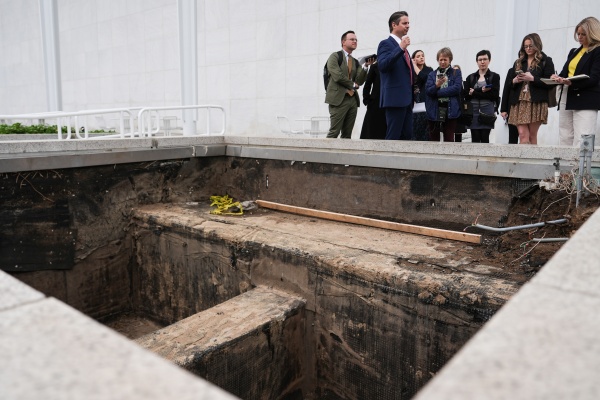
Trump has swiftly and systematically asserted control of the John F. Kennedy Center for the Performing Arts since taking office.
Last February he replaced its board members with his own allies, who promptly elected him board chair — prompting scores of artists to cancel planned performances in protest. Trump has been critical of the center, lamenting its physical disrepair, deriding its programming choices as "woke" and suggesting "maybe we close up some of the work that's been done … because it was done terribly."
In March, the Kennedy Center announced it would close in July for approximately two years to undergo a "comprehensive revitalization project." It said Trump had secured $257 million from Congress "to address decades of deferred maintenance."
A group of eight architecture and cultural organizations then sued the center, hoping to force it to comply with historic preservation laws and get congressional approval first. (The White House said in response it looks forward "to ultimate victory on the issue".)
Architectural plans have not yet been released. Trump has posted about turning the Kennedy Center into a "new and spectacular Entertainment Complex" and "World Class Bastion of Arts, Music, and Entertainment."
But others involved have described the renovation as a matter of infrastructure repairs. Kennedy Center officials led members of Congress and reporters on tours of the building in April to show water damage, outdated electrical equipment and other issues that they say justify the prolonged closure.
Eisenhower Executive Office Building

The Eisenhower Executive Office Building (EEOB) is the iconic French Second Empire-style building next door to the White House, containing office spaces for various parts of the president's team.
It was constructed in the 1870s and 1880s to house the growing staffs of the State, War, and Navy Departments. Its distinctive mansard roof, cast-iron details and granite columns reflected the optimism of the post-Civil War era, and stand out next to its neighboring neoclassical buildings.
That Maine granite has always been grey. Architecture groups say that was a deliberate design choice to highlight the stark white of the White House, which first got its lime-based whitewash in 1798 to protect its sandstone exterior during winter.
The Trump administration wants to paint the EEOB white, too.
"The color, design, and massing of the existing structure does not align visually with the surrounding architecture and lacks any symbolic cohesion with the White House," the Executive Office of the President wrote in a proposal to the National Capital Planning Commission for consideration at its May 7 meeting.
The Trump administration says the building's exterior has been stained by soot and grime, and has undergone only minor repairs, most recently in the early 2000s. Painting the facade, it says, will help with maintenance because it is "repeatable."
"The inability to bring the stone facade back to a baseline color has plagued the maintenance of the EEOB in the past, and will continue to plague it if not addressed," the proposal reads.
Preservation groups disagree — one of them, Cultural Heritage Partners, filed a lawsuit in November to try to halt the project. Nevertheless, the Trump administration presented its plan to the Commission of Fine Arts in April.
Around that time, the National Trust for Historic Preservation said in a letter to the Commission of Fine Arts that painting the building would irreversibly harm the landmark — by trapping moisture within the masonry — and likely require continued reapplication and cleaning, possibly on taxpayers' dime. It also says that, as a National Historic Landmark, the building's defining characteristics should be protected.
"The historic EEOB has been preserved, un-painted, since its completion in 1888," it said. "Painting the exterior now would obscure the EEOB's historic appearance, undermine its character-defining features, and accelerate the building's deterioration."
The Trump administration has said the specific kind of mineral silicate-based masonry paint it hopes to use — which Trump has called "magic paint" — would strengthen the stone and be easy to reapply, which dozens of preservation experts have disputed. Flanagan said that type of paint, which is really more of a stain, actually doesn't stick well on granite — "it would just come off."
"So they have to use some kind of epoxy or acrylic binder on it and they're going to have to sand or sandblast … the surface," he said. "I think that could honestly be one of those devastating cultural hits that this administration could do."
Lafayette Square
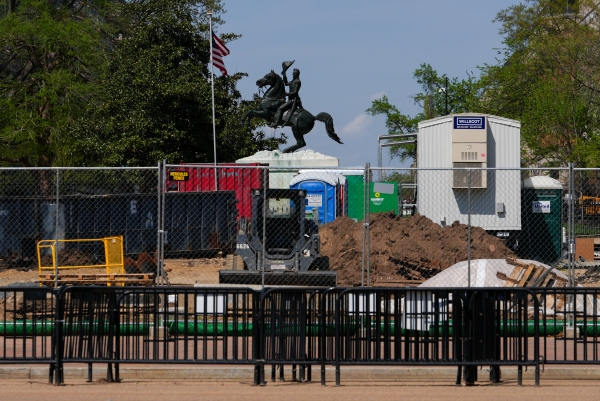
Lafayette Square, a 7-acre public park directly north of the White House, has been fenced off since January. The park is normally a high-traffic area for tourists snapping White House pictures, and a popular site for local protests — including the 2020 Black Lives Matter protests after the murder of George Floyd.
But much of the area is closed off for what the National Park Service calls "construction and turf renovation related to a major rehabilitation of Lafayette Park for America's semiquincentennial."
The park service says the project is slated to end on May 31 and involves installing irrigation lines, repairing historic fountains, installing new pumping systems and fountain vaults, replacing trees and turf, replacing benches and installing hardscape (like walkways) in some areas.
Trump told the New York Times earlier this year that he planned to replace Lafayette Square's brick walkways with granite, in part because of concerns that bricks could be thrown during demonstrations. He estimated the project would cost about $10 million, which he said would come from his own pocket.
The park service stresses that the closures are temporary, but necessary due to "concerns about security for construction equipment and prior vandalism associated with public protests in recent years."
Federal architecture

Trump has repeatedly signed orders promoting neoclassical architecture as the official style for federal buildings, during his first term and, after Biden revoked them, again in 2025.
On the very first day of his second term, Trump issued a memorandum directing the General Services Administration to "advance policies that ensure federal public buildings "respect regional, traditional, and classical architectural heritage in order to uplift and beautify public spaces and ennoble the United States and our system of self-government."
A few months later, he signed the "Making Federal Architecture Beautiful Again" executive order mandating that in D.C., "classical architecture shall be the preferred and default architecture for Federal public buildings absent exceptional factors necessitating another kind of architecture."
It defines classical architecture as encompassing the styles of neoclassical, Georgian, federal, Greek revival, beaux arts and art deco.
That's a shift from the brutalist and modernist designs of the mid-20th century, seen in federal buildings like the '70s-era FBI headquarters, which in 2023 topped a survey of ugliest buildings in the U.S. (FBI Director Kash Patel announced in December that the J. Edgar Hoover building will close permanently and the bureau will move to a more modern facility in D.C.)
Trump's architectural preferences are evident in the designs his administration has submitted for new projects like the triumphal arch and White House ballroom. But how his executive order will translate into renovations of existing federal buildings remains to be seen.
Flanagan says that such orders can easily be reversed by a future president, as they have been already: "The question is, will this discredit classical architecture for a generation?"
Flanagan says that within the architecture community, Trump's actions seem to have "reaffirmed the sense that classical architecture is associated with right-wing individuals," but he believes that everyday Americans have their own thoughts on D.C.'s aesthetics.
"It's some place that they were figuring themselves out in eighth grade [when] they came on a school trip, and it struck them and gave them certain thoughts about America or the sense … that this was connected to something," he adds. "People may have different views about what it is that is so offensive about Trump's changes."
D.C. beautification projects

A March 2025 executive order called "Making the District of Columbia Safe and Beautiful" aims to do so by creating a task force of federal agency officials aimed at "preventing crime, punishing criminals, preserving order, protecting our revered American monuments, and promoting beautification and the preservation of our history and heritage."
The order was the basis for Trump's federal law enforcement surge, including the ongoing deployment of National Guard troops to D.C. Other priorities include increased collaboration with immigration officials, restoring memorials, clearing homeless encampments and cleaning up parks.
Trump's proposed 2027 fiscal year budget, unveiled this month, includes a $10 billion "Presidential Capital Stewardship Program" for beautification and construction projects around the city, led by the National Park Service.
The federal government has already tackled some such projects, closing parts of some green spaces for things like grass restoration and fountain repairs. While some of those projects have been welcomed by residents, some have gotten pushback for making beloved city parks inaccessible for much of the spring and summer.
Copyright 2026, NPR