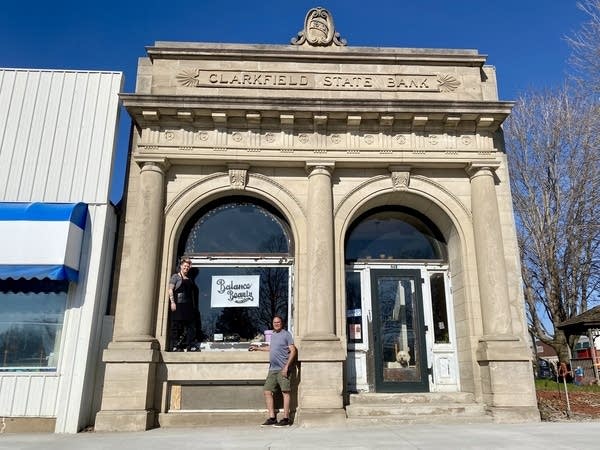
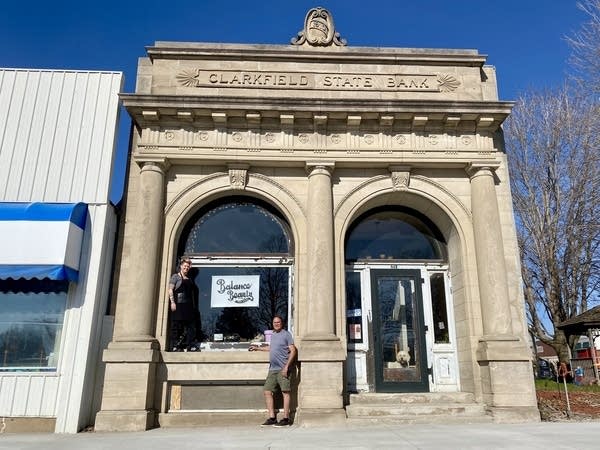
In the shadow of grain elevators in Clarkfield, a southwestern Minnesota town of some 900 people, a bank built 116 years ago sits transformed. What once was one of the town’s first financial institutions is now a creative space that invests in the local community.
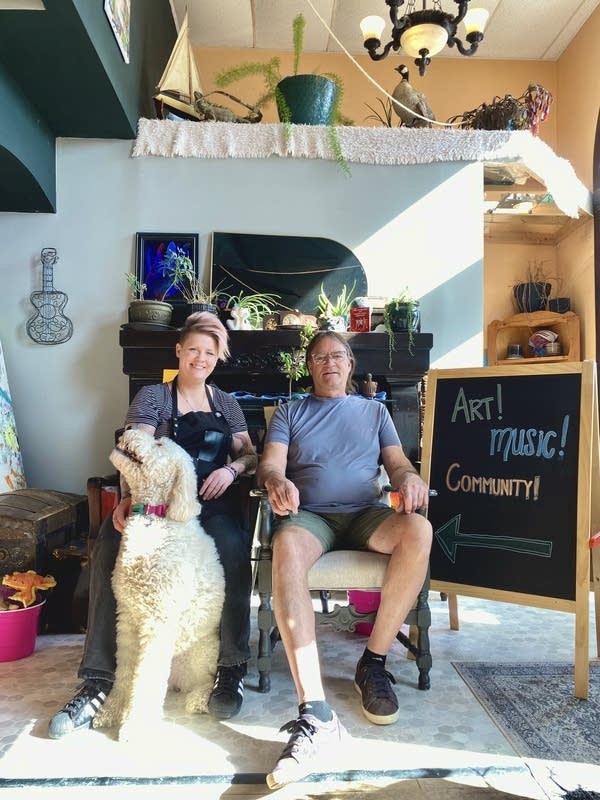
Clarkfield residents Betsy Pardick, Tim Pehrson and Ruby the dog walk the renovated space filled with sculptures, paintings, some taxidermy and remnants of the original Beaux-Arts building, like a hulking fireplace mantel.
Pardick, a hair stylist, said she learned to sheetrock for the project, and Pehrson said they had to fix up holes in the floor.
“You could have fallen through,” Pehrson said.
The Clarkfield State Bank is now the Clarkfield State Bank of Art. The renovated building features not only a salon for Pardick but also a stage, art gallery and space for art classes.
Southwest Minnesota is dotted with these emerging multi-use art spaces that utilize older buildings — a growing trend seen in rural and small-town communities across the state — challenging a common misconception that vibrant art scenes only exist in big cities.
Pardick, who is also an artist and musician, wanted to open the space because Clarkfield and the surrounding area has “a lot of creative people, but they just don't have a space or an outlet to go to do it.”
“It's a safe space to exercise your art or your ambitions,” Pehrson adds.
About 30 miles northwest of Clarkfield is the Madison Mercantile, which opened in 2021 in a former hardware store. The Mercantile, which has a gallery space for local artists, bills itself as “part-coffeehouse, part-creative space, part-small business incubator.”
Drive 14 miles east of Clarkfield, where farmland slowly gives way to the ancient rock of the Minnesota River Valley, and arrive at another arts hub: Granite Falls. The town of about 2,700 is home to the Granite Area Arts Council, operating out of the historic K.K. Berge Building, and a new art space called the YES! House.
“There should be spaces like this in every small town,” said Ash Hanson, a rural arts advocate. Hanson is the founder of the Department of Public Transformation, the rural arts nonprofit behind YES! House.
“We're a group of artists that came together and slowly made this happen, and we believe that lots of other artists have this same kind of dream and can make these things happen,” Hanson said.
The numbers: ‘It competes with sports’
In this corner of Minnesota alone, the arts and culture industries generated about $29.1 million in 2024, according to a report by MN Citizens for the Arts, a statewide arts advocacy organization, and the Southwest Minnesota Arts Council.
“The arts bring in millions and millions of dollars to communities,” Hanson said. “It competes with sports; it’s a big number.”
The report also finds that this region, as of 2024, is home to 119 arts and culture nonprofits, 3,217 artists and cultural workers and an audience of 279,319, including both local residents and visitors.
“Investing in the arts in rural communities not only can be an attractor for outsiders but help people who live here feel really psyched about where they live and not want to leave,” Hanson said.
Full (art) house
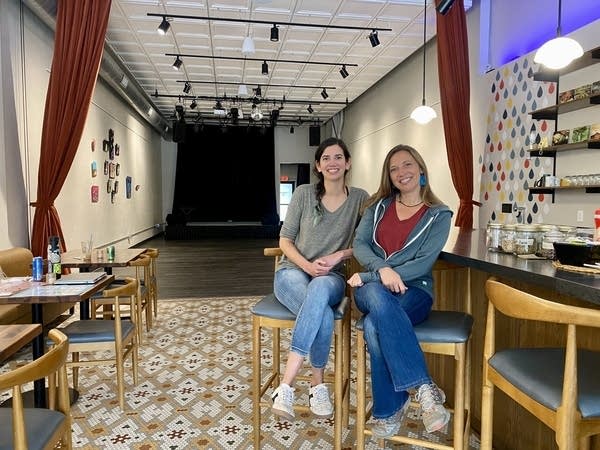
Much like the bank-turned-art-gallery in Clarkfield, the YES! House in Granite Falls had past lives. The building used to be a post office and, later, a drug store. The art space officially opened April 25 in a historic 1900s brick building, after 10 years of renovations and a $1 million capital campaign.
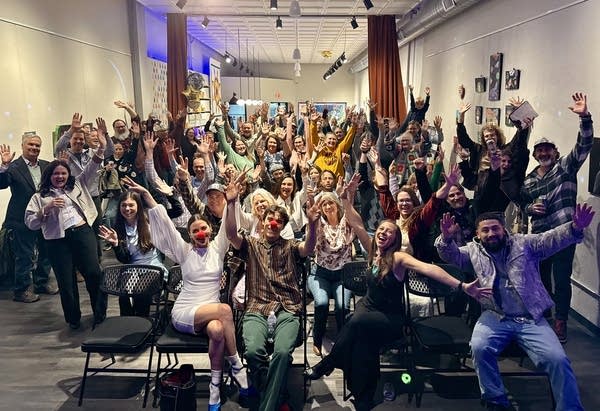
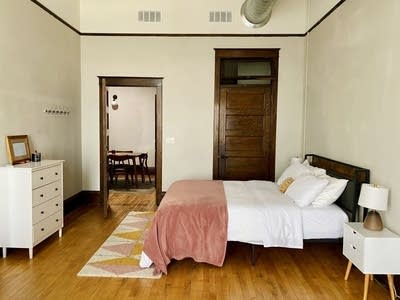
Luwaina Al-Otaibi, YES! House program director, gives a tour of the new space. The basement features a media lab, recording studio and workspaces. On the ground floor are gallery walls with a lighting and hanging system, a performance venue, a climbing wall and a cafe-style coworking space. The top floor features two fully furnished apartments for the artist-in-residence program, which hosts local artists as well as artists from across the region for two-week stints.
“The other day, we had the apartments full, stuff going on on the main floor and then a meeting in the basement,” Al-Otaibi said. “That was a moment for me, to have the whole building with people in it. And for me, it's really about the people.”
Even though the YES! House officially opened in April, the venue has been hosting events during the renovation process: theater productions, music readings, open mic nights, art exhibitions, sound bathing and yoga sessions.
Al-Otaibi said they’ve hosted about 150 visiting artists in the apartments since 2022, including Betsy Pardick of the Clarkfield State Bank of Art and local artist Nicole Brenny, both alums of the River Valley Ripple program for artists of southwest Minnesota.
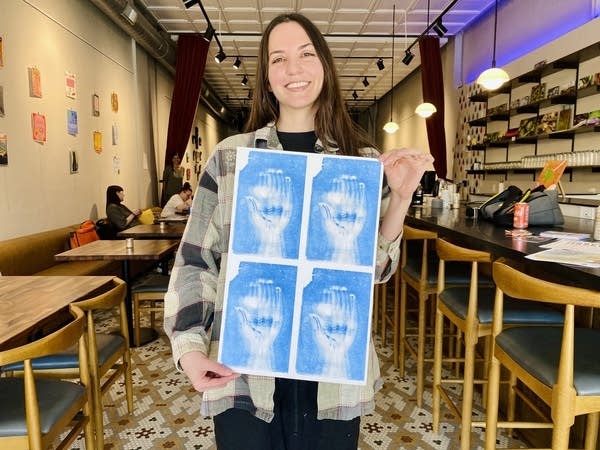
“The thing that was really life-changing for me on my artistic journey was the support,” Brenny said. She said the residency was one of her most prolific creative periods, making a short film and a stack of cyanotypes from photos she took in Chile where her grandmother grew up.
Being a rural artist can feel like “a creative vacuum,” Brenny said, but places like YES! House provide community and an “external motivating factor.”
Al-Otaibi said showing artists that it’s possible to stay in their communities and find support rather than leaving for bigger cities is key to the mission.
“It's a really vibrant ecosystem, and not just in Granite Falls, but in the region, of people having that craving to start creative spaces like this — like Betsy at the bank, or Madison Mercantile,“ Al-Otaibi said. “That's really important to be able to support our artists here and make them feel like there is an audience for it here, and that they are heard and wanted.”
“And, it’s more affordable to live and you can be really close face-to-face with your audience a lot more,” Hanson adds.
Say YES!
Hanson, who is from Aitkin County in north central Minnesota, is a theater artist herself, which is what first brought her to Granite Falls. In 2013, she helped produce “Paddling Theatre: From Granite Falls to Yellow Medicine,” a site-specific musical that spanned 8 miles of the Minnesota River and 11,000 years of the region's history, while audience members watched from canoes.
The production was so popular, they did several more, partly because of the support of longtime mayor Dave Smiglewski, Hanson said.
Smiglewski, who died in 2023, spoke to the University of Minnesota alumni association about the project at the time. “It’s not just about art; it’s about life here and enhancing our experiences as residents and citizens,” Smiglewski said. “We don’t have to look to other locations for entertainment and quality of life.”
“Mayor Dave Smiglewski was a huge advocate for this kind of work, and such a great supporter of place-based art,” Hanson said.
Hanson pushed for a small-town artist residency program and a network for rural artists across the country, which eventually became the Department of Public Transformation and the YES! House.
“What better place than the place that said yes to us. We wanted to say yes to Granite Falls,” Hanson said.
Community through art
YES! House is not the only organization in town with an artist residency program. The Granite Area Arts Council, which was established in 2008, has been hosting its own artists-in-residence for about five years, said council president Tamara Isfeld.
“What we lean into the most is building community through art,” Isfeld said.
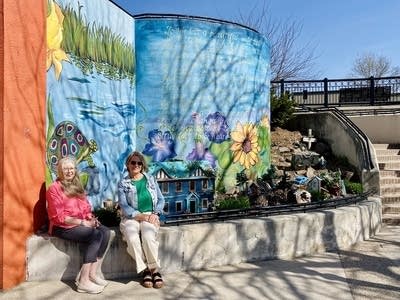
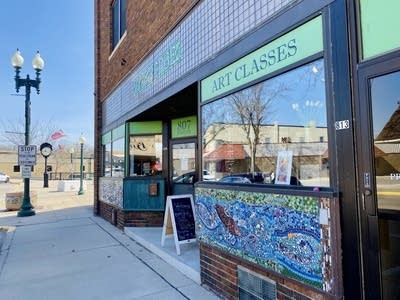
Isfeld looks out the window of the K.K. Berge Building, about a block from the YES! House. Below is the river and dam, where the town’s famous pelicans bathe in the April sun, and a riverwalk full of public art, murals and mosaics and a “fairy village” — community projects led by the council and Isfeld, who is also a local art teacher at Yellow Medicine East high school.
A few years ago, Isfeld started noticing a trend: Out-of-towners were coming to look at the public art.
“I was like, what?! That was something brand new, where public art was making an impact here in the little economy in Granite Falls,” Isfeld said.
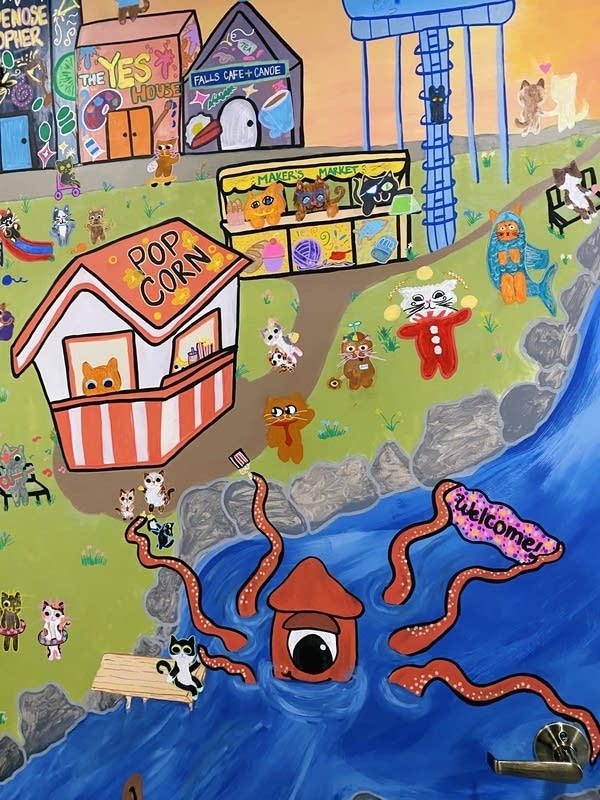
The council has a gallery, an “art lounge” full of art supplies, as well as a shop where more than 60 regional artists sell their wares on commission. They also do programming, including a recurring Makers Market and the artist residencies.
This year, the council’s artist residency program was selected as one of seven sites across the U.S. for the inaugural Transatlantic Rising Stars Project, a cultural exchange organized and funded by the European Union Delegation to the U.S.
“It’s the first of its kind. They wanted to bring artists into the United States as a cultural exchange to share with people in everyday walks of life what it's like to create art, what is it like to live in a community,” Isfeld said. “We feel pretty lucky.”
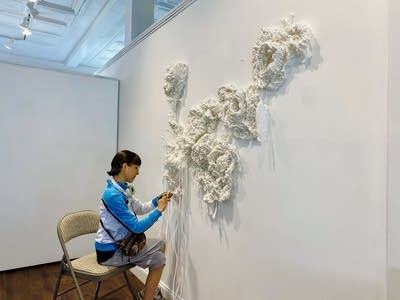
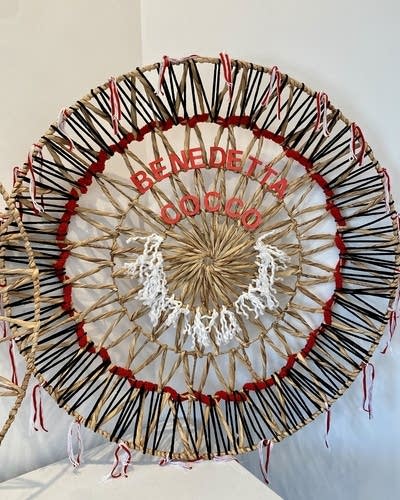
For the next three years, the council will host an artist from the European Union for two months. For 2026, that is Benedetta Cocco, a fiber artist from Sardinia, who arrived in Granite Falls on April 9 and will stay until May 29. Cocco has been collaborating with the community and local blacksmith artist Talon Cavender-Wilson.
They're creating a sculpture piece, and that will go to D.C.,” Isfeld said. In June, the artwork will go on display in Washington, D.C. for State of the Arts Night at the Eaton DC hotel. For the piece, Cocco asked community members to share small mementos that could be woven into a textile.
“I wanted to create a textile monument with the help of the community,” Cocco said.
Cocco said she immediately felt at home in Granite Falls.
“People are really cheerful and sunny,” Cocco said. “I really appreciate this kind of kindness and this kind of culture.”
Arts year-round, from SquidFest to haunted houses
Isfeld said there will be more artists-in-residence from around the region and nation arriving this summer and fall.
Clarkfield State Bank of Art will host an artist reception May 8 for their current artist on display, Krystl Louwagie of Marshall.
There will also be the annual SquidFest, a community-wide Granite Falls art festival, Aug. 15 at Memorial Park.
This summer, a new art space called Alma’s North Arts is slated to open in a renovated 19th-century church. Alma’s is a project of Sarina Otaibi, sister to Al-Otaibi and program director for the Activate Rural program at the Department of Public Transformation; it will be a partner of the arts council and provide lodging for artists-in-residence (Cocco is already staying there).
Come October, the Meander Art Crawl across the Upper Minnesota River Valley will have stops at more than 30 artist studios, and then there is the community- and artist-built haunted house at YES! House, which Al-Otaibi said is the biggest event of the year.
Hanson wants these spaces and events to foster an exchange with artists from bigger cities.
“What I would like the urban audience to know about rural artists is that we really see this as a two-way street,” Hanson said. “Visit some of these rural communities and connect with the local artists that live there.”