Historic homes, art centers and public works facilities were among the offerings available over the weekend.
MPR News joined a tour through one popular location: the Minneapolis Traffic Management Center.
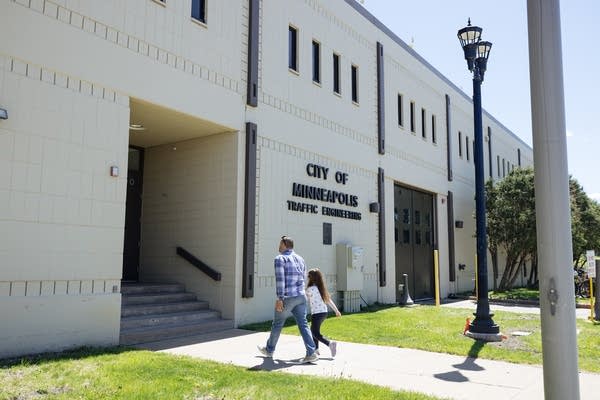
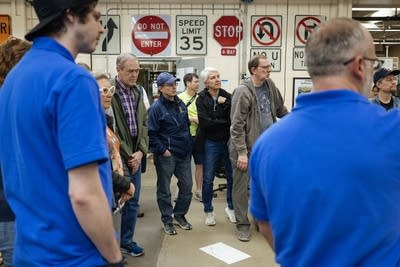
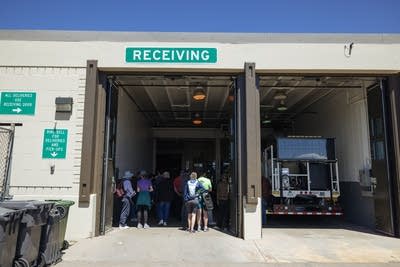
The Minneapolis Traffic Management Center was one of many public and private buildings open to the public during Doors Open on Saturday.
Carly Danek for MPR News
The Doors Open location competed with traffic from the Minneapolis Farmers Market across the street on Saturday morning. People of all ages packed the space despite sunny, warm weather outside.
There were eight stops.
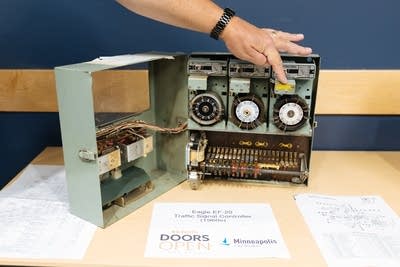
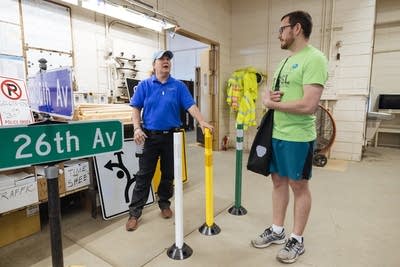
The first room had signalized controllers from across time, with TVs displaying photos of the center’s work. People posed with and explored traffic devices before the guided tour got started.
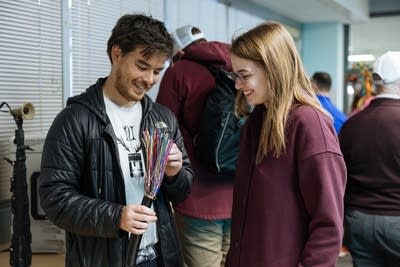
Joe Ling (left) and Katie Wright check out a cable on display at the Minneapolis Traffic Management Center during Doors Open event on Saturday. The two said they came to the event to learn more about how the city is run.
Andrea Monroy gets her photo taken by Jonathan Madera next to a traffic light and street sign at the Minneapolis Traffic Management Center during Doors Open on Saturday. The couple just moved to the city and saw the event as a good way to learn about their new home.
Carly Danek for MPR News
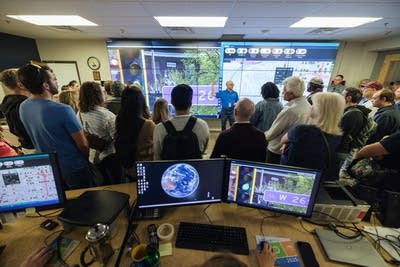
There are wall-sized screens in the control room where city employees keep an eye on every signalized intersection in Minneapolis. They typically work from peak-to-peak traffic hours but will come during big events to adjust traffic signal timing as needed.
Allan Klugman, director of parking and traffic services in Minneapolis, said Taylor Swift’s 2023 tour was the biggest event the division has managed traffic around.
The Director of Traffic and Parking Services, Allan Klugman, shows the public how the city monitors traffic lights at the Minneapolis Traffic Management Center during Doors Open on Saturday.
The Director of Traffic and Parking Services, Allan Klugman, shows the public how the city monitors traffic lights at the Minneapolis Traffic Management Center during Doors Open on Saturday.
Carly Danek for MPR News
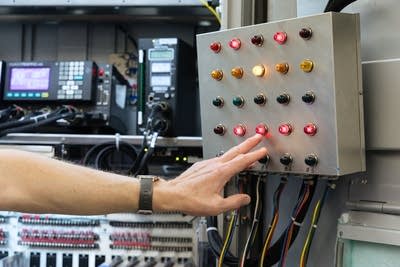
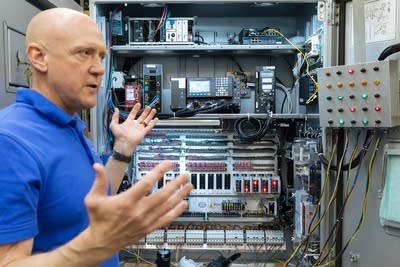
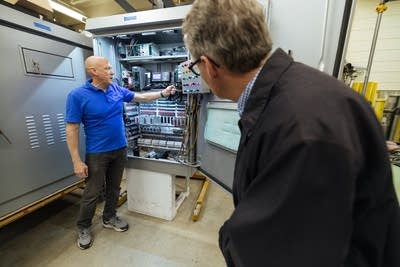
Down a few hallways is “the brains of the operation,” as an employee called it. Cabinets exist for every single traffic signal in Minneapolis — 820 in total.
Ryan Armstrong points to a panel that shows how the traffic lights work inside a signal cabinet at the Minneapolis Traffic Management Center during Doors Open on Saturday.
Ryan Armstrong shows off the insides of a traffic signal cabinet at the Minneapolis Traffic Management Center during Doors Open on Saturday.
Carly Danek for MPR News
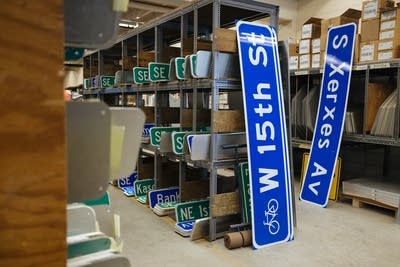
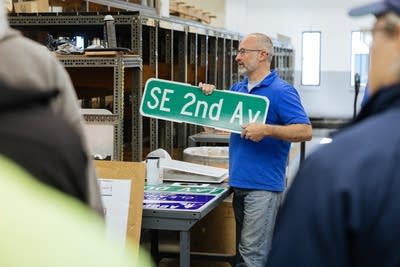
The sign shop makes every sign in the city. Shane Morton, who runs the shop, said there are 6,000 reported accidents a year and many involve knocked-down signs. Signs used to be made with vinyl, but that was labor-intensive. Now, they’re printed and applied onto aluminum.
The street sign library in the sign shop was one location open to the public in the Minneapolis Traffic Management Center during Doors Open on Saturday.
Members of the public learn about painting bike trails from Mike Lerach, a city painter, at the Minneapolis Traffic Management Center during Doors Open on Saturday.
Members of the public learn about painting bike trails from Mike Lerach, a city painter, at the Minneapolis Traffic Management Center during Doors Open on Saturday.
Carly Danek for MPR News
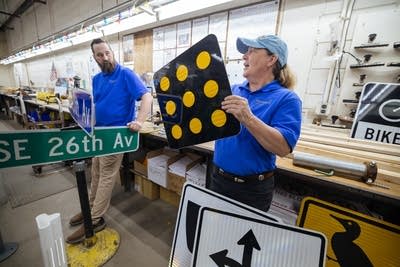
Gretchen Pederson and Dan Rooney are some of the people who install metal signs across Minneapolis with lift trucks. Citywide, there are more than 100,000 signs, both regulatory and directional — signs with street names.
The workers shared additional tidbits, such as a blue directional sign indicating a snow emergency street.
Crew leader, Gretchen Pederson (right), and Dan Rooney show off some of the street signs in the sign shop at the Minneapolis Traffic Management Center during Doors Open on Saturday.
Crew leader, Gretchen Pederson (left), talks about bollards with Shawn Grove, a city resident, who walked through the Minneapolis Traffic Management Center during Doors Open on Saturday.
Carly Danek for MPR News
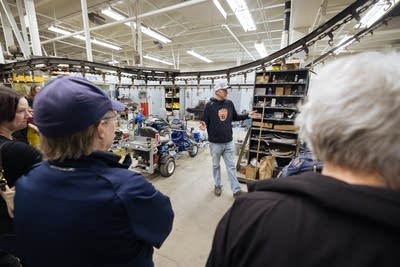
Dan O’Leary, city striping operations foreman of striping operations for the city, said the city uses a smart truck to paint road lines. He works from 9 p.m. to 7 a.m., using as much as 480 gallons of paint a night.
Dan Oleary holds cup of glass beads, which make street markings reflective, at the Minneapolis Traffic Management Center during Doors Open on Saturday.
Dan Oleary (right, by the truck cab) shows off the city’s newest striping truck at the Minneapolis Traffic Management Center during Doors Open on Saturday.
Carly Danek for MPR News
The last stop highlighted crosswalk painting. A new road might get thermoplastic which is melted into grooves and may last five years, according to Van Love, a lacquer varnish machine operator. Crosswalks are coated with glass beads to provide reflectivity.
Ewan Horn, 8, touches the glass beads that go on fresh paint to make street lines and crosswalks reflective at the Minneapolis Traffic Management Center during Doors Open on Saturday.
Red Lake Nation College announced Thursday that it received a $7 million unrestricted donation. It says the gift from philanthropist MacKenzie Scott’s foundation, Yield Giving, is the largest in the college’s history.
The tribal college has two campus locations — one in northern Minnesota and another in Minneapolis.
The school’s board and president say the school will invest the money into a permanent endowment fund, which they say will guarantee the school's financial stability well into the future — following Ojibwe teachings to visualize how today's decisions will impact the next seven generations.
“This is historic and this fund will end the poverty cycle for our college. The key is to put it all in a new fund, and let it grow and build, so we can get it to a point where we can use it to support us for anything we need,” said RLNC board chairman Delwyn Holthusen Jr.
Holthusen says the money in the endowment will only be used in “extreme emergencies.” If money were to be taken out, school leaders say it will be paid back with interest, to allow the fund to continuously grow over the next several decades.
Tight internal restrictions have also been placed on withdrawals. According to a press release, college board members must all agree to taking out funds from the endowment.
Chief Dan King is RLNC’s president. He says the endowment is the start to “ending poverty” for the college, which receives a quarter of its funding from private donations annually.
“I am so proud of our RLNC Board for having the courage and vision to look out for the long-term financial sustainability of our current and all future RLNC students,” King said.
After 35 years, the school estimates the endowment will reach $224 million.
Chandra Colvin covers Native American communities in Minnesota for MPR News via Report for America, a national service program that places journalists into local newsrooms to report on undercovered issues and communities.
To provide the best experiences, we use technologies like cookies to store and/or access device information. Consenting to these technologies will allow us to process data such as browsing behavior or unique IDs on this site. Not consenting or withdrawing consent, may adversely affect certain features and functions.
Functional
Always active
The technical storage or access is strictly necessary for the legitimate purpose of enabling the use of a specific service explicitly requested by the subscriber or user, or for the sole purpose of carrying out the transmission of a communication over an electronic communications network.
Preferences
The technical storage or access is necessary for the legitimate purpose of storing preferences that are not requested by the subscriber or user.
Statistics
The technical storage or access that is used exclusively for statistical purposes.The technical storage or access that is used exclusively for anonymous statistical purposes. Without a subpoena, voluntary compliance on the part of your Internet Service Provider, or additional records from a third party, information stored or retrieved for this purpose alone cannot usually be used to identify you.
Marketing
The technical storage or access is required to create user profiles to send advertising, or to track the user on a website or across several websites for similar marketing purposes.