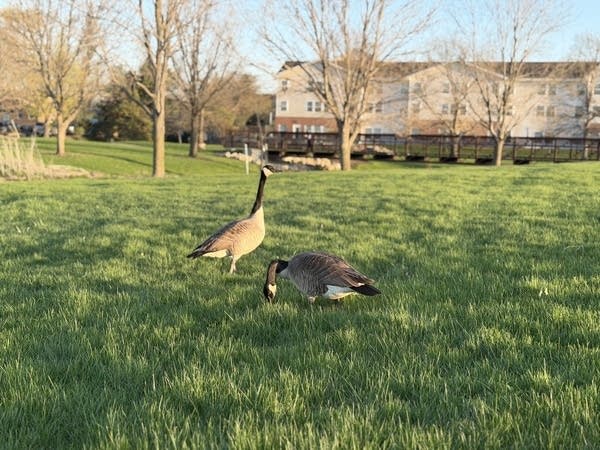
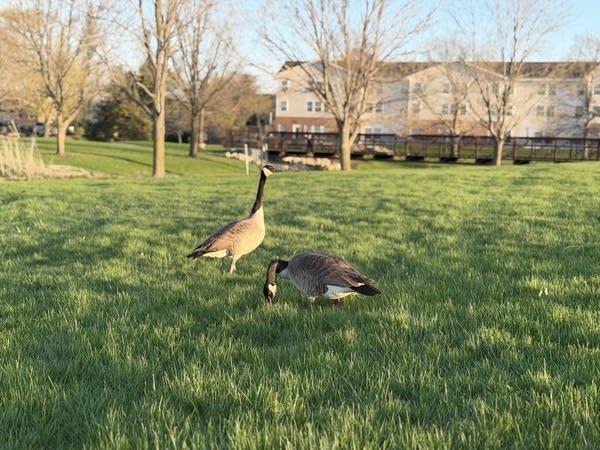
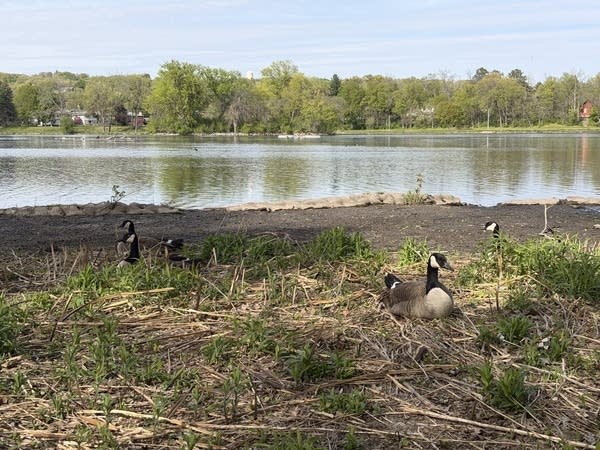
At Silver Lake in Rochester, you can’t miss the Canadian geese. They’re everywhere — in the park, in the water — and the nests dotting the shoreline hold the eggs of many more to come.
Rochester locals seem to have a love-hate relationship with the large, black and white waterfowl. Many residents shared fond memories of the geese with MPR News — of feeding them, listening to them honk on an early morning walk. Others complained of the birds’ aggressive behavior and goose poop littered across playgrounds and smeared all along the walking paths.
Rochester has been steadily trying to bring down the population count for years, and it seems to be working. Paul Widman, Rochester’s Director of Parks and Recreation, explained that the habitat in local parks can’t support the huge number of geese that are here.
“What we’re trying to do is create balance here,” Widman said. “Habitat balance to allow other species to come in. Get the vegetation to come back to life.”
But the effort is getting some pushback, as many Rochester residents see geese as a core part of the city’s identity.
‘They were just rampant’
Canadian geese are very common all across Minnesota; but few, if any places, have more than Rochester. In the 1920s, Mayo Clinic’s founder Charlie Mayo purchased some and brought them to his family estate, Mayowood. According to the Rochester Post-Bulletin, by the end of the decade, Dr. Mayo’s captive flock numbered in the hundreds.
Another reason Canadian geese were drawn to Rochester was because the Silver Lake Power Plant heated the 50-acre lake, giving it open water all winter long. So, for decades, migrating geese would stop in Rochester and stay year round, as there was no reason to fly farther south or return north in the spring.
By the 1960s, the flock at Silver Lake had grown to 4,000-5,000 birds.
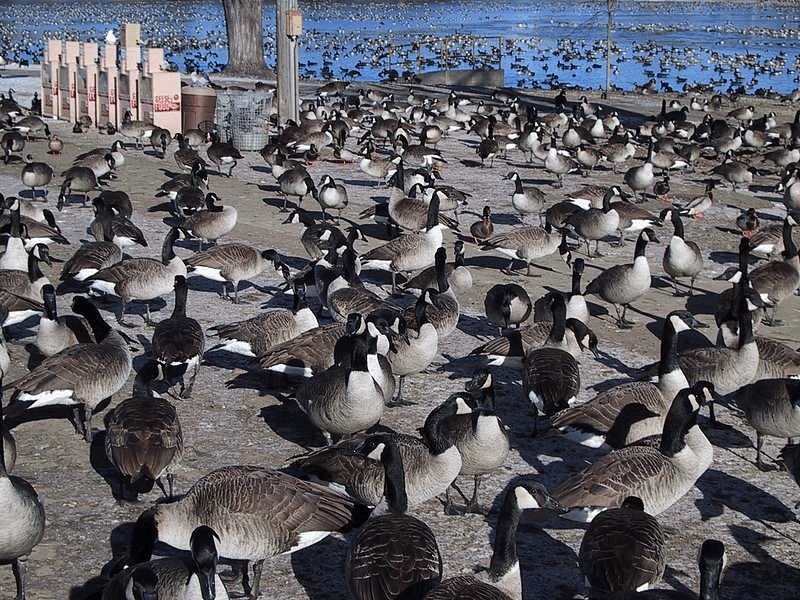
For a long time, the city embraced the waddling waterfowl, and it even added food dispensers. For a dollar, visitors could get a scoop of corn kernels to feed the feathered honkers.
“We had thousands of them coming in during that winter migratory season, like, ‘Hey, why should we go further south?’” Parks and Rec director Widman joked. “‘It's great right here. We got warm water. We got food. We got the city feeding us corn.’”
The Canadian geese came to be popular among the locals and became an unofficial city mascot. The local baseball team was even named the Rochester Honkers. But between the late 1970s and the mid 2000s, the population had grown out of control, with an estimated 20,000 to 40,000 making their home in Rochester.
Karen Kennedy, 64, recalled a harrowing experience bringing her granddaughter to Rochester’s Silver Lake Park about a decade ago.
"They were just rampant and they were surrounding her,” Kennedy said. “We have video of her screaming, hundreds around. And so we put her on top of the hood of our car."
The population has gone down significantly since then. The city got rid of the corn vending machines in 2007, and the power plant shut down in 2015. But Widman said there are still way too many geese for the local habitat to support.

The geese have few natural predators, reproduce frequently and efficiently and geese typically live for more than 10 years. And years of hunting and agricultural practices have created a much larger population of resident geese — those that no longer migrate. Widman said this is the group he’s most concerned about.
Since 2021, his department has been working on a strategy called “egg addling” to further reduce this population.
What is egg addling?
Egg addling, also known as nest management, is a strategy to prevent the goose eggs from hatching. Widman explained that they follow guidance from the Humane World for Animals, formerly the Humane Society, and that it’s a non-lethal way to manage resident geese.
Widman and his team spend these spring months tracking and visiting the nests across the city, most of which rim Rochester’s lakes. When they come across eggs, they either replace them with wooden dummy eggs or coat the eggs in corn oil, which cuts off the egg’s respiration and stops incubation.
If they took the eggs without leaving replacements, Widman said that the goose would simply create another nest and lay new eggs. He’s hoping the addling will slow the cycle of reproduction.
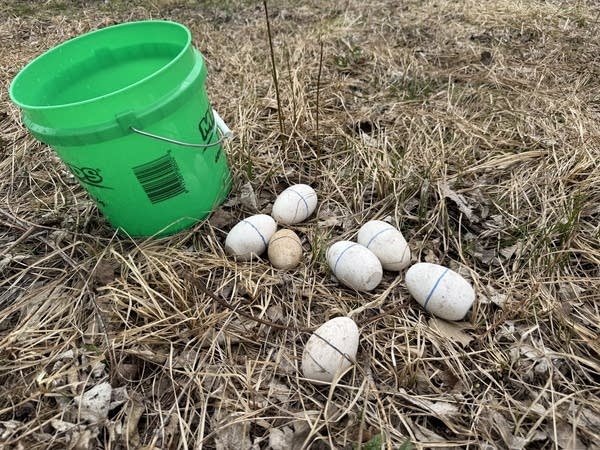
The goal is not to eradicate the bird entirely. In fact, at this point, that might not be possible. The city just wants to limit how many goslings hatch each year. The addling crews only treat nests once, so any eggs laid after that point will go untouched. And Widman said they don’t treat eggs that are past the halfway point in the incubation process, using a float test to determine the egg’s progress.
“What we want to see is the geese just aging out,” Widman said, “dying of natural causes and not having, you know, 300 goslings each year come in behind them.”
Widman says some cities have taken much more aggressive efforts like euthanizing adult birds in droves. Yet, even though Rochester is using this more humane alternative, he said the city is still getting push back from many residents.
Too many or too few
This is Rochester’s sixth year doing egg addling, but it’s still controversial in town.
Elise Pemberton was concerned enough to interrupt her walk and approach Widman while he was out at Silver Lake addling eggs. Pemberton, 72, has lived in Rochester for almost 50 years.
I remember when there were 20,000 geese on the lake, and that's too many.,” Pemberton said, “but, this is a park. It's not Disney World or a mall, and there’s going to be geese. I'm thinking of the balance of nature in this: How we can respect the geese and leave them with some sort of a nest with something in it? Because they like to have their babies like we like to have our babies.”
Widman talked with her for about 15 minutes, walking her through their strategy and answering her questions. The conversation seemed to assuage some of her fears, and she left with one of the department’s pamphlets in hand that details the egg addling process.
But at the end, Pemberton still stuck up for the geese.
“It gives people a lot of peace and solace to look at these geese and see the babies,” she told Widman and MPR News. “It makes you feel hopeful, well and happy.”
“Believe it or not, that's what we're trying to preserve,” Widman replied.
These types of conversations are fairly common, Widman said. And he also hears from people on the other side — those pushing for the city to take more aggressive efforts to limit the population.
But Widman said most Rochester residents seem to be coming around to accept the city’s approach. And he emphasized that just because the city is looking to control the population, it doesn’t mean that it doesn’t love the geese and value their presence.
“If you get here early in the morning and see the geese flying low over the lake, it's beautiful,” Widman said. “But the balance isn't there quite yet. We've got a growing population, crowding out the vegetation, crowding out other species. I believe we’ve reached a point where it would be just as cruel to do nothing.”