The tool that found me surprise flight credits this week


Multiple times this past week, I received a very exciting notification in my inbox: I’d earned a future flight credit … with almost no work on my part.

Here’s why that happened and how you can get in on it, too.

First, some background on why this matters now more than ever. It’s no secret that airfare prices are up in large part due to higher fuel costs.

Because of that, my usual advice on when to book flights has shifted a bit. These days, if I know I’m taking a trip and the fare is even remotely reasonable, I usually go ahead and book it — even if it’s too far in advance or a little more expensive than I’d prefer.

The upside of doing this is peace of mind. If prices keep climbing, at least my trip is secured. But traditionally, the downside to booking early is obvious: You risk overpaying if fares later drop.

This is becoming less of a risk, though, thanks to a growing number of fare-tracking tools that automatically monitor bookings after purchase. These tools track flights you’ve already booked and secure a future flight credit if the price drops.

I’ve been using a service called Junova to monitor the prices of several of my upcoming summer flights for a little while now. However, thanks to the general upward trend in airfare, none of the trips I had booked and forwarded to Junova had dropped in price … until this week.

Recently, I started receiving some exciting notices about future flight credits.

JUNOVA

At first, I was honestly confused because the credit notification from United arrived before the notification from Junova did.

Reward your inbox with the TPG Daily newsletter

Join over 700,000 readers for breaking news, in-depth guides and exclusive deals from TPG’s experts

But in the background, Junova had been monitoring the fare the whole time. Every time the price dipped below what I originally paid, I automatically received another future flight credit.
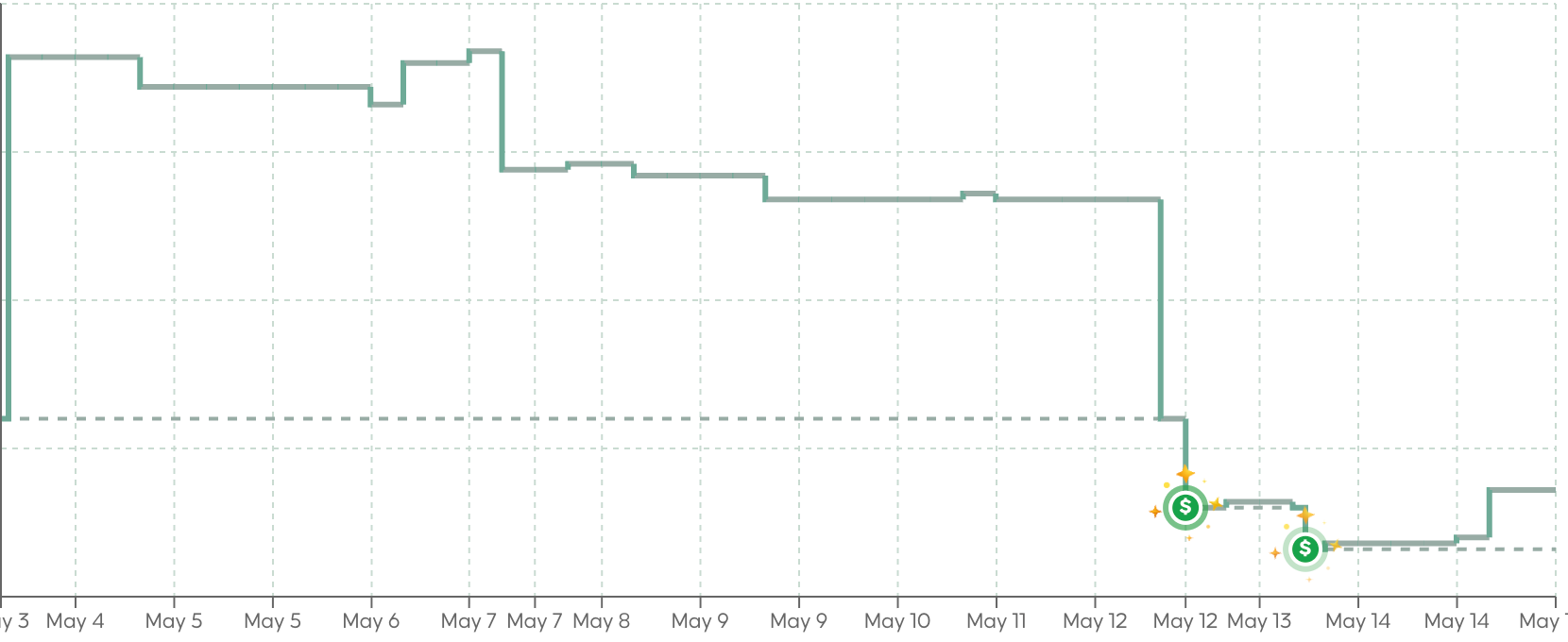
JUNOVA

After I received the flight credits, my seat selections were still there, and nothing discernible had changed about the flights at all — except for the fact that I received future flight credits to put toward my next booking.

JUNOVA

There’s no fee to try Junova as it only charges you if it finds savings for your flight. If it finds savings, then it charges a fee to your credit card equal to 20% of your savings. However, new users can get a $25 credit, meaning your first $125 in savings shouldn’t cost you anything thanks to that referral credit.

In a world where airfare feels increasingly unpredictable, tools like this can help take some of the sting out of booking early.

If prices rise, you’re protected because you already locked in your fare. And if prices fall? You may end up with a future flight credit without lifting a finger.


Source link

Leave a Reply

Subscribe to Our Newsletter

Get our latest articles delivered straight to your inbox. No spam, we promise.

Recent Reviews


What is Network Security?

The planning and implementation of network security procedures to preserve the integrity of networks and programs against hacking and illegal access is indeed a subcategory of information/cyber security. It defends the organization’s IT structure and network-accessible services against a wide range of cyber threats, including viruses, Trojan, spyware, spam ware, malware, and more. Network security includes user credentials, internet connectivity, firewalls, backups, and encryption. A network security professional’s goal is to make the system more secure by offering technical assistance using intrusion detection systems, encrypting, firewalls, and digital certificates, among other things.

Wish to make a career in the world of JNCIA? Start with JNCIA Training !

What is Cyber Security? 

Cyber security is a broad word that refers to all areas of the internet. It is a subcategory of data security that is concerned with defending the authenticity of systems, devices, and programs against assault, damage, or illegal access from the outside. It refers to a collection of approaches, technologies, and procedures for defending systems and networks from cyber-attacks. It protects networks against unwanted electronic access by putting in place a variety of security mechanisms and controls. All inbound and outbound network traffic is monitored by cyber security professionals to limit the danger of cyber assaults while also protecting the firm from unauthorized system use.

Wish to make a career in the world of Cyber Security? Start with Cyber Security Training! 

Cyber Security Training

  • Master Your Craft
  • Lifetime LMS & Faculty Access
  • 24/7 online expert support
  • Real-world & Project Based Learning

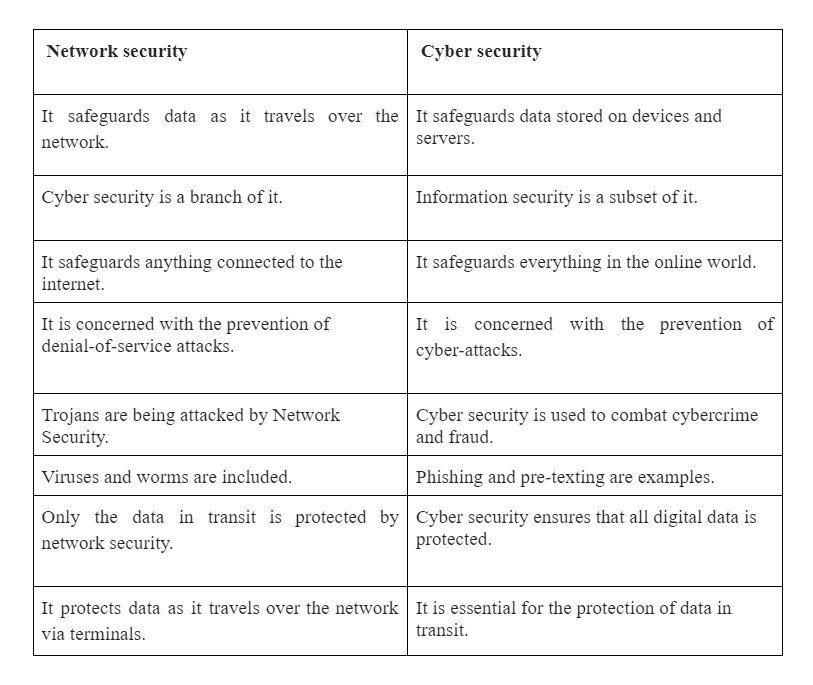
(Network Security vs Cyber security) Difference Between Both

1. Definition

Cyber security is a branch of information security that refers to a set of strategies and methodologies for preventing harm, attack, or illegal access to networks, devices, programs, and data. Cyber security, to put it simply, is the process of defending internet-connected devices and networks against digital threats. The process of safeguarding files and folders in a computer network from misuse, hacking, and illegal access to the system is known as network security. Network security is a subcategory of cyber security that guards against unwanted access to your system and network-accessible resources.

2. Security

While the phrases are interchangeable, they are vastly distinct in nature of security. If you see an organization as a walled castle, network issues are associated with keeping the peace within the castle walls and defending the organization’s sovereignty from network-related threats. Cyber security, on either hand, safeguards a company against external risks such as those posed by the internet. It defends an organization’s systems, networks, and applications against all types of digital attacks, such as phishing, baiting, and so on. The goal of network security is to secure an organization’s IT infrastructure from internet dangers such as viruses.

Wish to make a career in the world of Forescout Administrator ? Start with Forescout Administrator Training

3. Data

Network security becomes a component of cyber security, but cyber security is indeed a broad word like data security. While the authenticity of data and programs is the most important factor in both circumstances, cyber security emphasizes threat monitoring and detection to a higher extent. Network security is primarily concerned with protecting an organization’s IT network from the inside, while cyber security is concerned with protecting an organization’s information security technologies (ICT) against cybersecurity threats that exploit system weaknesses. Network security includes firewalls, user names and passwords, backup, and encryption.

If you have any doubts on Cyber Security, then get them clarified from Industry experts on our Cyber Security Tutorial !

Acquire Cyber Security certification by enrolling in the HKR Cyber Security Training in Banglore!

HKR Trainings Logo

Subscribe to our YouTube channel to get new updates..!

4. Security Expertise

Cyber security experts or analysts are those who, by their knowledge and experience of databases, firewalls, network security, and encryption, are fully responsible for defending network infrastructure and related systems. An expert in cyber security control, detection, and recovery is a cyber security professional. A security professional’s primary responsibility is to monitor all inbound and outbound traffic and to collaborate with other departments within the company to manage risk assessment tools and technology. A network security professional’s job includes securing the organization’s IT infrastructure, which contains data assets, financial data, and other confidential data

Network security and Cyber security

frequently asked Cyber security Interview questions and Answers !!

Cyber Security Training

Weekday / Weekend Batches

Conclusion

In brief, cyber security is an important part of information security dealing with data security during retention and transmission, while network security is indeed a subdivision of cyber security concerned with securing an organization’s IT infrastructure and limiting access to it. Both phrases are frequently used interchangeably, with the exception that cyber security is a much larger term, whereas network security is one component of information/cyber security.

Related Articles

  1. Cyber Security VS Data Science
  2. Cyber security Technologies


Source link