Steps You Need to Know About Making a Will


Most people don’t like thinking about what happens after they’re gone, but avoiding the topic doesn’t make it any less important. In fact, making a will is one of the most practical and responsible steps you can take to protect your loved ones and your assets.

Whether you’re just starting to build wealth or already have significant assets, understanding how to make a will ensures your wishes are honored. And contrary to popular belief, the easiest way to make a will today is more accessible than ever, thanks to digital tools and simplified legal processes.

This guide walks you through everything you need to know—from what a will actually is to how to create one step by step.


Affiliate

Stock Rover is an award winning investment research platform.

  • The site has 8,500+ stocks, 4,000 ETFs, and 40,000 mutual funds.


  • Access to 650+ metrics, financial data, market news, stock and fund ratings, fair value, margin of safety, etc.


  • Includes brokerage integration, portfolio tracking, rebalancing, watchlists, alerts, future income forecasts, etc.

Click here to try Stock Rover for free (14-day free trial).


What is A Will?

A will is a legally binding document that outlines how your assets, properties, and responsibilities should be handled after your death. It allows you to specify who receives what, appoint guardians for minor children, and name an executor who will carry out your instructions.

At its core, making a will gives you control. Without one, those decisions are left to the courts, and they may not align with your wishes. But if that’s not reason enough, here are more reasons why you should invest time and effort in creating a will.

Top 5 Reasons Why You Need a Will

First off, having a will isn’t just for the wealthy. It’s essential for anyone who wants clarity and protection for their family. It doesn’t matter if you have just a few assets or multiple properties to be spread across family members and relatives; a will helps save your family and relatives from the headache of dealing with the properties and assets you left behind.

1. You Decide Who Gets Your Assets

Without a will, your estate will be distributed based on local laws, not your personal preferences. This could mean assets going to relatives you didn’t intend to prioritize. By making a will, you clearly outline who inherits your money, property, and personal belongings. This eliminates confusion and ensures your wishes are followed.

The absence of a will often leads to lengthy legal processes, disputes, and additional expenses. Family members may disagree on how assets should be divided, causing unnecessary stress during an already difficult time. Learning how to make a will helps you avoid these complications and provides a smoother transition for your loved ones.

3. You Can Appoint Guardians for Minor Children

If you have children, this is one of the most critical reasons to have a will. Without clear instructions, the court will decide who takes care of your children. When making a will, you can name a trusted guardian, ensuring your children are raised by someone you choose.

4. You Minimize Delays and Expenses

A properly prepared will can speed up the legal process of distributing your estate. While it doesn’t eliminate all legal procedures, it significantly reduces delays and associated costs. The easiest way to make a will often includes using structured templates or legal services that ensure everything is properly documented, saving time later on.

5. You Gain Peace of Mind

Perhaps the most overlooked benefit is peace of mind. Knowing that your affairs are in order allows you to focus on living your life, rather than worrying about the unknown. By understanding how to make a will, you remove uncertainty for both yourself and your family.

How to Make A Will

So, how do you make a will? Where do you start?

If the process sounds intimidating, it doesn’t have to be. Breaking it down into clear steps makes making a will much more manageable. We’ve outlined those steps for you:

Step 1: List Your Assets

Start by identifying everything you own. Items like real estate, bank accounts, investments, personal valuables like jewelry and vehicles… This step ensures nothing is overlooked when distributing your estate.

Step 2: Decide Who Your Beneficiaries Are

Determine who will receive your assets. This can include:

  • Family members
  • Friends
  • Charities

Being specific is key. Clearly outline what each person will receive to avoid ambiguity.

Step 3: Choose an Executor

An executor is responsible for carrying out your will. Choose someone trustworthy, organized, and capable of handling legal and financial matters.

Step 4: Appoint Guardians (If Applicable)

If you have minor children, name a guardian who will take care of them. This is a critical part of how to make a will, as it directly impacts your children’s future.

Step 5: Draft the Will Document

You can create your will in several ways:

  • Hiring a lawyer
  • Using online will-making platforms
  • Writing it yourself (if legally valid in your jurisdiction)

For many people, the easiest way to make a will is through reputable online services that guide you through the process step by step.

Step 6: Sign the Will with Witnesses

Most jurisdictions require at least two witnesses and/or witnesses who are not beneficiaries. Their role is to confirm that you signed the will voluntarily and were of sound mind.

Step 7: Store Your Will Safely

Keep your will in a secure but accessible location, such as a safety deposit box, a trusted legal office, or a fireproof safe at home. And, of course, make sure your executor knows where to find it.

Important Things to Consider

  • Update your will regularly: Life changes like marriage, divorce, or new children require updates
  • Avoid vague language: Be as clear as possible
  • Understand local laws: Requirements vary depending on your location

Taking these steps ensures that making a will is not only easy but also legally sound.

What if You Die Without A Will?

Dying without a will—known as dying “intestate”—can create serious complications. Your assets will be distributed by law. Instead of your personal wishes, local laws determine who inherits your estate. This may not reflect your intentions. Another thing is that family disputes may arise. Without clear instructions, disagreements between family members are common. These disputes can strain relationships and lead to costly legal battles.

One of the most concerning issues is that guardianship decisions will most likely be left to the court. If you have minor children, the court will decide who becomes their guardian and this decision may not align with your preferences. Not to mention the whole process will take longer and incur legal fees, especially when you have lots of properties to be distributed. 

Conclusion

Thinking about end-of-life planning isn’t easy, but it’s one of the most important steps you can take to protect the people you care about. Making a will ensures your wishes are respected, your loved ones are supported, and your assets are distributed according to your intentions.

The good news is that the easiest way to make a will today is simpler than ever. With clear steps, accessible tools, and a basic understanding of how to make a will, you can put a solid plan in place without unnecessary stress. It’s not about expecting the worst, it’s about being prepared for it. And that preparation can make all the difference.

Related Articles on Dividend Power


Here are my recommendations:

Affiliates

  • Simply Investing Report & Analysis Platform or the Course can teach you how to invest in stocks. Try it free for 14 days. 


  • Free Dividend Kings Spreadsheet from Sure Dividend, complete with Buy/Hold/Sell recommendations, dividend histories, and much more. It is an excellent resource for DIY dividend growth investors and retirees.


  • Stock Rover is the leading investment research platform with all the fundamental metrics, screens, and analysis tools you need. Try it free for 14 days.


Receive a free e-book, “Become a Better Investor: 5 Fundamental Metrics to Know!” Join thousands of other readers !


*This post contains affiliate links meaning that I earn a commission for any purchases that you make at the Affiliates website through these links. This will not incur additional costs for you. Please read my disclosure for more information.


Tammy Danan

Tammy is a journalist and creative content writer with over 10 years of experience. Driven by curiosity, her work explores how digital marketing, SaaS, and varied creative pursuits intersect with everyday life.She focuses on creative storytelling and tackles how the search for a more meaningful life is changing the way we work.Tammy will meow at all stray cats, and won’t start the day without an iced Spanish latte.



Source link

Leave a Reply

Subscribe to Our Newsletter

Get our latest articles delivered straight to your inbox. No spam, we promise.

Recent Reviews


Salesforce Vlocity Tutorial – Table of Content

What exactly is Vlocity?

Vlocity (Salesforce Sectors) provides pre-built Salesforce solutions to meet the needs of specific industries which require CRMs that are significantly customized beyond Salesforce’s out-of-the-box state. Vlocity, which was founded in 2014, swiftly established itself as an “industrial cloud” pioneer, receiving 3 Forbes Cloud 100 honors in 2017, 2018, & 2019. What factors aided them in achieving such quick success?

What is Vlocity

Vlocity applications (based on the Salesforce platform) provide multichannel sales, advertising, servicing, and CPQ solutions to specific industries like Communications, Health coverage, Energy and Utilities, Financial Services, Multimedia, Healthcare, and Public Sector.  The secret to success is straightforward. Companies profit from pre-built flows and procedures that would otherwise take several months (& millions) to construct custom.  Salesforce purchased Vlocity in 2020. Salesforce has been able to include Vlocity’s industry-specific CRM systems in its current Salesforce Industries offerings as a result of the acquisition. Vlocity’s creator David Schmaier maintained his position as CEO of Salesforce Enterprises, a corporate unit in charge of establishing clouds for new verticals, following the rebranding.

What is Salesforce Industries, and what does it do?

Salesforce had a step up on the latest vertical solutions after acquiring Vlocity. In general, the 12 existing industry clouds are making progress inside the Vlocity apps. These add to Salesforce’s existing data model and give out-of-the-box services which reflect their industry’s language.

Two often used “clouds” are, for example:

Organizations gain all the tools and apps they need to develop subscription services, handle orders, quotations, and contracts in an agile manner with Media and Communications Clouds.

Financial Services Cloud: Provides a consolidated system with a unified customer’s perspective of their policy, financial information, and claims to support the banking, financial advisory, and insurance markets.

Marketing, sales, commercial agility, and also operating efficiency, are all enhanced by these clouds, which reduce time to value.

Salesforce Industries

What is Salesforce Vlocity, and how does it work?

Salesforce Vlocity is the hottest innovation on the Salesforce platform, which is the industry’s leading provider of industry-specific solutions and software. It stands out as a worldwide forerunner in Customer Relationship Marketing, transforming the total customer experience (CX) (CRM). Vlocity also aids in the comprehension of the CMT, healthcare, and insurance realms. Salesforce Vlocity also has a lot more to offer, such as Lightning Web Omnichannel processes, Integration processes, Vlocity Actions,  Tracking services, Data Migration, and so on. Salesforce Vlocity also improves CPQ and guided selling. Salesforce Vlocity is a trailblazer, enabling a slew of top and up-and-coming businesses to achieve their goals through its Omnichannel processes.

Become a Salesforce Vlocity Certified professional by learning this HKR Salesforce vlocity training !
 

Salesforce Vlocity Training

  • Master Your Craft
  • Lifetime LMS & Faculty Access
  • 24/7 online expert support
  • Real-world & Project Based Learning

What are the different Salesforce Vlocity components?

  • Vlocity Insurance– To process all components of the insurance, Vlocity employs Microservice Architecture. Financial Service Cloud is intended to function with Vlocity Insurance.
  • Vlocity Media& Entertainment– This section contains a comprehensive industry solution for ad sales and subscriber sales in order to strengthen consumer and owner relationships.
  • Industry Cloud for Communications in Vlocity Communications aids in providing a consistent and individualized client experience.
  • Vlocity Health– Companies could use a Vlocity specialized device called Vlocity Health to run all of the sections relating to the health industry.
  • Vlocity Energy & Utilities is responsible for a number of industry-specific apps that allow the sale & service of a wide range of commodities and non-commodities.

Vlocity Benefits Salesforce in What Ways?

As a result of this collaboration, industry-specific solutions have become a key component of the platform’s capabilities. Salesforce has improved its adaptability over time, seeking to meet any industry issue. Nonetheless, one stumbling block remains unsolved: IT complexity. Consider a company with a complex IT stack, including some in-house applications. It will take a long time and a lot of money to replace it with a centralized platform. To enable end-to-end business processes, consultants and developers must customize the system, align, and merge apps. 

This is where Vlocity comes in. Vlocity adds enterprise product catalogs (EPCs), customer relationship management (CRM), order processing, and digital commerce to Salesforce, and also pre-built methods and new models. The software is developed in strict accordance with industry standards established by organizations such as the TM Forum as well as the MAF. As a result, businesses are able to go live more quickly. They teach their employees and may eventually be self-sufficient, saving money on consultants and developers.

Top 30 salesforce Vlocity Interview questions & answers for freshers & experienced professionals

Cloud Technologies, salesforce-vlocity-tutorial-description-2, Cloud Technologies, salesforce-vlocity-tutorial-description-3

Subscribe to our YouTube channel to get new updates..!

Overview of OmniStudio

OmniStudio is a modular framework that allows you to easily develop Salesforce flows and solutions using standard click-based components. 

OmniStudio

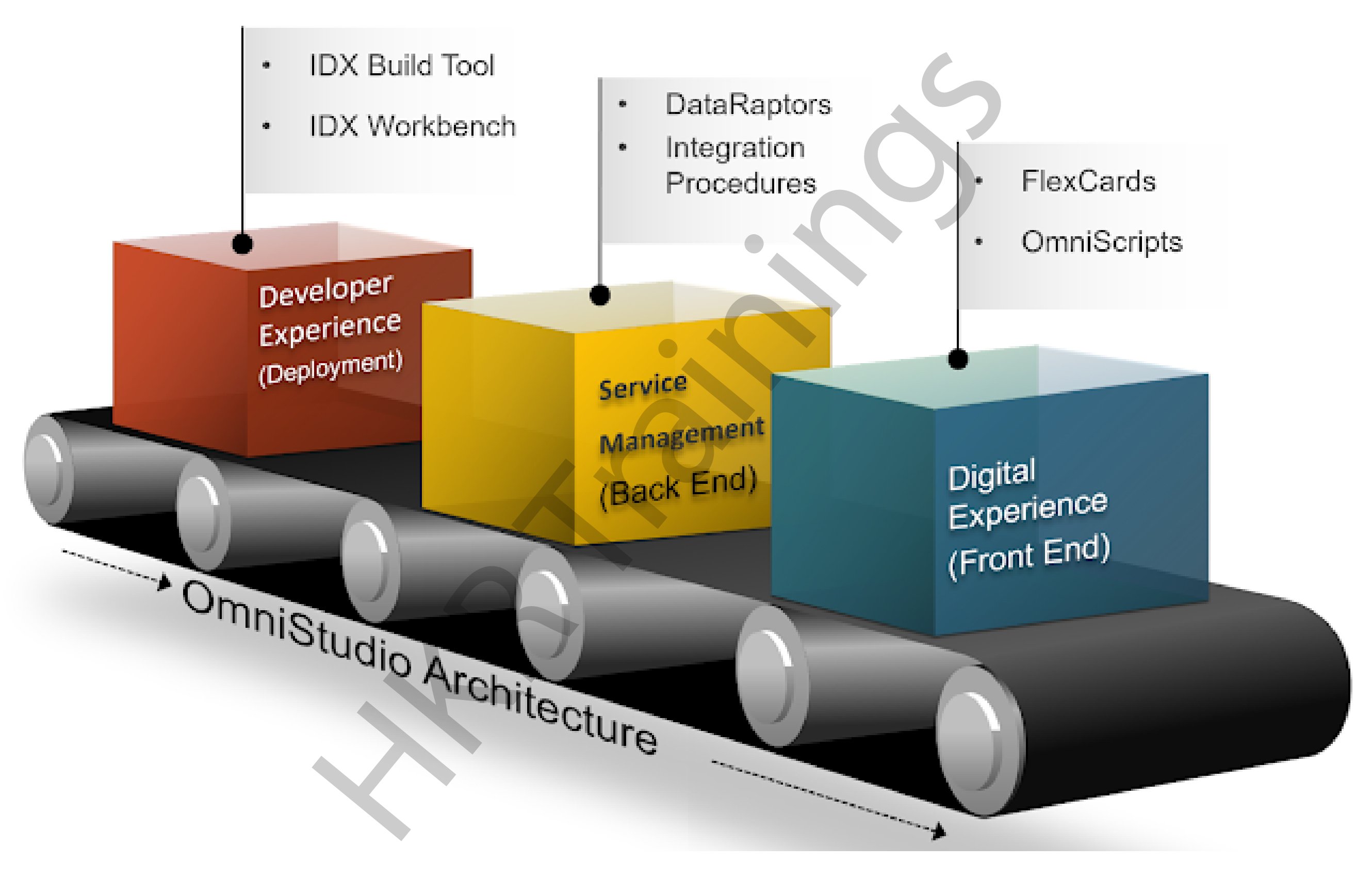
The architecture of OmniStudio is made up of three layers:

Digital Experimentation : 

This is the User Interface Engine. It contains all of the user interface elements that can be selected and dragged toward the action area. We must choose the appropriate component depending on business requirements. The back-end layer’s entry point is this layer. To conduct any operation, simply connect the back-end components to the components. This UI Engine gets separated into two categories once more:

FlexCards :

Flexcard is an alternative if you really want to display multiple data in less space. Flex cards have been used to display data at a glance. This is a drag-and-drop tool that allows you to quickly configure, preview, and troubleshoot a screen. FlexCards present and summarise contextual information and actions from Salesforce and third-party platforms.

Omniscripts : 

OmniScript is being used to give users a guided path through the business processes. That implies you can show multiple screens in a row. We may create pages quickly and effortlessly with the assistance of OmniScript, which is a drag-and-drop application. This is also entirely programmable, allowing it to be tailored to specific requirements. Another omniscript can be called from one omniscript. You may use OmniScripts to create sales, service pathways, and other business operations.

Service Management : 

Backend logic & data are handled by this layer. By using integrations, Service Management may read and write data via Salesforce and other external sources.

It is divided into two sections:

1. OmniStudio Dataraptors :

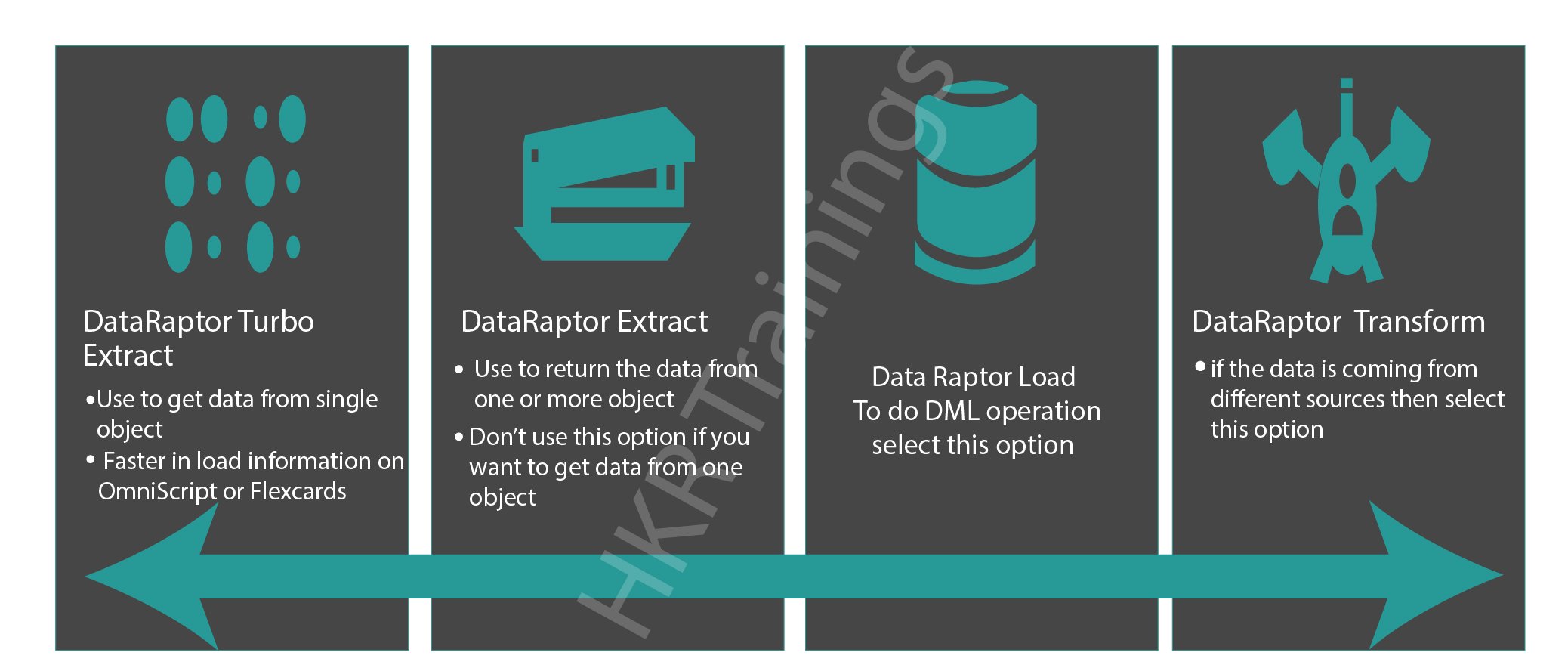
DataRaptors are used to retrieve, transform, and update information. They are used to perform data-related operations such as reading, writing, and transforming data from external sources. There are four parts to DataraptorsOmniStudio Dataraptors

  • DataRaptor Turbo Extract: As the name implies, this program is used to extract information from a data object. This component has the most efficient data retrieval speed. This option should be used if the need on your page would be to return just a single item.
  • DataRaptor Extract: Most of the time, we need to work with several objects on a page; in this situation, vlocity gives us this alternative. Use DataRaptor Extract to return many objects.
  • DataRaptor Load: This component is used to update the information in Salesforce.
  • DataRaptor Transform: Whenever your data isn’t solely in Salesforce and you’d like to retrieve it and display it in Omniscript/flex cards, use DataRaptor Transform.

2. OmniStudio Integration Procedures

To carry out such tasks, this instrument is quick and dependable. You can use Integration Procedures to retrieve data from third-party services.

Developer Experience

OmniStudio Data packs can be managed with the IDX Build Tool. IDX Workbench seems to be a desktop program for transferring Salesforce information and Data packs. In conclusion, like custom programming, OmniStudio provides simple shortcuts and greater reuse chances for adapting the industry-oriented solution to your specific needs.

However, there are several disadvantages to be aware of right now:

  • Many clouds are combined within one common functionality by industries. As a result, it’s difficult to tell if a certain feature is part of the current implementation.
  • Since all clouds & APIs receive information in one bundle, updates do not even have a defined structure.
  • Errors and platform constraints have limited support.
  • Vlocity’s data model and functionalities are best suited for enterprises at the enterprise level. Some argue that it’s inappropriate again for the SMB market, because not only does it need a greater budget, but it also leaves small-medium firms with capabilities they don’t want and won’t utilize.

Do you want to learn more about Salesforce Vlocity? Watch this Demo video now:


What are FlexCard Actions?

FlexCard Actions can be used to start or modify an OmniScript, connect to a website page or app, show a flyout, launch an event, or change the values of data fields. FlexCards can do the following actions:

  • Card — Load, modify data source, or erase cards at the card level. 
  • Event
    Custom — To alert the main FlexCard of an occurrence, fire a Custom Event.
    PubSub — To alert another element on a website or app of an event, fire a PubSub Event.
  • Flyout – In a modal or popover, show extra details from such a child card, OmniScript, as well as a custom Lightning web component (LWC).
  • Navigate — Choose a targeted URL or a PageReference type that allows you to navigate inside Lightning Experience, across Communities, to another website.
  • OmniScript — Use the FlexCard to launch an OmniScript.
  • Update OmniScript – Update an OmniScript from a FlexCard incorporated as a customized Lightning web component inside an OmniScript.
  • OmniScript Action – Update any OmniScript from a FlexCard integrated as a customized Lightning web component in an OmniScript A reusable OmniStudio Action can be used to launch OmniScripts, elements, websites, or external programs. The same OmniScript can be launched from numerous FlexCards using an OmniStudio Action.

Salesforce Vlocity Training

Weekday / Weekend Batches

Conclusion

To summarise, Vlocity achieved a breakthrough by offering businesses such an architectural foundation tailored to their industry. Salesforce’s acquisition signaled the company’s transition to industry-specific products that are easier to tailor and onboard users. For such a quicker digital transformation journey, firms can use the current Salesforce Industry clouds, which offer a configurable data model and a reliable version with reusable solutions. 


Source link