Xfinity Customers Still Have Time to Claim a Part of Comcast’s $117.5M Data Breach Settlement


A cyberattack exposed the personal information of approximately 36 million Xfinity customers in October 2023. Now, Comcast has settled a class-action lawsuit related to the hack, agreeing to pay $117.5 million to people affected by the breach. The settlement is open for claims, and if you’re a current or former customer who received a breach notification from Comcast in December 2023, you may be eligible for a flat cash payment of around $50, or up to $10,000 if you can document losses tied to the breach.

The deadline to file was initially Aug. 14, but it has since been extended to Sept. 14, 2026. Members of the settlement class who neglect to file a claim or dispute the settlement by the new September date will lose their right to take independent legal action against Comcast regarding this cybersecurity incident.

When Comcast notified users of the breach (PDF) in December 2023, the company admitted data thieves stole usernames, passwords, names, contact information, dates of birth and the last four digits of Social Security numbers. 

In a class action lawsuit, Hasson v. Comcast Cable Communications LLC (PDF), customers alleged that Comcast was responsible for financial damages and for the time spent pursuing identity theft protection related to the breach. While Comcast denied any wrongdoing, it reached a preliminary settlement in January 2026, agreeing to pay $117.5 million to 36 million affected customers.

The official settlement website is now live, although payments won’t begin until after the court’s final approval hearing. That hearing is currently scheduled for Aug. 5.

If you qualify for a settlement payout, you can file on the website now. You need a unique settlement member ID number included within the initial online communication sent to affected Comcast customers to file the claim.

Read more: The $135M Google Data Settlement Site Is Live. See if You’re Eligible

You have multiple options if you don’t want to file a claim. If you object to the agreed-upon settlement, you can write to the court or ask permission to speak at the final approval hearing. 

You can also opt out of the settlement, which will allow you to retain your right to separately sue Comcast in relation to this data breach. If you don’t file a claim by Sept. 14 or opt out of the settlement by July 1, you will lose out on payment from this settlement and lose the right to pursue further legal action. If you fill out a physical claim form, it will remain valid so long as it is postmarked by the filing deadline.

As part of the settlement, Comcast must pay for and provide identity defense services to any affected member of the class action suit. Unlike the settlement payouts, affected customers who do not file a claim will also be able to apply for the identity defense services. Anyone who opts out of the settlement will not be eligible for those services.

Representatives for Comcast and the law firm Lynch Carpenter LLP, which served as lead counsel for the plaintiffs, did not immediately respond to a request for comment.

Who can be part of the Comcast settlement?

Not every Comcast customer is automatically eligible to claim part of the settlement payout — the money is reserved for people whose personal information was accessed during the 2023 data breach.

In order to join, you must meet these three qualifications:

  1. Be a living individual human being in the US or its territories.
  2. Used Comcast services during the October 2023 data breach.
  3. Received a notification of being affected by the Comcast data breach.

While the court is scheduled to hold a final approval meeting on Aug. 5, those affected can file a claim on the official settlement website until Sept. 14. The approval meeting’s time and date have changed once already, and are subject to change again. Any updates will be posted on the website.

While some class action suit settlements pay out a lump sum to affected customers who don’t file a claim, that is not the case for Hasson v. Comcast Cable Communications LLC. You must file a claim and provide a payment method by the deadline to be compensated as part of the settlement.

How much will the Comcast settlement pay?

The amount of money each claimant will receive will be proportional to the out-of-pocket losses or lost time you can prove you incurred as a result of the data breach. 

The total payment for each claimant is capped at $10,000 and is affected by the total pool of settlement money and the number of affected customers who file a claim.

If you don’t want to go through the process of proving out-of-pocket losses or lost time are connected to the data breach, you can instead choose to accept an alternative cash payment of $50. The alternative cash payment is subject to change depending on the total number of claimants.

A third of the settlement money ($39.2 million) is earmarked to pay attorneys’ fees, subject to court approval. After this amount is paid out, the remaining settlement money will be divided among the settlement members who submitted the claim form before the deadline.

Whether you’re claiming restitution for out-of-pocket losses, lost time or accepting the alternative cash payment, you must file by Sept. 14. Payments will be distributed after the final approval hearing, assuming there are no appeals.


Source link

Leave a Reply

Subscribe to Our Newsletter

Get our latest articles delivered straight to your inbox. No spam, we promise.

Recent Reviews


What is Network Security?

The planning and implementation of network security procedures to preserve the integrity of networks and programs against hacking and illegal access is indeed a subcategory of information/cyber security. It defends the organization’s IT structure and network-accessible services against a wide range of cyber threats, including viruses, Trojan, spyware, spam ware, malware, and more. Network security includes user credentials, internet connectivity, firewalls, backups, and encryption. A network security professional’s goal is to make the system more secure by offering technical assistance using intrusion detection systems, encrypting, firewalls, and digital certificates, among other things.

Wish to make a career in the world of JNCIA? Start with JNCIA Training !

What is Cyber Security? 

Cyber security is a broad word that refers to all areas of the internet. It is a subcategory of data security that is concerned with defending the authenticity of systems, devices, and programs against assault, damage, or illegal access from the outside. It refers to a collection of approaches, technologies, and procedures for defending systems and networks from cyber-attacks. It protects networks against unwanted electronic access by putting in place a variety of security mechanisms and controls. All inbound and outbound network traffic is monitored by cyber security professionals to limit the danger of cyber assaults while also protecting the firm from unauthorized system use.

Wish to make a career in the world of Cyber Security? Start with Cyber Security Training! 

Cyber Security Training

  • Master Your Craft
  • Lifetime LMS & Faculty Access
  • 24/7 online expert support
  • Real-world & Project Based Learning

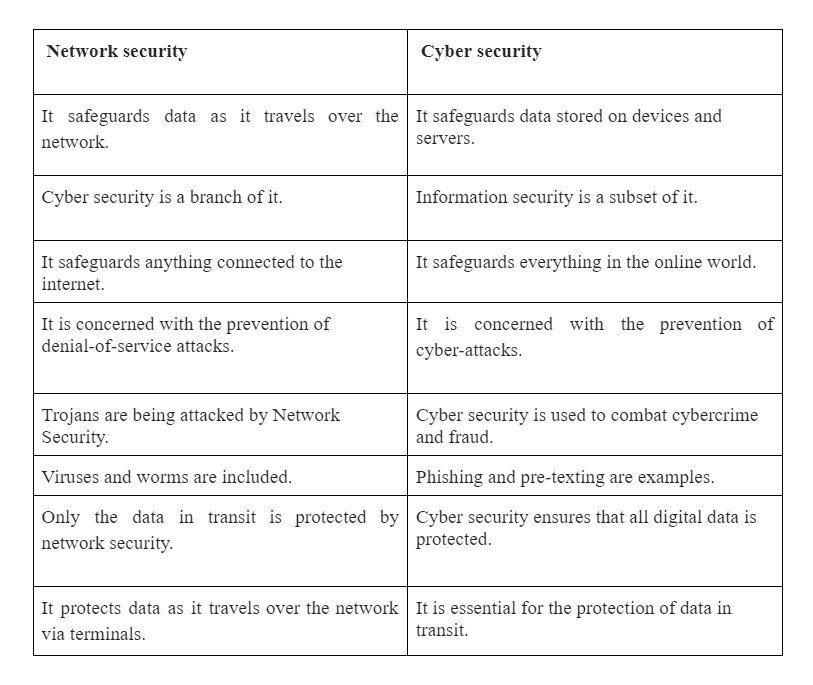
(Network Security vs Cyber security) Difference Between Both

1. Definition

Cyber security is a branch of information security that refers to a set of strategies and methodologies for preventing harm, attack, or illegal access to networks, devices, programs, and data. Cyber security, to put it simply, is the process of defending internet-connected devices and networks against digital threats. The process of safeguarding files and folders in a computer network from misuse, hacking, and illegal access to the system is known as network security. Network security is a subcategory of cyber security that guards against unwanted access to your system and network-accessible resources.

2. Security

While the phrases are interchangeable, they are vastly distinct in nature of security. If you see an organization as a walled castle, network issues are associated with keeping the peace within the castle walls and defending the organization’s sovereignty from network-related threats. Cyber security, on either hand, safeguards a company against external risks such as those posed by the internet. It defends an organization’s systems, networks, and applications against all types of digital attacks, such as phishing, baiting, and so on. The goal of network security is to secure an organization’s IT infrastructure from internet dangers such as viruses.

Wish to make a career in the world of Forescout Administrator ? Start with Forescout Administrator Training

3. Data

Network security becomes a component of cyber security, but cyber security is indeed a broad word like data security. While the authenticity of data and programs is the most important factor in both circumstances, cyber security emphasizes threat monitoring and detection to a higher extent. Network security is primarily concerned with protecting an organization’s IT network from the inside, while cyber security is concerned with protecting an organization’s information security technologies (ICT) against cybersecurity threats that exploit system weaknesses. Network security includes firewalls, user names and passwords, backup, and encryption.

If you have any doubts on Cyber Security, then get them clarified from Industry experts on our Cyber Security Tutorial !

Acquire Cyber Security certification by enrolling in the HKR Cyber Security Training in Banglore!

HKR Trainings Logo

Subscribe to our YouTube channel to get new updates..!

4. Security Expertise

Cyber security experts or analysts are those who, by their knowledge and experience of databases, firewalls, network security, and encryption, are fully responsible for defending network infrastructure and related systems. An expert in cyber security control, detection, and recovery is a cyber security professional. A security professional’s primary responsibility is to monitor all inbound and outbound traffic and to collaborate with other departments within the company to manage risk assessment tools and technology. A network security professional’s job includes securing the organization’s IT infrastructure, which contains data assets, financial data, and other confidential data

Network security and Cyber security

frequently asked Cyber security Interview questions and Answers !!

Cyber Security Training

Weekday / Weekend Batches

Conclusion

In brief, cyber security is an important part of information security dealing with data security during retention and transmission, while network security is indeed a subdivision of cyber security concerned with securing an organization’s IT infrastructure and limiting access to it. Both phrases are frequently used interchangeably, with the exception that cyber security is a much larger term, whereas network security is one component of information/cyber security.

Related Articles

  1. Cyber Security VS Data Science
  2. Cyber security Technologies


Source link