
After completing Turkish Airlines’ six continents challenge last year, I’ve been looking for ways to redeem my 1 million Miles&Smiles miles on long-haul business-class flights at promotional rates.
When possible, I’ve been trying to book award flights on Turkish Airlines’ A350-900 or 787-9 aircraft, as these offer newer seats and business-class cabin configurations with all-aisle access. In comparison, Turkish Airlines’ other long-haul planes have older seats and cabin configurations that don’t provide direct aisle access to every business-class passenger.
All this to say: When award space from Istanbul to Johannesburg opened for 75,000 miles plus $218 on dates that worked for a trip to South Africa that I had planned and on an A350-900, it was an easy choice. Of course, you can also look for award availability through other Star Alliance programs, such as United MileagePlus and Air Canada Aeroplan.
Here’s what the Turkish A350-900 experience was like on this long-haul flight and my main takeaways.
The lounge was very busy
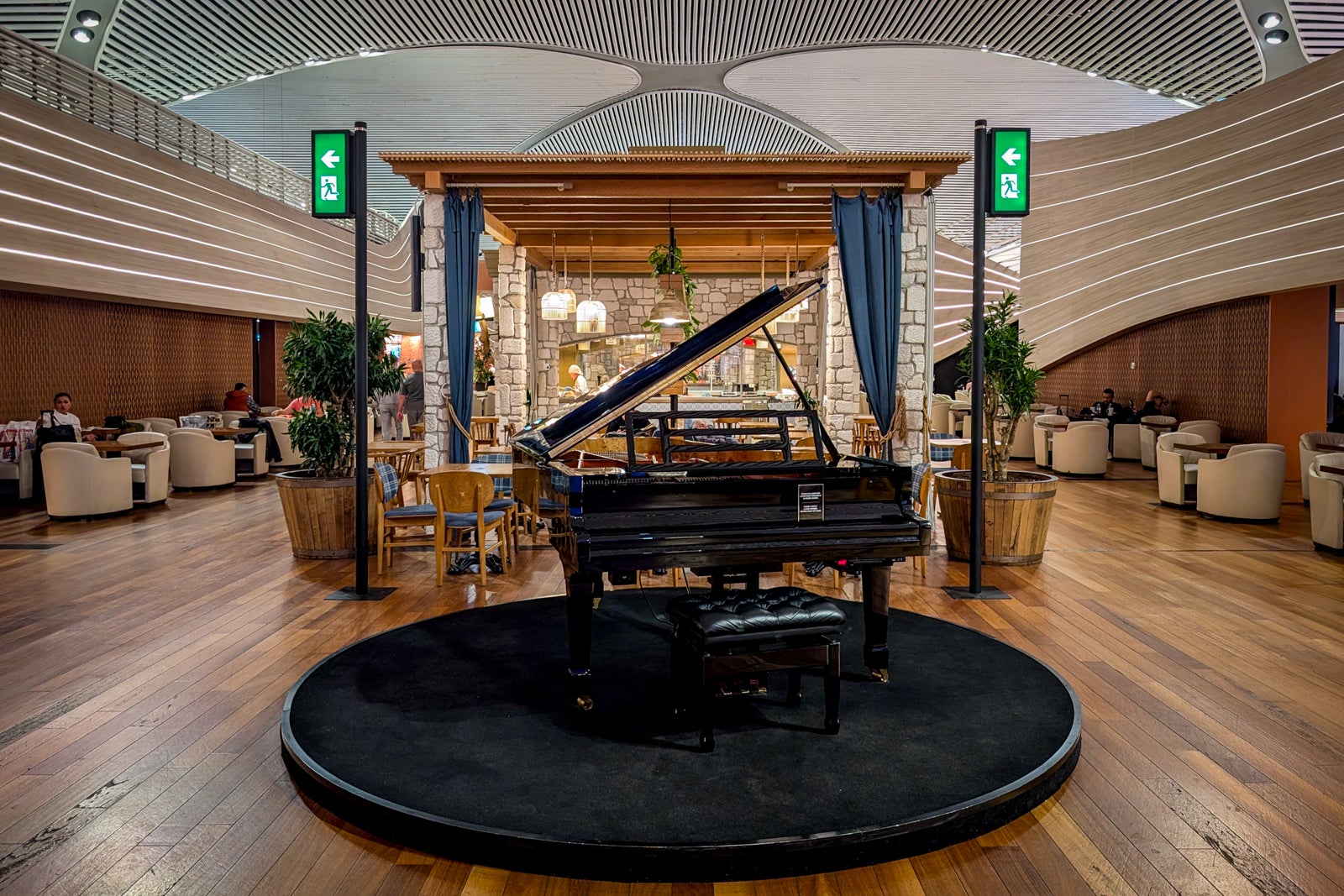
Turkish Airlines operates two 60,000-square-foot lounges in Istanbul: the Miles&Smiles Lounge for elite-status travelers and the Business Lounge for business-class passengers.
As a Turkish Elite member flying business class, I had access to both. Since the two are nearly identical, I opted for the Miles&Smiles lounge.
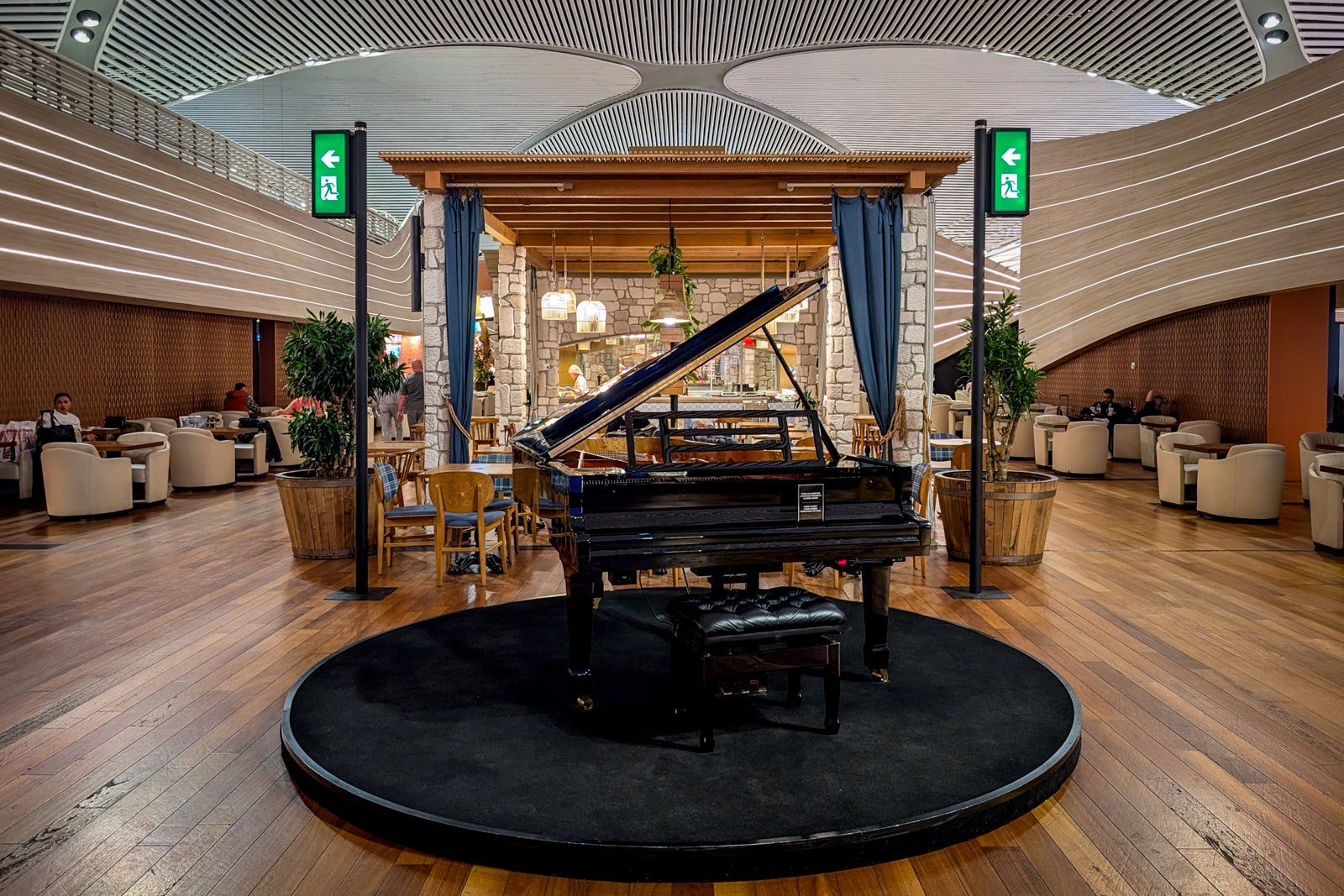
With a long layover, I had plenty of time to see how quickly the lounge can shift from nearly empty to very crowded and back again. On previous visits, I’ve struggled to find even two seats together. This time, I arrived during a quieter period and secured a pair of seats at a communal table with power outlets.
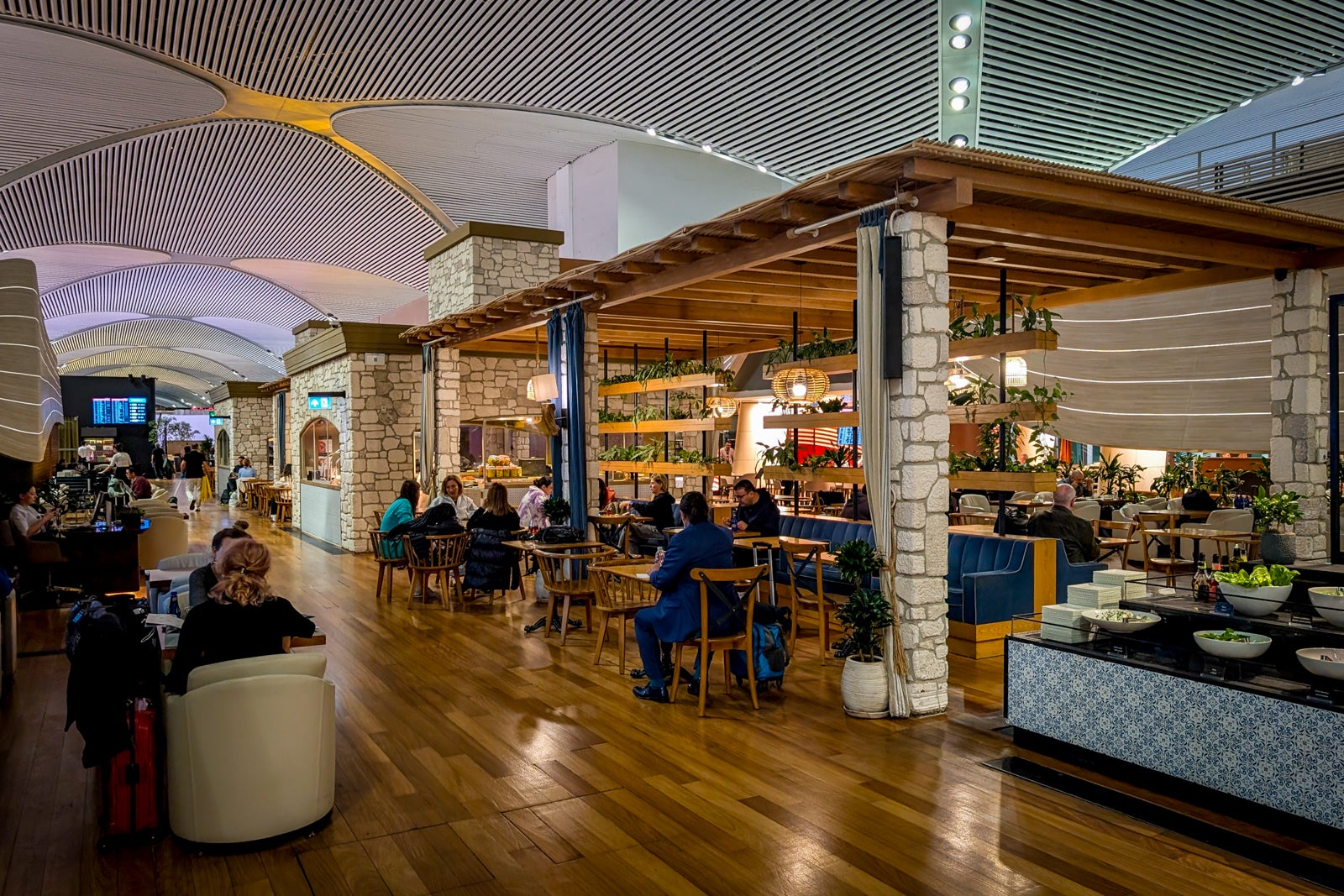
On past visits, finding power outlets had been a challenge — particularly frustrating given that many Turkish long-haul economy seats lack them — but I was pleased to see a newly renovated section with additional seating and ample outlets.
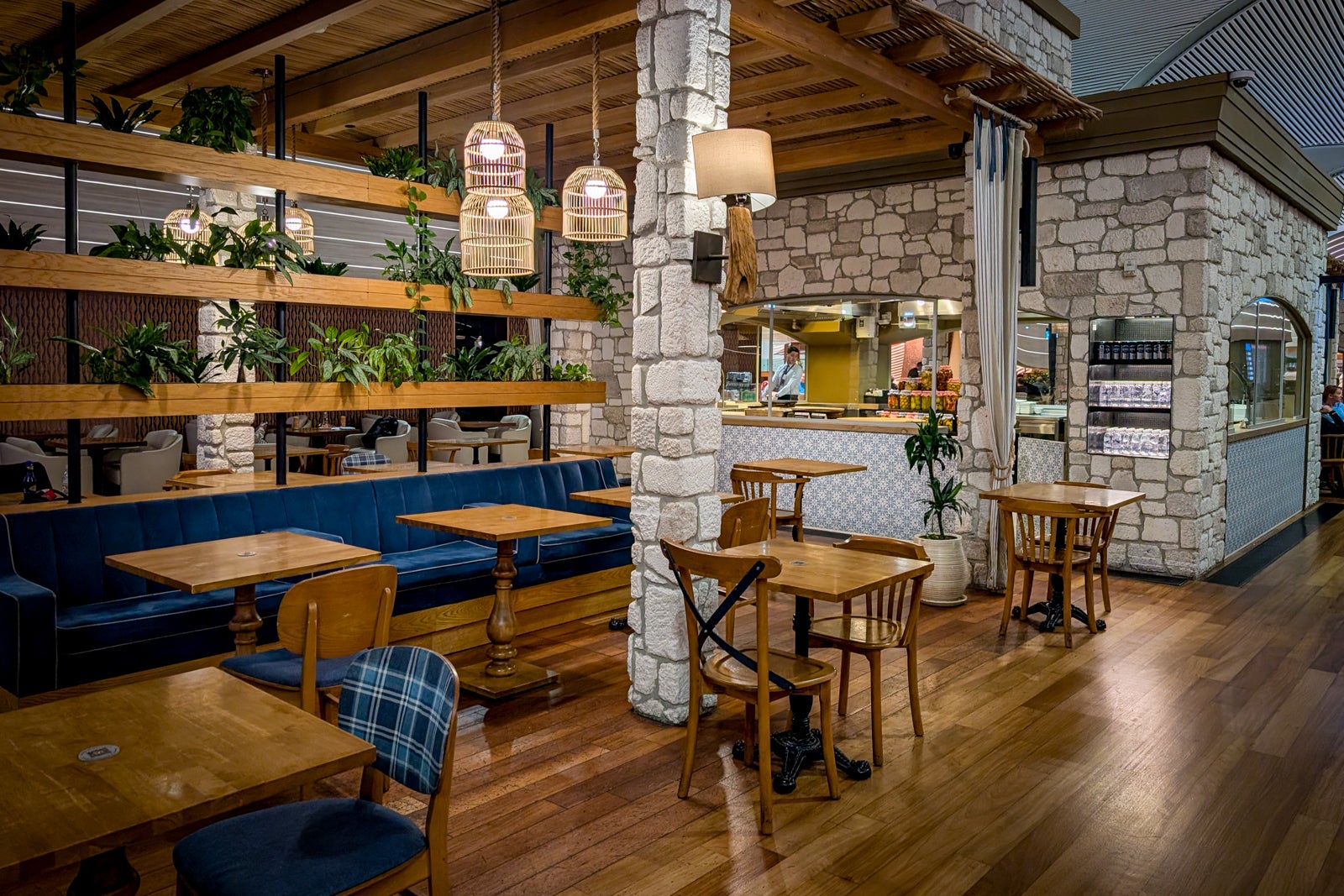
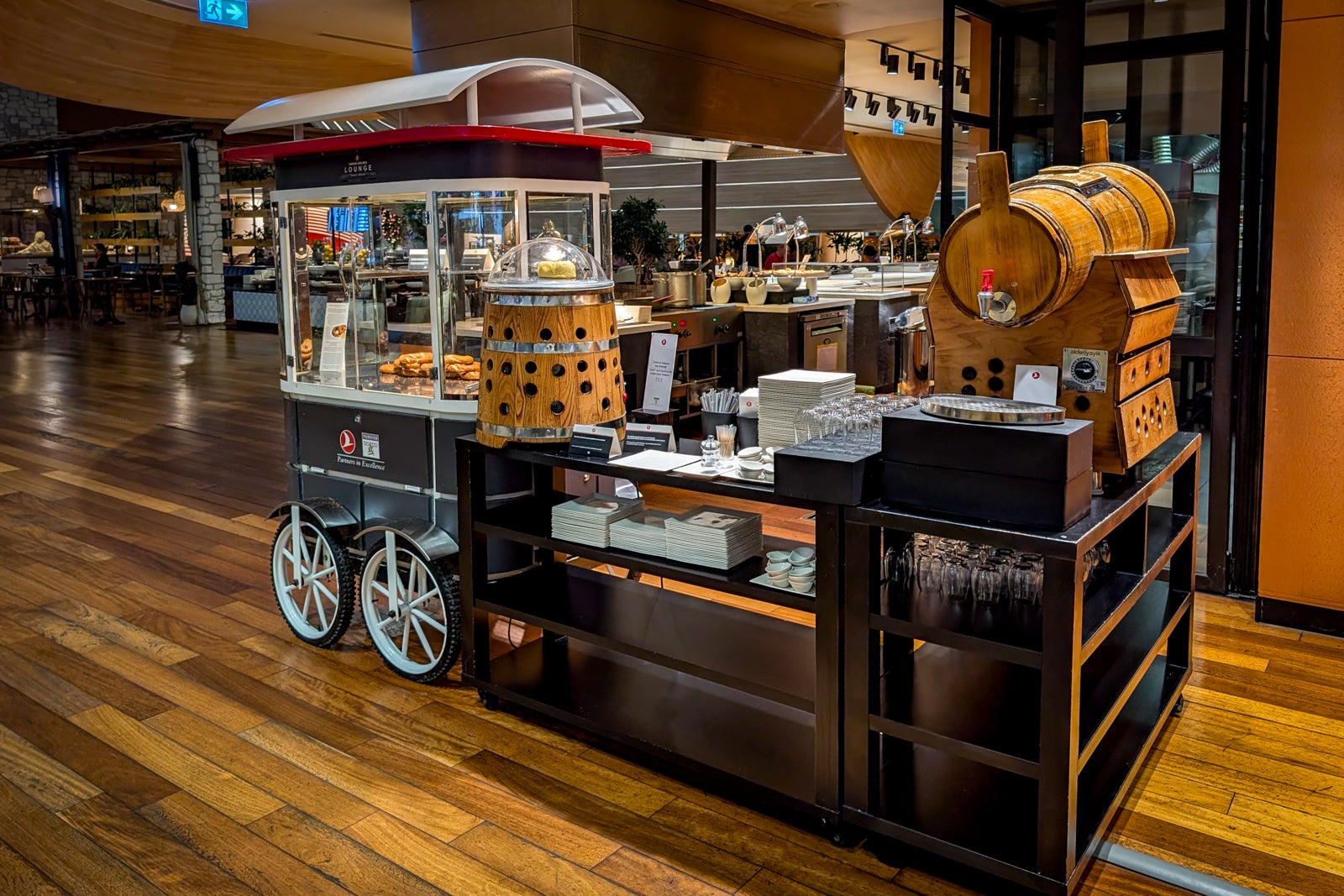
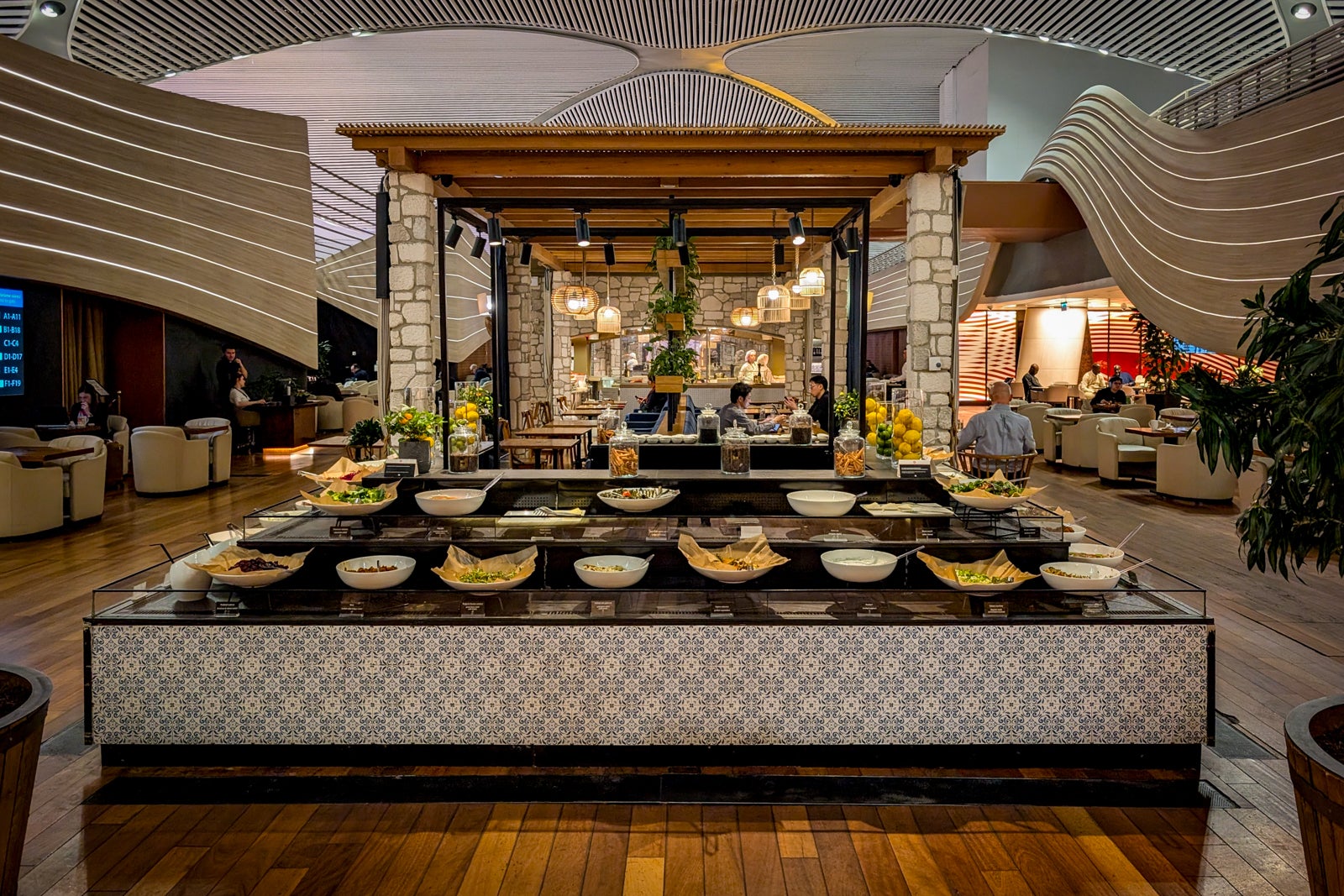
That said, the real highlight of the Turkish lounges in Istanbul is the food. The live cooking stations for gozleme and manti, freshly baked pide, on-tap Turkish tea and ayran and the sour cherry canned drinks are all personal favorites. After multiple visits while completing the Turkish six continents challenge, I now know exactly what to seek out each time.

Reward your inbox with the TPG Daily newsletter
Join over 700,000 readers for breaking news, in-depth guides and exclusive deals from TPG’s experts
1 of 2
KATIE GENTER/THE POINTS GUY
Related: 5 ways to ensure you have lounge access before your next flight
Boarding was chaotic
I arrived at the gate shortly before the scheduled boarding time to find nearly every seat taken and multiple lines already forming — one for business class and elite members, one for economy rows up to 27, and another for rows 28 and above.
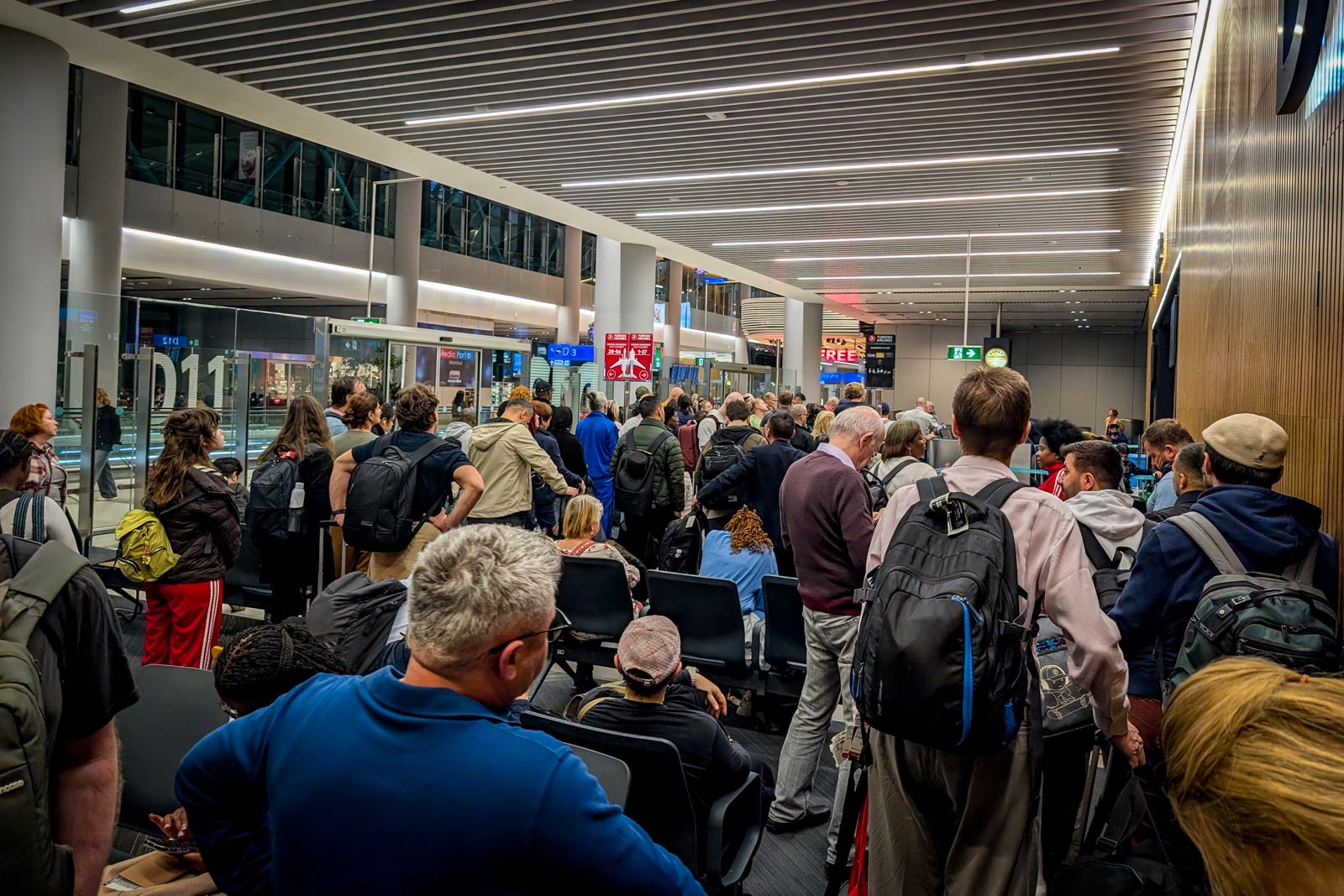
Boarding didn’t start until 15 minutes past the stated time, though. By the time the business class and elite line was called, the lines had devolved into clusters of people.
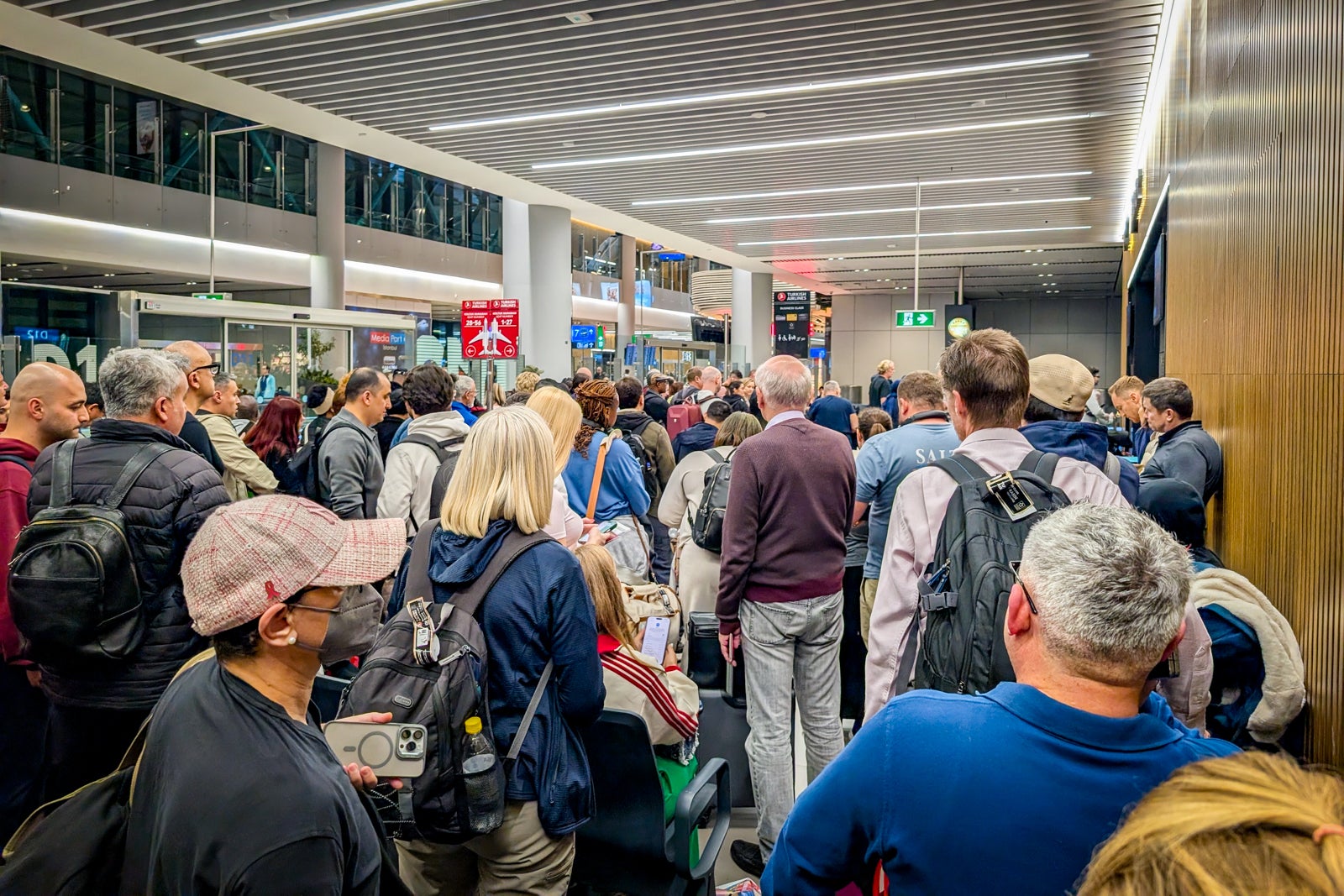
After boarding began, gate agents processed only the business-class and elite lines, prompting some passengers from later boarding groups to push forward toward the scanners. Still, the crowd moved quickly enough that I was on board within 10 minutes of when boarding began.
Solid lie-flat seats
The Turkish Airlines A350-900 business-class cabin on my flight featured 32 Stelia Aerospace Symphony seats in a staggered 1-2-1 configuration across eight rows. Note that Turkish Airlines also has several A350-900 aircraft with 28 Collins Aerospace Horizon seats in a seven-row business-class cabin, so the hard product on those planes is different from what I describe in this review.
Each seat is 20 inches wide and offers direct aisle access. I recommend checking out Aerolopa when selecting seats, but know that A and K seats are window seats and D, E, F and G seats are in the middle section. Due to the staggered seating configuration, window seats in even rows are closer to the window, and seats E and F in odd rows are situated closest together in the middle section.
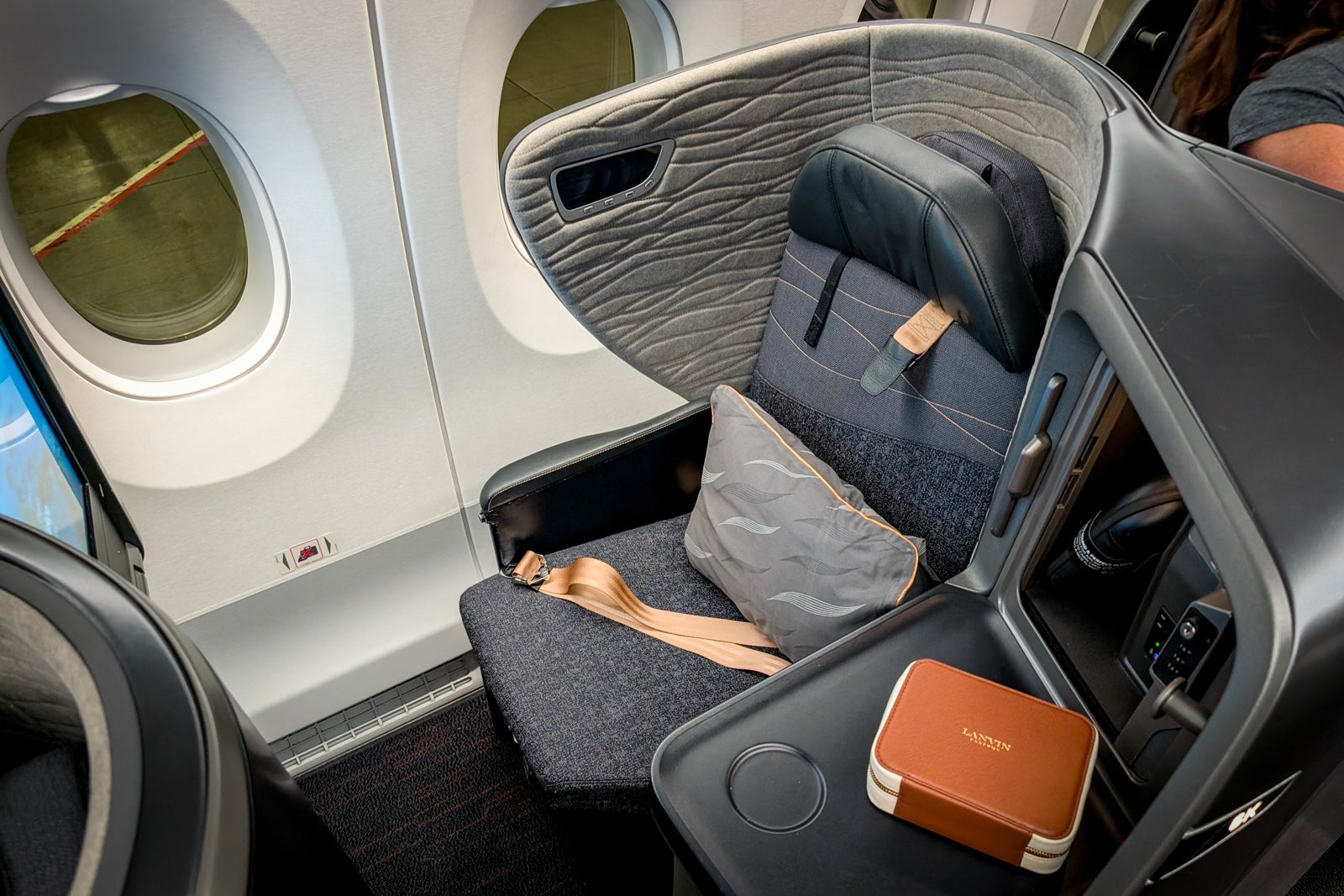
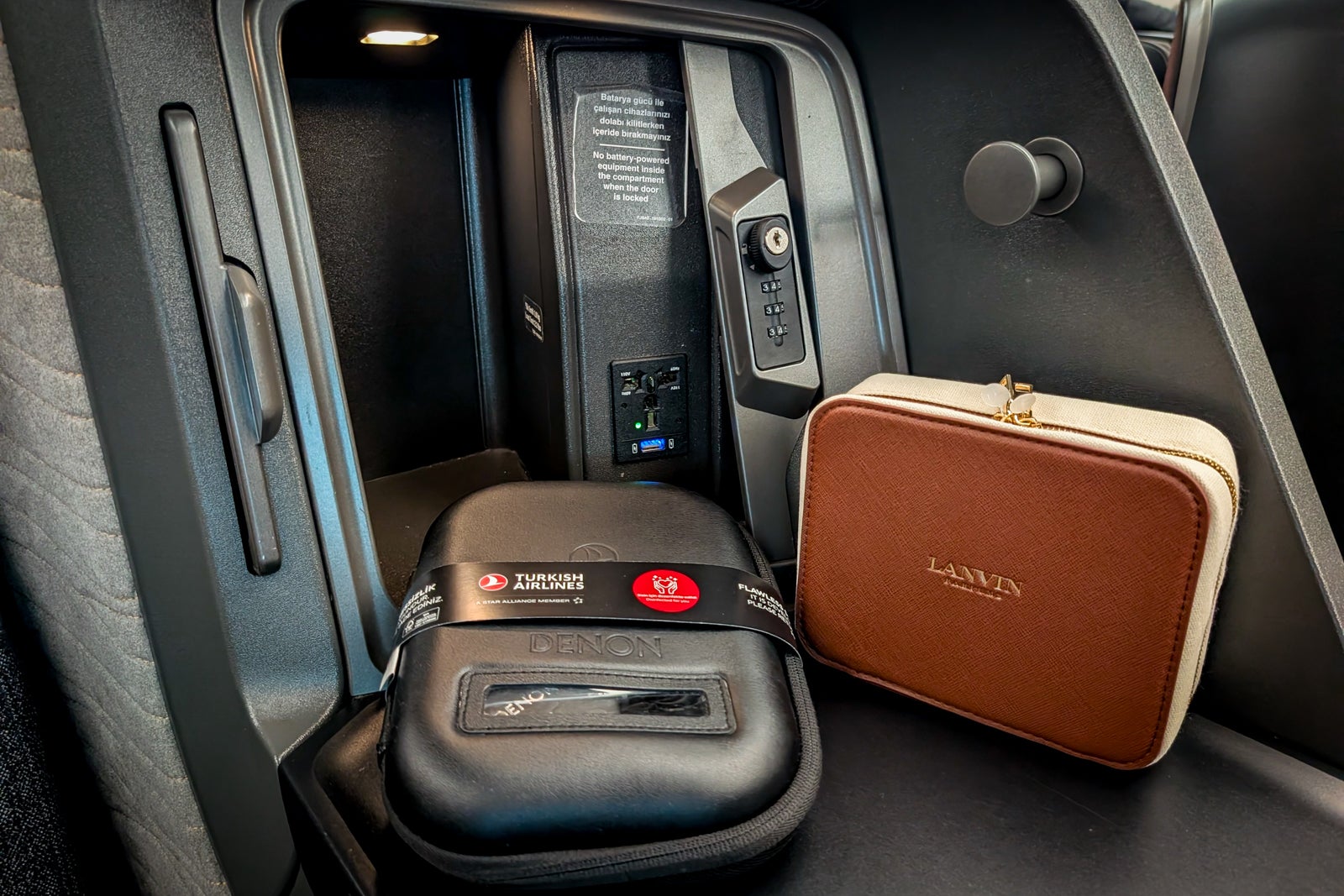
Each seat has a small side table and a lockable cubby, which houses a universal power outlet and a USB-A port.
In front of the seat is an 18-inch inflight entertainment system loaded with a wide selection of shows, movies, a moving map and live exterior camera feeds.
1 of 3
KATIE GENTER/THE POINTS GUY
The IFE remote is positioned beside the seat, though this placement proved poor. Both the remote’s screen and the main display repeatedly activated overnight when I accidentally brushed the touchscreen. This wasn’t an isolated issue — several passengers had their screens glowing while asleep when I walked through the cabin in the middle of the flight.
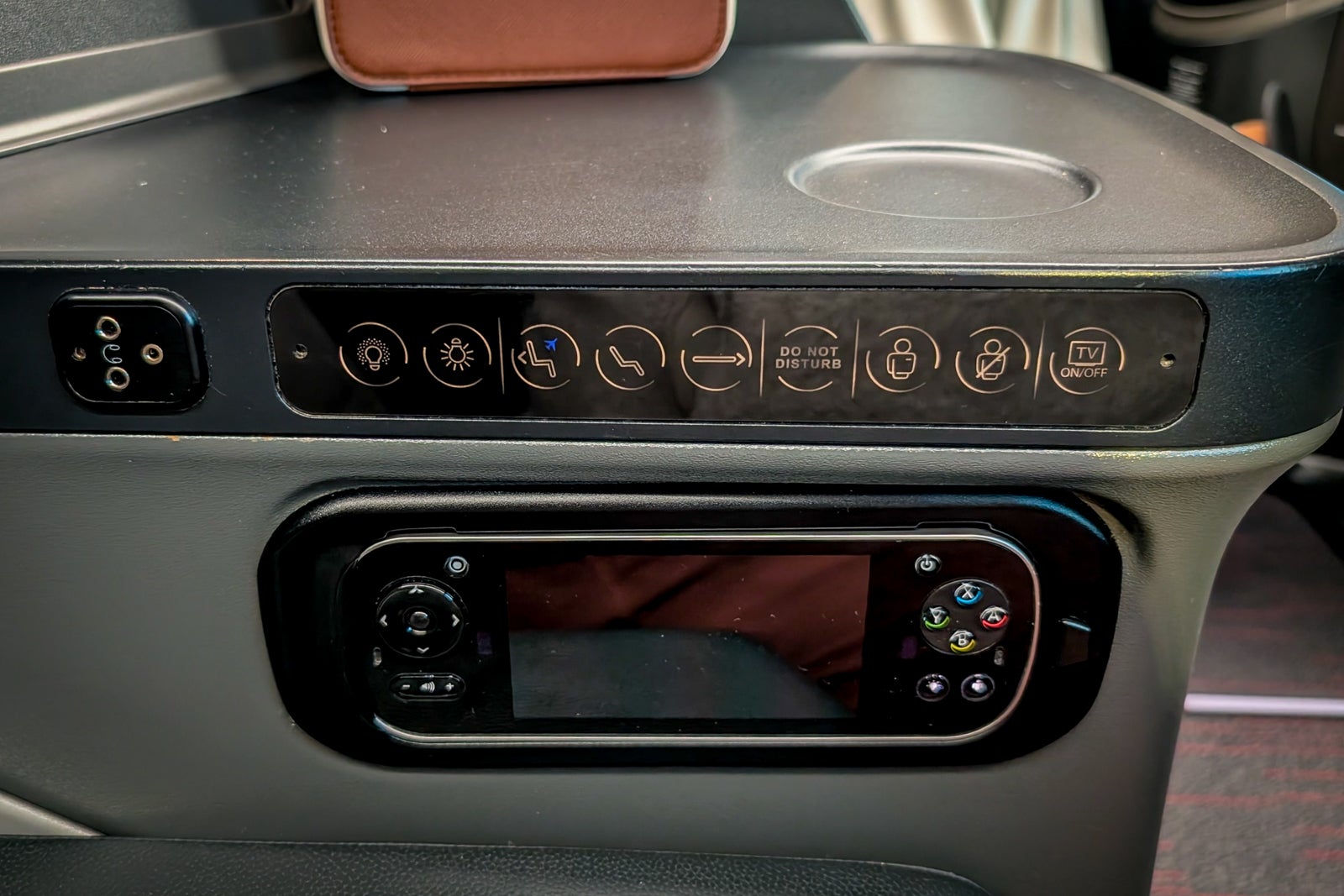
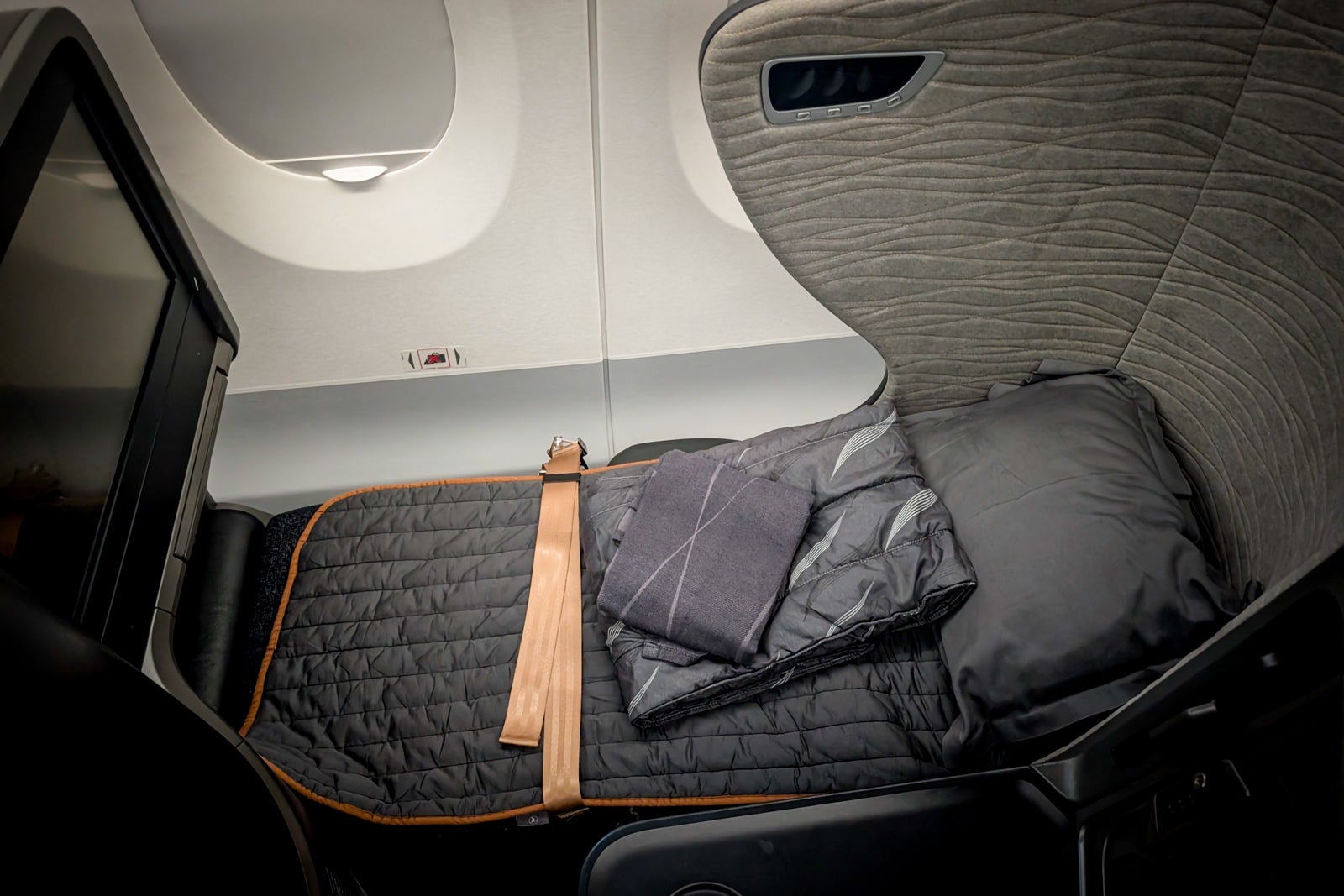
As for sleeping, the seat converts into a fully flat bed using the controls, and the armrests can be lowered to be flush with the bed. I found the bed comfortable overall, though it was a bit firm even with the mattress pad. The bedding also didn’t breathe particularly well, which was noticeable given the warm cabin temperature.
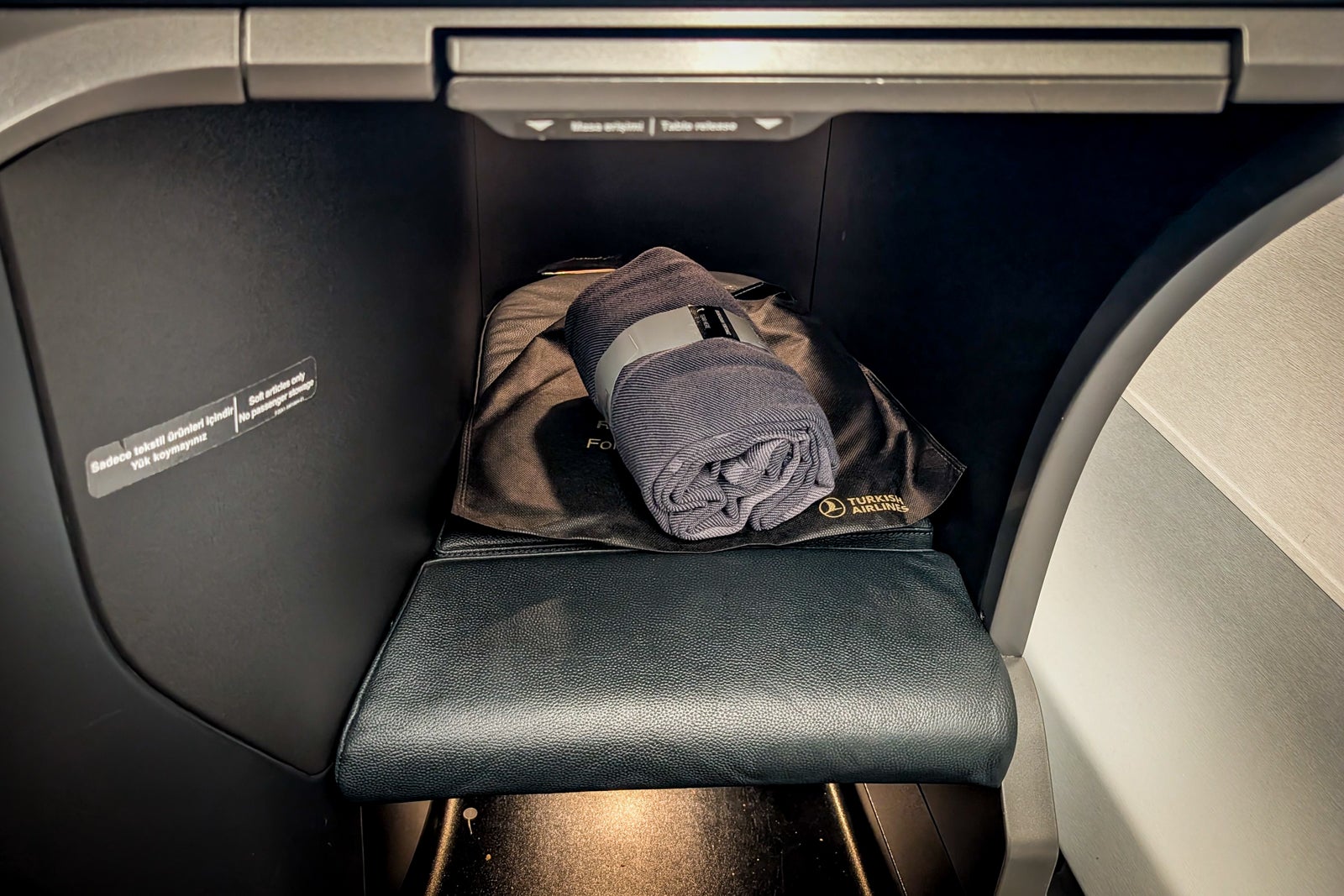
Below the IFE screen is a footwell with a small storage compartment beneath it, likely intended for shoes.
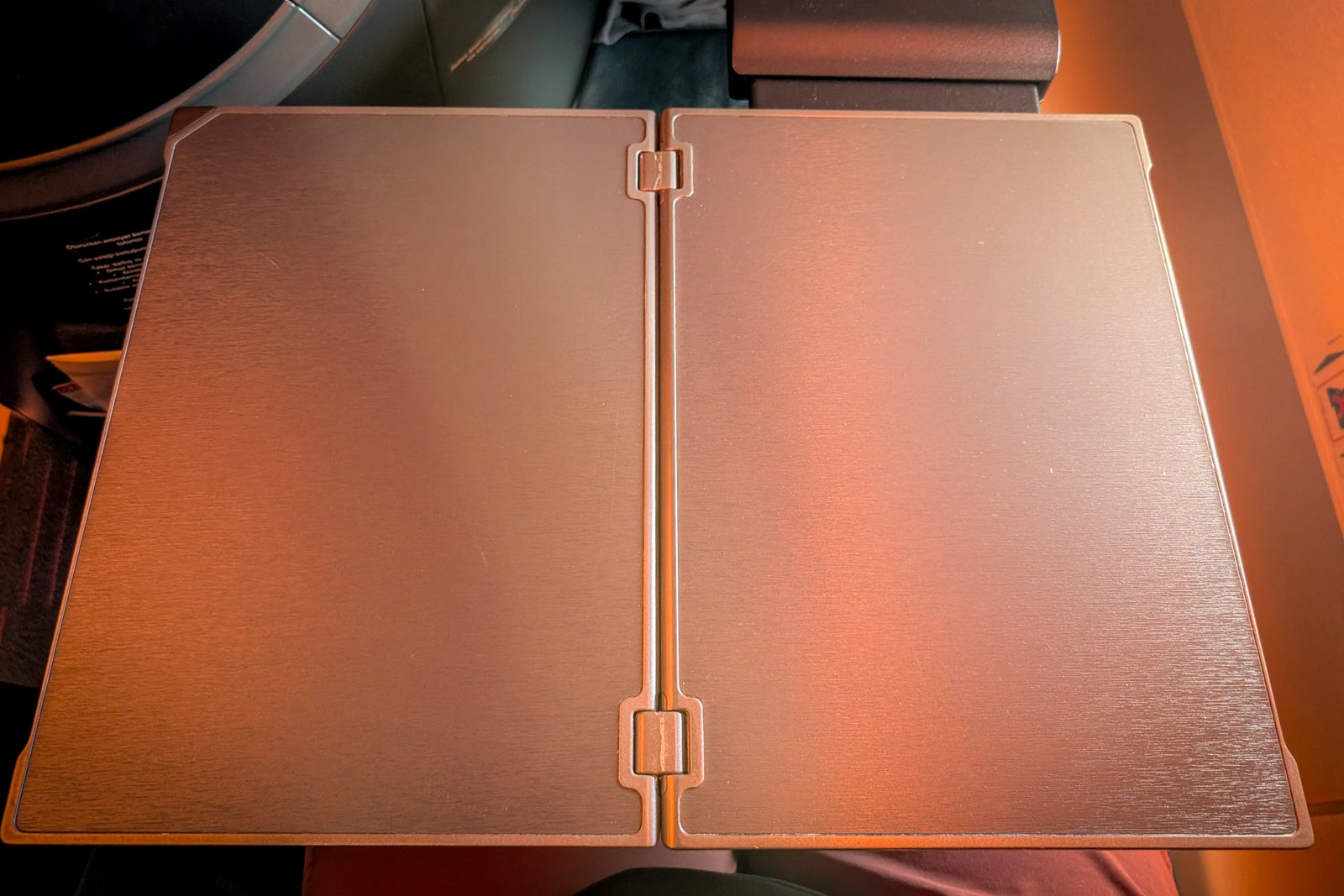
The tray table deploys from beneath the IFE screen via a release lever. Once unfolded, it’s large and sturdy.
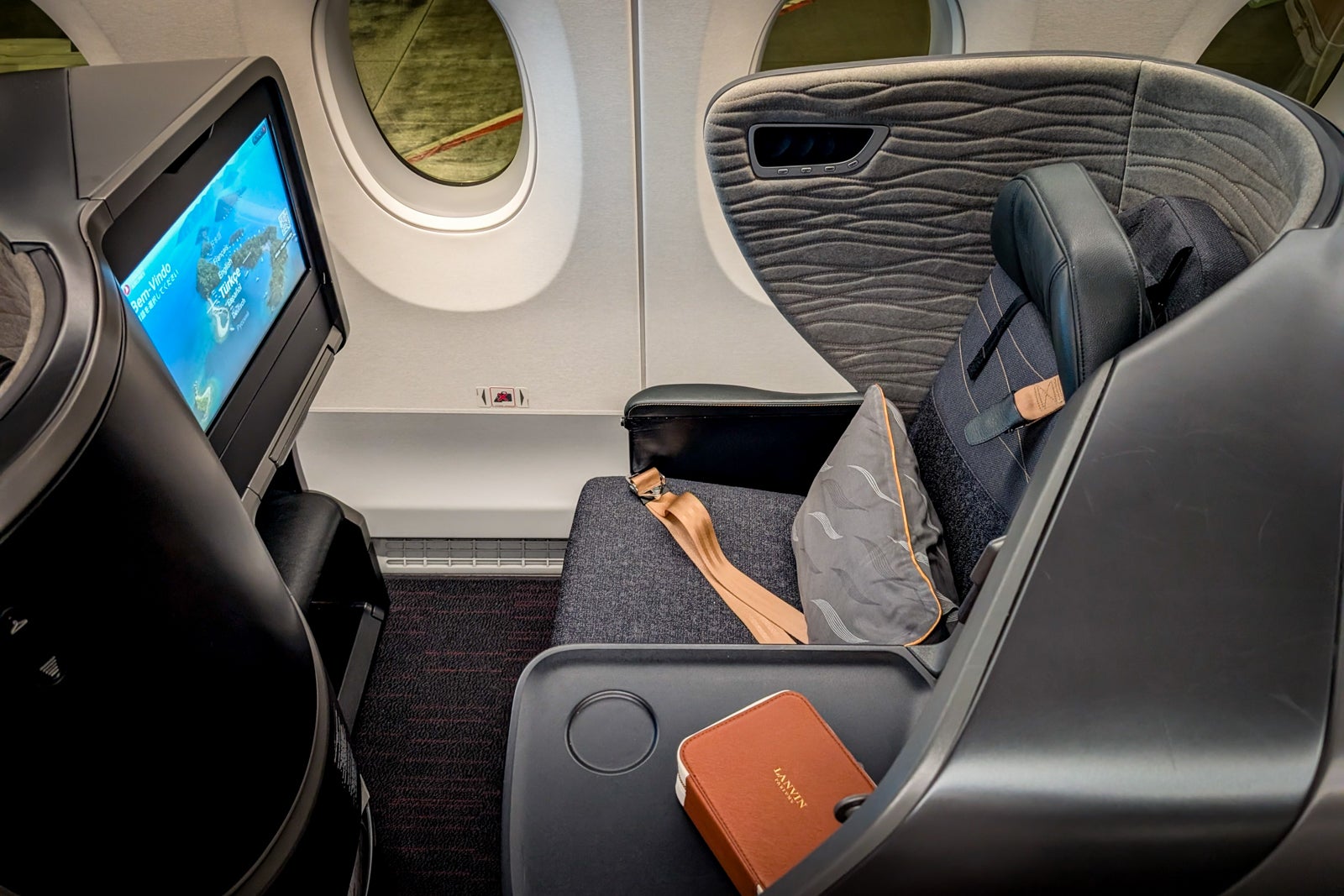
That said, the overall seat design felt inefficient as there’s a noticeable amount of wasted space where the shells curve. Although the shell might be designed to muffle noise and create more padded space — and is certainly useful on seats against the aisle — I found it limited my window views and made the space feel smaller.
Related: A review of Turkish Airlines’ 787 in business class: What’s all the fuss about?
The amenities are solid
Turkish business class offers a decent set of amenities on long-haul flights. While pajamas weren’t provided, a throw blanket, a shoe bag and slippers were waiting in the footwell at boarding.
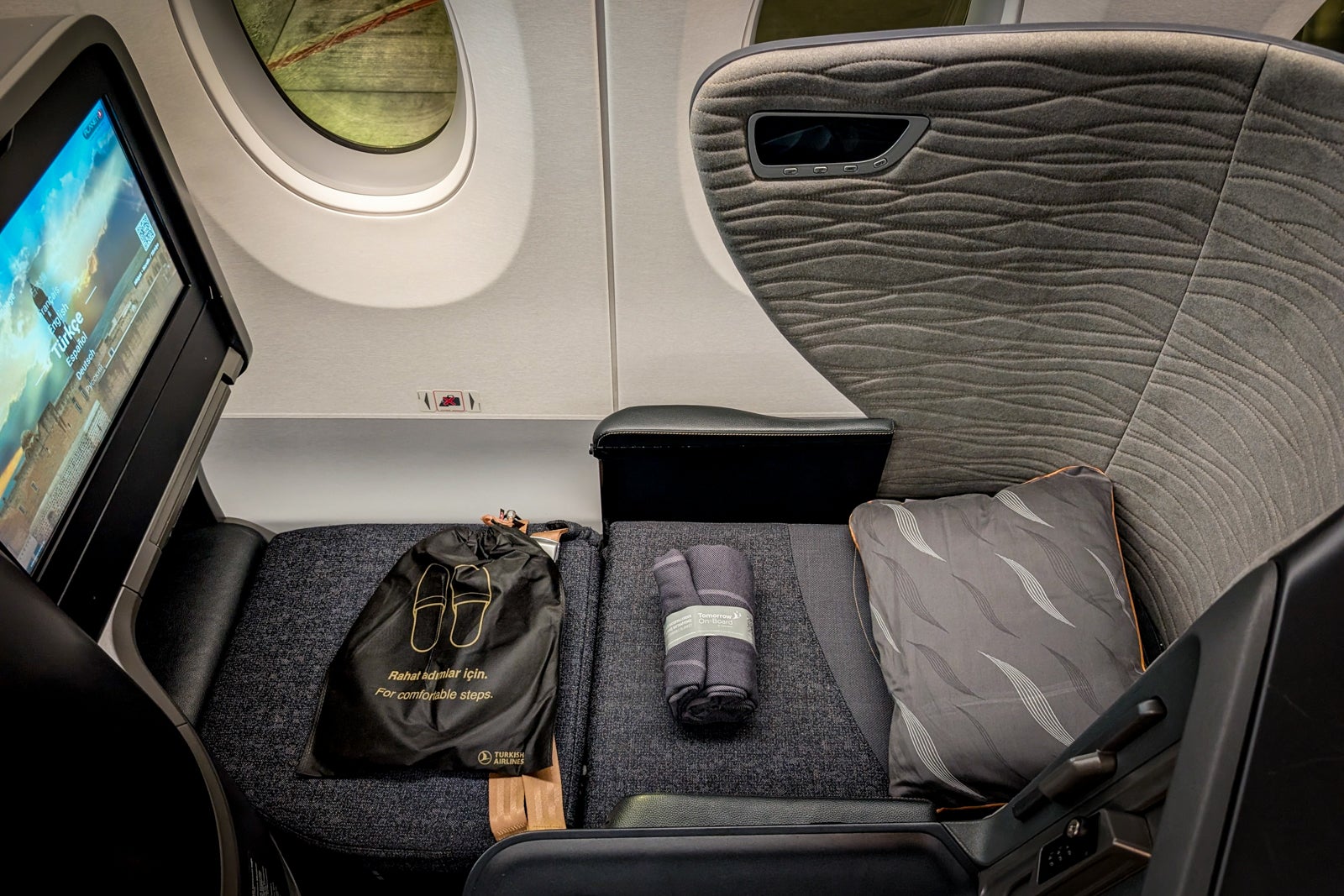
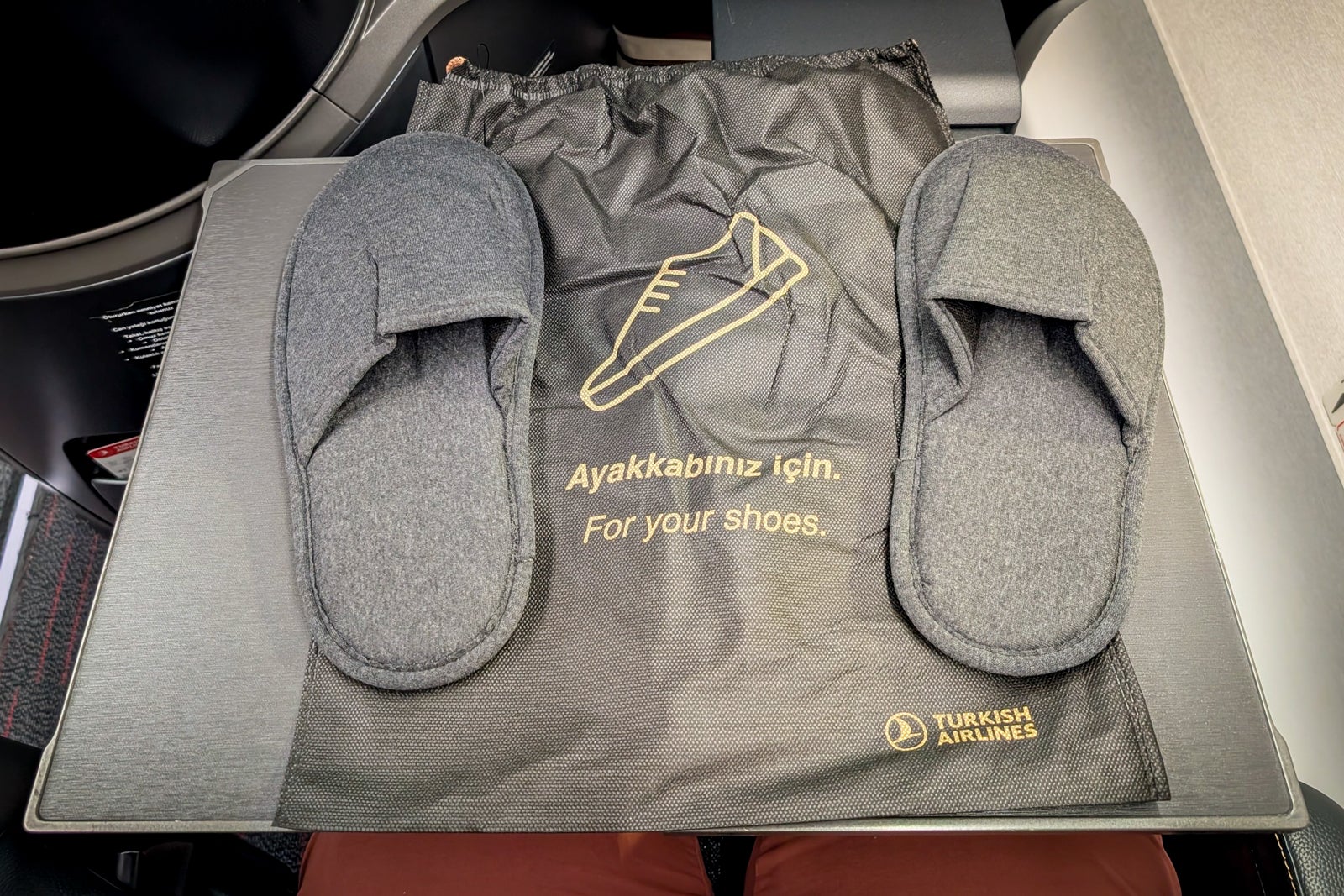
1 of 2
KATIE GENTER/THE POINTS GUY
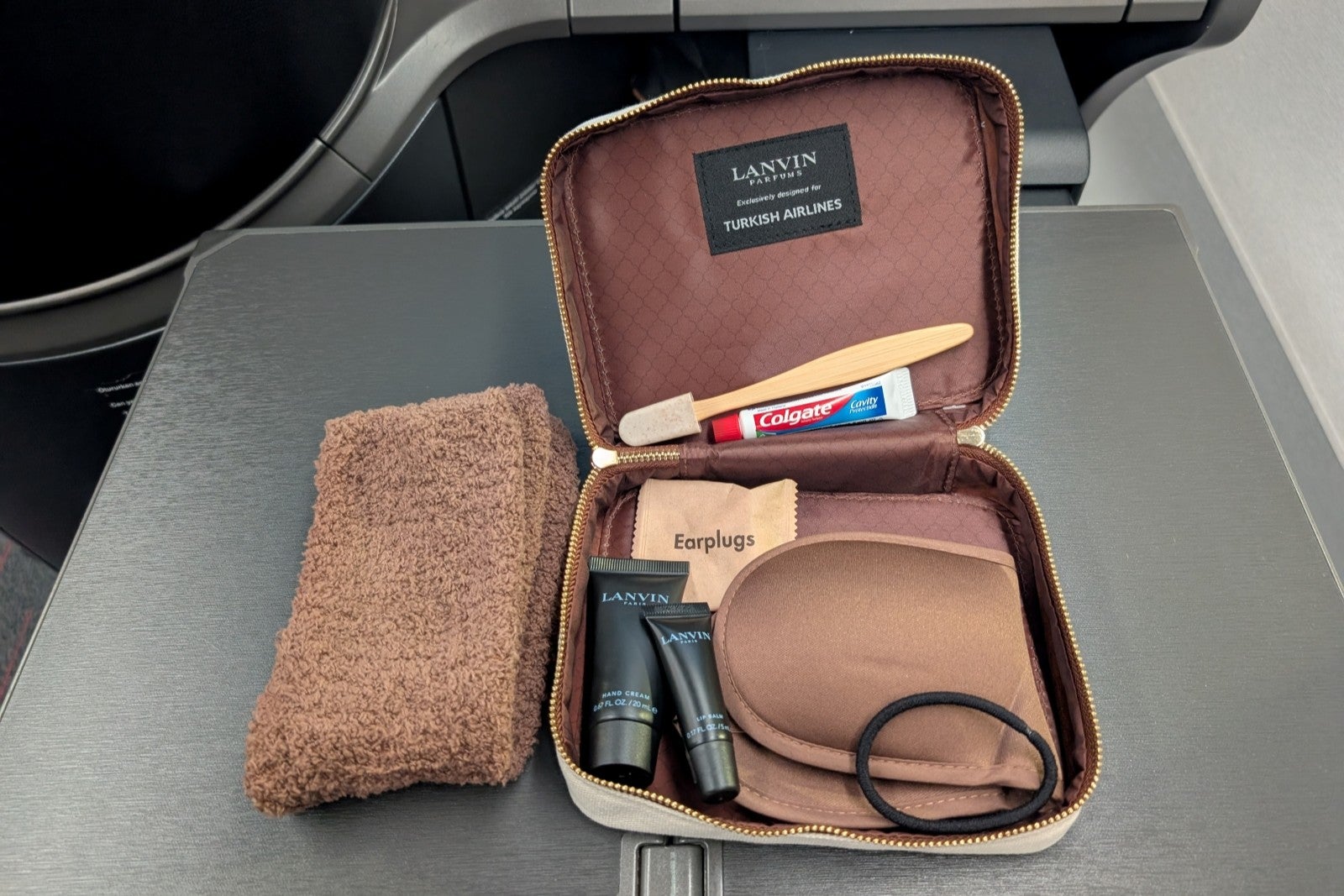
A gender-specific amenity kit from French fashion brand Lanvin and headphones were also placed at the seat. The women’s kit included fluffy socks, a toothbrush and toothpaste, earplugs, a hair tie, lip balm, hand cream and an eye mask. I appreciated that the mask had contoured eye cups, though it slipped throughout the night because it used a single band rather than two.
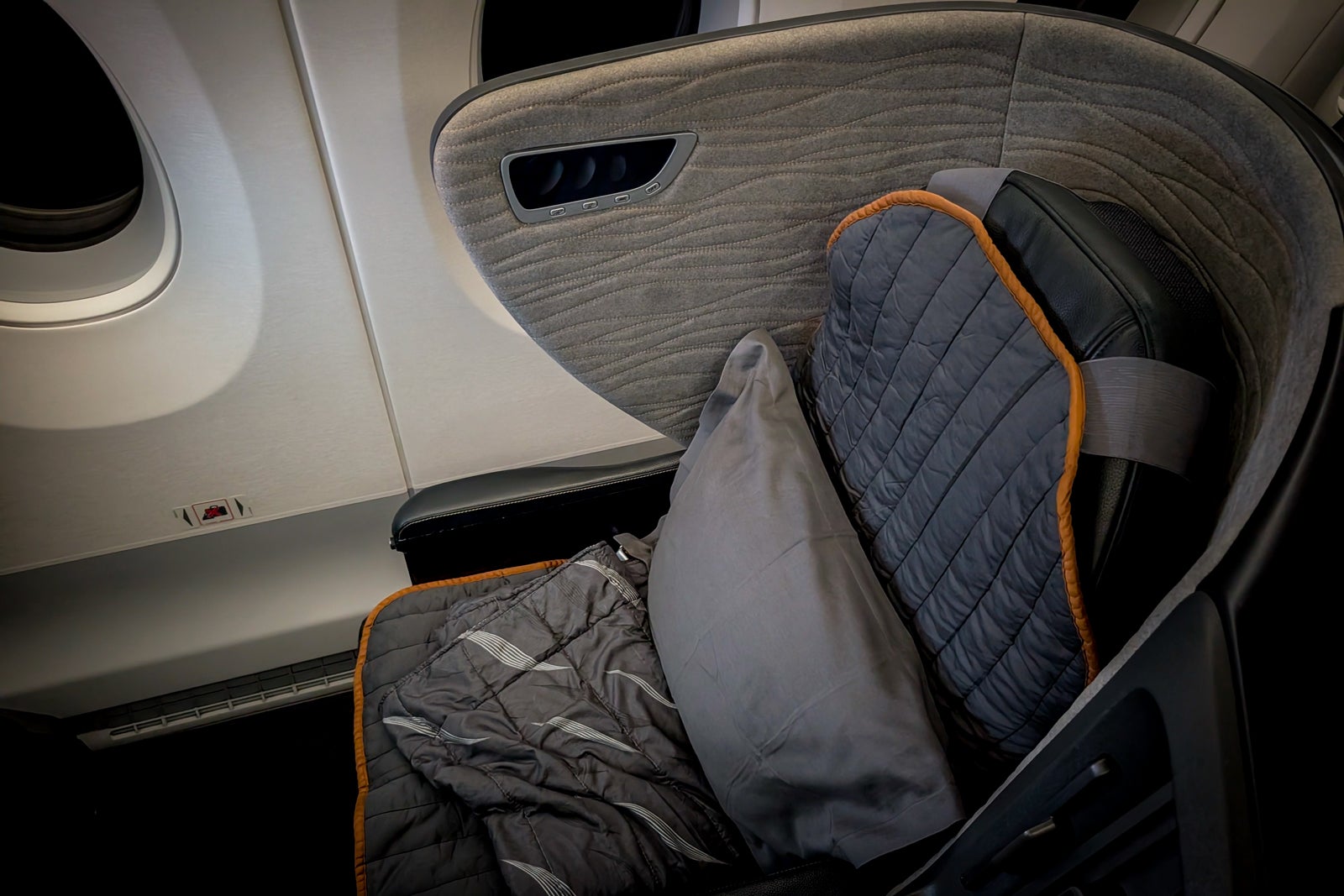
Shortly after takeoff, a flight attendant came through to add mattress pads to each passenger’s seat, place a heavier blanket and dress the pillow with a pillowcase. While the proactive bedding setup was appreciated, it felt slightly awkward to do this before meal service unless a passenger indicated they planned to sleep immediately.
Business-class passengers and select elite members receive complimentary Wi-Fi after entering their details. However, the connection was extremely slow — 10.9 Mbps download, 1.23 Mbps upload and 1,875 ms ping — making it effectively unusable.
Related: How to use Hyatt points for a boutique hotel in South Africa’s wine country
Delicious meals from a ‘Flying Chef’
The flight started on a good note, with flight attendants offering business-class passengers a choice of predeparture beverages. However, it felt a bit strange to be asked to choose without having seen a menu. As I wanted something nonalcoholic, the flight attendant suggested a sparkling fruit juice.
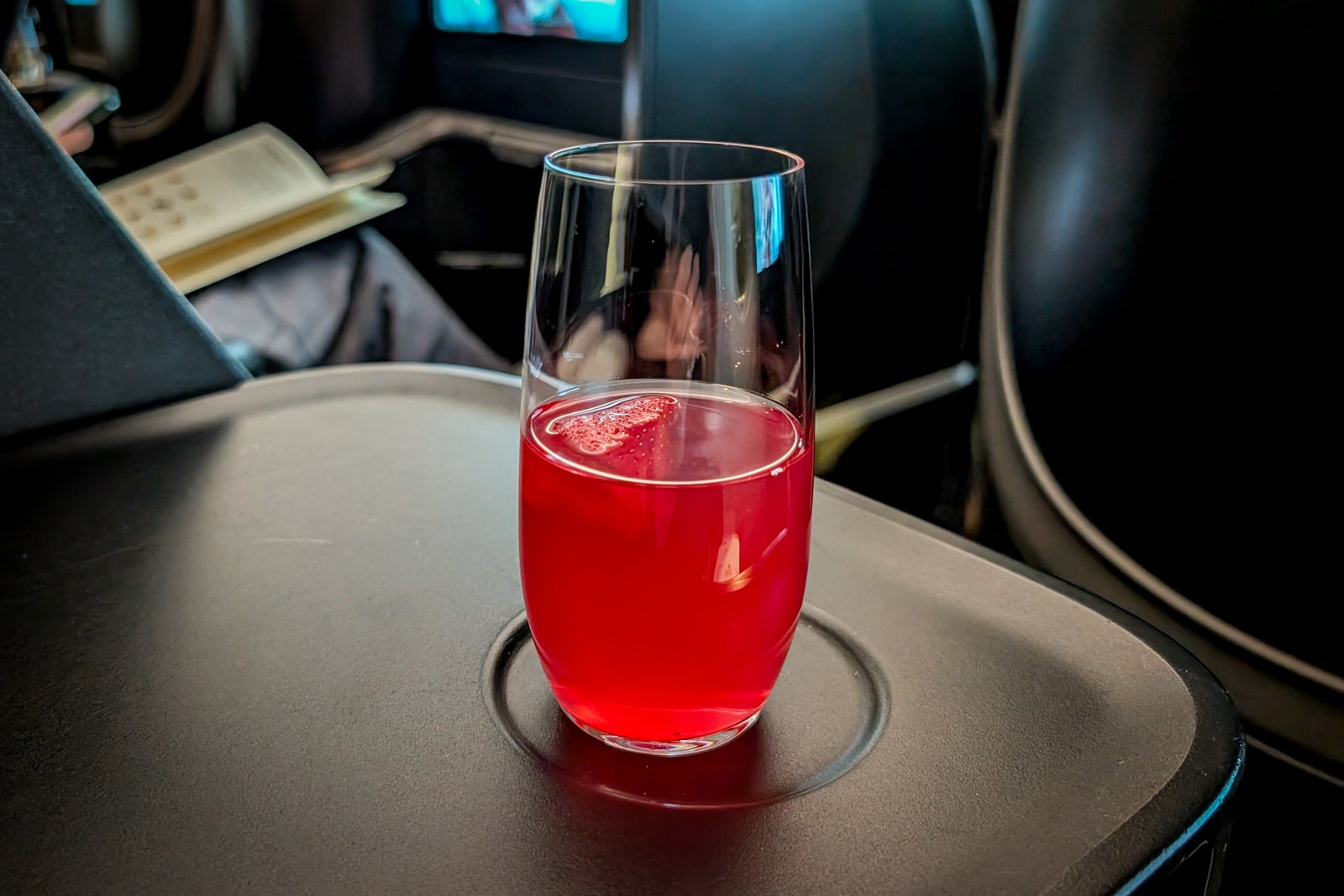
While I was sipping my drink, one of the airline’s signature ‘Flying Chefs’ delivered a menu to my seat. The menu highlights a “dine on demand” concept, where you can enjoy your primary inflight meal at any point during the flight (or at least until the crew closes down the galleys ahead of landing). However, since my red-eye flight didn’t cross many time zones, everyone seemed to default to post-departure meal service.
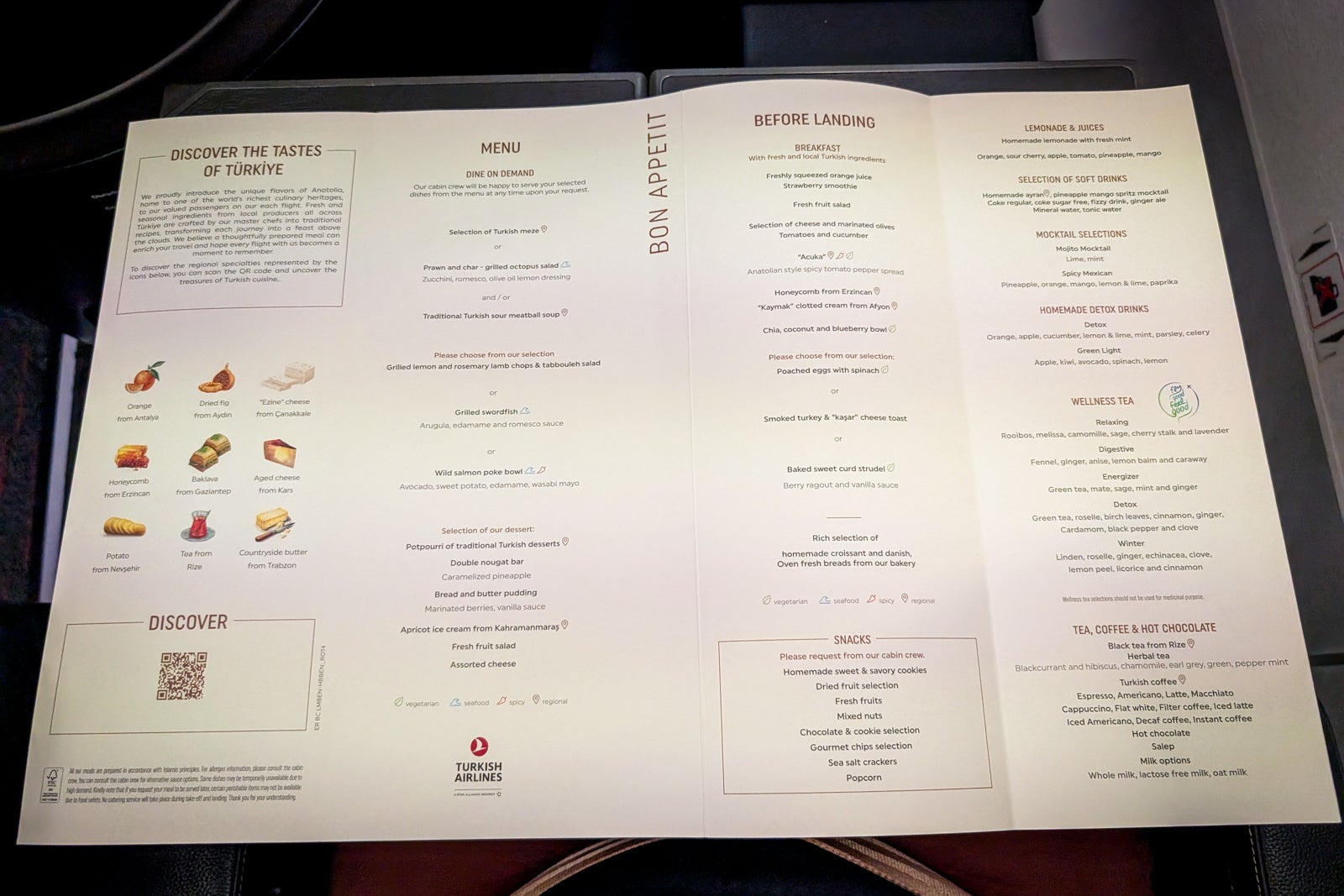
Shortly after takeoff, the Flying Chef returned to take meal orders. He didn’t ask whether I wanted to have my meal immediately after takeoff or later in the flight, but this would presumably be when I could have requested the dine-on-demand option. He then asked whether I wanted to be woken up two hours before landing for breakfast.
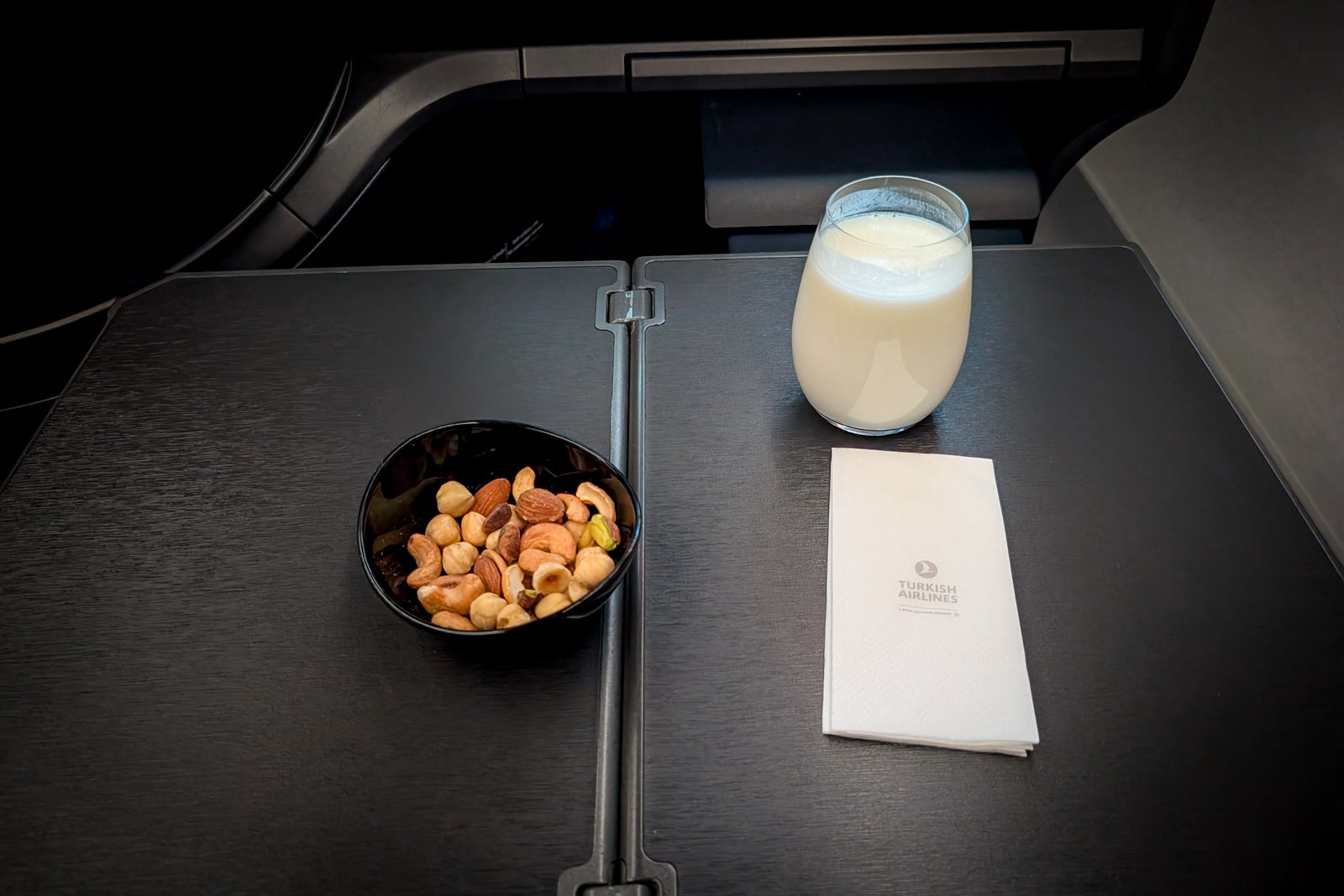
My drink choice (ayran) and a bowl of mixed nuts followed soon after.
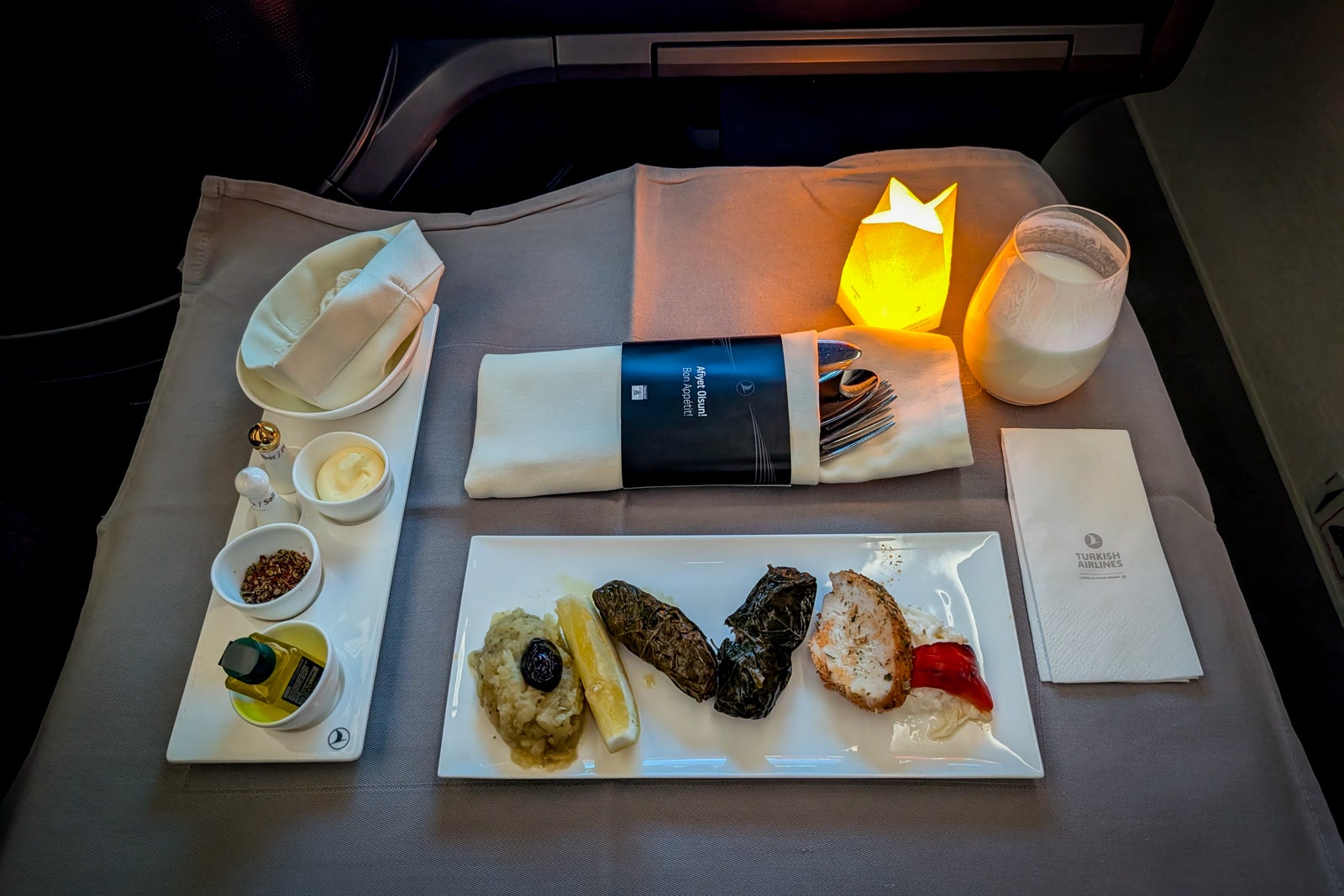
About 15 minutes later, a plate with stuffed grape leaves, eggplant-based salad and a few light accompaniments was served. Everything was nicely presented, with a balanced mix of earthy, tangy and savory flavors.
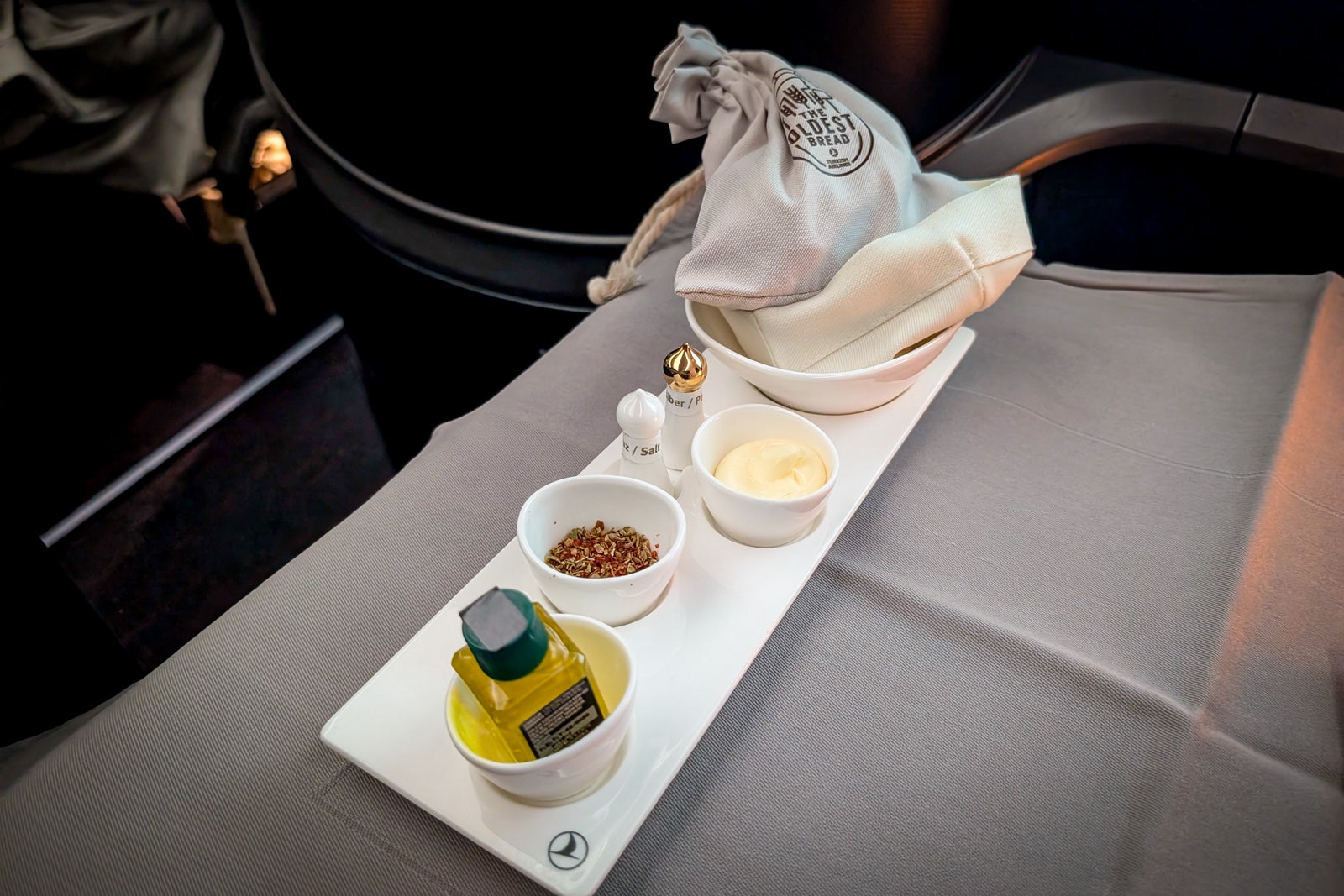
Six minutes later, a warm roll of Turkish’s “world’s oldest bread” arrived in a cloth bag. As expected, it had a dense, hearty texture with an earthy flavor.
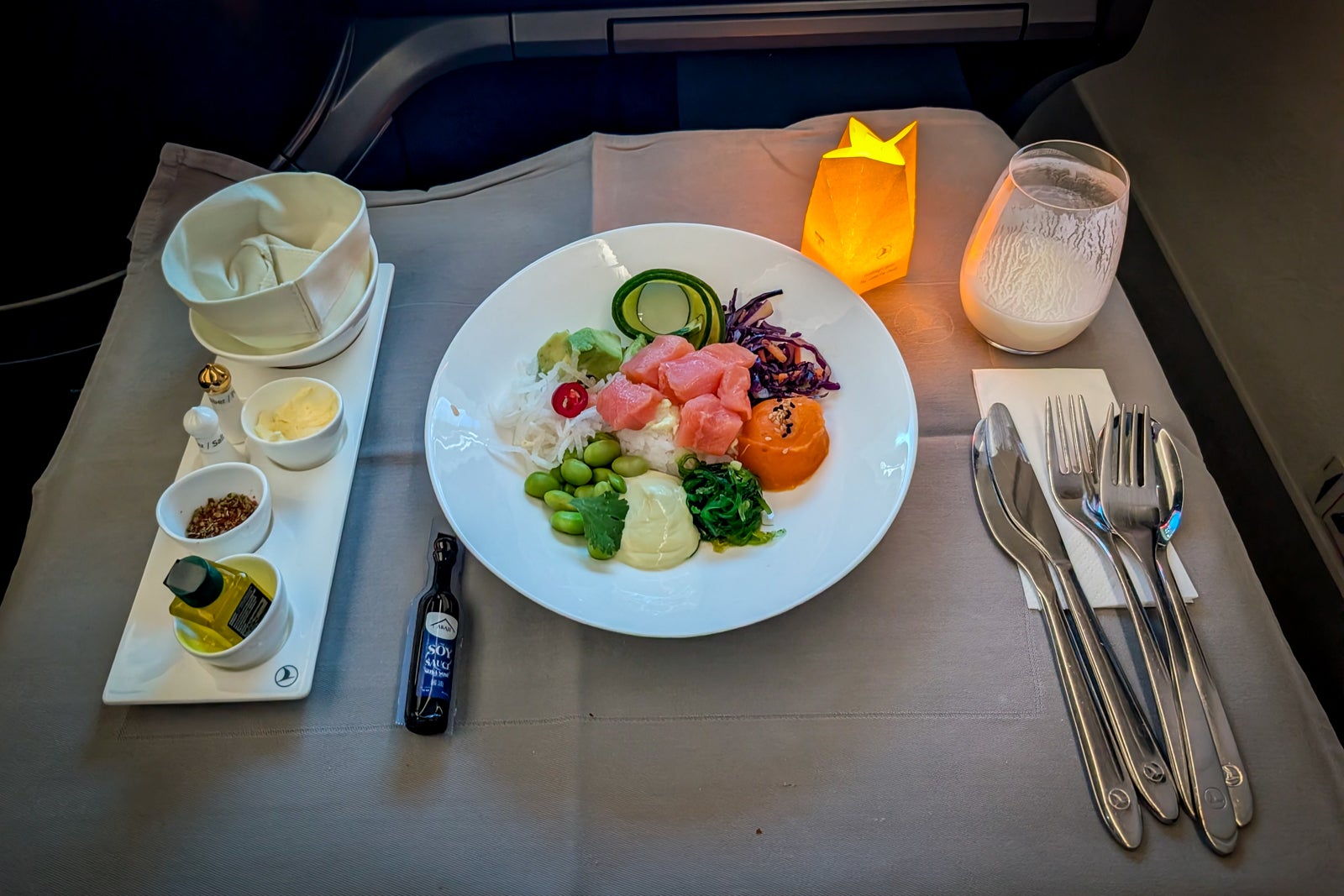
Seven minutes after that, my salmon poke bowl was served. Compared to the other options — swordfish or lamb chops — I was hoping for something lighter, and this option delivered. The tender fish, creamy sweet potato, diced avocado and crisp vegetables made for a fresh dish that felt perfect at the start of a long-haul flight.
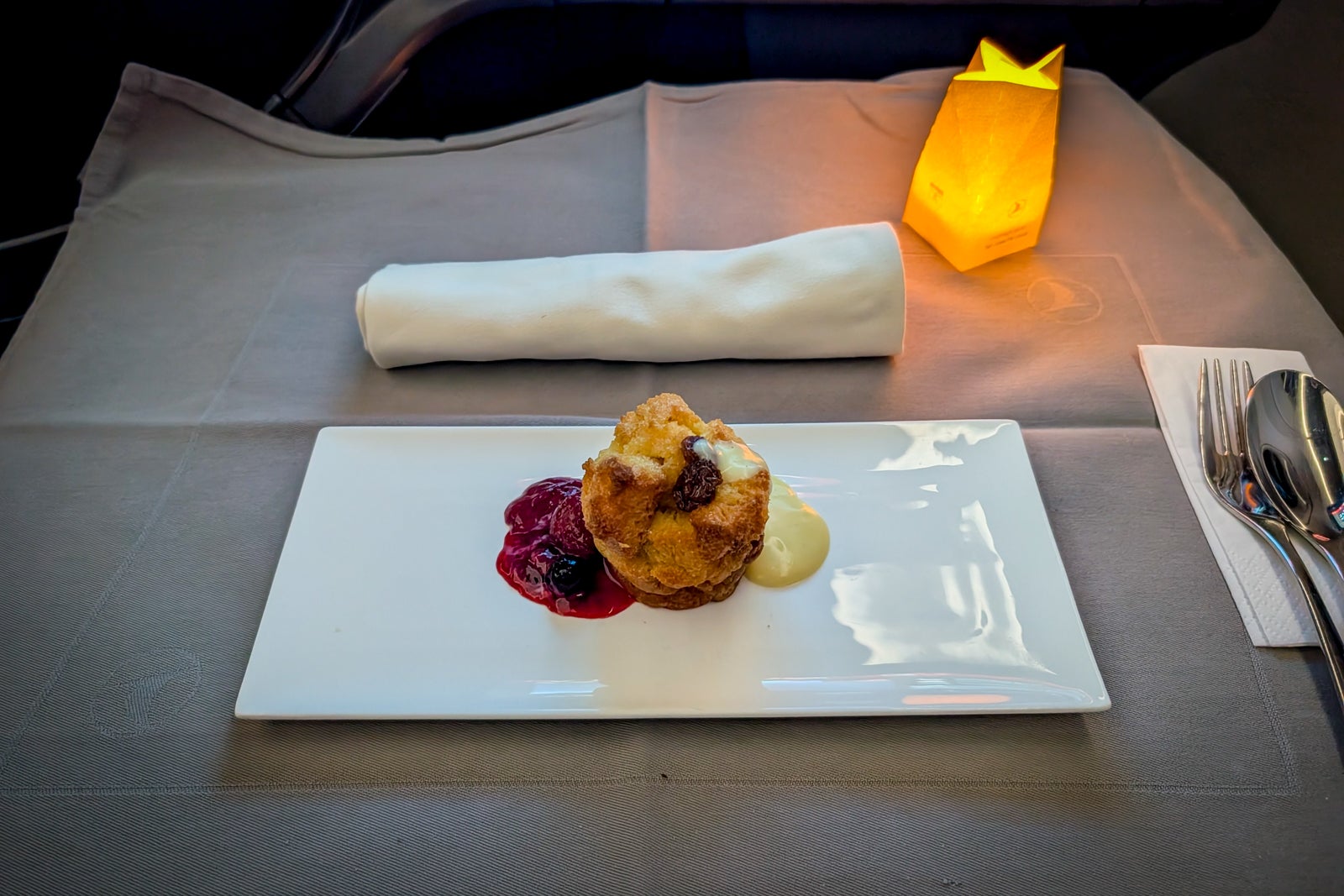
Roughly 25 minutes later, dessert — a bread and butter pudding — was served. Paired with berries and vanilla sauce, it was comforting without being overly heavy.
The beverage list in Turkish business class is impressive. Nonalcoholic options range from soft drinks and wellness teas to mocktails, detox drinks and coffees. The wine list is also extensive, with Taittinger Brut Réserve Champagne, three white wines, five red wines, one rosé, and one port on offer. You can also choose from four whiskies (including two 15-year varieties), Efes or Heineken beer, vodka and gin.
About two hours before landing, flight attendants distributed coffee menus and took orders for the arrival meal.
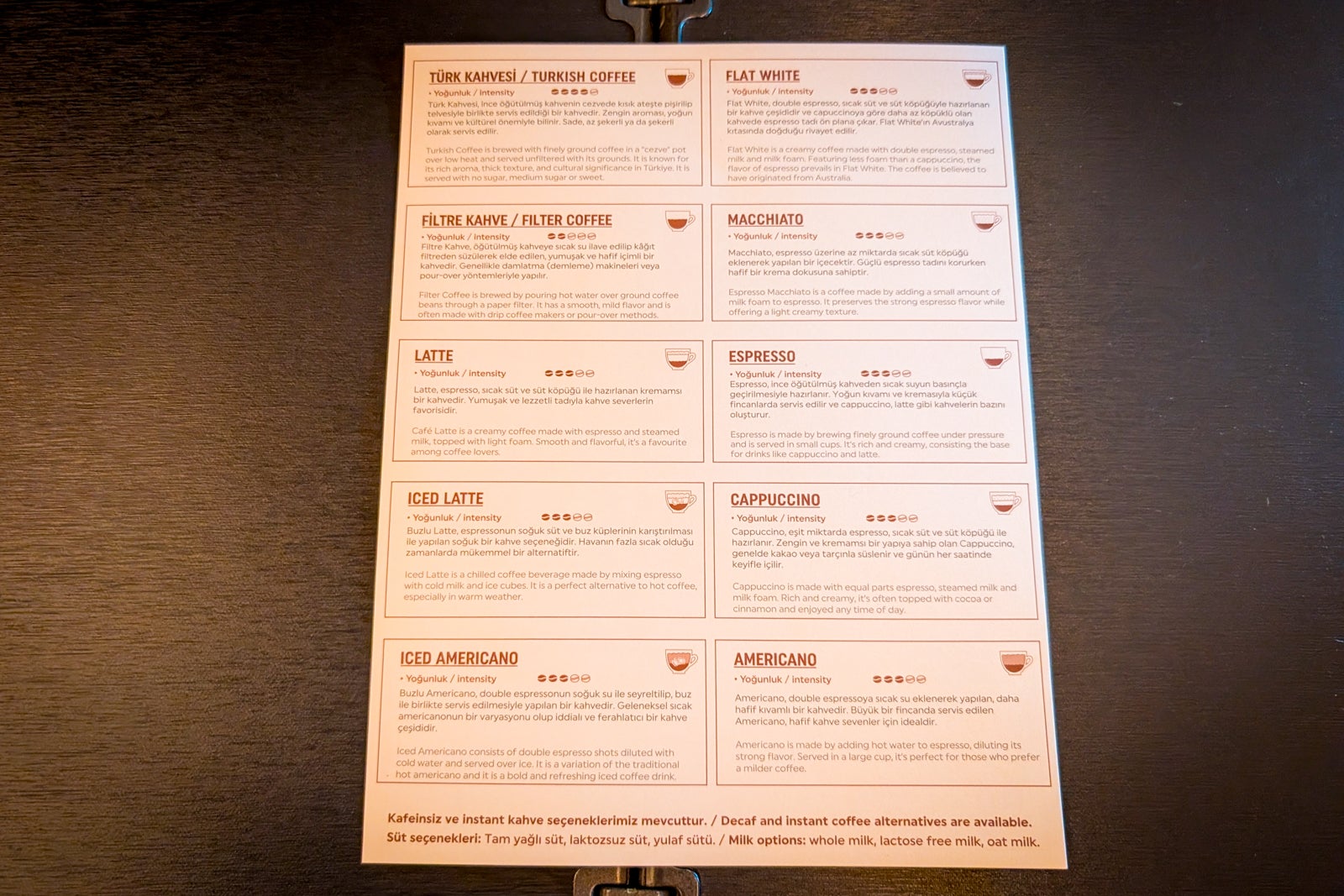
I ordered a latte, but about 15 minutes later was told the espresso machine was broken. I accepted a filter coffee with milk instead, though it was a bit frustrating to see espresso-based drinks being served elsewhere in the cabin later.
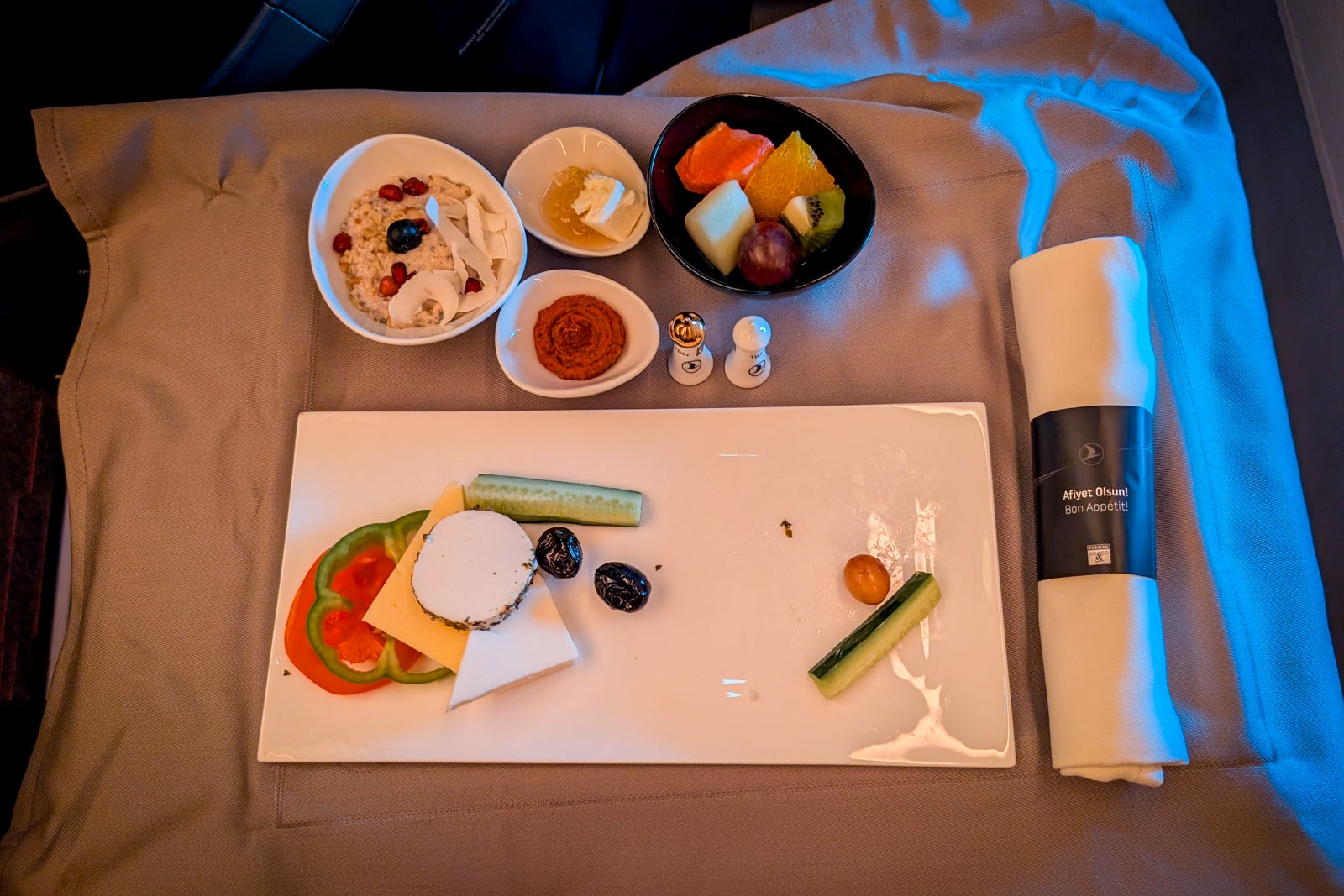
Shortly after ordering, I was served a tray with cheeses, olives, fresh fruit and a chia, coconut and oats bowl.
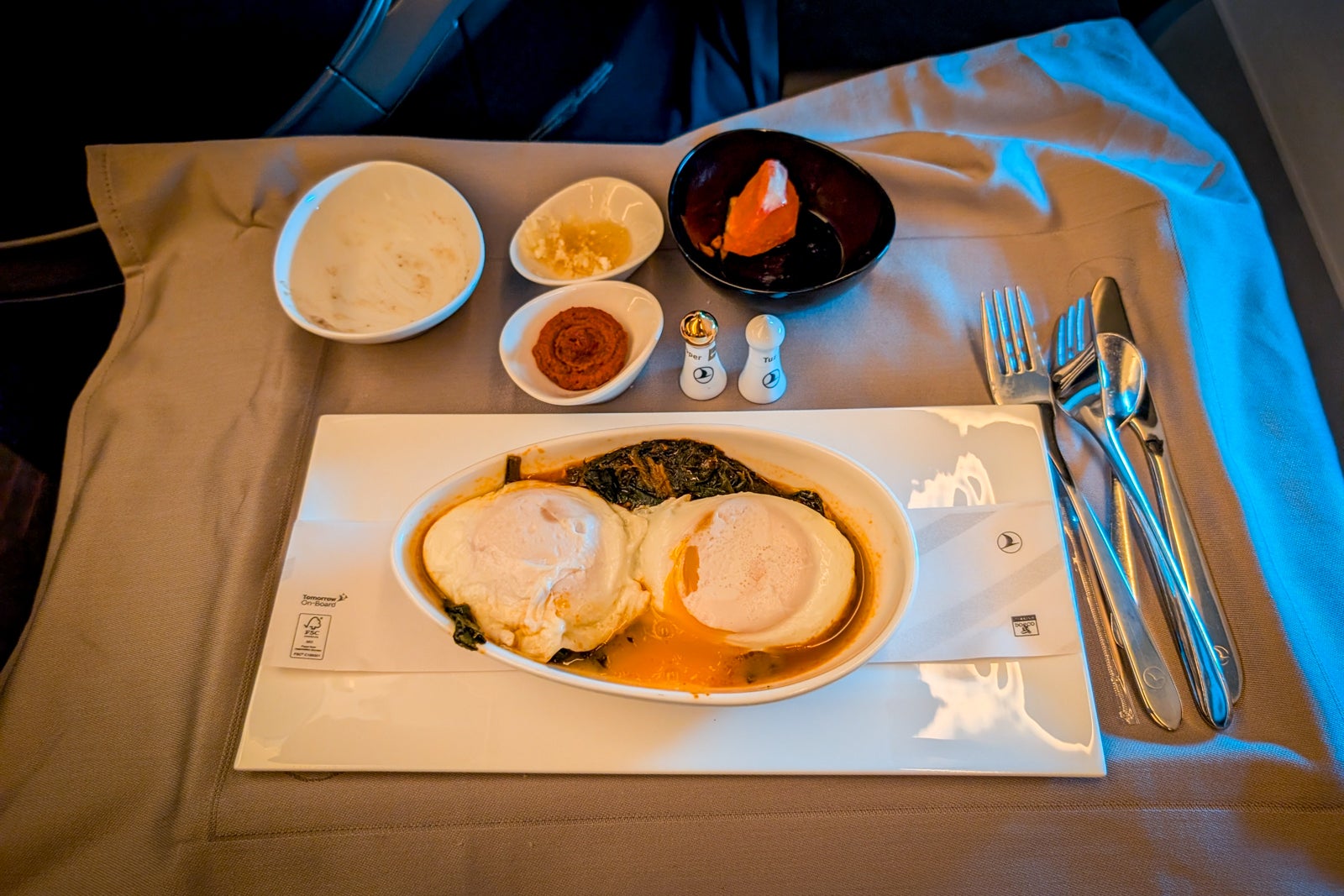
Around 30 minutes later, my main course of poached eggs with spinach arrived. The runny yolks paired nicely with the savory spinach base, making this one of the better egg dishes I’ve had on a flight.
Service throughout the flight was quick, efficient and professional. Flight attendants did an impressive job serving the cabin promptly, especially during the meal services, though interactions generally felt more procedural than warm. While nothing went wrong, the service lacked the friendliness and personal touches I’ve historically associated with Turkish Airlines business class.
Related: From Shake Shack to Magnolia Bakery, airlines are serving fan favorites in the sky
Bottom line
Turkish Airlines’ A350-900 business class delivers a solid long-haul experience, with standout catering, efficient service flow and comfortable lie-flat seats with direct aisle access. The crew did an impressive job of moving a full cabin through two meal services on an overnight flight.
However, inconsistencies — from chaotic boarding to slow Wi-Fi and crowded lounges in Istanbul — mean the experience can lack the polish of top competitors. Still, if you value a comfortable onboard experience with high-quality dining, Turkish Airlines business class remains a compelling option, especially if you can snag a good-value award.

Stacie Harris is a local resident and reporter of the Maple Grove area. Stacie reports on medicine and science for the Maple Grove Report.