Magnifica Humanitas Will Be the Pope’s Bid for Human Dignity in the Age of AI


Welcome to CNET’s new series of guest columns called Alt View, a forum for a diverse array of experts and luminaries to share their insights into the rapidly evolving field of artificial intelligence. For more AI coverage, check out CNET’s AI Atlas.


The last industrial revolution got its moral framework too late. AI doesn’t have to.

Last November, I was fortunate enough to meet Pope Leo XIV at a private audience on child dignity and artificial intelligence. I asked Pope Leo whether he was comfortable with artificial intelligence becoming the operating system for people’s lives.

He paused for what seemed like an eternity.

Then he said, simply: no.

A glowing translucent lightbulb, held by a hand, in front of lighted lines suggesting a circuit board

On May 15, Pope Leo signed Magnifica Humanitas — his first encyclical, on artificial intelligence and the protection of human dignity. It will be published next week. He signed it 135 years to the day after his namesake, Leo XIII, published Rerum Novarum — the document that gave the industrial revolution its moral framework. The parallel is deliberate.

Rerum Novarum arrived decades after the industrial revolution began. By then, communities had already been hollowed out. Workers exploited. Children had already paid the price of progress that was not designed with them in mind. The moral framework came — but after the damage was done and the architecture was fixed.

The people building AI are unambiguous about the scale of what is coming. Google’s Demis Hassabis — Nobel laureate, founder of DeepMind, one of the architects of modern artificial intelligence — has described this moment as 10 times the industrial revolution, at 10 times the speed. Anthropic’s Dario Amodei speaks of systems surpassing human capability across almost every domain within a matter of years. OpenAI’s Sam Altman has suggested what lies ahead may require a new social contract on the scale of the New Deal.

These are not rhetorical claims. They are the considered assessments of those closest to the technology.

If they are right — and I believe they are — then what we decide in this window will shape the conditions of human life for generations. Not just for those who can afford the best tools or live in the most connected cities, but for everyone.

That is the real promise of AI. Not productivity gains or market returns — though those will come. The deeper promise is a genuine civilizational uplift: compressing decades of scientific progress, extending human capability to people who have never had access to any of it, expanding agency rather than concentrating it.

But that outcome is not guaranteed by the existence of the technology. It depends entirely on the values embedded in the systems being built, the diversity of voices shaping them, and the frameworks governing how they are deployed. Right now, those decisions are being made within an extraordinarily narrow circle; without the participation of the communities most affected, and without the moral frameworks that have guided humanity through transformation before.

This is not a criticism of those building AI. Most understand the weight of what they are carrying. The problem is structural: the two communities most capable of shaping this moment — the builders of AI, and the world’s great moral and faith institutions — have never been in serious dialogue. They occupy parallel universes, each with an incomplete picture.

That is what the Faith-AI Covenant project is designed to change. We are bringing together AI companies and the world’s faith traditions in structured dialogue on the values that must govern this technology. Not to obstruct. Not to regulate from the outside. But to bring the wisdom, moral authority and trust that faith communities have earned over millennia into the conversation, while the architecture is still being built, and the path dependencies have not yet run too deep to redirect.

CNET AI Atlas badge; click to see more

Last month in New York, our first roundtable brought representatives from Anthropic, OpenAI and others into the same room as senior religious leaders from across every tradition. The conversations were unlike any I have had in four decades in this industry. Faith leaders bring something the technology sector cannot manufacture: the trust of billions of people who are not asking whether AI is impressive. They are asking whether it is just. Whether it will leave their communities behind, or bring them forward.

Those are the right questions. And they need to be asked now.

The encyclical sends a clear signal to every government, every investor, every technology company: There is a constituency of nearly one and a half billion people who believe human dignity is nonnegotiable. And they are paying attention.

Rerum Novarum changed the trajectory of the industrial revolution. But it arrived too late for the people who needed it most. 

This time, the moral framework is being written before the architecture is fixed. That is the moment we are in.


Source link

Leave a Reply

Subscribe to Our Newsletter

Get our latest articles delivered straight to your inbox. No spam, we promise.

Recent Reviews


What is Network Security?

The planning and implementation of network security procedures to preserve the integrity of networks and programs against hacking and illegal access is indeed a subcategory of information/cyber security. It defends the organization’s IT structure and network-accessible services against a wide range of cyber threats, including viruses, Trojan, spyware, spam ware, malware, and more. Network security includes user credentials, internet connectivity, firewalls, backups, and encryption. A network security professional’s goal is to make the system more secure by offering technical assistance using intrusion detection systems, encrypting, firewalls, and digital certificates, among other things.

Wish to make a career in the world of JNCIA? Start with JNCIA Training !

What is Cyber Security? 

Cyber security is a broad word that refers to all areas of the internet. It is a subcategory of data security that is concerned with defending the authenticity of systems, devices, and programs against assault, damage, or illegal access from the outside. It refers to a collection of approaches, technologies, and procedures for defending systems and networks from cyber-attacks. It protects networks against unwanted electronic access by putting in place a variety of security mechanisms and controls. All inbound and outbound network traffic is monitored by cyber security professionals to limit the danger of cyber assaults while also protecting the firm from unauthorized system use.

Wish to make a career in the world of Cyber Security? Start with Cyber Security Training! 

Cyber Security Training

  • Master Your Craft
  • Lifetime LMS & Faculty Access
  • 24/7 online expert support
  • Real-world & Project Based Learning

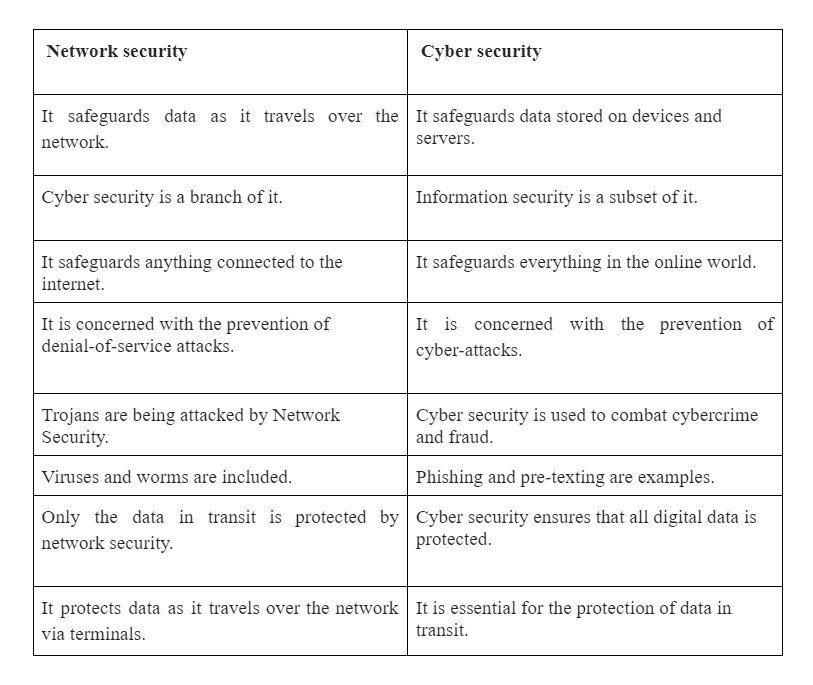
(Network Security vs Cyber security) Difference Between Both

1. Definition

Cyber security is a branch of information security that refers to a set of strategies and methodologies for preventing harm, attack, or illegal access to networks, devices, programs, and data. Cyber security, to put it simply, is the process of defending internet-connected devices and networks against digital threats. The process of safeguarding files and folders in a computer network from misuse, hacking, and illegal access to the system is known as network security. Network security is a subcategory of cyber security that guards against unwanted access to your system and network-accessible resources.

2. Security

While the phrases are interchangeable, they are vastly distinct in nature of security. If you see an organization as a walled castle, network issues are associated with keeping the peace within the castle walls and defending the organization’s sovereignty from network-related threats. Cyber security, on either hand, safeguards a company against external risks such as those posed by the internet. It defends an organization’s systems, networks, and applications against all types of digital attacks, such as phishing, baiting, and so on. The goal of network security is to secure an organization’s IT infrastructure from internet dangers such as viruses.

Wish to make a career in the world of Forescout Administrator ? Start with Forescout Administrator Training

3. Data

Network security becomes a component of cyber security, but cyber security is indeed a broad word like data security. While the authenticity of data and programs is the most important factor in both circumstances, cyber security emphasizes threat monitoring and detection to a higher extent. Network security is primarily concerned with protecting an organization’s IT network from the inside, while cyber security is concerned with protecting an organization’s information security technologies (ICT) against cybersecurity threats that exploit system weaknesses. Network security includes firewalls, user names and passwords, backup, and encryption.

If you have any doubts on Cyber Security, then get them clarified from Industry experts on our Cyber Security Tutorial !

Acquire Cyber Security certification by enrolling in the HKR Cyber Security Training in Banglore!

HKR Trainings Logo

Subscribe to our YouTube channel to get new updates..!

4. Security Expertise

Cyber security experts or analysts are those who, by their knowledge and experience of databases, firewalls, network security, and encryption, are fully responsible for defending network infrastructure and related systems. An expert in cyber security control, detection, and recovery is a cyber security professional. A security professional’s primary responsibility is to monitor all inbound and outbound traffic and to collaborate with other departments within the company to manage risk assessment tools and technology. A network security professional’s job includes securing the organization’s IT infrastructure, which contains data assets, financial data, and other confidential data

Network security and Cyber security

frequently asked Cyber security Interview questions and Answers !!

Cyber Security Training

Weekday / Weekend Batches

Conclusion

In brief, cyber security is an important part of information security dealing with data security during retention and transmission, while network security is indeed a subdivision of cyber security concerned with securing an organization’s IT infrastructure and limiting access to it. Both phrases are frequently used interchangeably, with the exception that cyber security is a much larger term, whereas network security is one component of information/cyber security.

Related Articles

  1. Cyber Security VS Data Science
  2. Cyber security Technologies


Source link