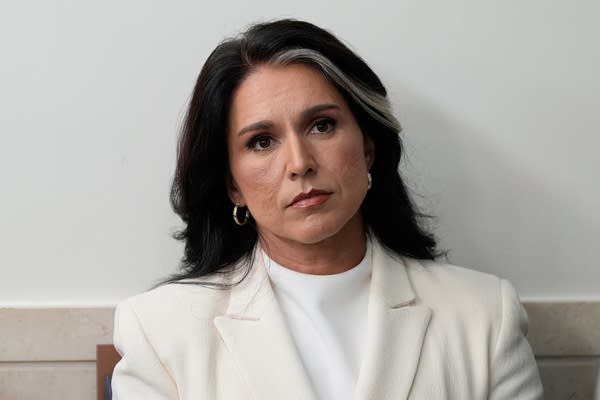
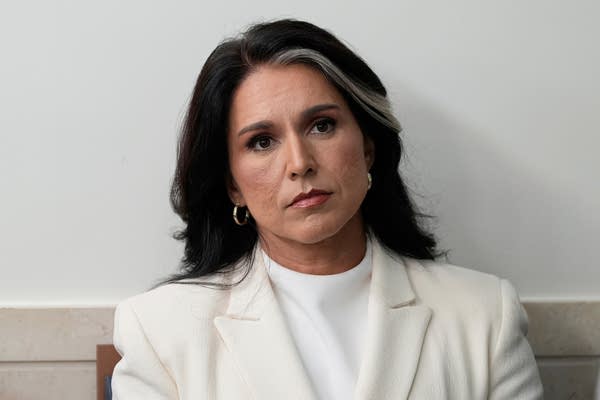
Tulsi Gabbard resigned as President Donald Trump's director of national intelligence on Friday, saying she needed to step away as her husband battles cancer. She is the fourth Cabinet official to depart during Trump’s second term.
In her resignation letter, which she posted on social media, Gabbard said she told Trump of her decision to leave office on June 30. She said her husband had recently been diagnosed with a rare form of bone cancer and “faces major challenges in the coming weeks and months.”
“At this time, I must step away from public service to be by his side and fully support him through this battle,” she wrote in the letter, which was earlier reported by Fox News.
Trump, in his own social media post announcing her resignation, said “Tulsi has done an incredible job, and we will miss her.” He said her principal deputy, Aaron Lukas, will serve as acting director of national intelligence.
During Trump’s first term, Lukas was as an intelligence aide to the acting director of national intelligence, Ric Grenel, in 2020. A former policy analyst at the Cato Institute, a libertarian think tank, he also served as deputy senior director for Europe and Russia at the National Security Council in the final year of Trump’s previous administration.
There had been rumblings that Gabbard would split with Trump after the president's decision to strike Iran, which caused some division within his administration. Joe Kent, the director of the National Counterterrorism Center, announced his resignation in March, saying he “cannot in good conscience” back the war.
Gabbard, a veteran and former Democratic congresswoman from Hawaii, built her political name on her opposition to foreign wars. This put her in an awkward position when the U.S. joined Israel in launching attacks on Iran on Feb. 28.
During a congressional hearing in March, her measured comments were notable for their careful non-endorsement of Trump’s decision to strike Iran. She repeatedly dodged questions about whether the White House had been warned of potential fallout from the conflict, including Iran’s effective closure of the Strait of Hormuz.
Gabbard said in written remarks to the Senate Intelligence Committee that there had been no effort by Iran to rebuild its nuclear capability after U.S. attacks last year “obliterated” its nuclear program. That statement contradicted Trump, who has repeatedly asserted that the war was necessary to head off an imminent threat from the Islamic Republic.
This created several awkward exchanges with lawmakers who asked Gabbard for her opinion on the threat posed by Iran as the nation’s top intelligence official. She repeatedly said it was Trump’s decision to strike, not hers.
“It is not the intelligence community’s responsibility to determine what is and is not an imminent threat,” she said.
Gabbard’s departure follows Trump having ousted Homeland Security Secretary Kristi Noem in late March, in the midst of mounting criticism over her leadership of the department — including the handling of the administration’s immigration crackdown and disaster response.
The second Cabinet member to leave was Attorney General Pam Bondi, in response to growing frustration over the Justice Department’s handling of files related to Jeffrey Epstein. And Labor Secretary Lori Chavez-DeRemer resigned in April, after being the target of various misconduct investigations.
A surprising choice for the job
A veteran but without any intelligence experience, Gabbard was a surprising choice to head the Office of the Director of National Intelligence, which oversees the nation’s 18 intelligence agencies. She ran for president in 2020 on a progressive platform and her opposition to U.S. involvement in foreign military conflicts.
Citing her military experience, she argued that U.S. wars in the Middle East had destabilized the region, made the U.S. less safe and cost thousands of American lives. Gabbard later dropped out of the race and endorsed the ultimate winner, President Joe Biden.
Two years later she left the Democratic Party to become an independent, saying her old party was dominated by an “elitist cabal of warmongers” and “woke” ideologues. She subsequently campaigned for several high-profile Republicans and became a contributor to Fox News.
She later endorsed Trump, who also was a strong critic of past U.S. wars in the Middle East and campaigned on a pledge to avoid unnecessary wars and nation-building overseas.
Iran caused early tensions
But friction with the president started soon after he began his second term and tapped Gabbard to lead ODNI, which was set up after the Sept. 11, 2001, attacks to improve coordination between the nation’s intelligence agencies.
Shortly after taking on the job, Gabbard testified before lawmakers that there was no intelligence suggesting Iran was seeking to develop nuclear weapons. After Trump launched attacks on Iranian nuclear sites in June he said Gabbard was wrong and that he didn’t care what she said.
She appeared to be back in Trump’s good graces when she took a lead role in Trump’s effort to relitigate his 2020 election loss to Biden, whom Gabbard had endorsed. She appeared at an FBI search of election offices in Fulton County, Georgia, even though her office was created to focus on foreign espionage, not state elections.
Earlier this week, however, she testified to lawmakers during an annual threats hearing that last year’s strikes on Iran’s nuclear sites had “obliterated” their nuclear program and that there had been no subsequent effort to rebuild.
The statement seemed to complicate Trump’s repeated assertions that Iran posed an imminent threat and created several awkward exchanges with lawmakers who asked Gabbard for her opinion on Iran’s threat as the nation’s top intelligence official. She repeatedly said that it was Trump’s decision to strike, not hers.
“It is not the intelligence community’s responsibility to determine what is and is not an imminent threat,” she said at one of this week’s hearings.
Gabbard wrought big changes in one year
Gabbard vowed to eliminate what she said was the politicization of intelligence by government insiders. But she quickly used her office to support some of Trump’s most partisan of arguments — that he won the 2020 election.
She also worked to undermine the results of earlier investigations into Trump’s ties to Russia.
In her year on the job, Gabbard oversaw a sharp reduction in the intelligence workforce, as well as the creation of a new task force that she charged with considering big changes to the intelligence service.
Earlier this year an intelligence sector whistleblower filed a complaint that Gabbard was withholding intelligence for political reasons, a complaint that prompted calls from Democrats for Gabbard’s resignation.
Gabbard, 44, was born in the U.S. territory of American Samoa, raised in Hawaii and spent a year of her childhood in the Philippines. She was first elected as a 21-year-old to Hawaii’s House of Representatives but had to leave after one term when her National Guard unit deployed to Iraq.
As the first Hindu member of the House, Gabbard was sworn into office with her hand on the Bhagavad Gita, the Hindu devotional work. She was also the first American Samoan elected to Congress.
During her four House terms she became known for speaking out against her party’s leadership. Her early support for Sen. Bernie Sanders ’ 2016 Democratic presidential primary run made her a popular figure in progressive politics nationally.