SAP HANA Architecture | Complete Guide on SAP HANA Architecture


A Brief Introduction to The SAP HANA:

SAP HANA is in-memory management, data-oriented, and relational development management system developed and produced by SAP SE enterprise corporation. The primary function of SAP HANA is to manage database applications, store, and retrieve the data as requested by the enterprises. SAP HANA stands for “High-performance analytic appliances” and is a combination of both hardware and software appliances. This module is a data foundation technology that offers advanced-level data analytical and multi-dimensional management data-driven applications. SAP HANA product written in JAVA, and C programming languages.

  Become a SAP Hana Certified professional by learning this HKR SAP Hana Training 

SAP HANA – Core Architecture

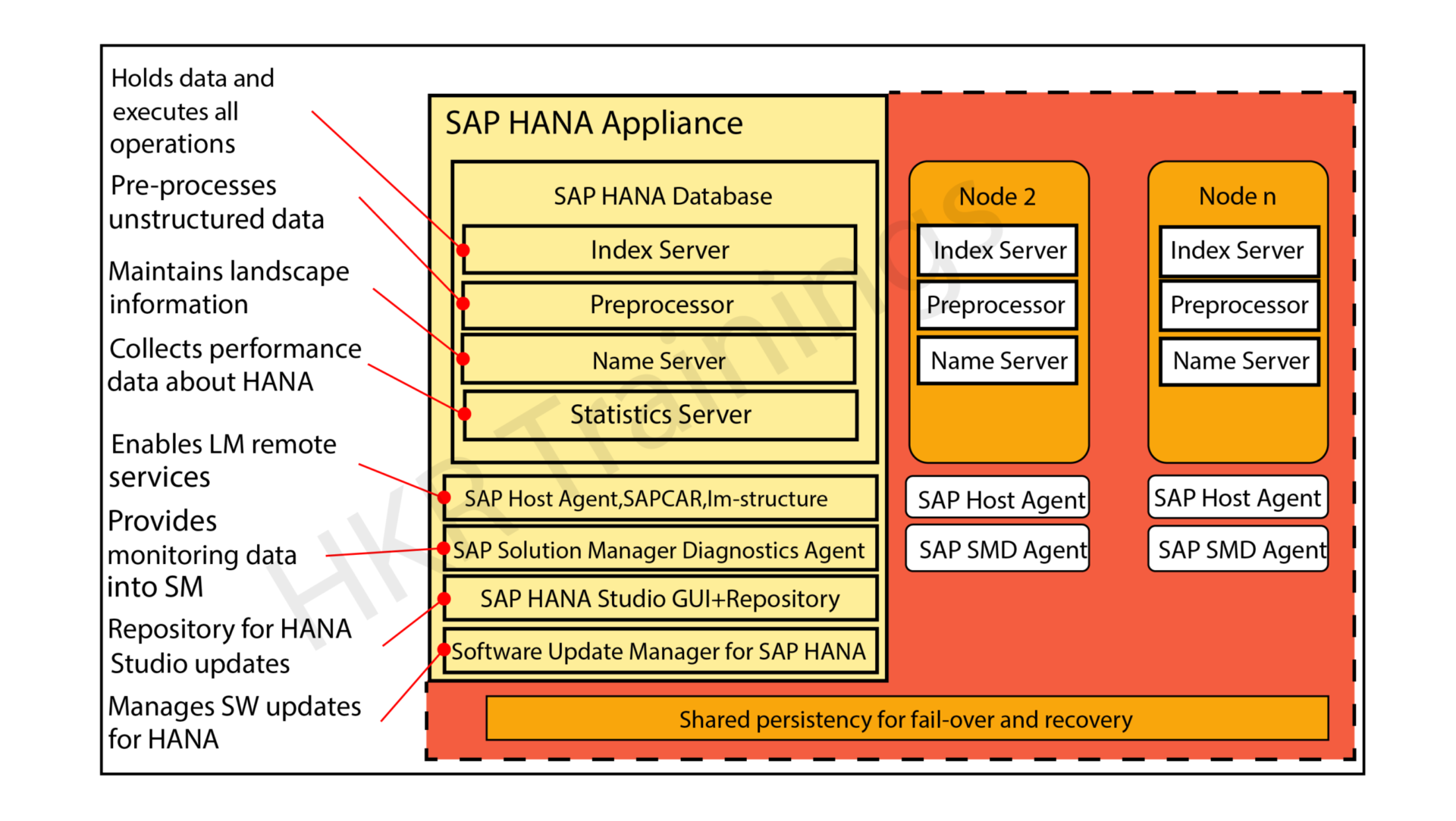
The below diagram explains the core components and work nature of the SAP HANA module:
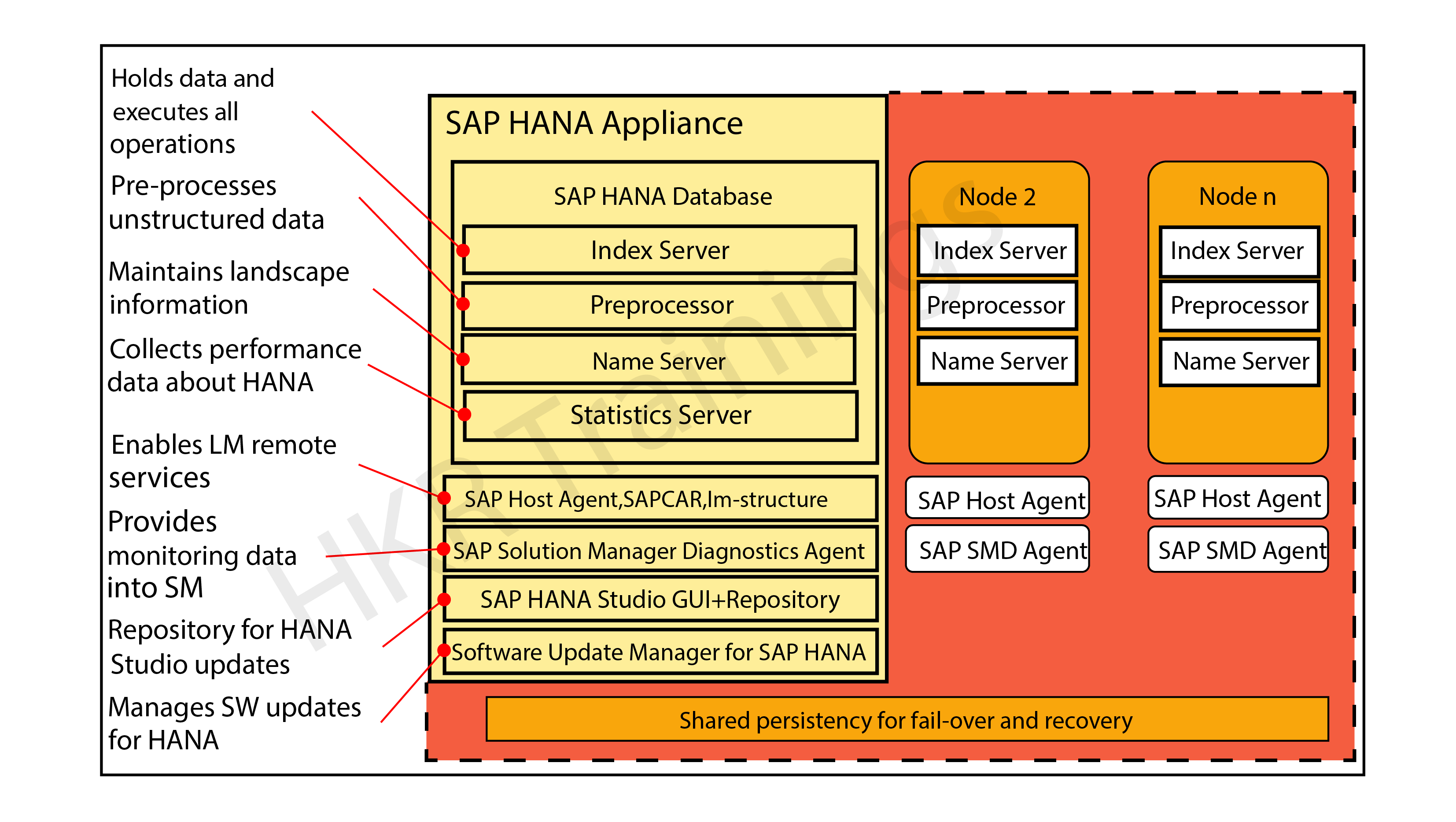
SAP HANA  Core Architecture

As we already know, the SAP HANA platform is developed with the help of C and JAVA programming languages and designed to run on operations systems like LINUX server enterprise edition 11. Sap HANA consists of multiple components that help to perform many activities. The most important component of SAP HANA architecture is an Index server which consists of an SQL/ MDX processor to handle any type of query statement. The SAP HANA system contains different servers like name servers, statistics servers, XS engines, and preprocessor servers. All these servers are used to communicate and host multiple web applications.

 Let’s know the core components one by one:

Index server:

The index server is an important component of SAP HANA architecture. This server is also known as the heart of the SAP HANA database system. An index server contains the original data and engines to process the data. This type of server takes care of the entire data request and processes them when they are mixed with SQL and MDX. The index server also consists of a data engine to handle all the query statements (SQL/MDX). This also holds a persistent layer used to check the durability of the HANA system and restore the data.

This figure illustrates the overall architecture of the Index server:

Index server

In the above diagram, you can see Index server also consists of a session and transaction manager, this is used to manage transactions and keep tracking of them.

SQL/MDX Processor:

The SQL/MDX processor type is responsible for processing the SQL/MDX data transactions with data engines to run different queries. It requests all the segments to correct the engine for performance optimization. In this processor type, data authorization also handles all types of errors. MDX or multi-dimensional expression is a query language used in OLAP systems like sequential query language and relational database management systems. The planning engine is responsible to run the planning operations within the database. The calculation engine converts the data into calculation models to build logical data execution. The stored processor executes the procedure call to optimize data processing. The persistent layer is also responsible to check durability and atomicity in SAP HANA systems and also manages the data and transaction logs to manage data backup, HANA system configuration, and log backups.

Preprocessor: This component of the SAP HANA architecture enables users to preprocess the data.
Name server: This SAP HANA component allows users to maintain landscape information.
Statistics server: This SAP HANA component collects information about the SAP HANA server.

Check It the Sample Resume SAP HANA SAMPLE RESUME!

Why SAP HANA is so popular?

The following are the important features of SAP HANA that make the technology so popular in the current business platform:

1. SAP HANA acts as an eclipse editor and web-based editor (also known as pick-up and drop services) to support the graphical creation of business applications.

2. Provides Source agnostic data access and integration services that allow accessing and indexing external data from across the entire organization. Add these analytical services to existing analytical models.

3. Real-time data analytical processing can be performed to analyze business operations in real-time using the huge volume of detailed information while business happening.

4. Data can be accumulated from many applications and data sources without disturbing in any way that continuing business operation.

5. View of business information can be carried on in a persistent data repository and built again in case of a crash.

Key benefits of the SAP HANA:

After knowing all the major factors and core architecture of the SAP HANA, now it is time to have a basic idea of the key benefits of the tool. It is necessary to know the importance of the platform before relying on implementation.

Below are the few advantages of SAP HANA:

1. Offers in-memory management: this type of in-memory allows for sophisticated data calculations.

2. Acts as calculation engine: In-memory processing gives more time for relatively slow updates to column data.

3. Provides massively parallel processing: MPP optimized software enables linear performance scaling making sophisticated calculations like allocations possible.

4. Larger storage: The columnar storage increases the amount of data that can be stored in limited memory (compared to disk).

5. Row +Column database: Column databases enable easier parallelization of queries. And Row database provides fast transactional processing.

SAP HANA Tutorials for beginners get started with your SAP carrier 

HKR Trainings Logo

Subscribe to our YouTube channel to get new updates..!

Differences between SAP and SAP HANA:

We think that before getting into the SAP HANA, it is mandatory to know the standard differences between the SAP and SAP HANA. Let us know them one by one:

SAP:

1. SAP is a traditional ECC business enterprise application.

2. In SAP, nearly all the SAP transaction codes are available and there is no concept of data simplification.

3. it’s easy to access all the functional modules of SAP and helps you to create real-time data reporting.

4. Also offers additional performance and the SAP solution also boasts amended transactions.

5. Upgrade to ECC6 enhancement package 7 and then perform a database management activity.

SAP HANA:

1. Helps to rebuilt to capitalize the significant simplification that the SAP HANA platform provides.

2. This is a packaged solution that has SAP ERP at its core optimized to run on the HANA platform.

3. Helps to integrate and leverage various solutions and technologies in SAP arsenal.

4. Achieve data simplification. This is achieved by replacing the core tables within certain processes with a single table.

5. SAP HANA is designed with SAP flori for a richer user experience and is easily configurable on cloud technology.

Different types of SAP HANA system monitors:

The SAP HANA system monitors are used to control various tasks like Log disks, Data Disks, trace disks, and alerts on resource usage.

Let me explain them one by one:

1. System ID: this helps in the ID assigned to the system when added to the studio environment.

2. Operational state: maintains the overall system status.

3. Alerts: This monitor is used to check the system issue alerts when resource usage and thresholds are violated. In general, these alerts are categorized into low, medium, or high priority.

4. Data Disks in (GB): this indicates the size of the data volume available on disk.

5. Log disks in (GB): this indicates the size of the log volume on the disk.

6. Database Resident Memory management: this indicates the size of the memory used in an operating system to manage SAP HANA database processes.

7. Used memory: Here is the amount of physical memory that is used by the SAP HANA database.

8. CPU in (%): This helps to know the percentage of CPU that has been used by the SAP HANA database.

9. Hostname: it indicates the name of the server hosting used in the SAP HANA database.

10. Instance Number: here the Instance number is the administrative unit that consists of the various server software components.

11. System trace disk in GB: it gives the total disk space used on the disk that contains trace files.

12. System physical memory in GB: this gives the total amount of physical memory used.

13. Distributed: this indicates whether the system is running on any single web host or this will be distributed in the system.

14. Start time first: this indicates when the time that first started and value is restarted for any important reason.

15. Versions: this indicates the software versions of the SAP HANA environment studio.

16. Platform: this indicates the different operating systems where the SAP HANA studio is running.

17. Number of crash dump files: here is the number of crash dump files removed in the SAP HANA system.

Top 30 Frequently asked SAP HANA Interview Questions 

SAP Hana Training Certification

Weekday / Weekend Batches

Final words:

SAP ERP market is booming like a rocket and it is a good career choice to pursue your IT profession latest Gartner report. The real reason behind developing this SAP HANA architecture is to get some knowledge concerning workflow and design factors. Reading this post has given our readers a complete idea to learn and explore concepts like Key benefits, reasons for SAP HANA’s popularity, differences between SAP and SAP HANA, and the architecture components. 

Related Articles:

  1. SAP HANA Modules


Source link

Leave a Reply

Subscribe to Our Newsletter

Get our latest articles delivered straight to your inbox. No spam, we promise.

Recent Reviews


What is SAP Ariba – Table of Content

What is SAP Ariba?

SAP Ariba is a cloud-based procuration solution to perform business-related transactions on a single platform. SAP Ariba module easily integrates with other SAP ERP modules without using any middleware or is easy to customize as per the business requirements. The benefit of the SAP Ariba module as it offers out-of-the-box functionalities to buyers and suppliers to perform business-related operations and offers effective benefits to procurement management. In today’s world, we need a tool that controls supply chain management and enables us to collaborate with suppliers in an effective way. SAP Ariba digitally transfers your supply chain and helps the organization to grow its business globally. The Ariba solution was first developed in 1996, and in 2012 the SAP was acquired at a total cost of 4.3 billion USD, thus we call it SAP Ariba. 

Want to Become a Master in SAP Success Factors? Then visit here to learn SAP Ariba Training  from hkrtrainings

Overview On SAP Arbia :

SAP Ariba defines how companies connect to get business done, using the marketing leading solutions for the collaborative commerce and Ariba network. Ariba application also helps buyers and suppliers from more than 2 million businesses and 190 countries discover new opportunities, collaborate on transactions, and grow their relationships. Selecting an Ariba implementation partner is perhaps the most important thing about jumping on the Ariba ship. With several Ariba partners out there it becomes difficult in choosing the right one that suits your business. 

What is SAP Ariba is used for?

We said it in the beginning, SAP Ariba is a cloud-based solution that helps to perform business transactions (buy, sell or purchase) efficiently. It also maintains the supply chain management solutions and integrates with other SAP ERP functions. 

We would like to list a few advantages of SAP Ariba;

  • Ariba is how companies connect to get business done, using the marketing leading solutions for collaborative commerce and Ariba network.
  • Ariba helps buyers and suppliers from more than 2 million businesses and 190 countries discover new opportunities, collaborate on transactions, grow their businesses.
  • Selecting an Ariba implementation partner is perhaps the most important thing about jumping on the Ariba partners out there, it becomes difficult choosing the right one that suits your businesses.
  • SAP Ariba helps to manage the project for the implementations in the organizations.
  • Responsible for project schedule, development, testing, execution, and delivery.
  • Helps users to utilize the features included in your subscription and functional tips on how to optimize features and reporting tools.
    Responsible for a successful Go live.

Related Article: What is SAP IBP

Types of SAP Ariba :

The following are the types of SAP Ariba:

  • Ariba collaborative sourcing : sourcing and contracts in the cloud.
  • Ariba spends visibility : Data enrichments and spends visibility in the cloud.
  • Ariba procurement on demand : On-demand requisitions to invoice solutions.
  • Ariba collaborative finance : Network efficiency for finance.
  • Ariba collaborative commerce : Extending network efficiencies to all B2B trading partners.

SAP Ariba Training

  • Master Your Craft
  • Lifetime LMS & Faculty Access
  • 24/7 online expert support
  • Real-world & Project Based Learning

What makes SAP Ariba is different from SAP on-premise applications?

The following are the major differences between the SAP Ariba and SAP on-premise solution.

Before beginning with explaining the differences between these two functional modules, we would like to explain a few things about SAP on-premise solution;

Note :

SAP On-premise : 

  • On-premise is an Enterprise business planning suite that is based on in-memory database management.
  • On-premise is an internal platform so that it will run from the company’s servers when users access it.
  • Most of the large companies prefer to implement on-premise SAP ERP edition this is because offers a full range of functionalities and highly monitoring customer applications.
  • The industries which use on-premise SAP ERP applications are financing, accounting, material management, supply chain management, marketing, and sales industries.
  • The features of on-premise editions include are;
  1. Database-driven 
  2. Networking 
  3. Customization.

Let’s know the differences between SAP Ariba and SAP on-premise solution based on the few features;

Spend Analysis:

  • The on-premise solution offers SAP spend performance management.
  • Whereas SAP Ariba spends visibility.

Sourcing : 

  • SAP on-premise solution performs SAP sourcing and SAP SRM.
  • SAP Ariba performs Ariba sourcing and Ariba discovery.

Contract management : 

  • The on-premise solution provides SAP contract lifecycle management and SAP SRM.
  • Whereas SAP Ariba provides contract management too.

Operational procurements : 

  • SAP on-premise solution offers operational procurement services to the modules like MM (material management), SRM, and SAP commodity procurements.
  • SAP Ariba procure-to-pay, service procurements, and procurement contents.

Invoice management :

  • SAP on-premise solution performs invoice management by open text.
  • Ariba offers invoice management, payment management, and discount management.

Supplier information management : 

  • SAP on-premise solution offers entire Supplier information lifecycle management.
  • Ariba also provides supplier information and performance management.

Salient features of SAP Ariba :

Below are a few key features of the SAP Ariba;

Fast time-to-value : 

  • Get underway quickly in the cloud, enjoying lower TCO and anyways current versions with minimal demands on IT.
Easy-to-use : 
  • Creates contracts quickly and easily using Microsoft Word and Pre-approved templates and legal clauses. 
Controlled processes : 
  • You will be alerted if the pre-approved format or language is modified, helping you control non-standard agreements.
Efficient Collaboration :
  • Work quickly and effectively with all stakeholders via a shared workspace on a multi-tenant, and web-based platform.
Complete visibility : 
  • Stay informed throughout the contract cycle with automatic alerts handy dashboards, and configurable reports.  
Central repository : 
  • Never lose track of a contract with secure, electronic storage, and powerful search tools for access on demand.
On-time renewal : 
  • Receive notification well in advance of the key milestone dates, and make the most of your business opportunities. 
E-signature savings :   
  • Eliminate the time and expense of shipping and signing the multiple contracts copies by adding e-signature capability.
Stronger compliance : 
  • Stay informed about any off-contract activity with controlled processes, automated tracking, and a full audit trail. 
End-to-end commerce : 
  • Integrate your contract processes with additional SAP Ariba solutions, your ERP, or other third-party systems for unrivaled compliance and control.

Frequently Asked Questions SAP Ariba Interview Questions 

HKR Trainings Logo

Subscribe to our YouTube channel to get new updates..!

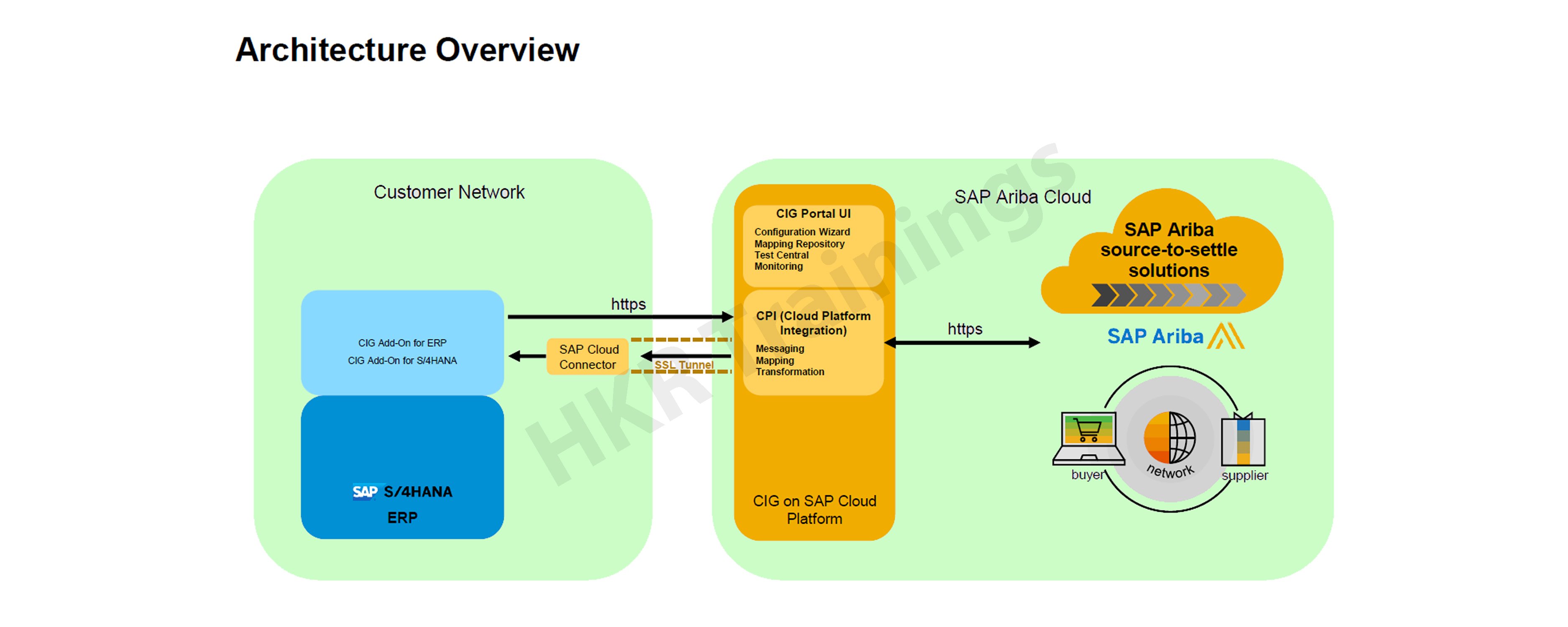
SAP Ariba architecture : 

In this section, we are going to explain the overall architectural overview, its work nature, and the data connectivity. SAP Ariba is the world’s leading B2B solution, this architecture is designed to perform world-class procurement business transactions.

SAP Ariba architecture

SAP Ariba delivers intelligent solutions that enable users to combine data with the latest technologies to improve the procurements and also SCM (supply chain management) services. SAP Ariba architecture is a suite of spend management solutions that is a key component of SAP’s strategy to help organizations to become intelligent enterprises.

 The core infrastructure of the SAP Ariba architecture:

  • Semantic search : the semantic search approaches enhance the user experience by applying the latest machine learning technologies to analyze each query, deliver higher results, and higher quality results.
  • Security : SAP Ariba provides everything from multi-factor authentication to data encryption with numerous security standards and audits. So SAP Ariba offers a high degree of protection for your business.
  • Microservices : the SAP Ariba platform evolving to a microservices-based architecture that simplifies the building tasks and maintains the applications to meet business requirements with greater productivity, and flexibility.
  • Master data service : SAP Ariba integrates with various ERP modules, with respect to that SAP HANA helps to manage master data easily with a centralized data store.

Get ahead in your career with our  SAP Ariba Tutorial !

SAP Ariba Training

Weekday / Weekend Batches

Final words :

We believe that after reading this SAP Ariba post, you might have gained knowledge and skillsets. SAP Ariba is considered to be one of the primary cloud applications that we can see in today’s ERP. application. With the help of this post, you would have become a master with respect to the SAP Ariba fundamental concepts. We have been trying our best to develop all the posts under the experts’ guidance to keep you updated with the recent developments.

Related Article


Source link