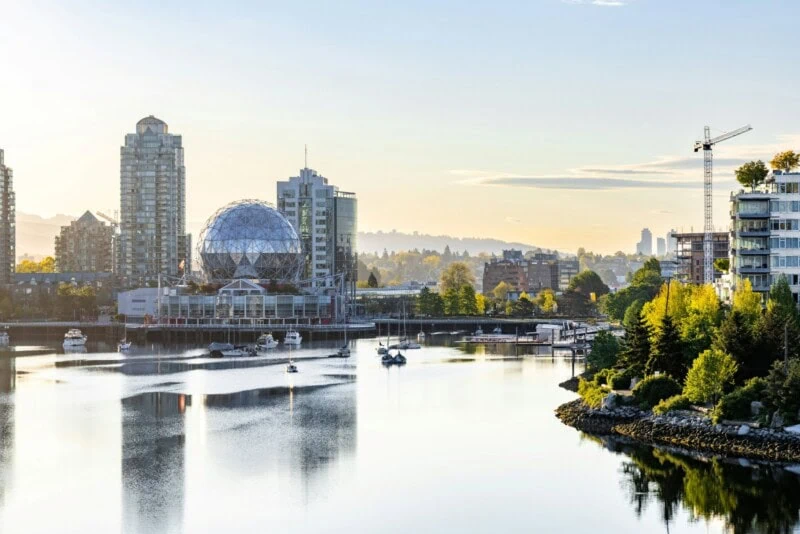

Vancouver’s skyline looks something like a dreamscape..
Mountains that rise directly from the water. A downtown skyline with the Coast Mountains immediately behind it – close enough that you can see the snow on the peaks from the streets. Ocean to the west, forest to the north, a harbor threading through the middle of it all. The light here in summer – long days, the sun setting over the Pacific at 9pm, the way it catches the mountains in the late afternoon – produces views that seem compositionally impossible for a real, working city.
Vancouver is quiet about all of this. The culture is low-key and outdoor-obsessed. Often described as “muted” – in color palette, in dress, in social temperature. Vancouver is reserved, not unfriendly. It reveals itself slowly. Beneath that surface: one of the most serious Asian food cities in North America, the best outdoor recreation access of any host city in the tournament, and a natural setting that stops people mid-sentence.
Anthony Bourdain said it was a great food city. He was right.
The World Cup arrives with seven matches at BC Place – including two Canada matches, a Round of 32, and a Round of 16. Vancouver is the deepest-running Canadian city in the tournament. If Canada makes the round of 16, they may play it here. This Vancouver World Cup 2026 Guide will get you ready for how it all unfolds
Why Vancouver for World Cup 2026

Vancouver is Canada’s third-largest metro area – approximately 2.5 million people – and one of the most visually stunning skylines in all North America. It sits where the Pacific Ocean meets the Coast Mountain range, which means that from essentially anywhere in the city, the combination of water and mountains is in your line of sight. Stanley Park – 405 hectares of old-growth forest on a peninsula jutting into Burrard Inlet – is within walking distance of downtown. The seawall that circles the park and continues along the waterfront is 28 kilometers of continuous car-free path.
The food scene is one of the best in North America and consistently underestimated. The Chinese food in Richmond – a suburb that is approximately 40% ethnic Chinese – is considered by many food writers to be the best in North America outside of Hong Kong itself. The Japanese food on Robson Street and in the West End reflects one of the largest Japanese-Canadian communities on the continent. The dim sum, the ramen, the sushi, the Vietnamese pho on Kingsway – the Asian food specifically is a revelation even for visitors from major American food cities.
The outdoor recreation access here is in a different category from any other 2026 host city. Whistler Blackcomb – consistently ranked among the top ski resorts in the world – is 2 hours north by car. The North Shore mountains (Grouse, Seymour, Cypress) are 30 minutes away and offer hiking, cycling, and year-round outdoor activity. Sea kayaking on the Indian Arm, surfing at Tofino, whale watching from the inner harbor – the natural assets around Vancouver are so extensive that locals often describe the city as the best base camp in the world.
Greenpeace was founded in Vancouver. The California roll was invented here. Botox was developed here. The city has a specific kind of Pacific-facing, environmentally-conscious, culturally diverse character that is genuinely distinct from anything else in North America.
The Vancouver World Cup Strategy
- Stay in Downtown Vancouver, Yaletown, or Gastown – BC Place is a 5-minute walk from the downtown core. All three neighborhoods give you direct access to the stadium, the seawall, and the city’s restaurant and bar scenes.
- Take the SkyTrain everywhere – Vancouver’s SkyTrain is exceptional by North American standards – clean, frequent, reliable, and covering key routes including from YVR airport directly to downtown. Expo Line to Stadium-Chinatown station is a 2-minute walk from BC Place.
- Plan outdoor time deliberately – The natural assets within reach of Vancouver are the best argument for arriving a day or two before your first match. Stanley Park seawall, a North Shore hike, or a day trip to Whistler – these are the experiences that separate a Vancouver trip from any other stop on the host city list.
- Bring a rain layer – June in Vancouver is the beginning of the dry season – significantly drier than winter – but rain is possible. A packable waterproof jacket is always worth having.
- Go to Richmond for food – The Chinese food in Richmond is, for many food writers, the best in North America outside Hong Kong. 20 minutes by SkyTrain from downtown. Do not skip it.
- Check entry requirements – Non-US, non-Canadian visitors may need an Electronic Travel Authorization (eTA) to enter Canada. Check the Government of Canada immigration website well in advance.
BC Place – What to Know

BC Place is the largest stadium in British Columbia and home to both the Vancouver Whitecaps FC (MLS) and the BC Lions (CFL). It hosted the 2015 FIFA Women’s World Cup Final – where USA defeated Japan 5–2 – and has been a proven major tournament venue.
The stadium sits on the south shore of False Creek in downtown Vancouver, with the city skyline visible from its upper concourses. The distinctive white fabric roof – a cable-supported retractable dome – is one of the most architecturally recognizable stadium structures in Canada.
During the 2026 World Cup it will be officially known as Vancouver Stadium under FIFA naming requirements.
Key stadium facts:
- Capacity: 54,000 (World Cup configuration)
- Retractable roof – matches will be played in a controlled indoor environment regardless of weather. Rain in Vancouver is irrelevant on match day.
- The retractable roof also means the acoustics are extraordinary when closed – the atmosphere of a full BC Place under the dome is unlike any open-air stadium on the host list
- Hosted the 2015 Women’s World Cup Final, the 2010 Olympic ceremonies, and the 2011 Grey Cup
Getting there – SkyTrain Expo Line to Stadium-Chinatown station – 2-minute walk to the stadium entrance. The Canada Line from YVR airport connects to downtown and Yaletown-Roundhouse, a 10-minute walk. From almost any downtown hotel, BC Place is reachable on foot in under 15 minutes.
Do not drive – Downtown Vancouver parking on match days will be limited and expensive. The SkyTrain is the answer – and one of the best transit-to-stadium experiences on the World Cup host city list.
The retractable roof advantage – Every other outdoor match on the 2026 schedule is weather-dependent. BC Place is not. Rain, cold, wind – none of it affects the match experience. And when the roof is closed, the sound doesn’t escape – it stacks. A full Canada match here will feel closer to a European indoor arena than an open-air North American stadium. For fans from tropical climates attending their first Canadian summer event, this matters more than they’ll expect.
Arrive 60-90 minutes early for Canada matches – The June 18 Canada vs. Qatar match will draw significant national support, and the stadium area will be full well before kickoff.
The 2026 World Cup Matches at BC Place
Based on the official FIFA release schedule (January 29, 2026), Vancouver Stadium will host 7 matches – 5 group stages, 1 Round of 32, and 1 Round of 16. Vancouver is the deepest-running host city in Canada.
|
Match |
Teams |
Date |
Time (PT) |
Stage |
|
Match 6 |
Australia vs. UEFA Playoff C Winner |
Friday, June 13 |
9:00 PM |
Group D |
|
Match 27 |
Canada vs. Qatar |
Thursday, June 18 |
3:00 PM |
Group B |
|
Match 40 |
New Zealand vs. Egypt |
Sunday, June 21 |
6:00 PM |
Group G |
|
Match 51 |
Canada vs. Switzerland |
Wednesday, June 24 |
12:00 PM |
Group B |
|
Match 64 |
New Zealand vs. Belgium |
Friday, June 26 |
8:00 PM |
Group G |
|
Match 85 |
Group B Winner vs. 3rd Place (D/E/I/J/L) |
Thursday, July 2 |
8:00 PM |
Round of 32 |
|
Match 96 |
TBD |
Tuesday, July 7 |
1:00 PM |
Round of 16 |
The Canada matches – Canada plays two of their three group stage matches in Vancouver – June 18 vs. Qatar and June 24 vs. Switzerland. If Canada wins Group B, they play the Round of 32 on July 2 at BC Place. If they advance to the Round of 16, they could play that here on July 7. Vancouver is the city where Canada could potentially play four World Cup matches at home – the deepest possible home run for any Canadian fan.
Belgium (June 26) – Belgium are ranked among the top sides in world football. The June 26 New Zealand vs. Belgium match closes out Group G and has knockout implications. Belgium has a large diaspora community in Western Canada.
The Round of 16 – On July 7 is the latest match at any Canadian venue – and if the draw is favorable, could involve major national teams. This is the fixture most worth monitoring as the group stage develops.
Where to Stay in Vancouver for World Cup 2026
Downtown / West End
BC Place is a 5–15 minute walk from most downtown hotels. The West End – the residential neighborhood immediately west of downtown – has good hotel options, is walkable to Stanley Park, and provides easy access to the stadium. The central location cannot be beaten for match-day logistics.
Best for: Transit-focused visitors, fans attending multiple matches, anyone wanting maximum convenience.
Yaletown
The converted warehouse district directly adjacent to BC Place – the closest neighborhood to the stadium. Excellent restaurants, the False Creek seawall, a good balance of boutique hotels and upscale options. For World Cup visitors, this is the optimal base.
Best for: Match-going fans who want neighborhood character with direct stadium access.
Gastown
Vancouver’s oldest neighborhood – cobblestone streets, the famous Steam Clock, heritage brick buildings, excellent restaurants and bars. A 20-minute walk to BC Place. More character than downtown core.
Best for: Visitors who want the historic city feel and don’t mind a slightly longer walk to the stadium.
Kitsilano
Across the Burrard Bridge from downtown – beach access, mountain views, the city’s yoga-and-coffee outdoor culture in concentrated form. Longer to the stadium but a beautiful base if you’re spending significant time outdoors.
Best for: Outdoor-focused visitors, anyone combining beach time with the tournament.
Getting Around Vancouver

SkyTrain – Vancouver’s rapid transit system is one of the best in North America – fully automated, frequent, clean, and covering the key corridors visitors need. Three lines:
- Expo Line: Surrey to downtown, passes Stadium-Chinatown (BC Place, 2-minute walk)
- Millennium Line: Connecting east neighborhoods to downtown
- Canada Line: YVR Airport to downtown to Richmond – the most important line for visitors
A Compass Card (reloadable transit card) works across all SkyTrain, bus, and SeaBus services. Buy at any SkyTrain station including the airport.
From YVR airport – Canada Line from YVR to Waterfront Station – approximately 25 minutes, around $10 CAD. One of the best airport-to-downtown rail connections in North America. Far superior to taxis or rideshare. Buy tickets at the airport station.
Walking and cycling – Downtown Vancouver and the seawall are exceptionally walkable and bikeable. Mobi bike share operates throughout the downtown core. The seawall from BC Place to Stanley Park is one of the great urban cycling routes in the world.
Driving – Useful for day trips to Whistler, the North Shore, or the ferry to Victoria. Not recommended within the city on match days – parking is expensive and the downtown grid is compact enough to make walking and transit faster.
Where to Eat in Vancouver

Vancouver’s food scene is one of the most underrated in North America. The Asian food specifically – shaped by one of the largest Asian communities on the continent – is the city’s genuine culinary claim to fame.
Richmond – The Chinese Food Destination
Richmond is not technically Vancouver, but it’s 20 minutes by Canada Line SkyTrain and the reason serious food people make the trip. The concentration of Chinese regional cuisines here – Cantonese, Shanghainese, Sichuan, dim sum, hot pot, Taiwanese breakfast – is extraordinary. Golden Village on No. 3 Road is the commercial heart, but every strip mall contains something worth eating.
Sushi and Japanese Food
Vancouver has one of the most significant Japanese-Canadian communities in North America. The result is sushi that is both technically excellent and significantly more affordable than comparable quality in Tokyo or New York.
- Miku – Downtown waterfront, aburi (flame-seared) sushi, one of the best Japanese restaurants in Canada
- Tojo’s – West Side, the restaurant where the California roll was invented. Hidekazu Tojo, still cooking.
- Minami – Yaletown, sister restaurant to Miku, excellent aburi program
Commercial Drive (“The Drive”) – Vancouver’s Italian-immigrant neighborhood that has evolved into a multi-cultural dining and coffee corridor. Italian bakeries, Ethiopian restaurants, Vietnamese cafés, the best independent coffee shops in the city. One of the great walking food streets in Canada.
Granville Island – A former industrial island under the Granville Bridge, converted into a public market, artist studios, and restaurants. The Public Market is one of the best food markets in Canada – local produce, seafood, charcuterie, and prepared food stalls. Go for lunch on a weekday to avoid weekend crowds.
Specific restaurants:
- Hawksworth Restaurant – Downtown, elevated Canadian cuisine, one of the finest restaurants in the city
- Bao Bei – Gastown, Chinese brasserie, inventive, one of the most interesting restaurants in Vancouver
- The Acorn – Main Street, vegetable-forward, genuinely exceptional, worth the trip even for confirmed carnivores
- The Farmhouse – Mount Pleasant, cozy dining specializing in Italian farm-to-table dishes
Where to Drink and Watch Games in Vancouver

Gastown – The bar district – Blood Alley and the surrounding streets have the highest concentration of interesting bars in the city. Heritage brick buildings, cocktail bars, craft beer spots.
- Alibi Room – Gastown, a craft-beer hotspot with more than 50 brews on tap
- Guilt & Co. – Gastown, underground live music venue and bar, one of the best evening options in Vancouver
- The Keefer Bar – Gastown, Chinese-inspired cocktail program, beautiful space
Yaletown – More polished, slightly more corporate, good for match-day atmosphere near BC Place.
Kitsilano Bars – More neighborhood, casual, outdoor-patio focused. Good for non-match day evenings.
FIFA Fan Festival – The official FIFA Fan Festival will be held at Hastings Park (PNE Amphitheatre) – a large public park and entertainment venue in East Vancouver. Live match screenings, cultural programming, food vendors. Free entry, family-friendly.
Soccer culture – Vancouver Whitecaps have built a genuine MLS supporter culture – the Southsiders are one of the more organized supporter groups in the league. For Canada matches at BC Place, that same organized energy translates to national team support.
Best Tours and Experiences in Vancouver
Stanley Park
405 hectares of old-growth forest on a peninsula in the heart of the city. The seawall around the park is 9 kilometers of continuous waterfront path – one of the great urban walks in the world. Totem poles, beaches, the Vancouver Aquarium, and views of the Lions Gate Bridge and the North Shore mountains. Free to enter, accessible from anywhere downtown on foot.
Capilano Suspension Bridge
A 450-foot suspended wooden footbridge across a canyon in North Vancouver, 70 meters above the river. One of the most-visited attractions in British Columbia. Go early in the morning to beat the crowds. The Cliffwalk extension adds a dramatic glass-and-steel walkway along the canyon face.
Grouse Mountain
30 minutes from downtown by SkyTrain and bus. The gondola ride up gives you panoramic views over the city, the harbor, and on clear days the entire Salish Sea. Grouse Grind – the trail up the face of the mountain – is a Vancouver rite of passage and one of the more brutal accessible hikes on the host city list.
Whistler
2 hours north on the Sea-to-Sky Highway – one of the great scenic drives in the world. Whistler Blackcomb is consistently ranked in the top three ski resorts globally. In summer: mountain biking, hiking, the Peak 2 Peak gondola, and the village. Pique Newsmagazine once described a day in Whistler as “arriving in a small Swiss village at the foot of mountains that make Switzerland look manageable.” Give it a full day.
Victoria & Vancouver Island
BC Ferries from Tsawwassen takes 1.5 hours. Victoria is one of the most charming capital cities in Canada – afternoon tea at the Empress, the Inner Harbour, Butchart Gardens. For visitors with an extra day, it is worth the ferry.
Whale Watching
Orcas, humpbacks, and grey whales are regularly seen in the waters around Vancouver Island. Multiple operators run tours from downtown Vancouver and from Victoria.
Beyond the Game – Vancouver in June

The Seawall – 28 kilometers of continuous waterfront path connecting Stanley Park, English Bay, False Creek, and the Olympic Village. Flat, beautiful, and the organizing spine of outdoor Vancouver. Rent a bike from Mobi and follow it in either direction for as long as you have.
Granville Island – See the food section. Go on a weekday. The artist studios and galleries add to the market experience.
English Bay – The beach in the West End. Vancouver’s most accessible beach – a short walk from downtown, mountain views across the water, the city behind you. Sunset at English Bay in summer is a Vancouver institution.
North Shore Mountains – Grouse, Seymour, and Cypress mountains are all within 30–40 minutes of downtown and collectively offer more hiking terrain than most entire national parks elsewhere.
Day Trips:
- Whistler – 2 hours. Non-negotiable for outdoor travelers.
- Victoria / Vancouver Island – 1.5-hour ferry. Beautiful, distinctly different from Vancouver.
- Squamish – 45 minutes north, halfway to Whistler. World-class rock climbing (the Stawamus Chief), Sea-to-Sky Gondola, Garibaldi Provincial Park access.
- Tofino – 5 hours (or 30 minutes by float plane). The Pacific surf coast, old-growth rainforest, and one of the most dramatic natural settings in Canada. Worth it if you have the time.
Vancouver Fan Culture
Vancouver has a genuine soccer culture built over decades of Whitecaps history and a significant international community – particularly from the UK, Australia, Asia, and the Pacific. Over 50% of Vancouver residents have a first language other than English, making it, like Toronto, a city where every World Cup match will have significant national representation already present in the city.
BC Place hosted the 2015 Women’s World Cup Final to a crowd of 53,341 – the largest attendance at any women’s football match in Canadian history – demonstrating both the stadium’s capacity for major tournament atmosphere and British Columbia’s proven appetite for the game at the highest level.
The Australia and New Zealand matches at BC Place will draw large contingents from the substantial Oceanian communities across British Columbia. Belgium’s June 26 match will bring organized European fan groups.
For Canada matches: the British Columbia soccer community has been building toward this moment for years. The Canada SheBelieves Cup win in 2020 and the men’s qualification for Qatar 2022 created a national football moment that has been building toward the home World Cup. Vancouver’s two Canada group stage matches – with potential knockout games at the same venue – could make BC Place the heart of the Canadian World Cup story.
Who Should Choose Vancouver?
- Canada supporters – Two group stage matches here, potential Round of 32 and Round of 16. The deepest possible Canada home run.
- Outdoor and adventure travelers – Whistler, the North Shore, kayaking, the seawall, whale watching. The best outdoor access of any host city in the tournament.
- Food obsessives – The Asian food scene, particularly in Richmond, is world-class. The sushi, the dim sum, the ramen – this is the specific food identity of Vancouver and it’s extraordinary.
- Australia and New Zealand supporters – Australia plays June 13, New Zealand plays June 21 and 26. Both Oceanian communities are large and well-organized in Western Canada.
- Travelers combining West Coast cities – Vancouver, Seattle, and San Francisco form a natural Pacific Coast World Cup itinerary. Vancouver is the northern bookend.
- Anyone who wants the most dramatically located host city setting – The mountains-and-ocean combination is singular in the tournament. “It looks like a fantasy, but it’s real.”
Vancouver World Cup Weather Guide
June in Vancouver:
- Highs: 68–75°F (20–24°C) – warm, never oppressive
- Lows: 54–58°F (12–14°C) – cool evenings
- Rain: June marks the beginning of the drier season – significantly less rain than winter, but occasional showers remain possible
- The retractable roof at BC Place means match-day weather is completely irrelevant – games are played in controlled indoor conditions
What this means: June is Vancouver at its best – long days, warm but not hot, the mountains clear of their winter cloud cover. The city’s famous grey-sky reputation is largely a winter and spring phenomenon. June is typically clear and beautiful. Pack a light layer for evenings and a packable rain jacket for the occasional shower. Sunscreen for outdoor time.
Mountain weather: Day trips to Whistler or the North Shore can be significantly cooler. Pack an extra layer if hiking at elevation.
See our complete FIFA World Cup 2026 Packing List for everything else.
Biggest Mistakes World Cup Visitors Make in Vancouver
Not going to Richmond for food – The Chinese food in Richmond is, for many serious food writers, the best in North America outside of Hong Kong. It is 20 minutes by SkyTrain. Skipping it for a restaurant near your downtown hotel is one of the most common and most correctable mistakes visitors make.
Skipping Whistler – Two hours north. One of the world’s great mountain destinations. In summer: gondola, hiking, village, unreal scenery. If you have a non-match day and outdoor inclination, this is the day trip.
Only walking in the tourist zone – Gastown and Robson Street are fine. Commercial Drive, Main Street, Kitsilano, and Richmond give you a more complete picture of what the city actually is.
Expecting the weather to be terrible – June in Vancouver is genuinely beautiful. The grey-sky reputation is a winter thing. Don’t pack for the monsoon season.
Driving downtown – The SkyTrain goes everywhere you need. Parking downtown is expensive and the streets are compact. The transit system is excellent by North American standards – use it.
Missing the seawall – 28 kilometers of continuous waterfront path, free, accessible from every downtown hotel, one of the great urban walks in the world. If you don’t walk or bike at least part of it, you’ve missed the experience that most defines the city.
Vancouver World Cup FAQ
Where is BC Place?
On the south shore of False Creek in downtown Vancouver. During the World Cup it will be officially known as Vancouver Stadium. SkyTrain Expo Line to Stadium-Chinatown station – 2-minute walk.
How do I get from YVR airport to downtown Vancouver?
Canada Line SkyTrain from YVR to Waterfront Station or Yaletown-Roundhouse – approximately 25 minutes, around $10 CAD. Far better than taxi or rideshare. Buy a Compass Card at the airport station.
Do I need a visa or eTA to enter Canada?
Depends on your nationality. Many countries require an Electronic Travel Authorization (eTA) rather than a full visa. Check the Government of Canada immigration website at canada.ca well in advance of travel.
What is the weather like in Vancouver during the World Cup?
June is Vancouver at its best – warm, increasingly dry, long days. Highs around 68–75°F. The retractable roof at BC Place means rain is irrelevant on match days. Pack a light jacket for evenings.
Is BC Place indoors or outdoors?
BC Place has a retractable roof. Matches will be played under a closed roof regardless of weather – a significant advantage for fans uncertain about Canadian summer rain.
What should I not miss in Vancouver?
Stanley Park seawall, Richmond for Chinese food, Capilano Suspension Bridge, at least one night in Gastown, a day trip to Whistler or Squamish, and English Bay at sunset.
What is the must-eat food in Vancouver?
Dim sum or Cantonese seafood in Richmond – non-negotiable. Aburi sushi at Miku. A meal on Commercial Drive. And a California roll at Tojo’s, where it was invented, at least for the story.
Conclusion
One photo from a morning jog in Stanley Park. Mountains behind the skyline. Ocean in the foreground. A city that looks like someone designed it to be impossible.
Vancouver doesn’t announce itself. It doesn’t need to. Mountains behind the skyline. Ocean out front. The seawall is 28 kilometers long and free. Whistler is two hours north. The dim sum in Richmond will reframe your expectations for what a meal can be. Lastly, a stadium under a roof that traps 54,000 voices.
Will you be there?
Read More:
FIFA World Cup 2026 Packing List

Stacie Harris is a local resident and reporter of the Maple Grove area. Stacie reports on medicine and science for the Maple Grove Report.