

Nearly lost to gunfire, John Hoffman powers forward


Two people posing for photo with Minnesota state seal

Gazing out from the top floor of a building that overlooks the state Capitol, John Hoffman took in the panoramic view and the state senator reflected on yet another heavy moment.

His wife, Yvette, stood next to him. He was there to file for reelection.

“I’m grateful we’re here to see it,” she said. “We almost weren’t.”

It has been almost a year since the Hoffmans had their peace of mind shattered. A gunman disguised as a police officer came to their door. When they cracked it open, the shooter fired into their home, bullets poured in — piercing them both. In her Pooh Bear pajamas, Yvette forced the door shut and their daughter, Hope, called 911.

John lay on the floor of his home with multiple bullet wounds, unsure whether he’d make it through the night. He said his daughter’s calm under pressure helped save their lives.

After a year of surgeries, physical therapy and healing, Hoffman isn’t retreating from public life. He’s leaning further into it.
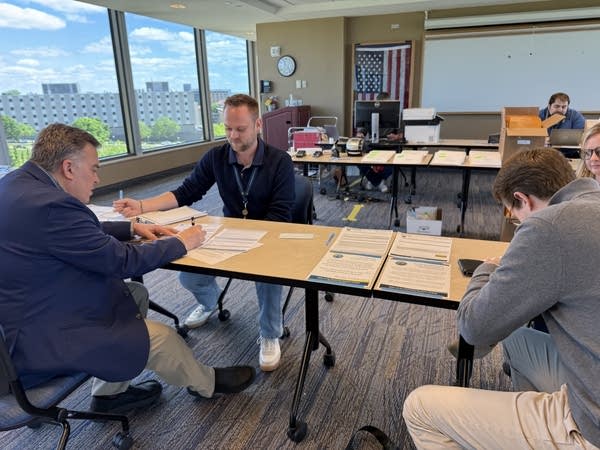
Three people sitting a table in an office
State Sen. John Hoffman, DFL-Champlin, pictured at left files to run for reelection on May 20 at the Veterans Services Building.
Dana Ferguson | MPR News

The four-term DFLer is seeking to return to the Legislature but faces a repeat race with the Republican who challenged him four years ago, Karen Attia, who filed for the ballot just before Tuesday’s 5 p.m. deadline.

His decision to come back was a difficult one for him and his family as they considered the potential risk they’d face remaining in public life.

“People would understand if we would have just said, ‘Time to find something else.’ Right?” the senator said. “But then it would win, evil would win, and there's so much that needs to be done.”

Yvette agreed, “We are not going to let a parasite sitting in a cell dictate the important work ahead, and so here we are.”

At the Capitol and beyond, the couple has tried to highlight their story to encourage people to ratchet down the political rhetoric.

“I guess, until you're shot eight times, because I was, maybe you just need to have some empathy,” Yvette said. “We've lost that, so let's get back to it.”

Sen. Hoffman chastised a colleague in committee this spring after the lawmaker referred to people without legal status as “illegals.” And on multiple occasions he urged his colleagues to let cooler heads prevail in debates.

“There seems to be that continuation of polarization that's occurring. It’s not okay,” John Hoffman said. “I've addressed it individually to people, publicly. I tried to address it too, and we just got to keep moving forward on it.”

He’s also tried to keep the memory of his colleague and “political kid sister” – House Speaker Melissa Hortman – alive. The same shooter who targeted the Hoffmans, Vance Boelter, is alleged to have killed Hortman and her husband, Mark, at their home along with their golden retriever, Gilbert.
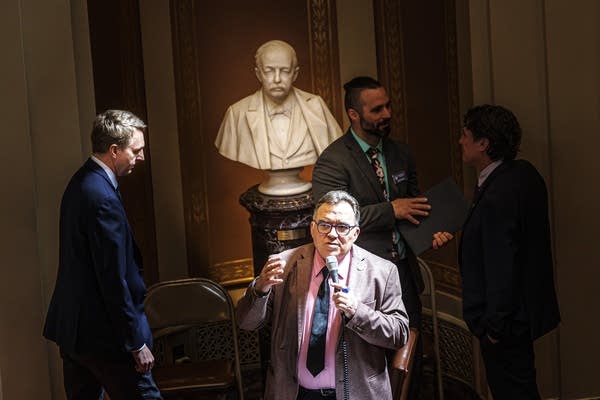
MN State Capitol
Minnesota state Sen. John A. Hoffman, DFL-Champlin, speaks on the Senate floor at the Minnesota State Capitol on May 12, in St. Paul. Hoffman has represented District 34 since 2013 and previously served on the Anoka-Hennepin School Board.
Kerem Yücel | MPR News

Sen. Hoffman helped ensure that the state will name a solar garden program for Hortman, a tribute because she worked to create the program. A stretch of highway that runs through both of their districts will be named in her honor.

And to help deter attacks like those lawmakers experienced on June 14, those who impersonate a police officer will see stiffer penalties. That was another Hoffman priority this year.

There are also additional safety measures in place at the Capitol and a new unit will be established to protect elected officials against threats.

“I still get threatening voicemails. I still get threatening emails, and to the point where my staff have, we've turned some of those voicemails in,” he said. “That's the polarization that's happening in politics. We have no room for that, we need to stop it.”

The senator is still a gregarious personality at the Capitol. He cracks jokes with colleagues and welcomes all staff members or legislative assistants that want to drop by his office for a snack or a quick “Hello.”

But his “flight of fight” sense kicks in at times when he doesn’t expect it. An unexpected sound or unfamiliar voice can provoke a stress response.

“I'm more observant of where I'm at and who's around me,” he said. "If I heard a voice in the hallway that I didn't understand, I would stop, you know, because that you're that's a, that's a reaction just to the fact that when somebody has trauma.”

Sen. Hoffman walks up stairs
Sen. John Hoffman ascends the steps to the Senate Chamber at the State Capitol on Feb. 17.
Ben Hovland | MPR News

He also quips that his doctor wouldn’t be happy to hear about his calendar packed with committee hearings, constituent meetings and long floor sessions in the Senate.

Yvette said legislative families take a risk when a spouse files to run for office. But, for now, they feel like it’s worth it.

“This is important,” she said. “So I'll just get another pair of Winnie the Pooh pajamas, and get some heavy duty locks on our doors, and all kinds of gadgets and gizmos, and we'll do it again.”




Source link

Leave a Reply

Subscribe to Our Newsletter

Get our latest articles delivered straight to your inbox. No spam, we promise.

Recent Reviews


Being a founder is awesome. And it also really sucks.

It’s a huge amount of stress, disappointment and uncertainty, with little appreciation or guidance.

It’s perfectly normal to find yourself questioning what it all means.

I’ve been there myself… questioning whether the sleepless nights and stress was worth it. And now, I’m often the person founders turn to when they do the same.

In this essay, I wanted to talk about happiness, purpose, and how to get more of it when you’re constantly living in survival mode.

Three Types of Happiness

Martin Seligman, the father of positive psychology, describes three distinct paths to happiness: the pleasant life, the engaged life, and the meaningful life.

  • The pleasant life is about pleasure—closing a deal, hitting a milestone, getting some great customer feedback. As a founder, there’ll be phases where pleasure is hard to come by. Clearly, you can’t build a founder life on pleasure alone.
  • The engaged life is about flow—the state when you’re fully absorbed in solving a hard problem. Most founders have this in spades early on, but as their companies grow, their role can evolve away from flow. Being out of flow is often a signal you need to redesign your role.
  • The meaningful life is about purpose—the sense that what you’re doing matters. Unlike pleasure and engagement, meaning doesn’t require things to be going well. It sustains you through the hard times, not just in spite of them.

So when times are hard, meaning is what we can return to. Unlike pleasure and engagement, meaning is up to you.

And it’s work you can start right now.

How to Make Meaning

So how do you actually build meaning, even when you can barely see past next week? A meaningful life has three components:

  • A meaningful future
  • A meaningful past
  • A meaningful present

Creating meaning in each is an act of creativity. It’s an active process in which you assign meaning to things.

If you aren’t intentional about this, your brain will assign meaning for you. And if you’re not feeling great, your brain will come up with interpretations that match and then reinforce the negative feelings.

What I’m about to share with you is the process I run through when my clients start questioning themselves, and what they’re building.

1. A Meaningful Future

In Man’s Search for Meaning, Viktor Frankl documented the atrocities of the concentration camps. He writes:

“Any attempt to restore a man’s inner strength in the camp had first to succeed in showing him some future goal.”

A lot of modern therapy fixates on the past. But Frankl realised that getting clear on our future goal is even more powerful.

When it comes to founders, they often have goals… but unless you’re fully pumped, your goals need refinement. 

I commonly see three issues with a founder’s goals:

  • They have too many goals. We accumulate goals over time, but we rarely sit down and remove goals. For example, you had goals when you were 18 years old. Most of these have been parked, but some might still be guiding you now.
  • The goal isn’t big enough. For most founders, the more ambitious the goal, the more energy it unlocks. Just increasing the size of the goal can act as a powerful clarifying force for what matters.
  • The goal isn’t framed by its meaning. It’s the difference between ‘I want to make $100M’ versus ‘I want to help 10,000 customers avoid what happened to me’. One is financial, the other is personal.

Refining and reconnecting to your primary goal is critical for building a life of meaning.

Questions to work through:

  • What’s the biggest and most exciting goal you can dream up?
  • If that was your primary goal, what other goals stop being relevant?
  • What people or person could the bigger goal attract that would make it achieving it easier?

2. A Meaningful Past

Being a founder can sometimes feel like a full-contact sport. You can get hurt, through disappointment, bad luck, and even betrayal. That’s why painful events in the past need to be treated like a wound.

When we don’t process the past, unhelpful stories we tell ourselves to protect our ego can cause havoc in the present.

Treating the past means framing every single thing that happened in two ways:

  • A win: an accomplishment that we can celebrate.
  • A lesson: a failure that we learn from, that we can celebrate.

We leave everything else behind. If, for some reason, we can’t let something go, it means we haven’t learned something important from it. As my mentor used to tell me: failures will be repeated until learned.

This work can be done separately, but it’s even more powerful to do it in the context of a big goal. This way, the wins and lessons can be aligned to the vision that truly excites us.

Questions to work through:

  • What is the meaning of what you’ve been through?
  • How did those experiences serve you?
  • Where are they failing to serve you today?

3. A Meaningful Present

Here’s the thing: the future and the past don’t physically exist. They’re tools to help us act in the present.

Often, clarifying the meaning of a bigger future and a happier past makes changing the present obvious and necessary.

As founders, it’s easy to be driven entirely by the past: old goals, old activities, old habits. This stops us from growing. And a lack of growth is one of the fastest paths to feeling meaningless.

Most founders I work with don’t need to do more. They need the courage to do less.

Growth often requires us to:

  • Start doing something we haven’t done before
  • Stop doing something we’ve already mastered
  • Double down on getting even better at some things

The meaningful present is about making these changes — aligning how you spend your time with the future you’ve defined and the lessons you’ve drawn from the past.

Questions to work through:

  • What is the biggest bottleneck to making the big goal viable?
  • What do you need to stop doing—even if there’s a cost involved?
  • What do you need to delegate?

Happiness Isn’t Always Happy

A meaningful life isn’t always smiles and rainbows. It comes with difficulty, sacrifice, and discomfort. But it’s the thing that keeps you going when pleasure and engagement can’t.

If you’re a founder questioning what it all means, the answer isn’t to push harder or to quit. It’s to invest time in making meaning.

Start with the future. Let it reshape the past. And then rebuild the present around what actually matters.

Related Reading: 


Originally published on March 11th, 2026


How do top founders actually scale?

I’ve coached CEOs for 10,000+ hours—here’s what works.
Join 17,000+ founders learning how to scale with clarity.

Unsubscribe any time.


Source link