Investigation Finds Donut Lab Made False Claims About Revolutionary Battery Tech


In January, there was a lot of hype around an announcement from Finnish company Donut Lab: It claimed to have created the world’s first production-ready solid-state battery.

The Donut battery, marketed as the energy source behind the Verge TS Pro motorcycle, was allegedly a “pioneer” in bringing this new battery technology to a production-ready electric vehicle. During CES 2026, Donut Lab’s phone-size powerhouse was even a finalist for CNET’s Best Transportation category, where we noted that the cell promised “huge improvements in energy density, charging speed and safety.”

But it now appears to be a wolf in sheep’s clothing. The battery is allegedly using existing lithium-ion technology, not sodium-ion solid-state chemistry, according to new reports following an investigation from battery researcher Ryan Inis Hughes, known for his YouTube channel Ziroth. 

Hughes, along with a team of over 20 specialists, presented electrochemical evidence, including voltage curves and cell expansion data, that conclusively identifies the battery as lithium-ion. In his YouTube video, Hughes interviews an executive in the battery industry who had dealings with companies developing the technology Donut Lab was promising. Hughes also consulted with battery experts on the company’s claims, such as the Donut Battery’s purported 400 watt-hours-per-kilogram energy density — a “holy grail” milestone for batteries — and its 100,000-cycle life. 

A representative for Donut Lab did not immediately return a request for comment.

Skepticism and investigation

The new research from Hughes confirms doubts raised by media outlets covering the EV and battery industries, including Electrek, which posted an article in mid-April about a whistleblower who came forward to say Donut Lab’s product was a fraud. Electrek also interviewed Donut Lab CEO Marko Lehtimäki in January, noting in a headline that the company’s leader would either be proven world-changing or a fool within months.

Fred Lambert, Electrek’s editor-in-chief, now notes that the site “called this one early,” adding that the investigation reveals clear-cut lies around manufacturing and shipping the battery. According to Lambert, Donut Lab also duped investors by inflating its valuation. “The company raised approximately $25 million from over 1,300 mostly small investors based on claims that now appear to be false,” he wrote. 

A closer look at Donut Lab is drawing comparisons to the Theranos saga, when founder Elizabeth Holmes falsified information about her blood-testing startup. She was eventually sentenced to 11 years in prison.

Outlets like Electrek have come out in support of the Hughes investigation. The Verge and AutoEvolution have also posted about the investigation’s findings.

Solid-state vs. lithium-ion 

A solid-state battery, as promised by Donut Lab, would solve many of the problems associated with lithium-ion batteries. For one, it wouldn’t be subject to overheating and fire risks because it wouldn’t use flammable materials. With denser technology, the hope was that a solid-state battery platform could usher in faster charging speeds, longer battery life and increased range for electric vehicles.  

Companies including Toyota are actively working on the technology, but no major manufacturer has pronounced anything production-ready the way Donut Lab did.


Source link

Leave a Reply

Subscribe to Our Newsletter

Get our latest articles delivered straight to your inbox. No spam, we promise.

Recent Reviews


What is Network Security?

The planning and implementation of network security procedures to preserve the integrity of networks and programs against hacking and illegal access is indeed a subcategory of information/cyber security. It defends the organization’s IT structure and network-accessible services against a wide range of cyber threats, including viruses, Trojan, spyware, spam ware, malware, and more. Network security includes user credentials, internet connectivity, firewalls, backups, and encryption. A network security professional’s goal is to make the system more secure by offering technical assistance using intrusion detection systems, encrypting, firewalls, and digital certificates, among other things.

Wish to make a career in the world of JNCIA? Start with JNCIA Training !

What is Cyber Security? 

Cyber security is a broad word that refers to all areas of the internet. It is a subcategory of data security that is concerned with defending the authenticity of systems, devices, and programs against assault, damage, or illegal access from the outside. It refers to a collection of approaches, technologies, and procedures for defending systems and networks from cyber-attacks. It protects networks against unwanted electronic access by putting in place a variety of security mechanisms and controls. All inbound and outbound network traffic is monitored by cyber security professionals to limit the danger of cyber assaults while also protecting the firm from unauthorized system use.

Wish to make a career in the world of Cyber Security? Start with Cyber Security Training! 

Cyber Security Training

  • Master Your Craft
  • Lifetime LMS & Faculty Access
  • 24/7 online expert support
  • Real-world & Project Based Learning

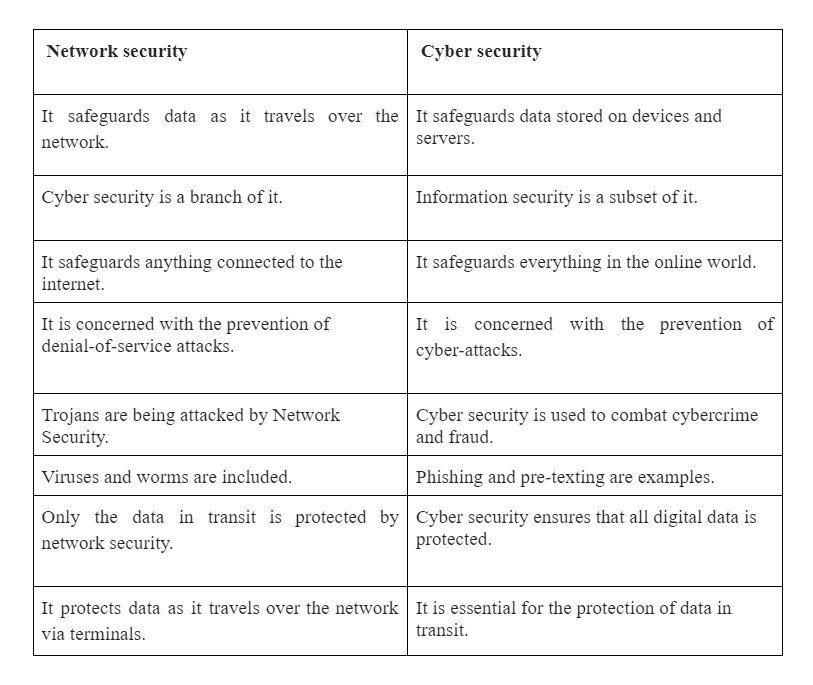
(Network Security vs Cyber security) Difference Between Both

1. Definition

Cyber security is a branch of information security that refers to a set of strategies and methodologies for preventing harm, attack, or illegal access to networks, devices, programs, and data. Cyber security, to put it simply, is the process of defending internet-connected devices and networks against digital threats. The process of safeguarding files and folders in a computer network from misuse, hacking, and illegal access to the system is known as network security. Network security is a subcategory of cyber security that guards against unwanted access to your system and network-accessible resources.

2. Security

While the phrases are interchangeable, they are vastly distinct in nature of security. If you see an organization as a walled castle, network issues are associated with keeping the peace within the castle walls and defending the organization’s sovereignty from network-related threats. Cyber security, on either hand, safeguards a company against external risks such as those posed by the internet. It defends an organization’s systems, networks, and applications against all types of digital attacks, such as phishing, baiting, and so on. The goal of network security is to secure an organization’s IT infrastructure from internet dangers such as viruses.

Wish to make a career in the world of Forescout Administrator ? Start with Forescout Administrator Training

3. Data

Network security becomes a component of cyber security, but cyber security is indeed a broad word like data security. While the authenticity of data and programs is the most important factor in both circumstances, cyber security emphasizes threat monitoring and detection to a higher extent. Network security is primarily concerned with protecting an organization’s IT network from the inside, while cyber security is concerned with protecting an organization’s information security technologies (ICT) against cybersecurity threats that exploit system weaknesses. Network security includes firewalls, user names and passwords, backup, and encryption.

If you have any doubts on Cyber Security, then get them clarified from Industry experts on our Cyber Security Tutorial !

Acquire Cyber Security certification by enrolling in the HKR Cyber Security Training in Banglore!

HKR Trainings Logo

Subscribe to our YouTube channel to get new updates..!

4. Security Expertise

Cyber security experts or analysts are those who, by their knowledge and experience of databases, firewalls, network security, and encryption, are fully responsible for defending network infrastructure and related systems. An expert in cyber security control, detection, and recovery is a cyber security professional. A security professional’s primary responsibility is to monitor all inbound and outbound traffic and to collaborate with other departments within the company to manage risk assessment tools and technology. A network security professional’s job includes securing the organization’s IT infrastructure, which contains data assets, financial data, and other confidential data

Network security and Cyber security

frequently asked Cyber security Interview questions and Answers !!

Cyber Security Training

Weekday / Weekend Batches

Conclusion

In brief, cyber security is an important part of information security dealing with data security during retention and transmission, while network security is indeed a subdivision of cyber security concerned with securing an organization’s IT infrastructure and limiting access to it. Both phrases are frequently used interchangeably, with the exception that cyber security is a much larger term, whereas network security is one component of information/cyber security.

Related Articles

  1. Cyber Security VS Data Science
  2. Cyber security Technologies


Source link