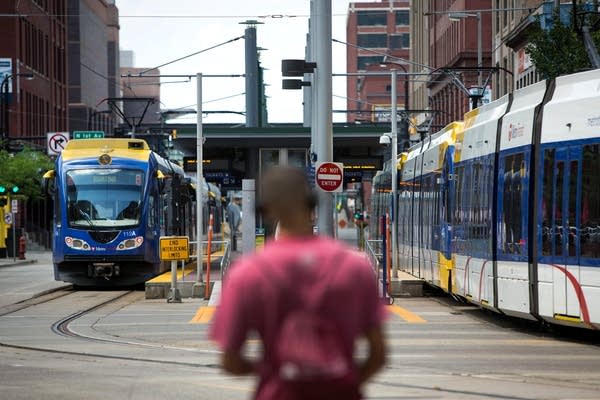

The estimated cost of the Blue Line light rail extension in the Twin Cities — a 13-mile route linking downtown Minneapolis to Robbinsdale, Crystal and Brooklyn Park — has jumped by $336 million.
The Metropolitan Council says the total cost of the long-planned, long-debated project is now estimated at $3.58 billion. That’s up from an estimate of $3.2 billion in 2024 — and just $1.5 billion back in 2018.
The cost increase has sparked a renewed round of debate over whether the project should move forward — or whether an alternative, such as a bus rapid transit line, might be a better and more cost-effective option.
It also comes after years of controversy over the Green Line light rail extension to Eden Prairie, which is set to open next year.
For its part, the Met Council said the 2024 estimate for the cost of the Blue Line was made when the design of the project was only 30 percent done. The latest estimate comes with the Blue Line extension design 90 percent complete.
“The updated project budget reflects major changes to the project requested by cities through the municipal consent process in 2024 that incorporates genuine engagement with communities,” the Met Council said in a statement.
Those changes included a new station added at Washington and West Broadway in Minneapolis, a redesign of the Lowry Avenue station, and improving road connections in the North Loop neighborhood.
The estimate also includes a contingency fund — set at 32 percent of the project — to cover “ongoing economic volatility and uncertainty.”
The new estimate comes as a required federal risk analysis was completed for the Blue Line extension project.
“The completion of this risk assessment is a significant milestone and means that as soon as the remaining local contributions are identified, the project is eligible to apply for a Full Funding Grant Agreement” with the federal government,” the Met Council said. “The Metropolitan Council is working with Hennepin County to advance the project. We will remain transparent with partners and communities throughout this process.”
If that federal funding agreement is applied for in the next six months and then approved, the Met Council said construction could begin in late 2027 — with service set to begin in 2033.
Light rail vs. bus rapid transit
Also this week, the Met Council released a technical study — mandated by the Legislature — to examine bus rapid transit (BRT) as an alternative to the light rail extension (LRT).
It found that a BRT line could be built and operated for less money than an LRT line, and offer more flexibility — but an LRT line would draw more riders, lead to a greater reduction in vehicle traffic, and offer a “one-seat ride” — no need for transfers.
The report also stated that switching the project to BRT “would add years to the project timeline. The change would require new planning, including re-visiting project alignment decisions with local partners, conducting a new environmental review, and receiving new federal approvals.”
But with one BRT option — arterial BRT, in which buses run mostly on existing streets instead of dedicated, transit-only lanes — the estimated capital cost was only about $120 million. That would be just a fraction of the estimated light rail cost.
That drew the attention of state Rep. Jon Koznick, R-Lakeville, who is co-chair of the House Transportation Finance and Policy Committee. Speaking with MPR’s All Things Considered, Koznick called the light rail plan an “extremely expensive way to move people from Point A to Point B.”
“We can certainly save billions of dollars by switching to a variety of busing options — including arterial bus rapid transit, we could do express bus,” Koznick said. He said bus options could “really meet more of a regional connectedness of transit that I think Hennepin County commissioners and policy makers should take a closer look at, to make sure that we appropriately use our transit dollars (and also) meet the needs of transit riders throughout the whole region better.”
Koznick also said construction of a BRT line would be less disruptive to residents and businesses along West Broadway in Minneapolis, and in downtown Robbinsdale.
Hennepin County issued a statement in support of the light rail extension, saying the study “clearly shows light rail is the right choice for this corridor. Bus alternatives have been evaluated many times throughout this project’s history, and each time technical analysis and community input confirms that light rail is the right choice.”
“Completing the Blue Line extension will connect tens of thousands of residents who rely on transit to get to work, go to school, and access healthcare,” the county statement said. “It will drive economic investment and new housing construction that will decrease property taxes for residents. It will create thousands of good paying jobs for Minnesotans.”