
Ways to use Chase Points (beyond flights and hotels)


For many travelers, Chase Ultimate Rewards points are synonymous with flights and hotel stays. And while those can certainly be some of the most valuable ways to redeem points, they’re far from the only options available.

If you’ve built up a stash of Chase points, you may be surprised by how many vacation expenses you can cover beyond airfare and lodging. Through the Chase Travel℠ portal, eligible cardholders can redeem points for everything from guided tours and attraction tickets to rental cars and cruises.

Whether you’re looking to reduce out-of-pocket costs or splurge on a bucket-list experience, here’s how to use Chase points to help enhance your next vacation.

Related: Why the best point redemptions are sometimes the most practical

When does it make sense to use Chase points for expenses beyond flights and hotels?

Before redeeming Chase Ultimate Rewards points for vacation expenses beyond flights and hotels, it’s worth understanding the trade-off.

In many cases, transferring Chase points to airline and hotel partners will offer the highest potential value, especially for premium-cabin flights or high-end hotel stays. Depending on the booking, Points Boost redemptions through Chase Travel may also provide solid value.

Bike Tour on AmaWaterway’s Rhone River cruise. AMA WATERWAYS

By comparison, Chase Travel redemptions for experiences, rental cars, cruises and attraction tickets often provide around 1 cent per point. That makes them easy to understand — a $100 activity will cost around 10,000 points — but it also means you may be getting significantly less value than you would from a high-value transfer partner redemption.

TPG’s June 2026 valuation pegs Chase Ultimate Rewards points at 2.05 cents apiece, so redeeming at around 1 cent per point effectively gives you about half of that value.

In other words, these redemptions are best viewed as a way to offset travel costs rather than maximize the value of your points.

Reward your inbox with the TPG Daily newsletter

Join over 700,000 readers for breaking news, in-depth guides and exclusive deals from TPG’s experts

That doesn’t mean these are bad redemptions. They can still make sense if you want to reduce out-of-pocket travel costs, have a large stash of Chase points or are struggling to find award availability for flights and hotels.

They can also be useful for budget-conscious travelers who want to cover as many trip expenses as possible — including attractions, rental cars and tours — even if they aren’t fully maximizing their value.

Related: Why all travelers should earn transferable credit card points

How to earn Chase Ultimate Rewards points

To access these redemption options, you’ll need an eligible card that earns Chase Ultimate Rewards points. The easiest ways to build your balance are to earn a welcome offer on a new Chase credit card and to maximize bonus categories on everyday spending.

Here are four top cards that earn Chase Ultimate Rewards points:

Welcome offers on these cards can be one of the fastest ways to build a Chase points balance, but before redeeming, compare the points price with the cash price to make sure the redemption makes sense for your trip.

Related: The complete guide to Chase Ultimate Rewards

How to book vacation experiences through Chase Travel

Before diving into specific redemption options, it’s worth understanding where to find them.

In addition to flights and hotels, the Chase Travel portal offers tours, sightseeing excursions, attraction tickets and other travel experiences that can be booked with cash or Chase Ultimate Rewards points.

Screenshot of Chase Travel portal
CHASE

To browse available options, log in to your Chase account and navigate to the Chase Travel portal. From there, select the tab you’d like to search and enter your destination and travel dates.

Availability varies by destination, but major tourist hubs, such as Hawaii, London and New York, often offer hundreds of bookable experiences ranging from guided tours and museum tickets to food experiences and outdoor adventures.

Use points for tours and excursions

Tours and excursions can be some of the most memorable parts of a vacation — and they’re also among the many travel experiences you can book with Chase points. Depending on your destination, options may range from guided sightseeing tours to outdoor adventures and specialty experiences.

For example, while searching for activities in Kauai, Hawaii, I found options including a Secret Falls kayak-and-hike excursion for approximately 13,500 points, a boat tour of the Nā Pali Coast for 22,629 points and a private helicopter tour over waterfalls and canyons for roughly 44,990 points (prices are per person).

Napali coast in Kauai
STEPHANIE STEVENS/THE POINTS GUY

At the time of my search, the cash rate for the Secret Falls excursion was $135 (compared to 13,500 points), while the Nā Pali Coast boat tour cost $227 (or 22,629 points). In both cases, redeeming points provided roughly 1 cent per point in value, which is typical of many Chase Travel redemptions.

While that can help offset travel costs, it’s not necessarily the highest-value use of Chase points. Cardholders will generally get more value by transferring points to airline or hotel partners. However, using points for tours and excursions may still make sense for travelers who have already booked their flights and hotels with points and want to offset additional vacation costs without spending cash.

Redeem points for attraction tickets

While helicopter tours and other once-in-a-lifetime experiences can be an exciting way to use Chase points, not every redemption needs to be a splurge. Chase points can also help cover everyday sightseeing costs.

Many destinations offer attraction tickets, museum admissions and city sightseeing passes through Chase Travel, allowing travelers to offset expenses they may have otherwise paid out of pocket.

For example, a search for activities in Chicago surfaced options including architecture river cruises, admission to the Skydeck at Willis Tower, museum tickets and multi-attraction city passes.
Screenshot of Chase travel
CHASE

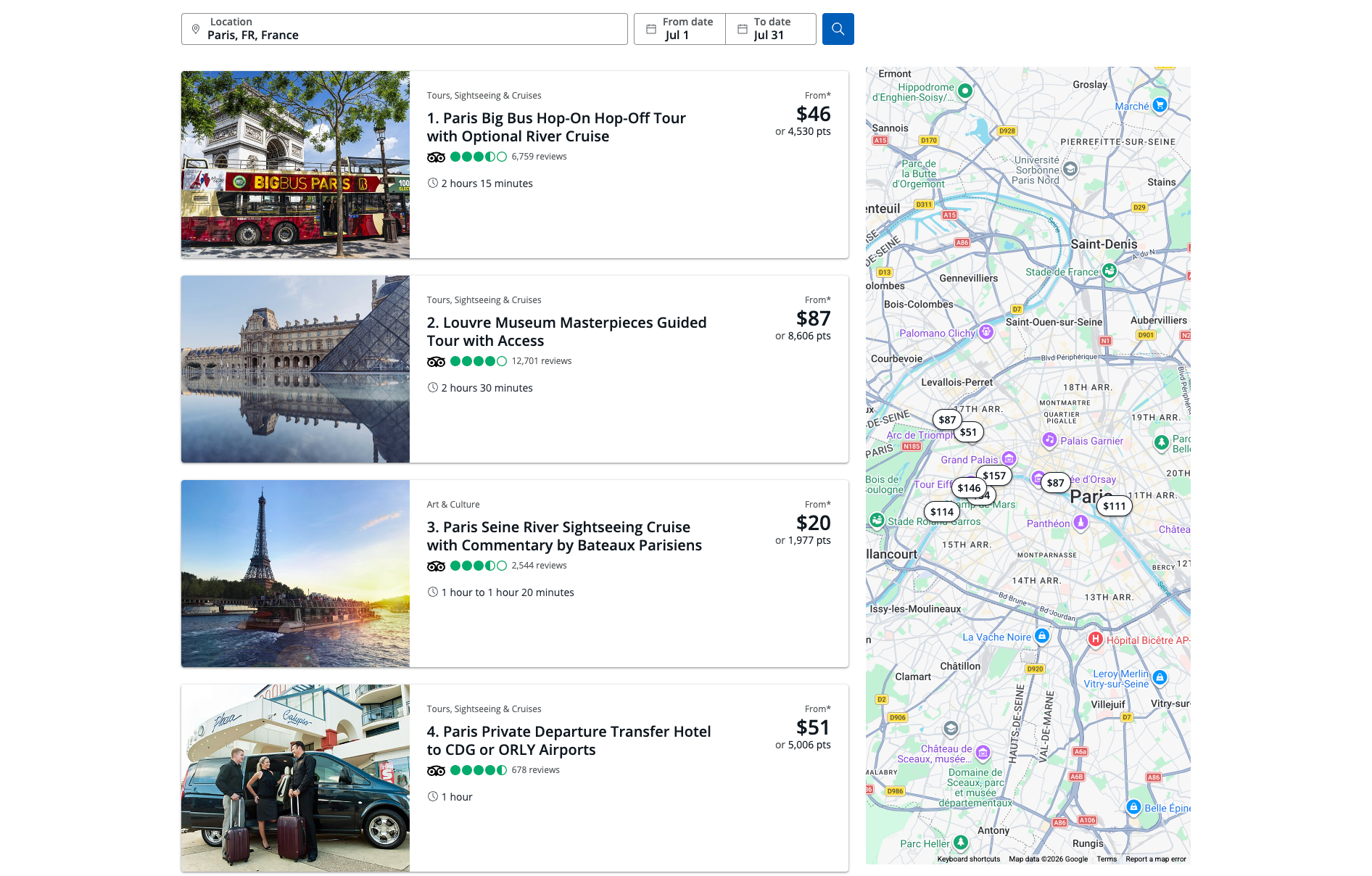
As I researched attractions for an upcoming trip to Paris, I found everything from a Seine River sightseeing cruise for 1,977 points (or $20) to a hop-on hop-off tour for 4,530 points (or $46) and a guided tour of the Louvre starting around 8,600 points.

While not the strongest value of Chase points, these redemptions can be especially useful for families or travelers planning busy sightseeing itineraries. Instead of spending cash on multiple attraction tickets throughout a trip, you can use points to cover some or all of those expenses in advance.

These types of redemptions can also stretch a relatively small points balance. Many attractions cost only a few thousand points, making them accessible even if you don’t have enough points for a flight or hotel redemption.

Cover rental cars

After flights, hotels and activities, transportation is often one of the biggest remaining vacation expenses.

Depending on your destination, you might be able to redeem Chase points for rental cars. This can be particularly valuable in places where having a car is essential, such as Hawaii, national park destinations or smaller cities with limited public transportation.

For example, when searching for Maui rentals for July 1-4, I found options ranging from an intermediate Kia K4 from Thrifty for $267 or 26,692 points to a Nissan intermediate SUV for $313 or 31,294 points.

Embrace the open road with open arms
GRADYREESE/GETTY IMAGES

In both examples, points offset the rental cost at a fixed-value rate. These redemptions make sense for travelers who want to offset a major vacation expense and preserve cash for other parts of their trip.

Travelers booking rental cars through Chase Travel can also take advantage of their card’s rental car coverage benefits. For example, the Chase Sapphire Preferred and Chase Sapphire Reserve provide primary rental car collision damage waiver coverage when the rental is paid with either Chase points through the portal or the card itself.

(You’ll still need to present the eligible Chase card at the rental counter to cover any incidental holds or fees. Check your card’s guide to benefits for complete details, terms and exclusions.)

Related: Chase Sapphire rental car insurance guide

Book cruises

Cruises are another travel expense that can be booked through Chase Travel using points.

Because cruises are notoriously difficult to book with traditional airline and hotel points, some travelers may find value in using Chase points to offset these costs directly.
Screenshot of Chase cruise options in Europe
CHASE

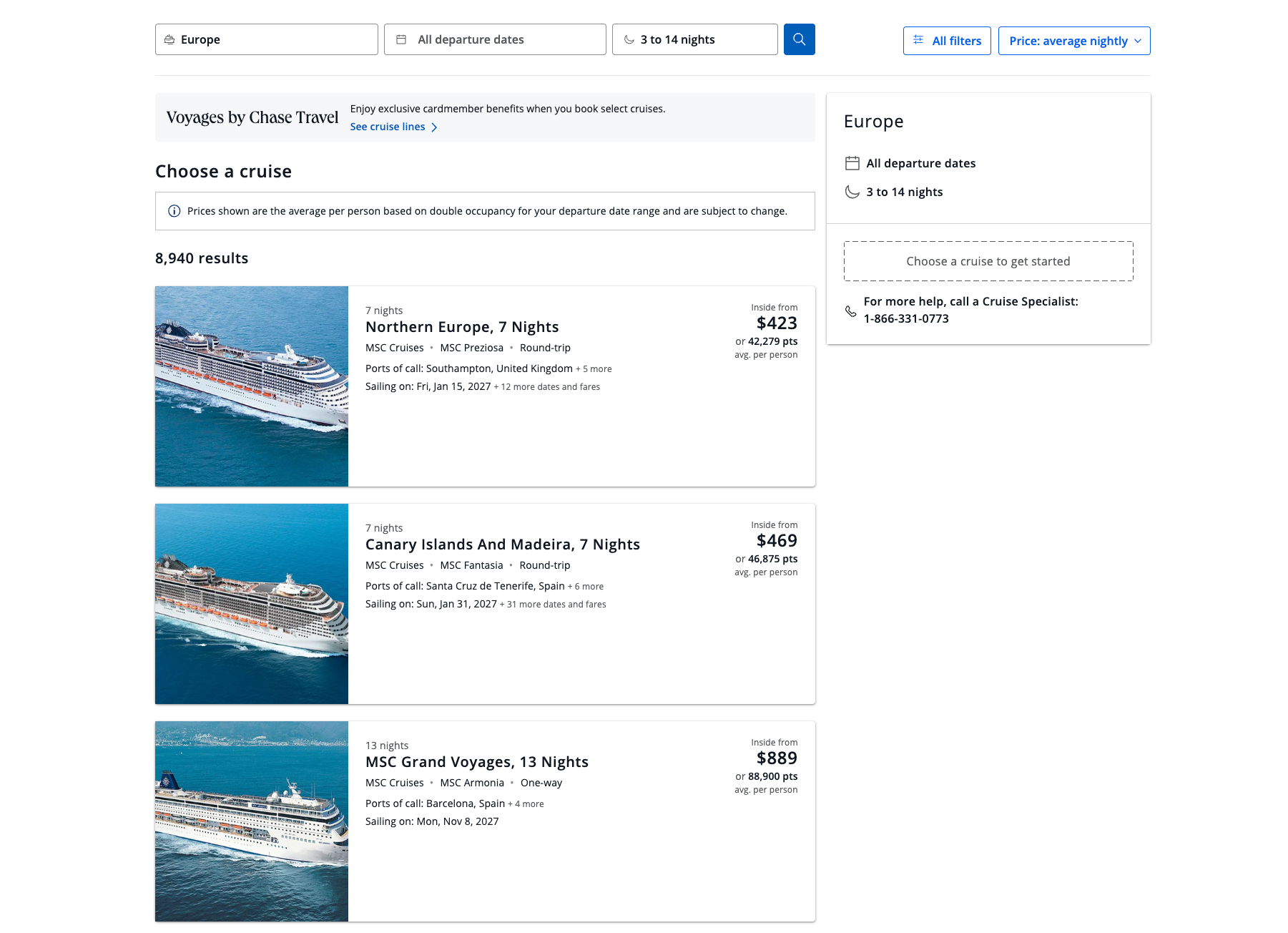
For example, cruise options available through Chase Travel ranged from a seven-night Northern Europe sailing for about 57,000 points per person to a 14-night Italy and Adriatic itinerary aboard Cunard’s Queen Victoria for roughly 130,000 points per person.

While this isn’t the most lucrative way to redeem Chase Ultimate Rewards points, it may appeal to travelers who want to reduce the out-of-pocket cost of a cruise or use points for a travel expense that can otherwise be difficult to cover with rewards.

Use points for dining and entertainment experiences

Depending on your destination and travel dates, Chase Travel may offer food tours, culinary experiences, cultural events and entertainment options that can be booked using points.

Travelers can also find opportunities to use points for select event tickets and special experiences, helping offset costs that might otherwise come out of pocket.

ERIC ROSEN/THE POINTS GUY

While researching activities for a trip to Paris with my mom this fall, I found a variety of food and entertainment experiences available through Chase Travel that could be booked with points. Available options included bakery tours in Paris for about 11,000 points and dinner cruises along the Seine starting at 15,700 points.

These redemptions may make sense for travelers looking to offset the cost of a special meal, cultural experience or entertainment activity without spending additional cash.

Bottom line

Flights and hotel stays may offer some of the highest-value Chase Ultimate Rewards redemptions, but they’re not the only way to put your points to work.

Through Chase Travel, cardholders can redeem points for everything from sightseeing tours and attraction tickets to rental cars, cruises and other vacation experiences. While these redemptions often provide less value than transferring points to airline and hotel partners, they can be a practical way to offset travel costs and make a trip more affordable.

Before booking, compare the points cost with the cash price and consider whether another redemption option offers better value. But if using points helps you take the trip you want — or enjoy a few extra experiences along the way — it can still be a smart redemption.

Related: Beyond transfer partners: 6 easy ways to get strong value from your Chase Ultimate Rewards points


Source link

Leave a Reply

Subscribe to Our Newsletter

Get our latest articles delivered straight to your inbox. No spam, we promise.

Recent Reviews


In the contemporary business landscape, which is fast-paced, leadership is no longer about making decisions and leading teams. It is also vision, communication, adaptability and emotional intelligence. Therefore, a large number of senior professionals now hire a top executive coach to hone their leadership style, enhance the decision-making process and perform better in stressful situations. Coaching can make a significant difference whether one is a CEO, director, founder, senior manager, or another person.

The executive level is usually accompanied with its own set of challenges. The leaders are supposed to motivate work teams, resolve hostility, boost performance, as well as take strategic decisions that influence complete organizations. However, blind spots, communication gaps, or habits of leadership that hinder growth may be challenging even to highly experienced professionals. It is at this point that a senior executive coach comes in. Instead of providing generalized recommendations, the coach assists leaders in finding out their weaknesses, enhancing the central skills, and creating a more concise leadership strategy.

Further, executive coaching no longer appears to be a corrective measure that is applied to troubled leaders. Instead, it is currently considered as a growth tool of high performers wishing to become more efficient, more self-aware and more influential. This article will discuss what executive coaching is, why it is important, and how executive coaching can help us grow as individuals and succeed in business by employing a top executive coach.

What Does an Executive Coach Do?

An executive coach collaborates with top professionals to enhance leadership effectiveness, communication, attitude, and strategic actions. As opposed to a consultant who is usually concentrated on the direct solution of business problems, a coach is more concerned with the creation of a leader behind these decisions. Thus, it is not the increased positive short-term outcomes, but also enhanced long-term leadership capacity.

A top executive coach can guide executives to realize the way they think, the way they communicate and the way they can influence others. Most executives in most instances are so business oriented that they hardly take a moment to analyse their leadership styles. But coaching provides that reflective and better space.

Why leadership coaching matters for lasting professional success

Supporting Leadership Development

A leadership coach has one of the primary roles to aid professionals in becoming stronger and more effective leaders. This involves becoming a better communicator, stress manager, confidence builder, and a leader.

In one instance, a coach can assist an executive to improve on his/her feedback skills, difficult-conversation skills, or team alignment. Simultaneously, the process tends to enhance self-awareness, and it is one of the most significant attributes of good leadership. Consequently, the executive is not only made more competent but also more stable and deliberate.

Helping Leaders See Blind Spots

Even experienced leaders have blind spots. These can be communication patterns, emotional response, delegation problems, or behaviors that influence team trust. As senior professionals can easily get filtered feedback, they might not be quite aware of how they are viewed.

This is one of the reasons why the best executive coach is so essential. The coach provides an independent, objective viewpoint that assists leaders in discerning patterns that otherwise would be overlooked. This means that they are able to implement specific changes that enhance performance and the relationships in the organization.

Why Executive Coaching Matters in Modern Leadership

The demands on senior leaders are much greater than they were in the past. The modern-day executive is challenged with the responsibility of being able to balance strategy, culture, people management, innovation and performance simultaneously. Due to this fact, technical expertise will no longer suffice.

Leadership Pressure Has Increased

Executives are always obliged to perform, handle ambiguity, and lead teams to change. Moreover, they tend to take incomplete information and are under time pressure when making decisions. Consequently, good judgment and control of emotions have been crucial.

An executive coach can assist a leader to remain down to earth and functional in such cases. Instead of being impulsive, coached leaders tend to offer a clear and assured response. This enhances their pressure-management capability and helps establish the mood of the larger team.

Communication Has Become a Strategic Skill

Communication in modern organizations is not a soft skill. It is a strategic leadership tool. The executives need to convey vision, develop trust, handle conflict, and motivate action. Nevertheless, numerous good leaders are unable to be consistent in this respect.

This is the reason why several professionals engage an executive leadership coach to enhance their speaking, listening, and influencing skills. Enhanced communication can result in higher team cohesiveness, reduced misunderstanding, and confidence throughout the organization.

Who Can Benefit from Executive Coaching?

There is not just one kind of professional executive coaching that is helpful to. It can be applied by most leaders at various points in their careers, though commonly linked to CEOs and top managers.

Senior Executives and CEOs

Isolation occurs at the very top of leadership. Often, there is little room for executives to speak frankly about challenges, doubts, or internal pressure. These issues can be discussed in a friendly manner with a top executive coach in a confidential setup.

This is particularly pertinent to the CEOs, who are charged with the strategic as well as emotional responsibility of the organization. Coaching enables them to cope with that weight better without losing sight of being strong.

Emerging Leaders

Coaching is also useful to professionals who transfer to senior positions. To move the focus of functional expertise into the role of an executive, a significant change in thinking and behavior is frequently necessary. Hence, a leadership development coach can assist in equipping these leaders towards increased responsibility.

Such support is frequently in terms of executive presence, confidence in communication, decision-making, and thinking. Consequently, the change will be easier and more effective.more than profit a client achievement of small business coach associates

Business Owners and Founders

Business owners and founders also have leadership issues, particularly when they expand their companies. As teams grow in size and complexity, what works well in the initial stages might not be applicable in the later stages. An executive coach of the top ranks assists founders in adjusting their leadership style to the changing demands of the business.

Key Qualities of a Top Executive Coach

The value of all coaches is not the same. Trust, expertise, and challenging leaders in a constructive manner are the elements upon which the best coaching relationships are based.

Strong Business Understanding

The best executive coach must be aware of what leadership, organizational pressure, and strategic responsibility entail. In the absence of such an understanding, coaching can seem too abstract or unrelated to the real-life problems of leadership.

This is why a lot of professionals want a coach who has a good background in leadership, management or organizational development. The coaching is more applicable and more practical with practical knowledge.

Honest and Constructive Feedback

Flattery is unnecessary to the executives. They need clarity. An effective executive leadership coach poses the correct questions, provides direct feedback, and enables the leader to confront hard truths without being judgmental.

This support and challenge are what render coaching powerful. It also enables the leader to develop without the feeling of being attacked, yet he is challenged to achieve meaningful change.

Focus on Measurable Growth

Coaching is not about talking and talking. It is an improvement. Thus, the most effective coaches are concerned about quantifiable improvement in leadership behavior, communication, decision-making, and performance. The practical focus assists in making sure that the coaching generates real value.

How Executive Coaching Supports Long-Term Success

Growth of leadership is not a single event. It is a process that is continuing. The roles of responsibilities and organizations are always in a state of flux, so leaders have to keep adapting. It is supported by executive coaching, which assists the professionals in building habits and views that would endure beyond the immediate challenges.

A senior executive coach makes leaders stronger and more considered, and able to cope with the complexity. In the long run, this builds a more professional presence and enhances long-term results. Moreover, the effect is not limited to the individual but is usually spread to the team, the culture at the company, and the general direction of the business.

Coaching can be one of the best investments in the career of many professionals. It enhances their leadership abilities, their thinking, and their reaction to difficulties. Hence, it remains a valuable asset even after the official coaching process has been completed.

Final Thoughts

An executive coach with top competence can be very influential in assisting leaders to play to a higher level. Coaching gives the clarity, feedback, and development that many senior professionals require in a business world where the pressure is ever-present and the expectations of the leadership are constantly increasing.

From enhanced communication and self-awareness to enhanced decision-making and team leadership, executive coaching services generate both beneficial and long-term advantages. In addition, they enable leaders to develop aspects that contribute to their personal and organizational achievement.

As an executive, founder or aspiring leader, engaging an executive coach is not just a professional benefit. It is a savvy investment towards long-term leadership success.

About the Author

Alan Melton is an Inc. 500 founder, award‑winning entrepreneur, and business coach who has built or acquired 18 companies and coached more than 1,100 business owners. His companies have served elite clients including the Ritz‑Carlton and the Jacksonville Jaguars. He is a Florida Governor’s Sterling Award winner and former SBA Small Business Person of the Year.

Frequently Asked Questions

1. What does an executive coach do?

An executive coach works with leaders to improve communication, decision-making, leadership effectiveness, and self-awareness. Instead of solving business problems directly, the coach focuses on developing the leader behind the decisions.

2. Why is executive coaching important for modern leaders?

Executive coaching helps leaders manage pressure, improve communication, and adapt to changing business demands. Modern leadership requires emotional intelligence, strategic thinking, and the ability to guide teams through uncertainty.

3. Who can benefit from executive coaching?

Executive coaching benefits CEOs, senior managers, business owners, founders, and emerging leaders transitioning into higher-level roles. Coaching helps professionals strengthen leadership skills and improve long-term performance.

scaling small businesses with Google Business Page


Source link