Some local police have access to an ICE facial recognition app


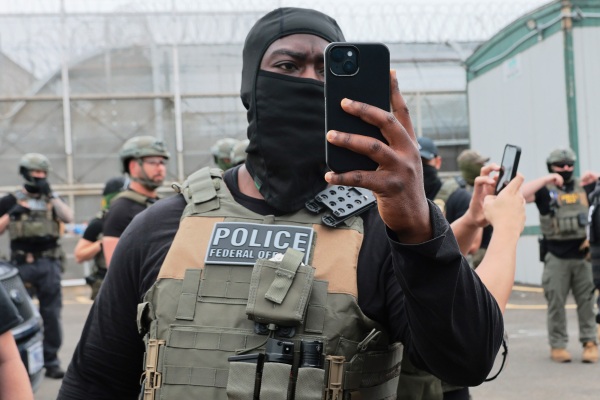
An Immigration and Customs Enforcement (ICE) officer takes a video as they stand guard in front of protesters outside Delaney Hall, which is being used as an ICE detention center on May 27, 2026 in Newark, New Jersey.

An Immigration and Customs Enforcement (ICE) officer takes a video as they stand guard in front of protesters outside Delaney Hall, which is being used as an ICE detention center on May 27, 2026 in Newark, New Jersey.
Michael M. Santiago/Getty Images North America

Federal immigration officers often use facial recognition technology to identify immigrants in the field. Now, a newly revealed document from the Department of Homeland Security outlines plans to give local police working on its behalf the same type of technology.

The document, first reported earlier this month by the tech news outlet 404 media, is a Privacy Threshold Analysis, which is essentially a federal report assessing whether the privacy implications of a tool warrant further government study.

The tool in question is a mobile app called the ICE Task Force Module, which allows local police to scan the faces of people they stop in their communities.

The app then compares the facial scan against more than 250 million government records. Those include the State Department's Visa records and records from the Traveler Verification Service, used by the Transportation Security Administration at airports to verify identities on international flights.

Once police scan a person's face, the app then instructs an officer either to "not detain or arrest," or it gives the officer a reference code to use to obtain more information from ICE.

The photos captured by the app are then stored in an internal DHS system for 15 years, the document states.

DHS declined to provide NPR with more insight about the app and how it is used. In a statement, the agency said ICE is committed to ensuring that the local police who partner with them have the tools needed to support ICE's mass deportation mission.

Those local officers, called "ICE non-federal law enforcement officers" in the document, are likely participants in the federal 287(g) program. A subset of that program, the Task Force Model, gives local police the authority to arrest immigrants on ICE's behalf during their routine police duties. There are around 1,300 police agencies participating in the Task Force Model nationwide.

The DHS analysis "raises more questions than I think it answers," says Clare Garvie, deputy director of the Technology Law and Policy Program at New York University School of Law's Policing Project.

For one, the document says the app launched last September, which suggests police are already using it.

It also seems to work similarly to Mobile Fortify, a facial recognition app that ICE and officers with Customs and Border Protection already use, but it's unclear if the new app uses the same technology or something entirely its own.

Garvie says there are also questions about how and when police will deploy the app.

"It's unclear to me whether a pre-existing stop based on some level of suspicion is required before law enforcement can use this app," Garvie says. "Can they walk around taking photos of whoever as sort of a dragnet way to attempt to identify individuals who might be in the country unlawfully?"

That sort of surveillance already appears to be happening at the federal level: In places like Minnesota and Maine, community members observing ICE activity reported that federal immigration officers would take photos of their faces and license plates. They said the officers would often know personal information about them, including their names and where they live.

Privacy experts told NPR that allowing local police to conduct similar surveillance could create a chilling effect on freedom of speech, if people begin to worry they'll face repercussions for attending protests, for instance, or for legally observing ICE activity in their communities.

Homeland Security Secretary Markwayne Mullin acknowledged at a congressional hearing this month that the agency has used facial recognition technology on protesters, and had been able to identify people who were present at protests in Oregon that were also at the recent protests outside the Delaney Hall Detention Facility in Newark, N.J.

What's more, Garvie says, facial recognition technology is not always accurate, and there have been cases of people detained by ICE who were wrongly identified by the technology.

Patrick Eddington, a senior fellow in homeland security and civil liberties at the Cato Institute, a libertarian think tank, says giving police this capability magnifies its potential problems.

"This kind of technology which can impact individual rights, when it's scaled, it can have potentially very, very large effects affecting lots and lots of people," he says. "It's like a Bill of Rights disaster pretty much waiting to happen."

In its statement to NPR, DHS said its law enforcement methods are constitutional.

"Like other law enforcement agencies, ICE employs various forms of technology to investigate criminal activity and support law enforcement efforts while respecting civil liberties and privacy interests," the statement said.

But Eddington says U.S. citizens will get caught up in this surveillance. Officers conducting immigration enforcement, whether they are federal or local, will not know a person's citizenship status before they conduct a scan.

"It is conceivable that a photo taken by an ICE non-federal law enforcement officer using the TFM mobile application could be that of someone other than a removable individual, including U.S. citizens," the DHS document states.

Because every photo taken through the app is kept for 15 years, Eddington says that suggests a long-term government record of citizens and immigrants alike.

The administration has repeatedly denied the existence of a database of protesters, despite instances in which federal agents have told community members observing them that their photo will end up in a database of "domestic terrorists."

However, earlier this month, NPR reported on a previously unpublished letter sent to members of Congress in which former acting ICE director Todd Lyons indicates the agency gives itself wide latitude to collect information on the people its officers encounter.

"This app wouldn't work if they didn't have databases to pull people's pictures from and compare against," says Cooper Quintin, a senior staff technologist with the Electronic Frontier Foundation, a nonprofit that advocates for digital privacy. "They're playing semantics. They're certainly not being forthright. You know, do they have a database of protesters? Maybe they don't call it that."

He says allowing police to use this technology to do immigration enforcement is a significant expansion of ICE's operations.

"It makes this sort of face surveillance ubiquitous on American streets," Quintin says. "I don't think that Americans should tolerate law enforcement being able to scan anyone's face at any time for any reason to try to determine their identity. This is the new form of 'papers, please.'"

Copyright 2026, NPR


Source link

Leave a Reply

Subscribe to Our Newsletter

Get our latest articles delivered straight to your inbox. No spam, we promise.

Recent Reviews


Last updated on
Jun 12, 2024

What is VPC in AWS – Table of Content

What is Amazon VPC?

Amazon Virtual Private Cloud or Amazon VPC is an AWS service that provides you with a separate area of the cloud. Having this separate area, you can launch your own defined AWS services in a virtual network.

Here, in VPC you have complete control of your virtual environment which includes IP address range, the configuration of route tables, the creation of subnets, and network gateways. Also, the network configurations can be easily customised for the Amazon VPC. 

Like all the other AWS services, Amazon VPC provides top-notch security. It has multiple layers of security which include network access control lists and security groups to manage the Amazon EC2 instances’ access in each subnet.

We have the perfect professional AWS Training course for you. Enroll now!

Now to understand the entire scenario of VPC, even better, let’s have a look at the architecture of VPC.

Architecture of VPC

Architecture of VPC

  • The above picture shows the architecture of VPC, so there’s an outer region and inside that outer region there’s an Internet Gateway and Virtual Private Gateway.
  • Internet Gateway and Virtual Private Gateway are what help in the connection with the VPC. These connections pass through the router which directs the coming traffic to the router table.
  • The two Router Tables then direct the traffic to Network ACL, which is like a firewall for security purposes. 
  • The Network ACLs can either accept or deny the roles. Also, the IP Address can be blocked on the Network ACL. 
  • The respective Network ACL signals to their respective security groups to access lines against the EC2 Instance. 
  • Now, there are two subnets – Public Subnet and Private Subnet. 
    As the name suggests, in the public subnet internet can be accessed by the EC2, while in the private subnet EC2 instance cannot be accessed through the internet. 
  • There’s also a process called “Jump Boxes” which enables you to connect the EC2 Instances (the public subnet can be connected to the private subnet’s instance).

Now, when we know about the architecture of VPC, it’s time to understand the different elements of VPC. 

Top 50+ Frequently Asked AWS Interview Questions !

AWS Training

  • Master Your Craft
  • Lifetime LMS & Faculty Access
  • 24/7 online expert support
  • Real-world & Project Based Learning

Elements of Amazon VPC.

The elements included in the Amazon VPC are:

IPv6 and IPv4 address blocks

VPC IP addresses use CIDR (Classless Interdomain Routing) IPv6 and IPv4 blocks to define their ranges. Primary and secondary CIDR blocks can be added to the VPC if the secondary Classless Interdomain Routing block comes from a similar address range as the primary block.

Subnet Creation

The EC2 Instance that is launched runs inside a specific VPC subnet. And, each subnet’s CIDR as a subset of the VPC Classless Interdomain Routing block. Every subnet separates its respective traffic from all the other VPC subnet traffic. It must be noted that a subnet can only have one CIDR block and different subnets are to be designated to handle diverse traffic types. 

Route Tables

Route Tables are actually the rule book that decides how much network traffic must be directed inside the VPC and subnets. A default route table is created by the VPC called the main route table. And, this main route table has an automatic association with other VPC subnets. 

There are two options – either the main route table can be updated and used to direct network traffic OR a new route table can be created for individual subnet traffic.

Internet Connectivity

Each VPC configuration is able to host one Internet Gateway and hence provide NAT or the Network Address Translation services using a NAT Gateway or NAT instances.

Elastic IP Addresses (EIPs)

Elastic IP Addresses or EIPs are IPv4 addresses permanently allocated to the user’s AWS account. The EIPs enable public internet access to the following:

  • An instance
  • Elastic Network Interface or ENI
  • Miscellaneous services that require a public IP address.
Network/Subnet Security

In the VPC architecture, you had seen there’s something called the “security group,” so VPCs use those security groups to give protection for instances. These security groups are referred to as firewalls by AWS.  

Additional Networking Services

There are several more services provided by a VPC. The VPC can also be used to configure the following: 

  • Virtual Private Networks or VPNs
  • Direct connectivity between VPCs or VPC peering
  • Gateways
  • Mirror sessions

Now, when you are well versed with the basics of Amazon VPC, let’s have a look at what you can do with a VPC.

HKR Trainings Logo

Subscribe to our YouTube channel to get new updates..!

What can you do with a VPC?

  • Instances can be launched in a subnet that you choose. 
  • Custom IP address ranges can be assigned in each subnet
  • Route Tables can be configured between subnets.
  • An internet gateway can be created and attached to your VPC. 
  • You get excellent security over your AWS resources.
  • Security groups can be assigned to individual instances.

Conclusion 
By now you would be well versed with everything you need to begin with Amazon Virtual Cloud. In the beginning, we learnt the basics of Amazon VPC and continued to learn its architecture. While at the architecture of VPC, we saw different parts of it and saw each of them briefly. 

Once you knew all the architectural parts, you saw the elements of VPC and studied them in brief. Finally, after learning about different elements and several other basics of Amazon Virtual Cloud, we saw the applicability of the same.

AWS Training

Weekday / Weekend Batches

 Related Articles:


Source link