
The Oversight Board Says Meta Needs To Do More To Protect Regular People From Sexualized Deepfakes


Meta’s Oversight Board has called on the social media company to strengthen its protection for ordinary people targeted by sexualized deepfakes. The Board recommends the addition of AI-generated impersonations in Meta’s Adult Sexual Exploitation policy, arguing that those images and videos are non-consensual by default. It also wants Meta to allow users to designate “connected accounts,” such as trusted friends and family, who can report potential violations like non-consensual intimate imagery on their behalf. 

Finally, the Board recommends making AI-generated sexual impersonation a separate category from harassment and nudity in the company’s content reporting and appeal forms. At the moment, only the residents of Texas and Florida have access to a specialized form that lists deepfake intimate imagery as a reason for the report. The Board wants all Meta users to have access to it, because “AI-generated non-consensual intimate abuse, including sexualized impersonations, is a global issue.”

The Meta Oversight Board came up with these recommendations after investigating an incident wherein the company kept ignoring a user’s report about the sexualized impersonation of a friend on Instagram. It launched the investigation after it received an appeal from the user who reported an AI-generated video on Instagram showing a woman adjusting her dress, with her underwear visible in a few frames. According to the Board’s report, the reporter said they were a friend of the person being impersonated in the video without content. The person who was depicted in the AI video had already closed her account. 

Two users originally reported the video to Meta, but the company didn’t remove the deepfake. The user who appealed to the Board had submitted an appeal to Meta first, but the company still didn’t remove the video from Instagram. After the Board itself raised the issue with Meta, the company merely made the post adults-only but concluded that it did not merit removal under its community standards. 

Meta told the Board that at the time the post was originally reported, it had no indications that the individual in the AI deepfake was a real person. If the depicted individual herself had reported the video, it would have violated its Adult Sexual Exploitation policy. The self-report would have served as a clear sign of non-consent. Other credible indicators of non-consent in Meta’s eyes are reports from law enforcement, media or trusted partners. Captions or page titles suggesting that images or videos are shared in a “vengeful or sensationalist manner” will work, as well.

The Board says Meta’s responses to its investigation indicates that the only viable way for non-public figures to establish non-consent is to self-report. It wouldn’t be easy for ordinary people to get law enforcement or the media involved, after all. Those avenues are mostly accessible to public figures. Meta is required to respond to these recommendations, but it’s not obligated to implement them. If it does choose to adopt them, the Board will monitor its implementations. For the particular case that started this investigation, the Board has overturned Meta’s decision to leave the video up and has required the company to remove the post. 

“It is clear that the scale, speed and sophistication of AI tools have resulted in a proliferation of AI-generated sexualized non-consensual content globally. The spread of sexualized deepfake videos leads to reputational and psychological harm, which disproportionately impacts women and girls, and has a chilling effect on participation in social and political life,” the Board wrote in its report of the investigation.

This isn’t the first time the Board has been critical of Meta in matters involving AI content and moderation. In mid-2025, it called the company’s inability to enforce its rules consistently “incoherent and unjustifiable.” Back in March, the Board urged Meta to create a new rule for AI content that’s separate from its misinformation policy. That recommendation came from an investigation involving an AI-generated video that claimed to show damaged buildings in the Israeli city of Haifa. The video was posted by an account claiming to be a news outlet but was actually ran by a user in the Philippines. 


Source link

Leave a Reply

Subscribe to Our Newsletter

Get our latest articles delivered straight to your inbox. No spam, we promise.

Recent Reviews


What is Network Security?

The planning and implementation of network security procedures to preserve the integrity of networks and programs against hacking and illegal access is indeed a subcategory of information/cyber security. It defends the organization’s IT structure and network-accessible services against a wide range of cyber threats, including viruses, Trojan, spyware, spam ware, malware, and more. Network security includes user credentials, internet connectivity, firewalls, backups, and encryption. A network security professional’s goal is to make the system more secure by offering technical assistance using intrusion detection systems, encrypting, firewalls, and digital certificates, among other things.

Wish to make a career in the world of JNCIA? Start with JNCIA Training !

What is Cyber Security? 

Cyber security is a broad word that refers to all areas of the internet. It is a subcategory of data security that is concerned with defending the authenticity of systems, devices, and programs against assault, damage, or illegal access from the outside. It refers to a collection of approaches, technologies, and procedures for defending systems and networks from cyber-attacks. It protects networks against unwanted electronic access by putting in place a variety of security mechanisms and controls. All inbound and outbound network traffic is monitored by cyber security professionals to limit the danger of cyber assaults while also protecting the firm from unauthorized system use.

Wish to make a career in the world of Cyber Security? Start with Cyber Security Training! 

Cyber Security Training

  • Master Your Craft
  • Lifetime LMS & Faculty Access
  • 24/7 online expert support
  • Real-world & Project Based Learning

(Network Security vs Cyber security) Difference Between Both

1. Definition

Cyber security is a branch of information security that refers to a set of strategies and methodologies for preventing harm, attack, or illegal access to networks, devices, programs, and data. Cyber security, to put it simply, is the process of defending internet-connected devices and networks against digital threats. The process of safeguarding files and folders in a computer network from misuse, hacking, and illegal access to the system is known as network security. Network security is a subcategory of cyber security that guards against unwanted access to your system and network-accessible resources.

2. Security

While the phrases are interchangeable, they are vastly distinct in nature of security. If you see an organization as a walled castle, network issues are associated with keeping the peace within the castle walls and defending the organization’s sovereignty from network-related threats. Cyber security, on either hand, safeguards a company against external risks such as those posed by the internet. It defends an organization’s systems, networks, and applications against all types of digital attacks, such as phishing, baiting, and so on. The goal of network security is to secure an organization’s IT infrastructure from internet dangers such as viruses.

Wish to make a career in the world of Forescout Administrator ? Start with Forescout Administrator Training

3. Data

Network security becomes a component of cyber security, but cyber security is indeed a broad word like data security. While the authenticity of data and programs is the most important factor in both circumstances, cyber security emphasizes threat monitoring and detection to a higher extent. Network security is primarily concerned with protecting an organization’s IT network from the inside, while cyber security is concerned with protecting an organization’s information security technologies (ICT) against cybersecurity threats that exploit system weaknesses. Network security includes firewalls, user names and passwords, backup, and encryption.

If you have any doubts on Cyber Security, then get them clarified from Industry experts on our Cyber Security Tutorial !

Acquire Cyber Security certification by enrolling in the HKR Cyber Security Training in Banglore!

HKR Trainings Logo

Subscribe to our YouTube channel to get new updates..!

4. Security Expertise

Cyber security experts or analysts are those who, by their knowledge and experience of databases, firewalls, network security, and encryption, are fully responsible for defending network infrastructure and related systems. An expert in cyber security control, detection, and recovery is a cyber security professional. A security professional’s primary responsibility is to monitor all inbound and outbound traffic and to collaborate with other departments within the company to manage risk assessment tools and technology. A network security professional’s job includes securing the organization’s IT infrastructure, which contains data assets, financial data, and other confidential data

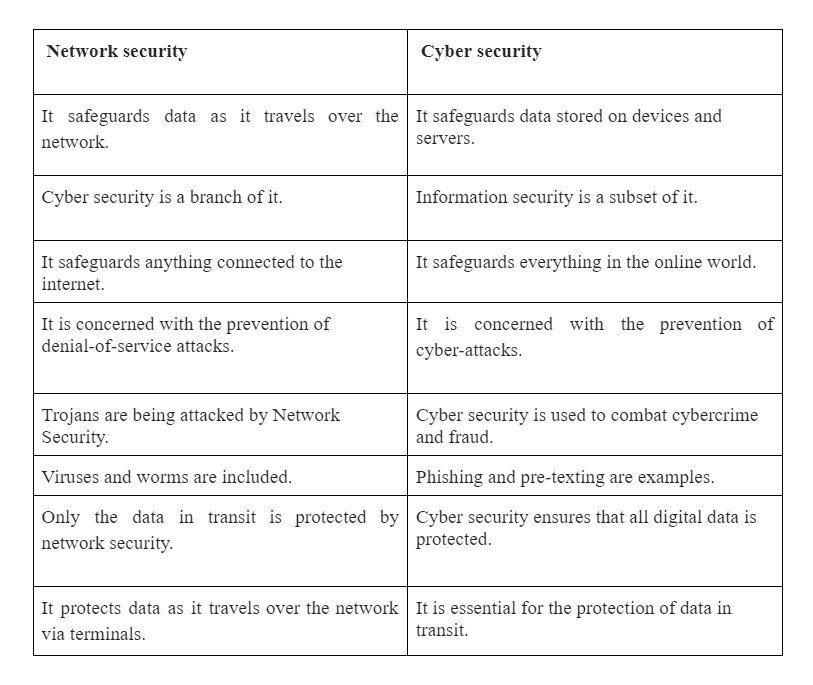
Network security and Cyber security

frequently asked Cyber security Interview questions and Answers !!

Cyber Security Training

Weekday / Weekend Batches

Conclusion

In brief, cyber security is an important part of information security dealing with data security during retention and transmission, while network security is indeed a subdivision of cyber security concerned with securing an organization’s IT infrastructure and limiting access to it. Both phrases are frequently used interchangeably, with the exception that cyber security is a much larger term, whereas network security is one component of information/cyber security.

Related Articles

  1. Cyber Security VS Data Science
  2. Cyber security Technologies


Source link