Hilton CEO Chris Nassetta is a busy man. Between launching new brands like Undergraduate by Hilton and overseeing a hospitality company opening “two to three hotels a day,” per his estimate, there’s a lot he wants travelers and Hilton loyalists to know, in terms of what’s happening behind the scenes.
In an exclusive sit-down interview with TPG, Nassetta spoke about the economics of points and how Hilton Honors is handling rising prices, as well as the value proposition of the program for the most loyal guest and those who just stay a few nights a year. Plus, he even hinted at the potential for a new elite status tier higher than the new Diamond Reserve tier.
Nassetta was on site with TPG at the grand opening of the Westerly, a highend addition to the Hilton Aruba Caribbean Resort & Casino — one of the most popular hotels in the entire Hilton portfolio.
Here are five key takeaways from our conversation.
There’s a Hilton brand for everyone
The first thing Nassetta wants folks to know is that Hilton is operating in an industry that “just has extraordinary potential,” as he said, and that he believes Hilton has “done a reasonably good job of differentiating” itself from its competitor set.
To do that, Nassetta explained, the company has leaned into the “experience economy” and continued to meet its loyal customers — and those joining the Hilton Honors ecosystem for the first time — where they’re at, and where they’re going.
“What we’ve done is we’ve built a really cool network effect where we’re now able to serve every customer for any need they have anywhere in the world they want to be, and we do it across a broad spectrum of price points and product types,” Nassetta said.
When Nassetta joined Hilton back in 2007, the company’s portfolio consisted of just eight brands. Now, nearly two decades later, that portfolio has more than tripled in the number of brands guests can book through Hilton Honors. And those brands really do touch every type of traveler, from introducing new luxury products like LXR to strategic partnerships with brands like Small Luxury Hotels (which it managed to grab from Hyatt) to a new series of lifestyle hotels focused around college-themed stays at Graduate, wellness-oriented experiences with Tempo and an entire collection of stays and experiences centered around nature.
“We stop adding brands when customers stop telling us they want new brands, right? So that probably is never,” Nassetta said.
Reward your inbox with the TPG Daily newsletter
Join over 700,000 readers for breaking news, in-depth guides and exclusive deals from TPG’s experts
HILTON
Award pricing is in line with rising luxury hotel rates
TPG frequently hears from readers that award pricing, especially dynamic pricing, has made many top-tier stays inaccessible. For Hilton, it sometimes costs hundreds of thousands of points for a Premium Award Night — and over 150,000 for a Standard Night. But behind the scenes, Nassetta explained, it’s important to remember that points equate to real money flowing between Hilton Honors and hotel owners, to the tune of billions of dollars.
“The high-end luxury [market] has gotten a lot more expensive and the system has to pay for it,” he explained. “If [owners] are giving up the rooms, particularly in times where they otherwise could sell them, then they have to be paid for it.”
But it’s a balancing act, he explained. “Think of it like ‘Chris, I’m going to give you a hundred bucks, and you only have a hundred bucks to go give all these hotels that are redemption hotels.’ I could say, ‘You guys [in] premium, you take it all,’ and then the guys that have all the Hamptons get screwed, or vice versa. We have to balance it out. It’s basically a relative rate structure and demand issue,” he said.
Diamond Reserve was a much-needed elite status tier
HILTON
It’s a fact that the loyalty space has become crowded as more and more consumers find ways to leverage points and miles in their travels and everyday lives. “Diamond members have become in the millions,” he said, explaining that at some point, quantity really does start to hurt quality.
“We’re pretty good at what we do, but if you’re going to create a truly bespoke experience where you can [offer] 100% of the time true concierge-level service, you can’t have millions of people,” Nassetta said.
Enter Diamond Reserve, Hilton Honor’s new top-tier elite status level that requires 80 nights or 40 stays and $18,000 in annual spend. While it’s not the easiest level to reach, many honors loyalists fear it will devalue the other tiers.
Nassetta advises not to fret, though. “We didn’t take anything away [from Diamond]. We made it easier to get to Gold because we realized we were sort of out of sync with some of our competitors, and those benefits are things people really care about. And then we created this upper tier that’s more aspirational, and so far, so good.”
But there will be some more net-positive changes. “What will change is we’re going to keep figuring out what we can do for the most elite travelers and what experiences we can connect to it.”
You don’t have to be a frequent traveler to benefit
Don’t think Hilton is forgetting the other end of the spectrum: the more casual travelers who might hit the road once or twice a year.
“Ten years ago, we kind of revolutionized the space, saying, ‘All right, we want to do really good things for the most frequent travelers, but if you’re not that frequent a traveler, we love you, too.'”
But what does that mean? “That means [immediate] discounts, that means Amazon deals, Lyft deals and other things. I think we’ll continue to do things in that arena because we want all travelers to feel special.”
CARLY HELFAND/THE POINTS GUY
A new tier might just be in the works
Over the last few months, rumors have swirled online about a new invite-only elite status level above Diamond Reserve called “The Honors Society.” Though Nassetta did not confirm its existence, he did say that “maybe there’ll be something beyond [Diamond Reserve]. Maybe some day there’ll be something that we don’t really publicize.”
Even without Nassetta’s confirmation, a recent Paris Hilton Instagram campaign, where her phone shows “The Honors Society” emblazoned on the Hilton Honors app, has fueled a lot of speculation.
“While there’s nothing to confirm at this time, our Hilton Honors team is always focused on creating special ways to celebrate and reward our most loyal members,” a Hilton spokesperson told TPG, when we inquired.
Or, as Nassetta cheekily put it: “Nothing to talk about.”
Denodo tool is a leading data virtualization tool that helps many business users across industries. Moreover, Denodo serves as an interactive data storage for semantic search and data governance across the enterprise.
Data virtualization is a technical approach to data management. It develops a single logical data layer linking multiple data. Also, it offers integrated access to the apps that use the semantic components. These components are stated within the virtual layer, and users can reuse them.
Denodo tool has the potential to provide the logical data fabric across the industry. Further, the Denodo platform offers combined data access across the business entity. It does so without replicating the data. The Denodo tool is handy for many users across industries. Thus, it offers data virtualization (DV) technology.
Why Denodo Tool?
Denodo is really the market leader in data visualization. For many years, Denodo has indeed been ahead of many other vendors throughout this industry. Clients, partner organisations, and industry experts have identified denodo trusted technology. Here are a few examples:
It really can apply sophisticated optimization algorithms instantaneously, which is critical in large data scenarios.
To really be accessible in a Docker container and be registered on the Amazon Web Services (AWS) and Microsoft Azure Marketplaces.
It enables business customers to look for information and explore connections. It has received more industry accolades than any other data virtualization vendor.
Denodo persists to push the boundaries of data virtualization with the in fabric assistance, data cataloging, and enterprise-wide rollouts.
Denodo platform offers leading data virtualization and data integration facilities. By using the Denodo tool, many industries got satisfied due to its data virtualization technology. It helps entities to recover data faster by saving time. It allows business users to find accurate data through an intuitive and interactive interface.
Moreover, it helps to achieve advanced performance benefits in big data scenarios, logical data storage, and operations. It offers powerful data integration software that automatically applies advanced optimization techniques to optimize data. Also, it speeds up the usage of cloud DV and allows many business users to search data and find out the relations. Hence, the following are the various benefits of using the Denodo tool.
Prompt data usage by business users with Self-Service data discovery
Denodo Platform offers a user-friendly and interactive interface to search actual data. Further, users can browse specific links among the data items to search for data specifically. Now users can build many improvised queries. Also, they can store these queries as views using the latest Advanced Query Wizard (AQW). Moreover, users can use the approved data model to learn about various things. These include data accessibility, structure, and connectivity with other data systems.
Extensive integration with a vast range of data sources
We can connect to any data source, including the web and any other structured or unstructured format at any time, to the Denodo Platform. But it doesn’t support some data sources for which Eclipse Plugin and connector SDK are used. Moreover, the Denodo Platform can manage the RDMS, Streaming data, Hadoop, flat files, REST, SOAP Web Services, Email, Documents, etc.
Speedy adoption of cloud Data Virtualization (DV)
The latest version of the Denodo tool is Denodo 8.0. But the Denodo version 6.0 is the only version available as a data virtualization solution at AWS Marketplace. Further, the platform minimizes the DV costs, simplifies its use and speeds up its adoption. It doesn’t need any installations.
Advanced level performance in the context of Big Data and logical data storage
The Denodo Platform comprises a caching process that allows complete materialization and sequential query caching. It does so additionally apart from the Dynamic Query Optimizer (DQO). Further, the Denodo Platform also uses progressive Big Data optimization methods.
To minimize the network traffic automatically, the DQO implements the approach of “forward processing to the data”. Further, this dynamic optimizer selects the best query performance plan based on various data source statistics. It also includes the features of significant data sources to provide outstanding performance.
Governed and secured access to the information
The strategy, row and column-based security management skill consist of managed access to role-based security access, data-specific and across schema permissions. Further, it includes support for crucial security protocols, including single instances like Kerberos.
Support for many analytical, operational, and Big Data scenarios
Denodo Platform supports Big Data, Web Integration, and other conventional data handling use cases. It also provides various use cases and the typical analytical examples that many data virtualization platforms offer. Moreover, using the Denodo Platform, you can build a data services layer that reveals the primary data sources as services.
Also, to integrate with the business web portals and MS SharePoint, we can produce data services as REST Web Services, including web components. Further, in the Denodo Platform, the data services enable the virtual presentation created for reusability. Apart from this, it offers a single and compatible rendering of the fundamental data assets.
To gain in-depth knowledge with practical experience in Denodo, Then explore HKR’S Denodo Training!
Denodo Training
Master Your Craft
Lifetime LMS & Faculty Access
24/7 online expert support
Real-world & Project Based Learning
Is Denodo considered a Database?
The Denodo tool is considered a database where Denodo Server includes multiple virtual databases. A database schema consisting of various data sources, stored processes, web services, and other capabilities is a virtual database. Each virtual DB built within the Denodo Server is different from other databases.
Moreover, each virtual DB may have multiple benefits allocated by various users. The Denodo tool also contains a cache module that saves the local copies of data. This data is recovered from the data sources inside a relational database. Along with a database, it is also a modern data management and data integration tool.
Denodo Express
Denodo Express is a simple and free-to-use edition of Denodo Data Virtualization platform. It is easy and free to use, develop and download and offers some essential Denodo features. Further, the Denodo Express combines and links different data sources on the cloud and on-premise, like structured, unstructured, and others.
Moreover, users can easily access these resources, including business apps, dashboards, portals, and other valuable tools. Any single user registering online can utilize Denodo Express. Furthermore, we can use Denodo Express for training in DV, department-related projects, and model enterprise projects. However, it helps to create value for the clients and users.
Understand Data Virtualization (DV) in Denodo
The Denodo tool is famous for its data integration and virtualization fields. Data virtualization is the fastest way to access all enterprise-level data without worrying about primary difficulties.
Moreover, DV offers a logical data layer that links diverse data and provides blended access to ingest apps.
These apps will utilize the semantic components stated within the virtual layer and reuse them as required. It combines all the business data from different sources and manages the blended data central security and control. Also, it makes it available for many business users in real time. It makes your apps free from the physical sources of data storage.
How does Data Virtualization Work?
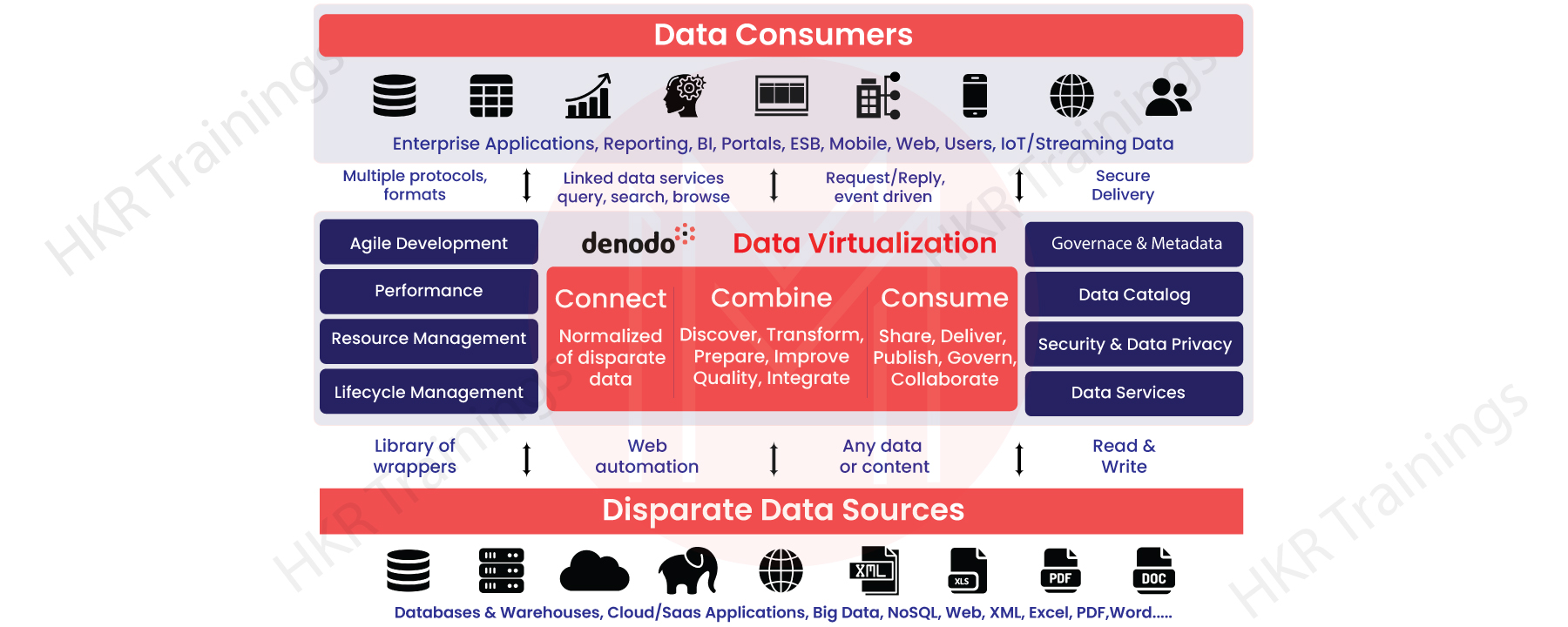
This concept includes the logical data layer that allows business users to utilize business data in various forms. It blends the enterprise data from multiple systems and manages it for central security and administration. Further, data virtualization uses an approach that includes three steps- connect, unify, and consume. It provides a complete view of the enterprise data throughout the primary systems of the enterprise. There are many benefits of using data virtualization.
The primary concept behind the Denodo tool is to offer it more power. Also, it provides the fastest way to get all the business data without any issues quickly.
Let us know in detail how the virtualization of data in Denodo works.
Connect with multiple data sources
The connect layer in the Denodo tool enables the upper layer to access the data from different storage. It protects them from the core reporting protocols and layouts. The DV links various data sources, Big Data Systems, databases, and cloud storage.
It uses custom connectors to link specific apps and turns data source types. Therefore, all the primary views look like relational views to the upper layers.
Combine any data type
Data Virtualization (DV) in the Denodo tool unifies the related data into business views. The data can be in any format like Hadoop, NoSQL, Cloud APIs, etc. The layer uses the pre-built template library and some components to automate the web integration process interactively. This layer provides the flexibility to do so. It performs so by designing workflow, extraction, and driving, including the construction of web and other data types.
Further, users using this layer can execute complex data changes, designing metadata, data quality, etc., through SQL and other relational tools. It supports data changes using logical operators for creating composite data views flawlessly.
Consume data in any mode
The Consume layer under DV offers single-point access to the primary data sources, including distracted data views in an ordinary delivery form. However, data virtualization allows business users to consume data in various forms like reports, web & mobile apps, dashboards, etc.
Moreover, the Consume layer offers various data delivery options. Such as JDBC, SOAP and RESTful Web Services, ODBC, OData, Portlets, exporting data to MS Excel or SQL, etc.
Hence, these are the various layers and their uses under the Denodo tool’s data virtualization concept.
Subscribe to our YouTube channel to get new updates..!
Denodo Testing Tool
Denodo Testing Tool is a discrete application with a simple and easy-to-use user interface executable through the command line. It allows Denodo users to automate the testing process of their data virtualization situations. It does so at the time of development and maintenance of its virtualized solutions. Further, it acts as a safety net before making major alterations to these environments.
Here is some important information regarding the Denodo Testing Tool:-
You don’t need to acquire Java skills for this. The text files and folders are stated and arranged for testing.
It holds a test result reporting system which is Pluggable.
All test sets are executed with automation. We can combine the executions of these test sets with the existing CI procedures.
Support for test inheritance makes developing big sets of closely related tests simpler.
So, this is all about the Denodo Testing Tool and its usage.
Denodo Platform Architecture:
The Denodo Platform that connects to numerous data sources, incorporating and publishing data in a business-friendly format to various users.
Follow these three simple steps such as:
Connect
Combine and
Consume
With the connect step, one can easily integrate or connect any type of data from any source.
The combine phase describes data transitions and configurations that are appropriate for your business.
The consume step provides real-time data services to one’s corporate data consumption platforms.
Key Features of Denodo Tool:
Here are some key features of the denodo tool. They are:
A completely revamped web-based user experience provides an exceptional user experience that is tailored to the specific needs of business and IT stakeholders.
Intelligent and optimal query execution method utilizing a Dynamic Query Optimizer for fast information access.
With the help of Summaries, Smart Query Acceleration can be used for various analysis scenarios.
In-Memory Parallel Processing accelerates data access to unprecedented speeds.
A collection of automatically generated product lifecycle features that allow users to spend less time in finding data and much more time utilizing information to make decisions.
A Dynamic Denodo Data Catalog facilitates easy data access, increased collaboration, and ML-driven fully automated suggestion.
Cloud systematic approach that is automated, with PaaS support for cloud and hybrid contexts.
A advanced data services level which endorses OAuth 2.0, SAML, OpenAPI, OData 4, GraphQL, as well as other cloud standards to facilitate connectivity with existing cloud environments.
Denodo can be deployed using marketplaces such as Amazon Web Services (AWS), Microsoft Azure, Google Cloud Platform (GCP), and Docker. Secure, preferential connectivity to a firm’s complete data holdings via a single interface and management key to establishing safety and leadership.
Denodo Training
Weekday / Weekend Batches
Pros and Cons of Denodo Tool:
Pros of Denodo Tool:
You could indeed connect directly to various environments and combine data sets.
The “miracle” of data virtualization is that no information is generated, so data is noted to target consumers in relatively close time.
For development companies, the UI is simple to use. Simply attach to a source of data, create tables, as well as join those to certain other datasets to get started.
Cons of Denodo Tool:
Denodo does have a tiny community of users, so there isn’t a lot of information available if you do get trapped.
Cost: Because data virtualization is not relatively inexpensive, smaller companies may be hesitant to use it due to high licensing fees.
Caching strategy: A few really slightly quicker sets of data will necessitate caching. Which begs the question, why not do conventional ETL if these are required?
Conclusion:
In the above blog post we had explained about the denodo tool in brief. Had any doubts please drop them in the comments section to get them clarified.
To provide the best experiences, we use technologies like cookies to store and/or access device information. Consenting to these technologies will allow us to process data such as browsing behavior or unique IDs on this site. Not consenting or withdrawing consent, may adversely affect certain features and functions.
Functional
Always active
The technical storage or access is strictly necessary for the legitimate purpose of enabling the use of a specific service explicitly requested by the subscriber or user, or for the sole purpose of carrying out the transmission of a communication over an electronic communications network.
Preferences
The technical storage or access is necessary for the legitimate purpose of storing preferences that are not requested by the subscriber or user.
Statistics
The technical storage or access that is used exclusively for statistical purposes.The technical storage or access that is used exclusively for anonymous statistical purposes. Without a subpoena, voluntary compliance on the part of your Internet Service Provider, or additional records from a third party, information stored or retrieved for this purpose alone cannot usually be used to identify you.
Marketing
The technical storage or access is required to create user profiles to send advertising, or to track the user on a website or across several websites for similar marketing purposes.