Trump axed a Black history exhibit. Former park rangers are teaching it anyway.


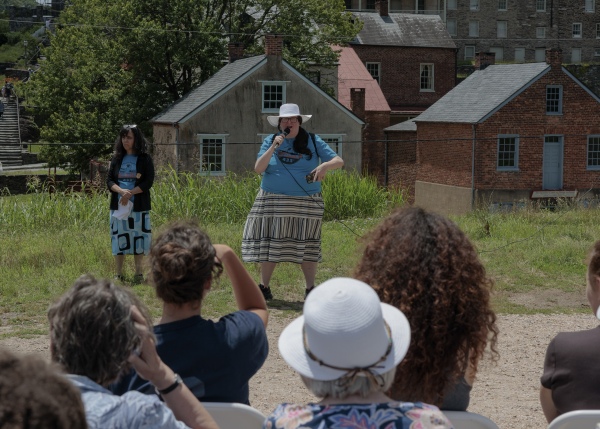
Former National Park Ranger Melissa Dalley, 49, seen here holding a microphone in front of a crowd, speaks during the America 433+ teach-in at Harpers Ferry National Historic Park on June 19, 2026.

Former National Park Ranger Melissa Dalley, 49, seen here holding a microphone in front of a crowd, speaks during the America 433+ teach-in at Harpers Ferry National Historic Park on June 19, 2026.
Former National Park Ranger Melissa Dalley, 49, speaks during the America 433+ teach-in at Harpers Ferry National Historic Park on June 19.
KT Kanazawich for NPR

The summer of 2026 was going to be a triumphant debut for former National Park Ranger Elizabeth Kerwin.

Kerwin, who used to be the exhibit planner at West Virginia's Harpers Ferry National Historic Park, had spent years building a wall of remembrance to highlight hundreds of enslaved people with ties to this historic site — a place best known for a violent raid that attempted to incite an uprising and end American slavery.

Instead, the old stone building that was set to house Kerwin's exhibit has sat empty. The door, locked. Its windows boarded up. The only indicator of what might have been is a green sign at the top of the entryway. "African-American History," it says.

The would-be exhibit is one of dozens that were scrubbed from federal land by the Trump administration as the nation prepared to honor the 250th anniversary of the United States.

These removals, which began after President Trump signed an executive order aimed at "restoring truth and sanity to American history," have prompted lawsuits and protests.

Elizabeth Kerwin, 58, poses for a photo ahead of the America 433 pop up event at Harpers Ferry National Park. Kerwin spent the last three years working on a new park exhibit about African-American history, which was cancelled due to new federal guidelines.
Elizabeth Kerwin, 58, poses for a photo ahead of the America 433+ teach-in at Harpers Ferry National Historic Park. Kerwin spent several years working on a new Black history exhibit, which was nixed by federal officials following an executive order from President Trump.
KT Kanazawich for NPR

"Over the past decade, Americans have witnessed a concerted and widespread effort to rewrite our Nation's history, replacing objective facts with a distorted narrative driven by ideology rather than truth," the order read. "Under this historical revision, our Nation's unparalleled legacy of advancing liberty, individual rights, and human happiness is reconstructed as inherently racist, sexist, oppressive, or otherwise irredeemably flawed."

Neither the National Park Service nor the U.S. Department of the Interior responded to multiple requests for comment for this story.

The about-face felt personal to former parks workers who spent their careers preserving artifacts that have now been deemed too radical for display.

Some, like Kerwin, 58, decided to push back. They began to organize under the moniker "Resistance Rangers" and helped found an education coalition dubbed America 433+ in reference to the 433 sites that comprise the National Park System.

This summer, advocates and former federal workers say they are trying to redefine the message of the country's 250th anniversary by hosting protests, teach-ins and other events aimed at honoring the country's diversity and complex history.

First stop: Harpers Ferry.

Honoring Juneteenth

On the sun-drenched afternoon of June 19, the historic main street here was crowded with families. Some got ice cream or perused shops, while others read up on the historic placards that dot the stone path.

"Hello," Anna Bakalis, a volunteer from former federal worker collective Branch4, said as she handed postcards to a group of tourists. "We're actually doing a little exhibit talk in a few minutes about the erasure of an African American exhibit that was right around the corner that this park actually censored."

Visitors to the John Brown Museum watch an informational video at Harpers Ferry National Historical Park on June 18, 2026.
Visitors watch an informational video at the John Brown Museum at Harpers Ferry National Historical Park.
KT Kanazawich for NPR

The ex-rangers picked Juneteenth — the federal holiday that honors the day in 1865 that enslaved people in Texas learned that slavery had been abolished — to launch their public education campaign. It's a nod to Black history and the speed at which it was being removed from public sites, said Melissa Dalley, a Resistance Ranger and former park guide at the Martin Van Buren National Historic Site in upstate New York.

Holding it on site at Harpers Ferry meant the rangers could capture the very audience they might have reached with Kerwin's exhibit. Only now, Dalley said, they had a more urgent message.

"The only way that change has ever happened in this country is through a small, committed group of American citizens working really hard," Dalley said. "What we're doing out here is trying to recruit those people into that citizen army."

After Trump signed the 2025 executive order that redefined what stories and artifacts could be featured at national parks and historic sites, the National Parks Conservation Association and other advocacy groups sued the Department of the Interior, challenging the agency's ability to enforce it.

A week before Juneteenth, a federal judge ordered the government to cease any further removals and replace any historic materials already taken down from national sites.

In her order, U.S. District Judge Angel Kelley wrote that "history cannot be faithfully told while excluding the experiences of communities whose contributions, struggles, and achievements form an important part of our Nation's story."

The removed exhibits, according to the federal judge, touch on issues of climate change, Black history, women's suffrage, civil rights and indigenous tribes, including: information at Glacier National Park in Montana that detailed the impact of carbon dioxide emissions and hotter temperatures; roughly 80 artifacts from the Selma to Montgomery National Historic Trail in Alabama that mark the 1965 march for voting rights; and exhibits detailing historic slave rebellions or massacres of indigenous peoples.

Ella Wagner, 35, and Melissa Dalley, 49, unpack Junior Resistance Ranger booklets for the America 433 pop up event at Harpers Ferry National Historical Park on June 19.
Former National Park Service historian Ella Wagner, 35, and ex-ranger Melissa Dalley, 49, unpack activity booklets for the America 433+ teach-in at Harpers Ferry National Historical Park.
KT Kanazawich for NPR

Kelley ordered the DOI to reinstate the nixed exhibits before July 4 and the nation's 250th anniversary celebration. When the government asked the court to push back its deadline and delay implementation, the judge declined.

Kelley ordered that 52 items be put back in place at more than 30 federal sites, beginning the week of June 22.

It was not immediately clear if Kerwin's exhibit, which was axed before it ever opened to the public, would also be reinstated. But the Resistance Rangers are done waiting for officials to act. They've printed copies of banned pamphlets and made plans to bring information the government wants out of federal parks directly to visitors.

The Resistance Rangers will set out again Saturday for a national protest of Trump's vision of the 250th celebration. Organizers intend to solicit signatures onto a "declaration of interdependence" that advocates for safety, dignity, living wages and access to a clean environment for all.

A 'debt to the past'

A stone obelisk bearing the words "John Brown's Fort" marks the spot where, in 1859, abolitionist John Brown and more than 20 of his followers captured a U.S. military armory. The plan was to seize the weapons and then hand them out to enslaved people who they hoped would revolt and join their cause.

But the mass rebellion Brown predicted never materialized, leaving him and his comrades trapped inside the arsenal. Days later, the U.S. Marines snuffed out the uprising, captured Brown and ultimately executed him.

The John Brown Monument at Harpers Ferry National Park.
KT Kanazawich for NPR

More than 160 years later, Brown is still remembered for giving his life to the cause of abolition. But the Black men who joined him in this battle typically get second billing.

Kerwin said she hoped her exhibition might help change that.

She and her colleagues compiled a database of names of hundreds of enslaved people who lived in the area from 1769 to 1861 — many of whom had not previously been identified publicly in historic accounts.

Visitors would have heard the account of Osborne Perry Anderson, the lone surviving Black member of John Brown's raid, former rangers said.

The African-American History exhibit was three years in the making at Harpers Ferry National Historical Park. New federal guidelines prevented the exhibit from ever opening.
An African-American history exhibit was years in the making at Harpers Ferry National Historical Park when it was abruptly cancelled by the Trump administration. A year later, the building that was supposed to house the exhibit sits empty.
KT Kanazawich for NPR
Informational signs are placed around Harpers Ferry National Historical Park.
KT Kanazawich for NPR

Instead, this month, tourists were greeted with a shuttered building and a scannable QR code that links to a five-paragraph overview of the park's African American history.

That, Kerwin said, is not enough.

"The people who were overlooked and unnamed and didn't count in the official record, they deserve to take up space in our national memory," Kerwin said. "They are America."

When her project was sidelined, Kerwin said, she was devastated. Not just for herself and the years she had spent on the piece, but for the public, for her country and for her teenage son — a Black boy who she hoped might see his own history reflected in the exhibit's walls.

"He was foremost in my heart as I was working on this," Kerwin said. "I hoped he would see strength and resilience in that story."

Steven Mintz, a history professor at the University of Texas at Austin, did not attend the event, but said that even from afar, it seemed powerful — and necessary.

Mintz compared the former rangers' teach-in to similar public education campaigns during the Vietnam War, and commended them for doing what they could to ensure the Black families and individuals whose history remains tied up with Harpers Ferry are not forgotten.

"The most lasting form of reparations is remembrance. We owe a debt to the past," Mintz said. "All of the prosperity we enjoy and the freedoms we enjoy are due to the people who were willing to sacrifice for us. We have a duty to remember them."

The work is not done

On Juneteenth, Kerwin still got her chance to tell the story of what might have been.

A steady trickle of visitors to the park made their way up the hill to the spot where the group had set up tables filled with banned books, workbooks discontinued by the Trump administration and wooden "junior Resistance Ranger" badges for those willing to take a pledge to "protect our parks, history and science by speaking up, learning and sharing the full stories of our national parks."

Zinn Education Project’s Deborah Menkart, in red shirt, shares examples of banned books and other reading materials during the America 433 pop-up event at Harpers Ferry National Historical Park on June 19.
Zinn Education Project's Deborah Menkart, in the red shirt, shares examples of banned books and other reading materials during the America 433+ teach-in at Harpers Ferry National Historical Park.
KT Kanazawich for NPR
Newly banned booklets from other National Parks are presented during the America 433 pop up event at Harpers Ferry National Park; Junior Resistance Ranger pins are given out at the same event.
Newly banned booklets from other National Parks are displayed during the America 433+ pop up at Harpers Ferry National Park; Junior Resistance Ranger pins are given out at the same event.
KT Kanazawich for NPR

"It's really disturbing to see that there's two educational booklets for children from different Black history sites that are no longer being printed because of our government's decision to support racism instead of justice and liberty for all," said Cathy Fulkerson, 69, a visitor from New Hampshire.

As visitors like Fulkerson settled into folding chairs arranged along the same grassy knoll where John Brown and his followers fought their way into the red-brick armory, Kerwin rose, stepped to the microphone and looked out at the crowd gathered before her.

She remembered why she had wanted to hold this teach-in: To tell stories history had ignored or forgotten, and to set an example for her 13-year-old son. When she cast her eyes out into the crowd, searching for his small face and dyed locs, Daniel had disappeared.

The eighth grader later said what he did next would surprise them both.

Kerwin began to speak on the erasure of Black history, the exhibit she had dreamed up for her son and generations of kids like him. And there was Daniel. Standing at her side.

Former Park Ranger Elizabeth Kerwin, 58, speaks at the America 433 pop up event at Harpers Ferry National Historical Park alongside her son Daniel Nisbett, 13 on June 19.
Kerwin speaks at the America 433+ teach-in at Harpers Ferry National Historical Park alongside her son, Daniel Nisbett, 13.
KT Kanazawich for NPR

Copyright 2026, NPR


Source link

Leave a Reply

Subscribe to Our Newsletter

Get our latest articles delivered straight to your inbox. No spam, we promise.

Recent Reviews


SAP R/3 has been one of SAP’s main products, where R stands for RealTime and 3 refers to three-tier application architecture (Database,Application Server and Client).

In the modern environment, the SAP R/3 system powers the majority of businesses.

This software was used by approximately 80% of the businesses.

SAP Ariba Training

  • Master Your Craft
  • Lifetime LMS & Faculty Access
  • 24/7 online expert support
  • Real-world & Project Based Learning

Why SAP R3 architecture?

The primary goal of R/3 Architecture is to provide a set of tightly coupled, major business applications. The typical range of hypotheses for any R/3 process is as follows:

  • Production Planning
  • Materials Management
  • Sales and Distribution
  • Financial Accounting
  • Controlling, Etc

SAP R3 Architecture:

SAP R/3 Architecture simplifies and connects all of an organization’s business transactions through real-time integration. Real-time integration ensures that any change or upgrade in one application causes the data in the other applications to be automatically modified or updated.

We are aware of the SAP R/3 Architecture, specifically the client-server software. This ensures that the R/3 system’s groups and layers are designed to run concurrently on a number of different computing devices. When a business wants to install SAP software, each component is stored, regulated, and filtered using the equipment of completely separate and specialized computer systems.

Each layer has the ability to call on all of the other layers built to complete the task. Clients are components/layers that request services, while servers are components/layers that deliver services. This is referred to as “client/server.”

, others, sap-r3-architecture-description-0, others, sap-r3-architecture-description-0, others, sap-r3-architecture-description-0, , others, sap-r3-architecture-description-0, others, sap-r3-architecture-description-0, , others, sap-r3-architecture-description-0, , others, sap-r3-architecture-description-1, others, sap-r3-architecture-description-1, others, sap-r3-architecture-description-1

Subscribe to our YouTube channel to get new updates..!

This R/3 Architecture’s three Conceptual Layers are… The R/3 Framework’s classic configuration includes the following software layers:

  • Presentation layer
  • Application layer and 
  • Database layer

Presentation layer:

Receives user input and produces a method request. The Presentation Layer is a user interface that can use a variety of different graphical user interfaces ( GUIs). SAPGUI is SAP’s proprietary user interface program over 20 languages.

The presentation or GUI layer includes collaborating keyboard and mouse information from the device and submits it to the application layer inside the form of workflow requests for the further computation. When the layer receives application layer outcome, it recopy it and exhibits text and graphical data on the user’s PC screen.

Application layer:

Receives and processes a process request using the Software Logic Application.

The application layer is made up of R/3’s core components. The application server layer is where the majority of R/3 business logic processing takes place. The dispatcher is in charge of the job procedures here.

The comprehensive logic of R/3 implementations for business operations is provided by the database server. A system may well be connected to a range of different application servers that are geographically distributed.

Database Layer:

All data is saved and recovered. The Database Layer is in charge of both the R/3 Framework’s application elements and the enterprise’s working data. As needed, applications are downloaded from the database, loaded into the application layer, and executed from there.

The database component contains an engine whose sole purpose is to retrieve the data on the application layer’s behalf. SAP R/3 interfaces with its supporting databases using the industry-standard database access language SQL.


SAP Ariba Training

Weekday / Weekend Batches

Components of SAP R3 architecture:

In the application layer there are several elements or components that carry out different operations. Now we will check one after the other.

  • Message Server: In an ABAP system, it handles communication between distributed dispatchers.
  • Dispatcher Queue: This queue stores various types of work processes.
  • Dispatcher: This component distributes requests to work processes.
  • Gateway: It allows collaboration between some of the SAP systems and external systems.
  • ABAP-Work processes: It implements dialog steps in R/3 applications separately.
  • Memory-pipes: It allows ICM and ABAP work processes to communicate with one another.
  • Message Server: It is in charge of java dispatchers and server processes.
  • It allows for communication within the Java runtime environment.
  • Enqueue Server: It manages logical locks set by a Java application program in a server process.
  • Central Services: A specific example of the central services is required by Java cluster for managing locks and transmitting messages and data. A Java cluster is a
  • collection of processes that collaborate to create a dependable system. An instance is a collection of resources such as memory and work processes.
  • Java Dispatcher: This process receives client requests and routes them to the server process.
  • J2EE components are installed using SDM: Software Deployment Manager.
  • Java Server Processes: It can handle a large number of requests at the same time.
  • Threading: When different tasks execute independently in the background, this is referred to as threading.
  • ICM: It facilitates communication between the SAP system and the HTTP, HTTPS, and SMTP protocols. This means that by entering the system URL into the browser, you can also access SAP from the browser.

How does SAP R3 architecture work?

SAP R/3 Processes are being used to successfully manage os resource requirements for the software program. The technique is inextricably linked to the software application. Memory, as well as system support for renewable energy, are accessible for any operation. The on request is determined by the type of work performed in the application server.

The SAP DISPATCHER, SAP’s proprietary control agent, is located in the R/3 Basis kernel. The deploying device, in collaboration with the respective operating system, manages the facilities used by R/3 systems to control their operational activities. The exact number of activities varies depending on the configuration. The dispatcher’s main function is to filter the working process that has been submitted.

There are specific work process models for:

  • Online work process dialogue -Interactive SAPGUI screen processing request
  • Updating the database as part of the work process
  • Background Work Process -used for background processing, such as batch jobs.
  • Spool work procedure-Spooling/Printing procedure
  • Work process-lock management should be enqueued.

Conclusion:

In this blog post we had clearly disused all the points related to the SAP R3 architecture in a clear cut manner. If you have any queries please drop your comments to get them resolved. Happy learning at HKR trainings.


Source link