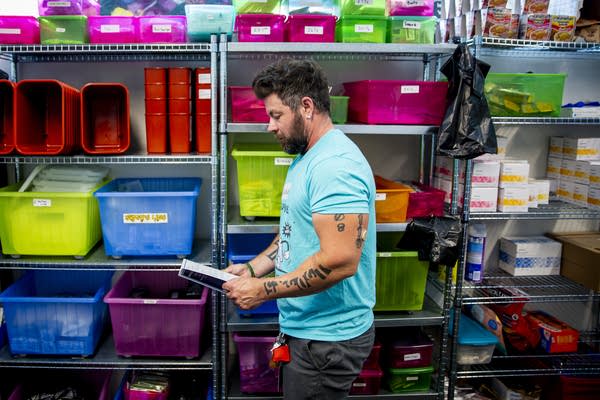
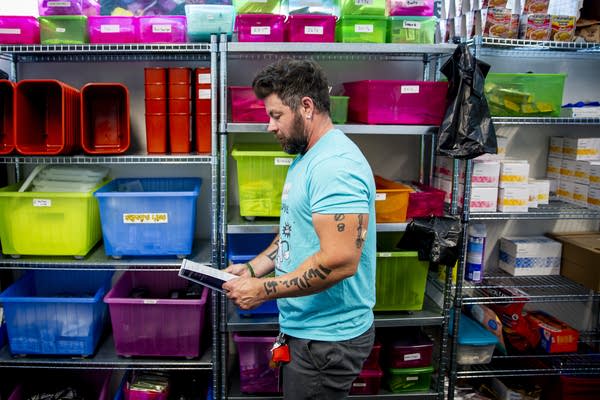
It was a small victory, but one Gabe Lyrek was eager to share.
The county had found housing for a woman who was a regular at the NorthPoint Health and Wellness Center’s needle exchange program in north Minneapolis. A permanent home might not end her opioid use but it would mark an important step forward.
As a harm reduction services coordinator for NorthPoint, Lyrek spends much of his time providing prevention education, distributing sterile syringes and helping people access treatment.
He is a key piece of what has become an informal but vital overdose response network across north Minneapolis made up largely of healthcare providers, community coalitions, a fire station and neighbors equipped with naloxone. Collectively, advocates say it has helped address the opioid crisis that has gripped the area in the years during and since the COVID-19 pandemic.
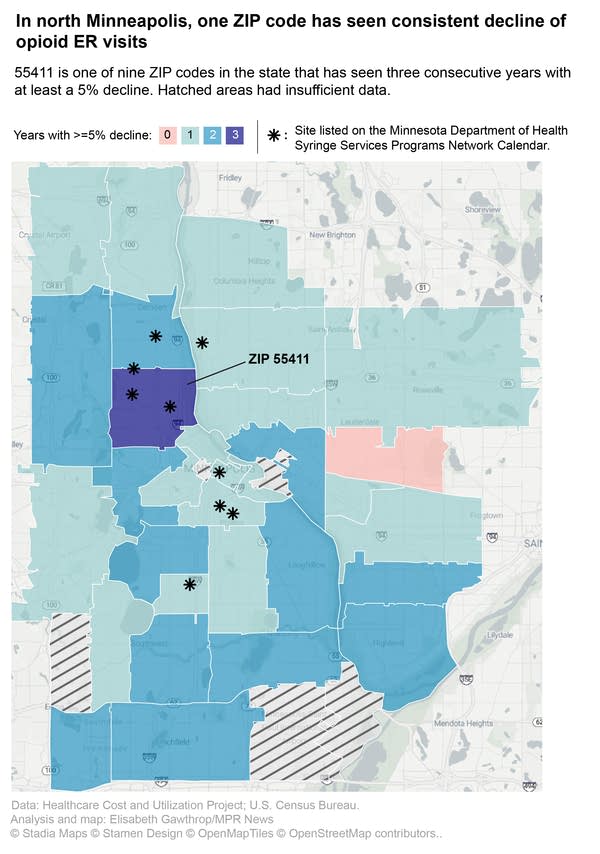
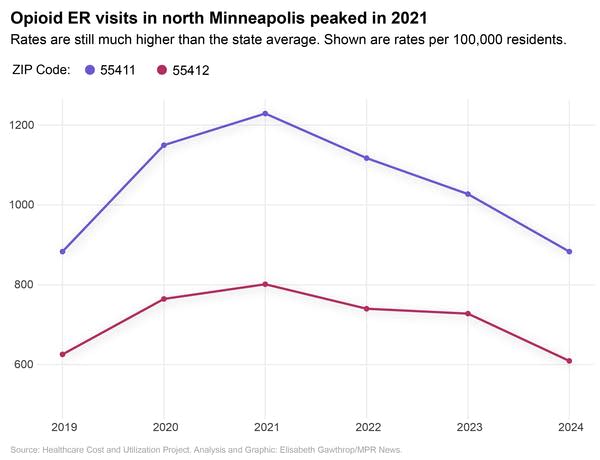
A data analysis by MPR News found the number of people going to the emergency room with opioid-related illness decreased in north Minneapolis.
From 2021 to 2024, ER visits related to overdoses as well as visits for health issues associated with opioid use, dependence and withdrawal consistently declined for residents in the 55411 ZIP code, the heart of the Near North neighborhood. It is a trend seen in only nine ZIP codes across the state.
Public health officials cannot say for certain what caused the drop, although they point to the commitment of the people on the ground in north Minneapolis.
The declining numbers only tell part of the story, though, as opioid-related emergency department visit rates remained more than three times the statewide average. Overdose deaths in the neighborhood did not similarly decline.
Building a neighborhood response
In north Minneapolis, where fentanyl has reshaped the local drug landscape, the opioid crisis persists. At the same time, harm reduction programs have expanded dramatically, giving residents greater access to lifesaving services.
Participation in NorthPoint's Harm Reduction and Testing Services program has grown more than 1,000 percent since launching in 2018, according to program data. Between 2018 and 2025, it served nearly 17,000 individuals.
Through the first half of 2026, participation was already up another 27 percent compared with the same period in 2025, and Lyrek said demand continues to grow.
Harm reduction is a public health approach that seeks to reduce the health risks associated with drug use rather than requiring abstinence first. Strategies include distributing sterile syringes, providing overdose prevention education and expanding access to naloxone, the overdose-reversal medication commonly sold under the brand name Narcan.
Public health officials said fewer emergency visits may indicate that more overdoses are being reversed in the community through wider naloxone availability, faster emergency response, expanded prevention efforts and treatment that increasingly occurs outside hospital emergency departments.
“I think it's a culmination between a lot of things, like Narcan became available over the counter at pharmacies,” Lyrek said. “You can’t spit without hitting free Narcan in North.”
A new campaign led by the North Minneapolis Harm Reduction Coalition has placed red “Narcan Available” stickers in 32 businesses between West Broadway and Lowry Avenue, signaling that the overdose-reversal medication is available at no cost.
A spokesperson for the city of Minneapolis said the response system also includes Minneapolis’ Safe Station program at Fire Station 14, which has helped nearly 8,000 people connect with detoxification services, substance use treatment and recovery resources since opening in 2023.
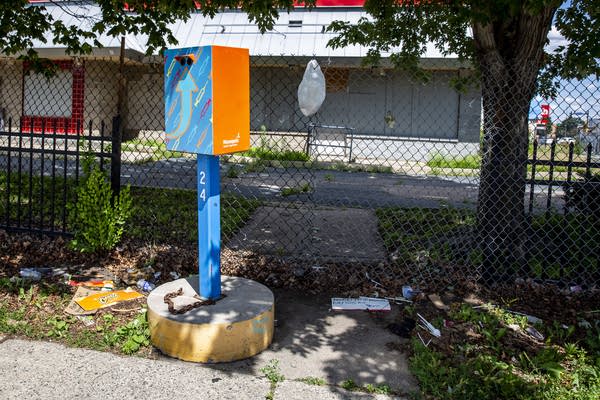
Access to naloxone has also expanded through self-service vending machines installed at Fire Station 14 and two other Minneapolis fire stations through a partnership between the Minneapolis Fire Department, the Minneapolis Health Department and Hennepin County. By the end of 2025, the machines had dispensed more than 8,500 doses.
‘No one wants to be in it’
Public health researchers and clinicians say the shifting data cannot be understood without considering the medical realities of opioid use disorder.
The American Medical Association’s 2025 report on the nation’s overdose epidemic notes that while opioid-related overdose deaths declined nationally in 2024, the increasing prevalence of fentanyl mixed with other substances and the unpredictability of the illicit drug supply continue to drive severe risk.
Almost a decade after the U.S. government declared the opioid epidemic in the U.S. a national public health emergency, the crisis remains deeply entrenched in communities across the country, including in Minnesota.
Dr. Robert Levy, a family medicine and addiction medicine specialist and associate professor at the University of Minnesota who treats patients at the Broadway Family Medicine Clinic in north Minneapolis, describes opioid use disorder as a treatable medical mental health condition.
“It’s simply another illness,” he said. “It’s not that different than diabetes or hypertension or asthma. It has psychological, physiological and physical causes and effects like all illnesses. There are risk factors that make it more dangerous or more likely to be severe.”
Levy said a defining feature of opioid use disorder is the cycle of withdrawal and relief that drives continued use.
“Opiate withdrawal feels terrible,” he said. “It feels like you’re very ill. No one wants to be in it.”
He noted that many people continue using opioids not to get high, but to avoid withdrawal symptoms.
“The only way they know to get out of it is to take more opioids,” Levy said. But that cycle, he added, can eventually lead people into getting healthcare. “It gets them to a point where they’re willing to walk into my office or go to treatment.”
Levy said the increasing potency of synthetic opioids such as fentanyl complicates the situation. Because fentanyl and related substances have a narrow margin between a dose that produces an effect and a dose that can cause respiratory failure, small variations in use can be deadly.
As tolerance builds, people need more to achieve the same effect, Levy explained. And eventually, he said, the amount that relieves withdrawal is very close to the amount that can stop someone from breathing.
Guilt and shame remain major barriers to care that can keep people away from the emergency room, he added, “but most people don’t want to die. If there’s a way to feel safe and avoid going to the emergency room, they will choose that.”
Minnesota also saw a drop in opioid-related deaths from 2023 to 2024, recording a 26 percent decline. But provisional data from the Centers for Disease Control and Prevention shows the number of deaths from opioids remained steady in Minnesota in 2025, even as they continued to decline nationally.
‘Not everything is equal’
In 2020, the Hennepin County Board of Commissioners declared racism a public health crisis, acknowledging the role systemic inequities play in health outcomes, including substance use.
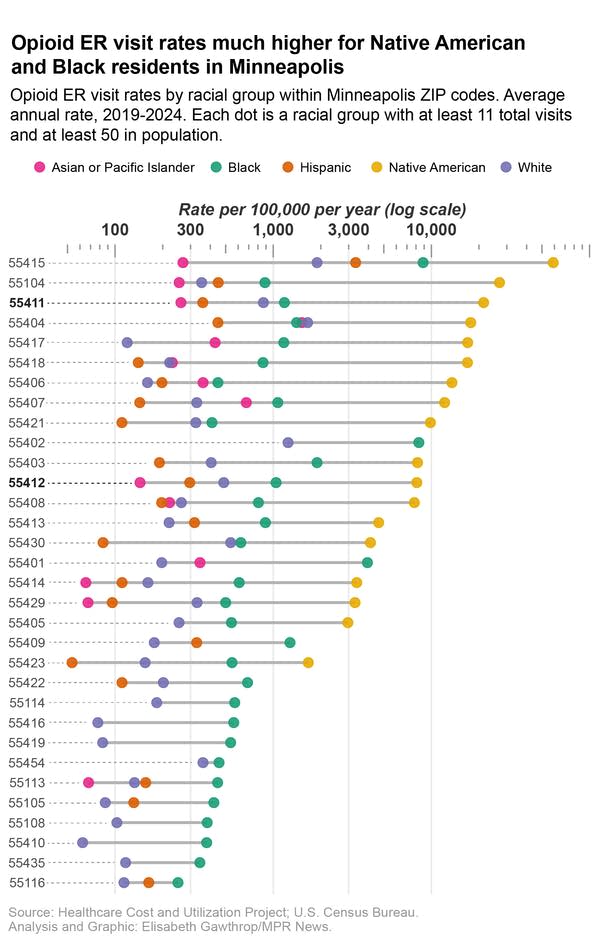
The county's opioid response funding has increasingly been directed toward Native American and Black communities, particularly in north Minneapolis, where data show the greatest need.
“Not everything is equal in this crisis for all the communities,” said Lolita Ulloa, who leads the county’s opioid response work. “You have to measure everything you do with compassion and help. We’re in the community all the time. They see our faces. They know who we are.”
Julie Bauch, the county’s senior strategist for opioid response, said data show Black residents in north Minneapolis account for a disproportionate share of opioid-related deaths. Black people “have by count more opioid-related deaths than any other population,” she said, even though “the number of white people in Hennepin County far surpasses the number of Black and African American people. That is troubling.”
Ulloa and Bauch said those disparities helped drive the creation of a north Minneapolis coalition in 2025 that brings together community organizations and outreach workers responding directly to people affected by opioid use.
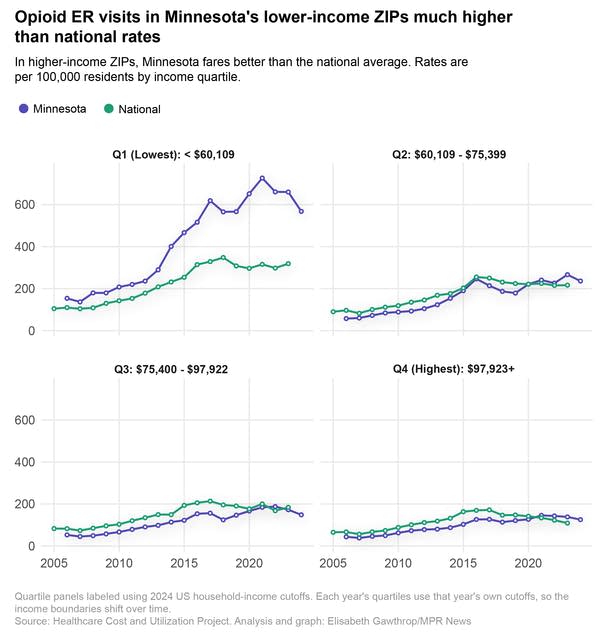
The area is also lower-income, which in Minnesota is associated with particularly high ER visit rates related to opioid use. In 2023, opioid ER rates for low income ZIP codes in the state were two times the average of low income ZIPs nationally, an MPR News analysis found.
Bauch said longstanding distrust of medical systems and law enforcement rooted in historical and ongoing inequities continues to shape how people seek help.
As a result, she said, community-based organizations like the coalition play an increasingly central role in overdose prevention and response, combining naloxone distribution with relationship-building and healthcare navigation.
“It’s a constant, long-term relationship,” Bauch said. “We might not see somebody show up at a hospital, but that doesn’t mean their journey isn’t going to lead them to treatment and recovery.”
Showing up, day after day
Walking the streets of north Minneapolis on a recent day, Lyrek is well-known to people on the street and consistently has a kind word to share.
As he spoke, a young man moved erratically down the street. Lyrek’s expression brightened. “Oh my God, this kid,” he said with a smile. “I love him.”
He said he tries to seek people out first, so they do not have to spend time tracking him down.
On this day he tried but could not find the woman he was looking for to tell her Hennepin County had found her a home, but he was confident they would connect.
“She is someone who has expressed that she wants to stop using,” he said. “But that’s not something she can focus on if she’s not sleeping in a safe place.”
SAMHSA’s National Helpline is a free, confidential, 24/7, 365-day-a-year treatment referral and information service for individuals and families facing mental and/or substance use disorders. Call: 1-800-662-HELP (4357)