
They call Guyana, “South America Undiscovered,” and it felt that way as we splashed down red dirt roads, paddled dugout canoes to remote indigenous villages, and saw more tropical birds than tourists. Over 85% of the country is pure rainforest and, as part of the Guiana Shield, a 1.7-billion-year-old geological formation with over 3,000 vertebrate species, 20,000 plant species (40% of which are endemic), and 15% of the world’s fresh water supply (including the world’s largest single drop waterfall by volume), Guyana’s biodiversity is off the charts.
Arriving in the capital, you feel Guyana’s British colonial past with its wooden Anglican churches, cricket fields, and everyone chatting in English (the national language). Though it’s the European, West African, Indian, and Indigenous populations that have been blending for centuries that make Guyanese culture so unique. On the coast, you feel the Caribbean flair, with the spice on your tongue and tropical beat in your feet. Head inland and you’ll see 90% of the country’s Amerindian population, still thriving in the remote rainforest.
We had the pleasure of spending two weeks in Guyana and are excited to share our favorite places, tips, and stories, from an Indo-Guyanese cooking class in the capital to dugout canoeing into the depths of the Rupununi. Enjoy our travel guide to Guyana, the “Land of Many Waters” and one of South America’s best-kept secrets.
GEORGETOWN
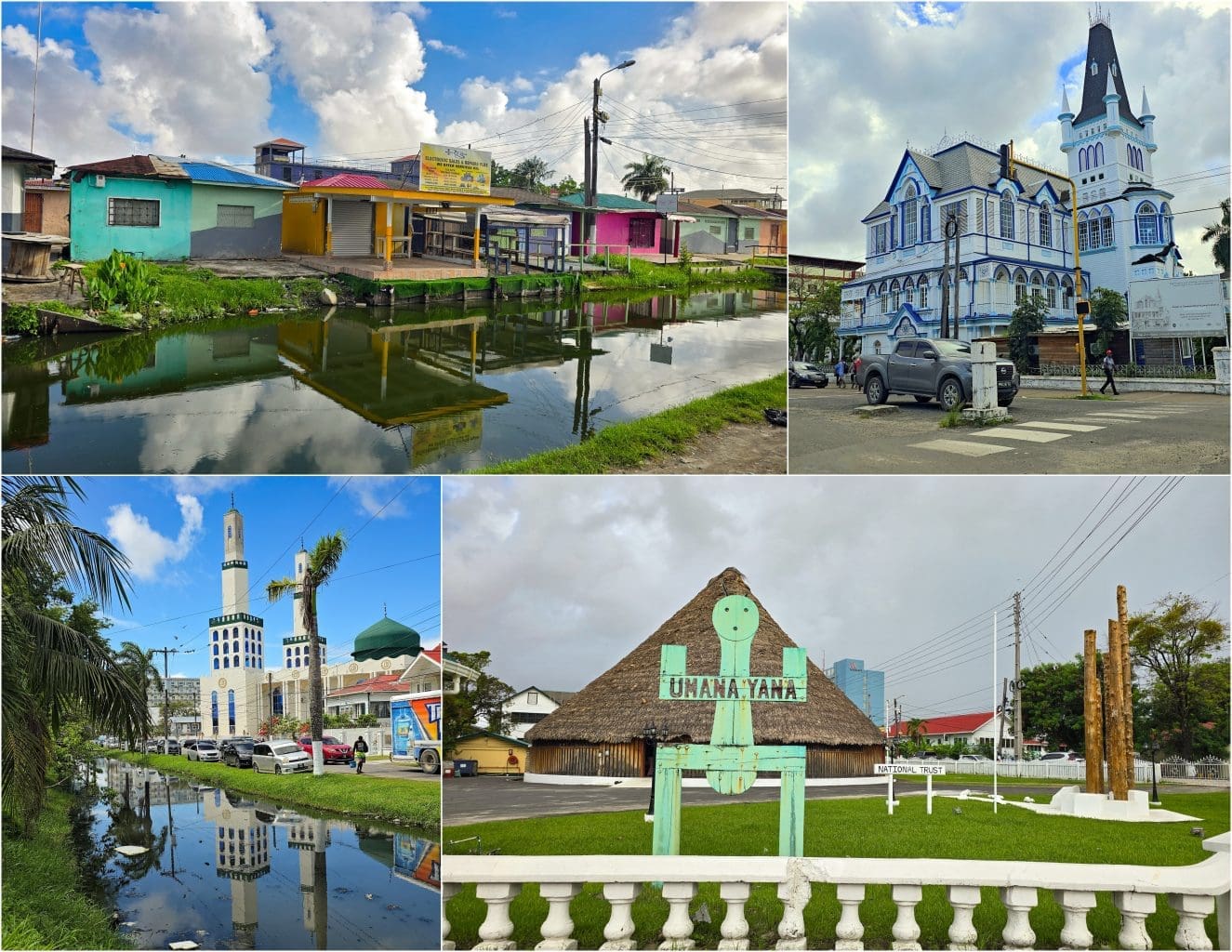
Our shared taxi pulled into the capital, and we were immediately struck by Georgetown’s colorful colonial architecture reflected in the canals. As a Dutch and British colony for centuries, the city’s architecture is a beautiful blend of European and Caribbean influences. One of the Dutch’s greatest contributions was the “seawall,” which keeps this below-sea-level city from flooding and provides a lovely promenade to enjoy the coast.
Georgetown may be Guyana’s one big city, but it still only has a population of 120,000, and an exceptionally diverse one at that. With 40% of the country being Indo-Guyanese, this means Hindu temples, mosques, and chapati restaurants add an Indian allure. In the city itself, Afro-Guyanese become the majority and elevate Georgetown’s Caribbean vibe.
Reggae, calypso, and dancehall music mix with West African beats pulsing from storefronts and down taxi lines. With such disparate groups, the country makes a concerted effort to foster national identity and unity, and you’ll notice the mantra “One Guyana” everywhere, from street signs to pop songs. One thing every Guyanese can agree on is that their culinary fusion of flavors is the best in South America, and we concur!
Capital City Tour
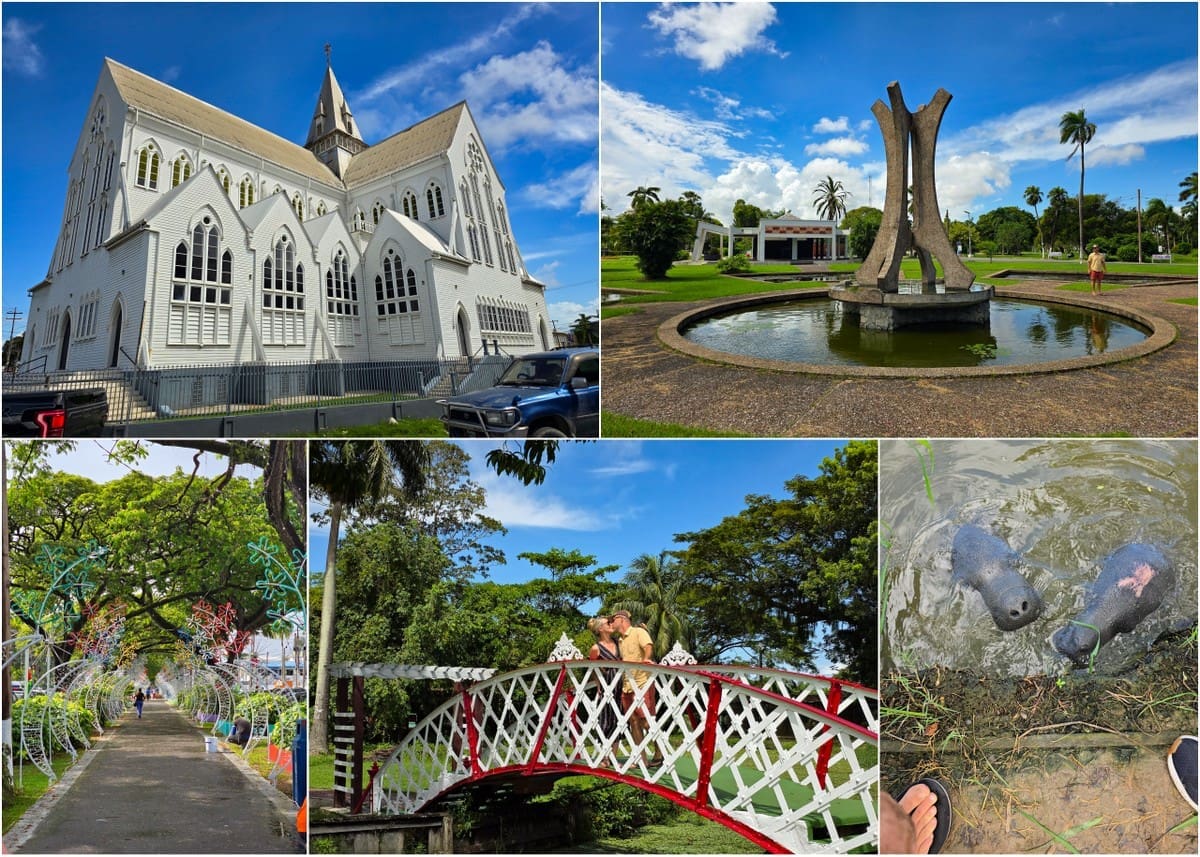
To get our bearings in the capital and the country’s history, we took a Georgetown city tour. Main Street is a great place to start, with its grand governmental buildings, museums, and manicured promenade running up the center. We loved the Botanical Gardens (est. 1877) with its 7 Ponds commemorating national heroes and the red wrought-iron “kissing bridges,” St George’s Cathedral (one of the tallest wooden churches in the world), and the national park to feed the resident manatees! Tours typically make brief stops at museums, more on those below.
Guyana National Museum & Walter Roth Museum of Anthropology
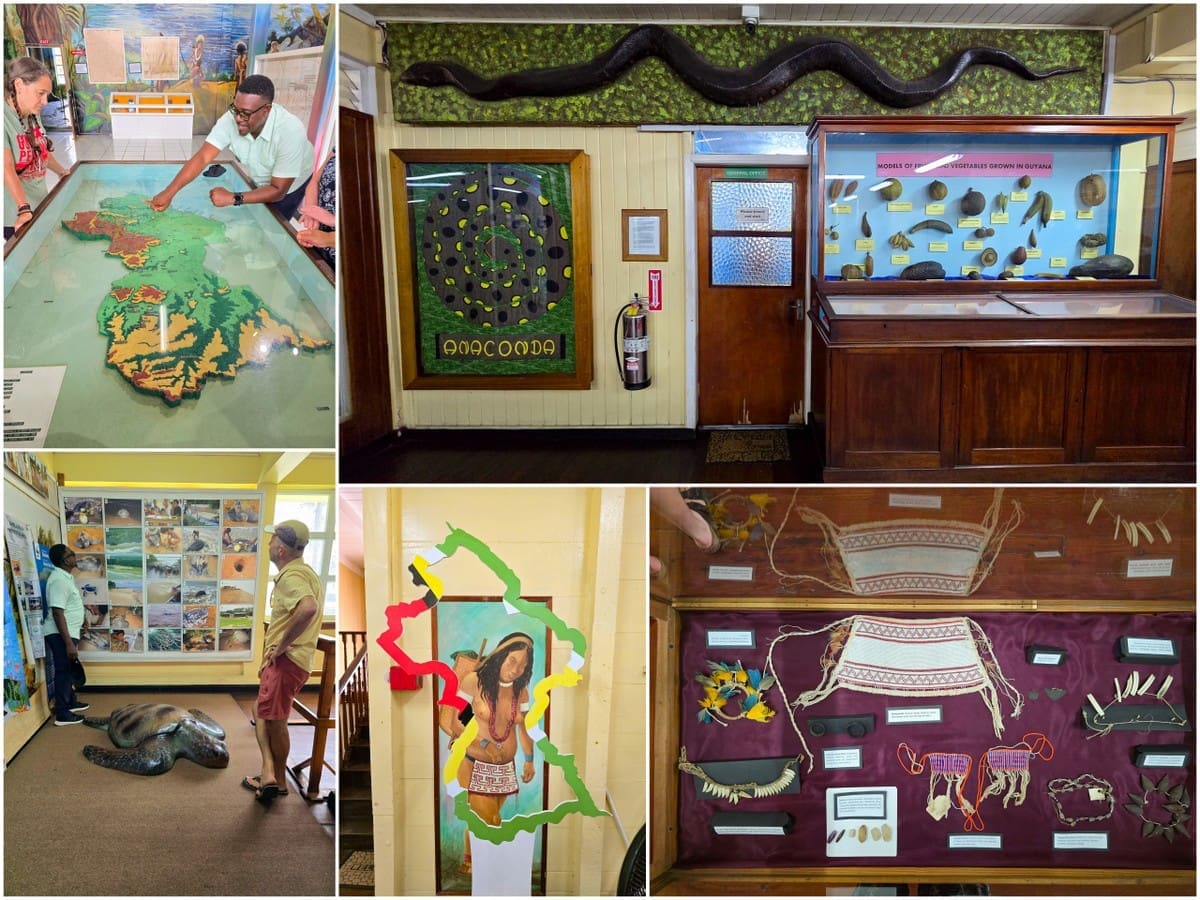
The National Museum may be a little worn (oy, the taxidermy!), but it offers the best overview of everything from the country’s flora and fauna to its industries, including the oil boom that has made Guyana the fastest-developing country in South America! We’re also glad we visited the Walter Roth Museum of Anthropology to get a sense of the nine indigenous groups that make up Guyana, including the Makushi and Arawak, two groups we would get to know well during our trip into the rainforest.
Local Markets: Stabroek Market & Bourda
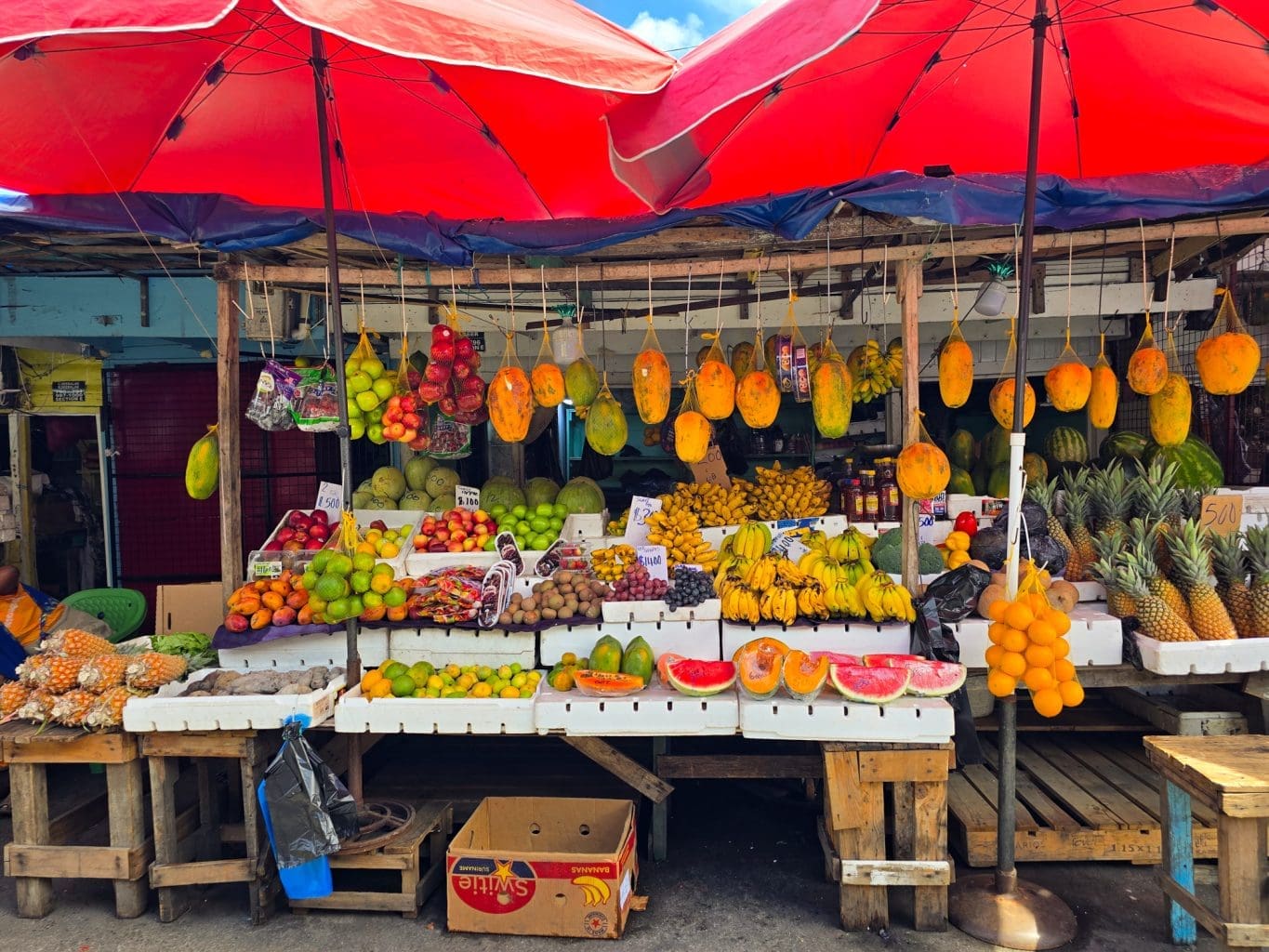
We went to the 19th-century Stabroek Market to see its beautiful iron construction and what might be the busiest place in all of Guyana! As if the back-to-back food stalls weren’t enough bustle for you, the market doubles as the main bus stand and ferry terminal for the Demerara River. As a result, it doesn’t feel like the safest place for tourists, so go with a guide or opt for our favorite market, Bourda. It’s one of the world’s largest drive-through markets, which means it’s largely open-air, with streets lined with tropical delights. Sample as many goodies as you can!
Singing Chef Adventures: 7 Curry Experience
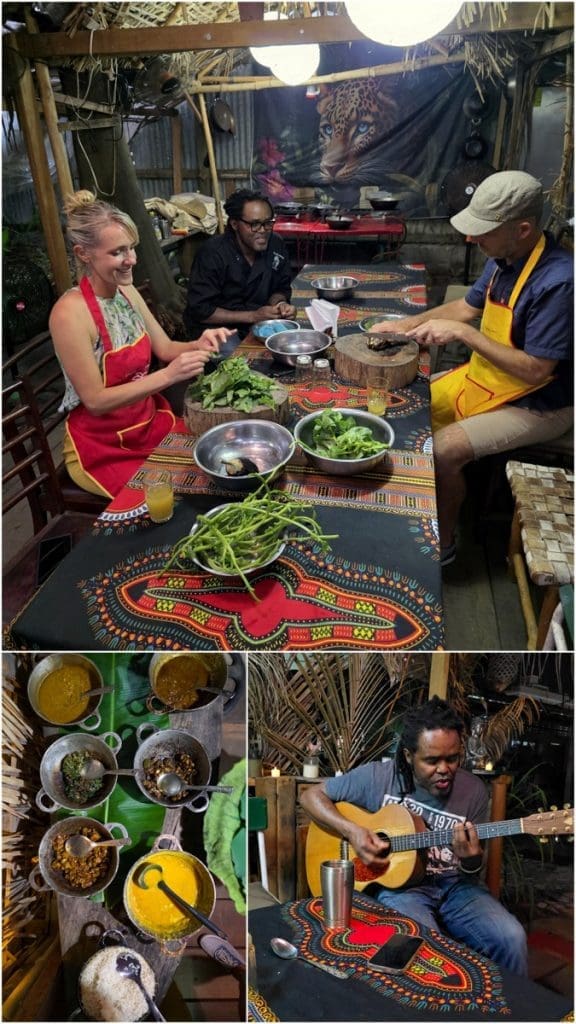
The best expression of Guyana’s multicultural beauty is a cooking class with The Singing Chef! Guayanese-born, with African, Asian, and Amerindian roots, a chef trained in top restaurants around Europe, a musician who toured the world with bands from Blondie to Toots & The Maytals, and a TV host of the Singing Chef Cooking Show, Eon John is a man of many talents and a fountain of inspiration. Eon and his wife, Jess, a larger-than-life Brit and Guyanese resident for 20+ years, run a range of tours that dive into a variety of Guyanese culinary heritages–from Indian to African to British–covering the history of the country and every ingredient as you go from the market to their secret garden kitchen.
We took their 7 Curry Tour, learning about this quintessential Guyanese masala paste, which originated with the Indian indentured laborers brought here in the 19th century. It was used to make the seven dishes for Hindu celebrations, and today it’s central to Indo-Guyanese cuisine. With a rum punch in one hand and a mortar and pestle in the other, we got cooking! We toasted spices, chopped exotic produce, and stirred in the magical paste to create 7 different dishes: Katahar Coconut, Sweet Potato & Chickpea, Eggplant Bunjal, Pumpkin, Pineapple & Papaya Curry, Callaloo, and Spicy Okra & Red Curry.
Using our giant lily plates, we created a base of rice and dahl, and took a scoop of each curry for one of the most flavorful meals we’ve ever had. To top off this incredible feast, Eon broke out his guitar for a private concert, including a performance of the charming theme song from his cooking show. Get a taste of Signing Chef Adventures with our video above, and you 1000% need to take their tour when you come to Georgetown; no visit would be complete without it!
Where to Stay in Georgetown
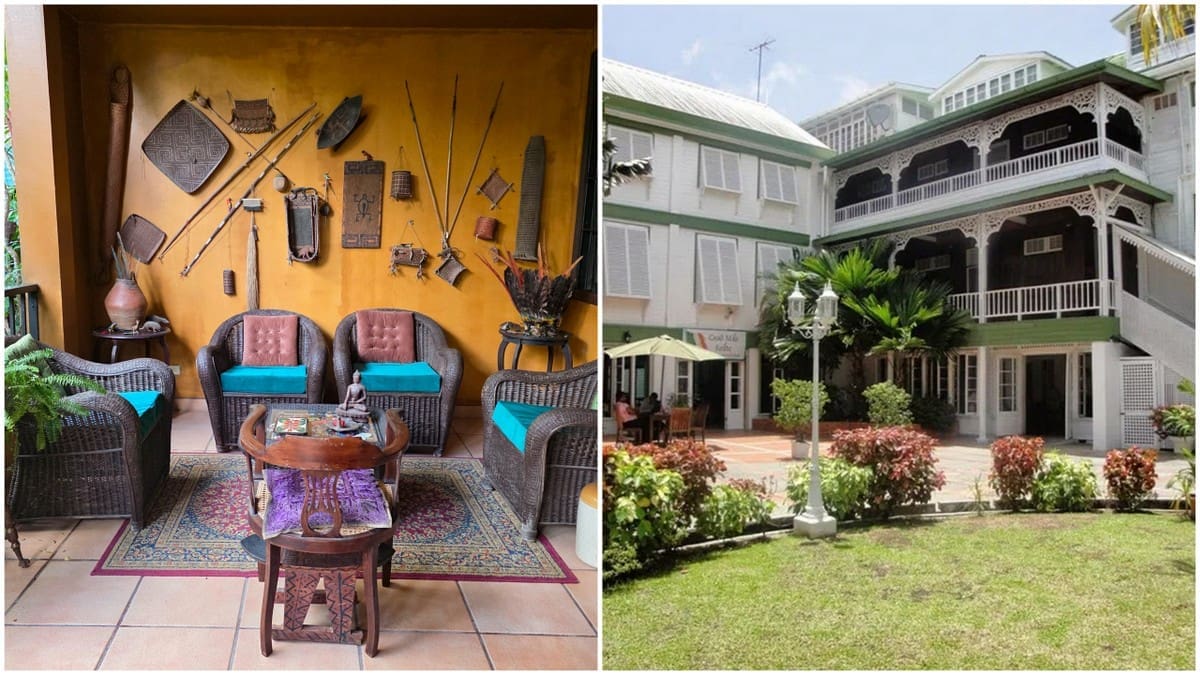
Rainforest B&B: We are so glad we found this 4-room B&B set in the stunning home of Sayeda and Jerry, two people not just recognized for their hospitality but also for their humanitarian work around the country. It’s located in the heart of the city (and conveniently one block from The Singing Chef), but it truly has rainforest vibes, with huge trees, manicured gardens, and vibrant indoor-outdoor spaces. As lovers of art and world religions, they have a home with global vibes and a Guyanese soul. Guests have the run of the downstairs, including the kitchen and garden, and the owners are upstairs if you need them and are always happy to chat over their home-cooked breakfast service.
Cara Lodge: A Victorian beauty from the 1840s, the Cara Hotel is colonial Guyana at its most regal. We loved their central courtyard and bar, which offers rum tastings of Guyana’s award-winning El Dorado Demerara rum (try the 25-year if you can!). Well situated within walking distance of Georgetown’s main attractions, including the Walter Roth Museum of Anthropology and Georgetown City Hall, it’s a fantastic option downtown.
Overlanding Guyana: The Wild Georgetown-Lethem Road to the Interior
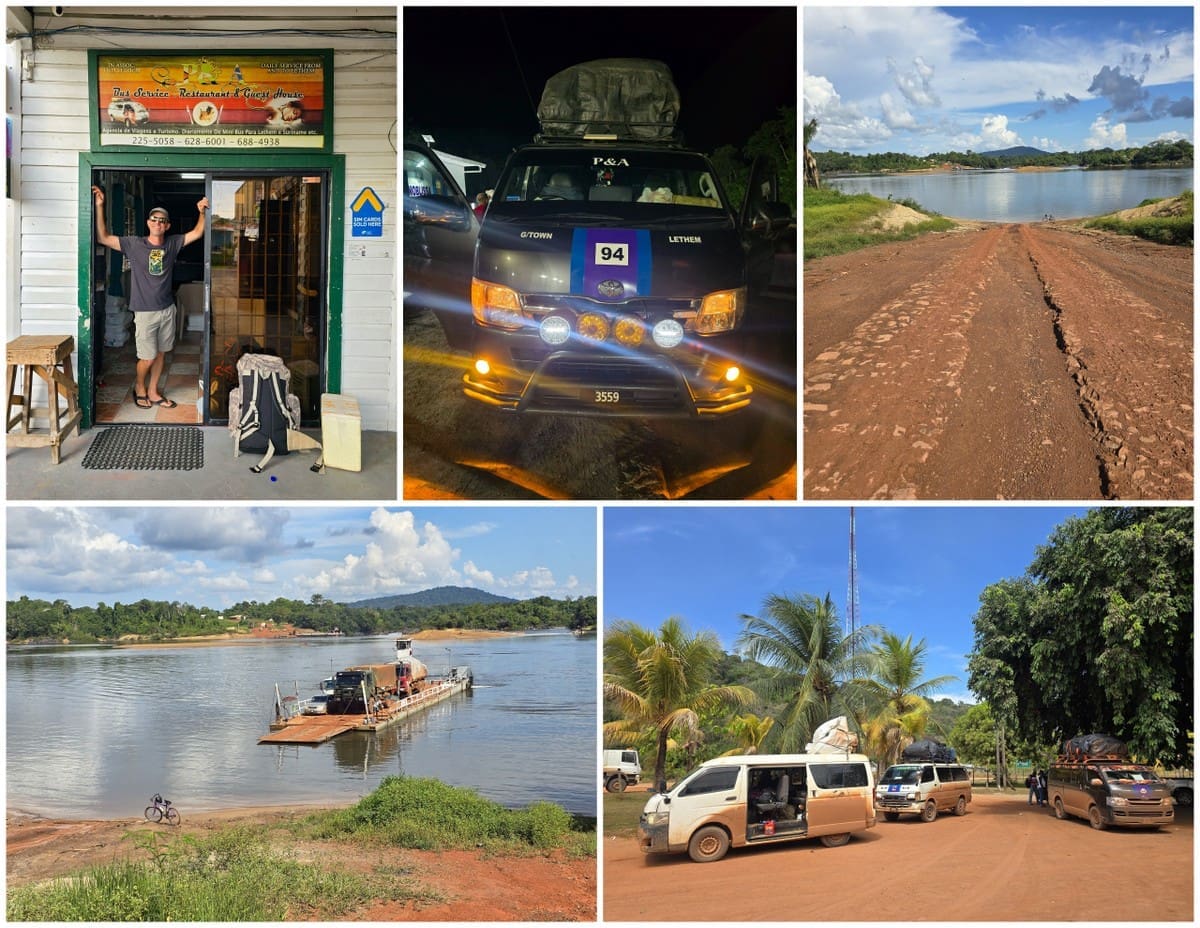
Leaving Georgetown for the Rupununi and heart of Guyana’s rainforest, most people fly to Fair View village or Lethem…not HoneyTrek! We opted for the locals’ way; a 12-hour overnight journey down the mostly unpaved “Trail,” Guyana’s only road into the interior and border with Brazil. After a lot of research into the best schedule and price combo, we went with P&A Bus, run by a super-nice father-son team with a good fleet of vehicles.
We tried to catch some Zzzs on this overnight journey, but between sardine-style seating, blaring music, potholes, speeding, and multiple passport checks, sleep was but a dream. We reached the Essequibo River around 3am, where the whole van took a collective nap until the ferry started running at sunrise. We rumbled onto a wooden-deck barge and puttered across the river, feeling like we had earned our Guyana stripes and so happy to have made it to the Rupununi!
NORTH RUPUNUNI
As a whole, Guyana is a world-class wildlife destination with 228 mammal species, 820 bird species, 900 fish species, and 330 reptile and amphibian species. The best place to experience that biodiversity is in the Rupununi. With very few humans and huge swaths of rainforests, mountain ranges, savannahs, and rivers, it’s where Guyana’s reputation as “The Land of the Giants” shows itself with large populations of giant anteater, anaconda, jaguar, black caiman, giant river otter, and Arapaima (the world’s largest freshwater scaled fish). As a region spanning 57,000 square kilometers, we decided to explore both the North and South Rupununi to experience the diversity in its land and people.
Iwokrama River Lodge & Research Centre
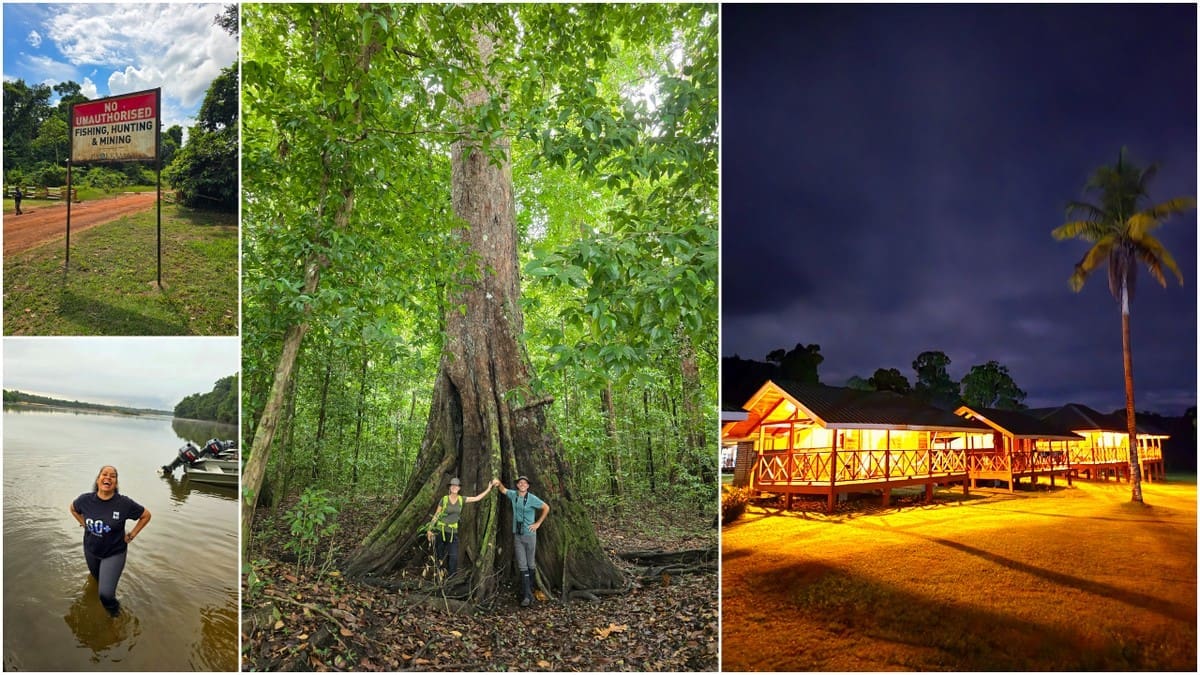
To best experience the North Rupununi, there is no place better than Iwokrama River Lodge. Founded by the national government in the 1990s to promote conservation, scientific research, sustainable forestry, and community development, Iwokrama is such an inspiring project and experience! We checked into our cabin, the same one that hosted Prince Harry and King Charles (the patron of Iwokrama since the early 2000s)! In addition to the cabins with spacious patios and river views, we appreciated that they have six basic rooms for nature enthusiasts at all budget levels, including researchers working to protect the environment.
Turtle Mountain
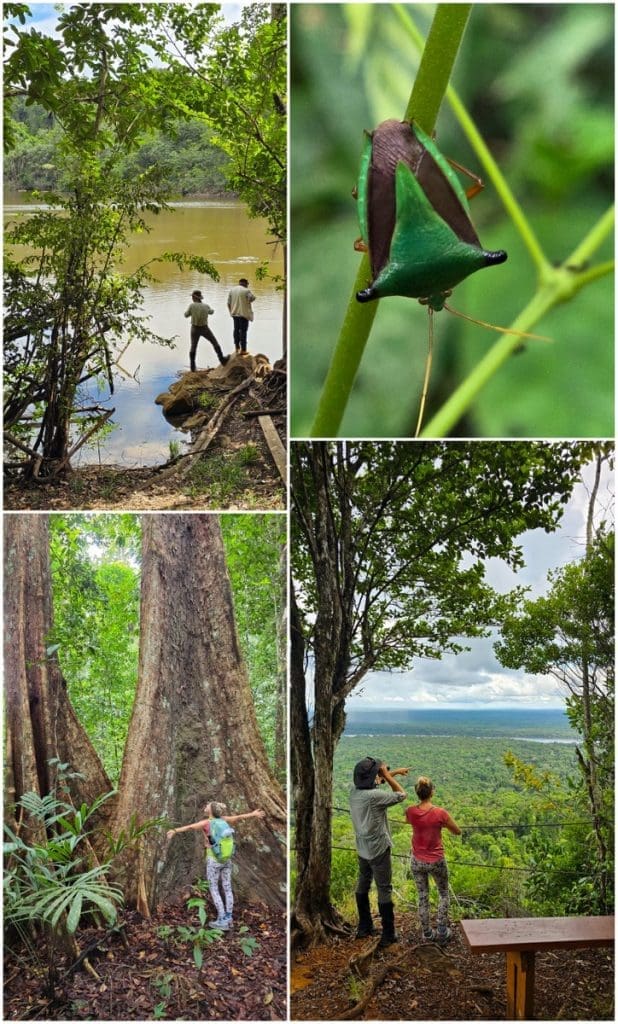
With our Makushi-Amerindian guide Alex, we headed 40 minutes downstream toward Turtle Mountain. Along the way, we spotted black caiman, osprey, Amazon kingfisher, and many more of Iwokrama’s 130 mammal and 475 bird species. We hopped out for the two-mile hike to the summit. As we moved through the dense forest, Alex pointed out its inner workings, with stops to observe the bright blue morpho butterflies and to touch the Greenheart tree, a timber so strong it’s still holding up British bridges around the world, and so healing that it’s used to treat diseases like malaria.
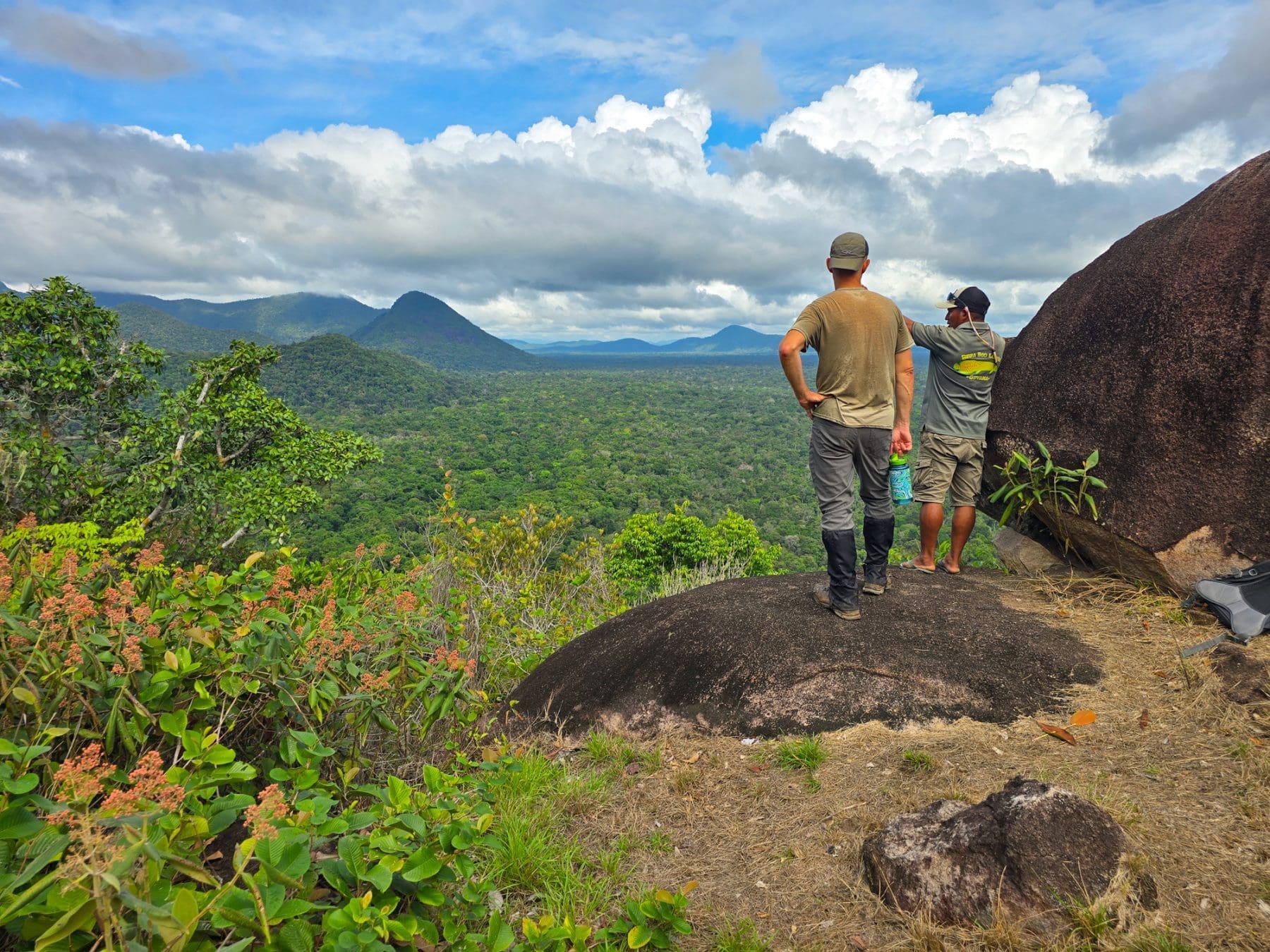
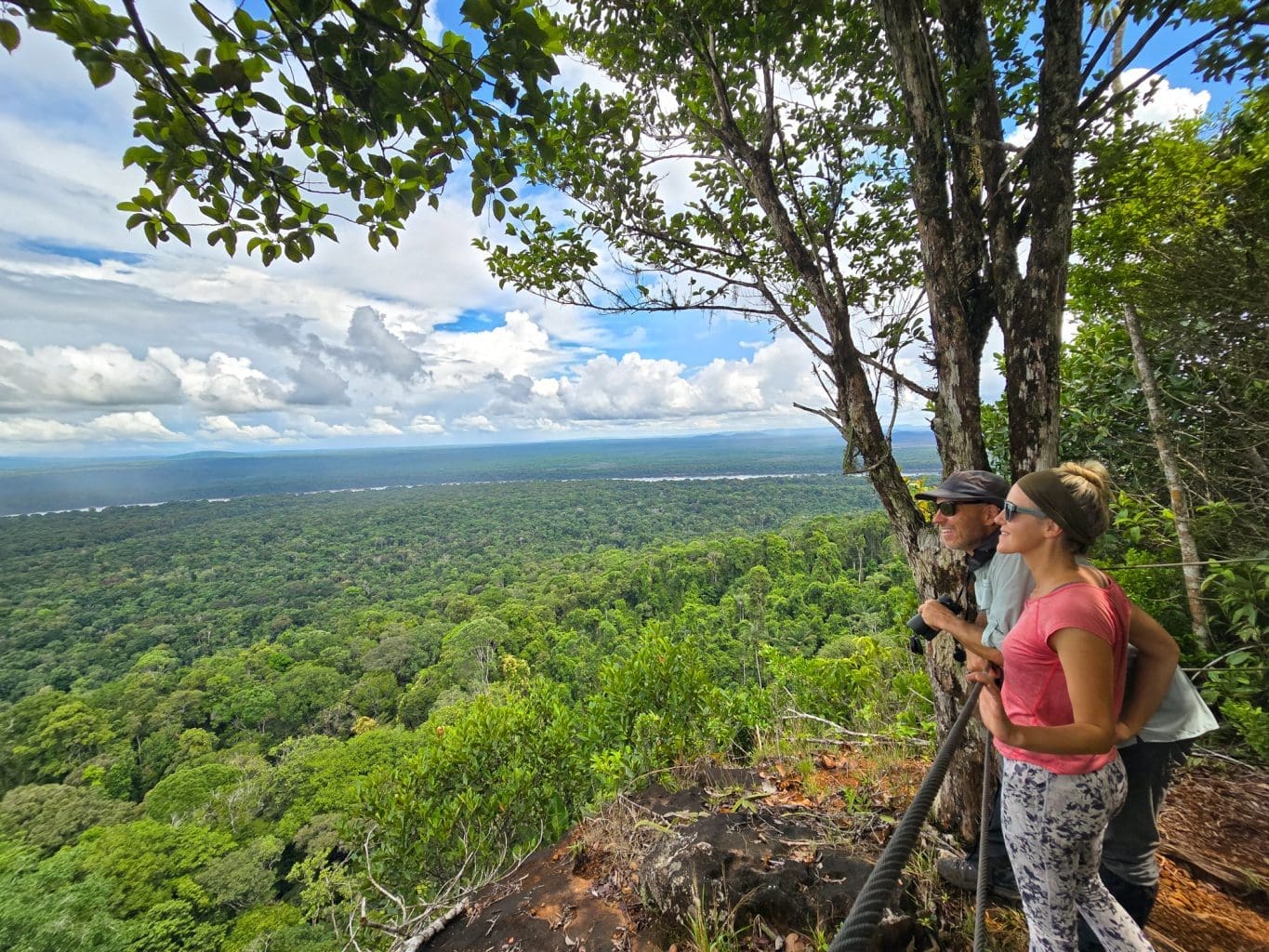
The last stretch of trail was the most challenging and equally beautiful, with huge boulders, until it opened up to a sweeping view across the Iwokrama Reserve and Essequibo River–left utterly wild.
Kurupukari Falls & Petroglyphs
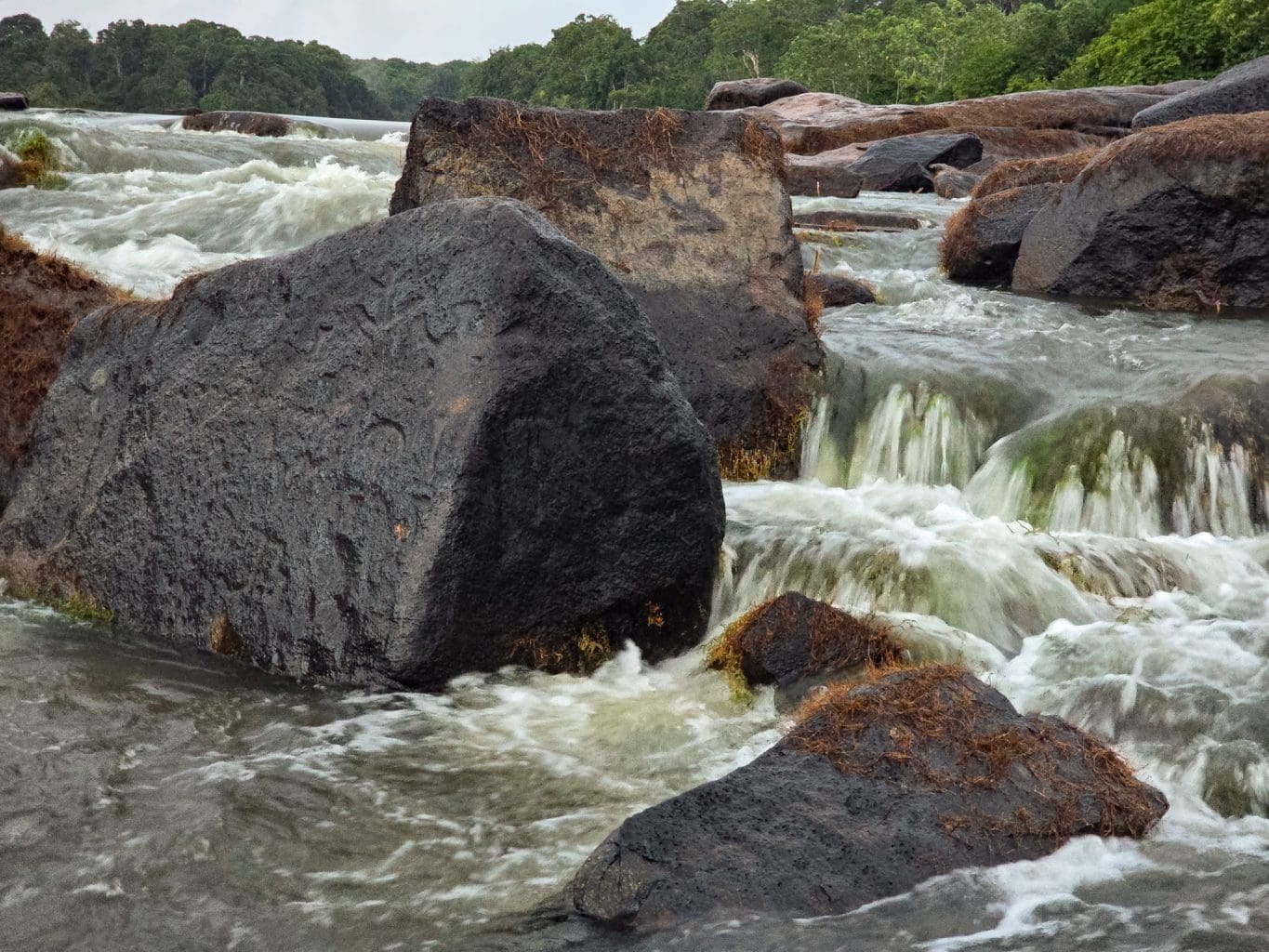
Heading upstream, we reached Kurupukari Falls, a favorite local swimming hole and rock art site. When the river is low enough, petroglyphs dating back 6,000 years reveal themselves in the boulders. Depictions of the rapids, fish, hunters, and geometric patterns tell the story of the earliest inhabitants, many of whom the local Makushi people descend from. Fair View is the only village within the reserve, and they run the day-to-day at Iwokrama, so we wanted to get to know them better. We stopped by for the Saturday soccer game with packed stands, grills roaring, beers flowing, and people waving us over to enjoy the fun.
Essequibo River Safari & Local Intel
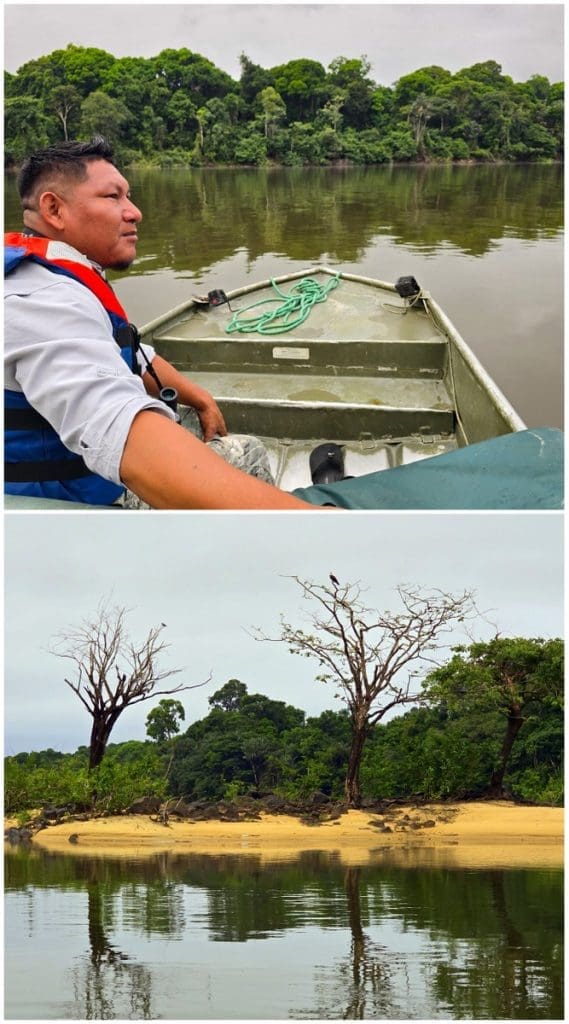
Traveling the Essequibo River was just as much about seeing a kingfisher pierce the water for a snack and a caiman’s eyes shining back at us as it was chatting with our indigenous guides. Larry, our boat captain, regaled us with childhood stories about traveling the river on multi-week camping trips with his grandparents in a dugout canoe. While Alex was great at fielding the hard questions, like “Why are gold mining claims looming at the edge of the reserve?”
As much as Iwokrama River Lodge is here for tourism, it is also the front-line defense against illegal mining, logging, and poaching. In addition to their powerful presence, they are actively offering jobs in sustainable forestry, hospitality, and environmental research as economic alternatives. They are reaching out to kids at a young age to join their Wilderness Clubs and become lifelong stewards for the rainforest. Children from all over the Rupununi are members, and we happened to be there when a group of first graders from the savannah were coming for a nature walk–many for their first time in the rainforest. The kids were enraptured, and the group’s excitement was contagious.
Iwokrama Canopy Walkway
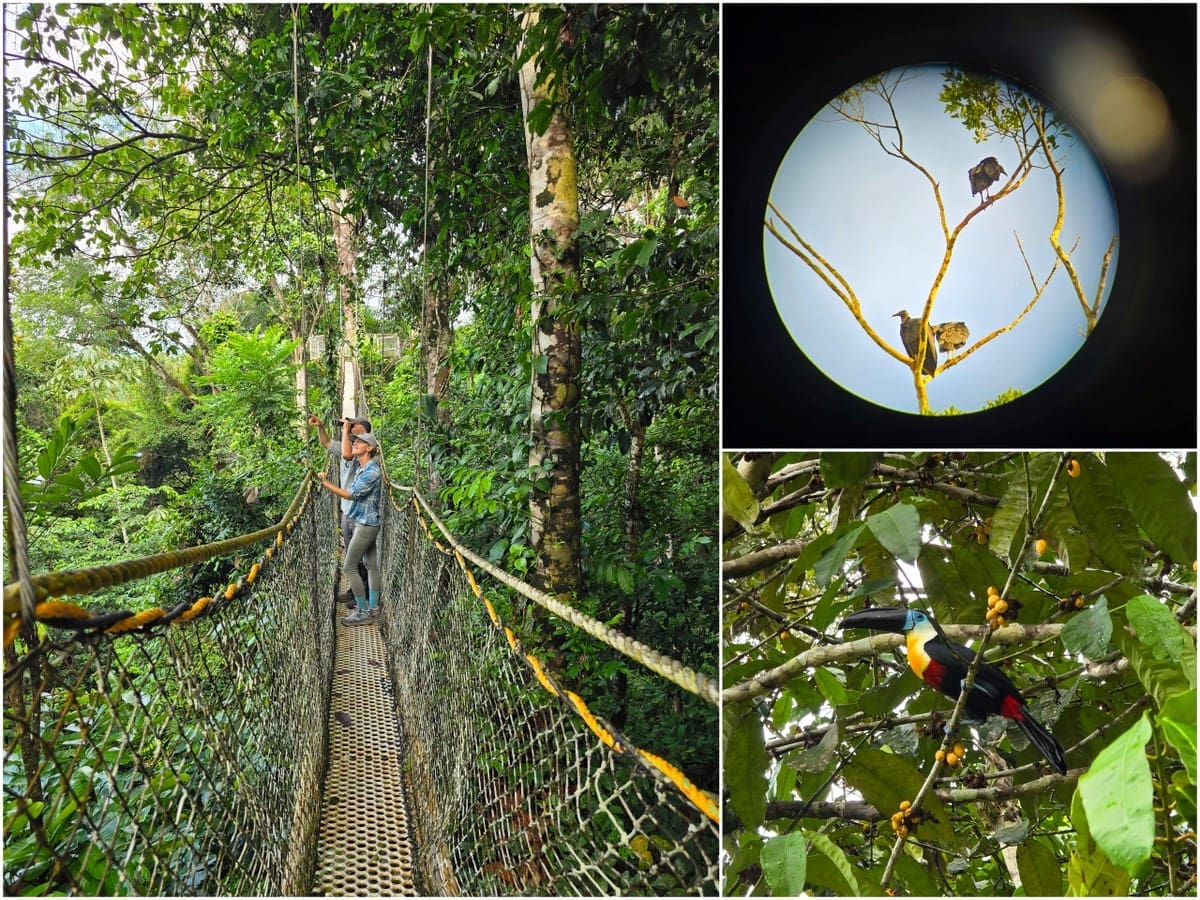
Fifty-eight kilometers deeper into the reserve is the Iwokrama Canopy Walkway at ATTA Lodge. This series of suspension bridges, hovering 100 feet above the forest floor, was built to better understand the canopy and to serve as a premier birdwatching spot. We took a short hike along a well-marked path, read the tree-identification signs, and listened to our local guide’s insights. The last stretch was up, up, up, until we reached the first bridge. Feeling the bounce of the ropes, we got our giggles out, then moved into keen observation mode as we spotted channel-billed toucans, scarlet macaws, pompadour cotinga, and more. Our guide, Davis, said that during a recent 2-hour session, he spotted 42 species!
Joining Iwokrama’s Conservation Efforts
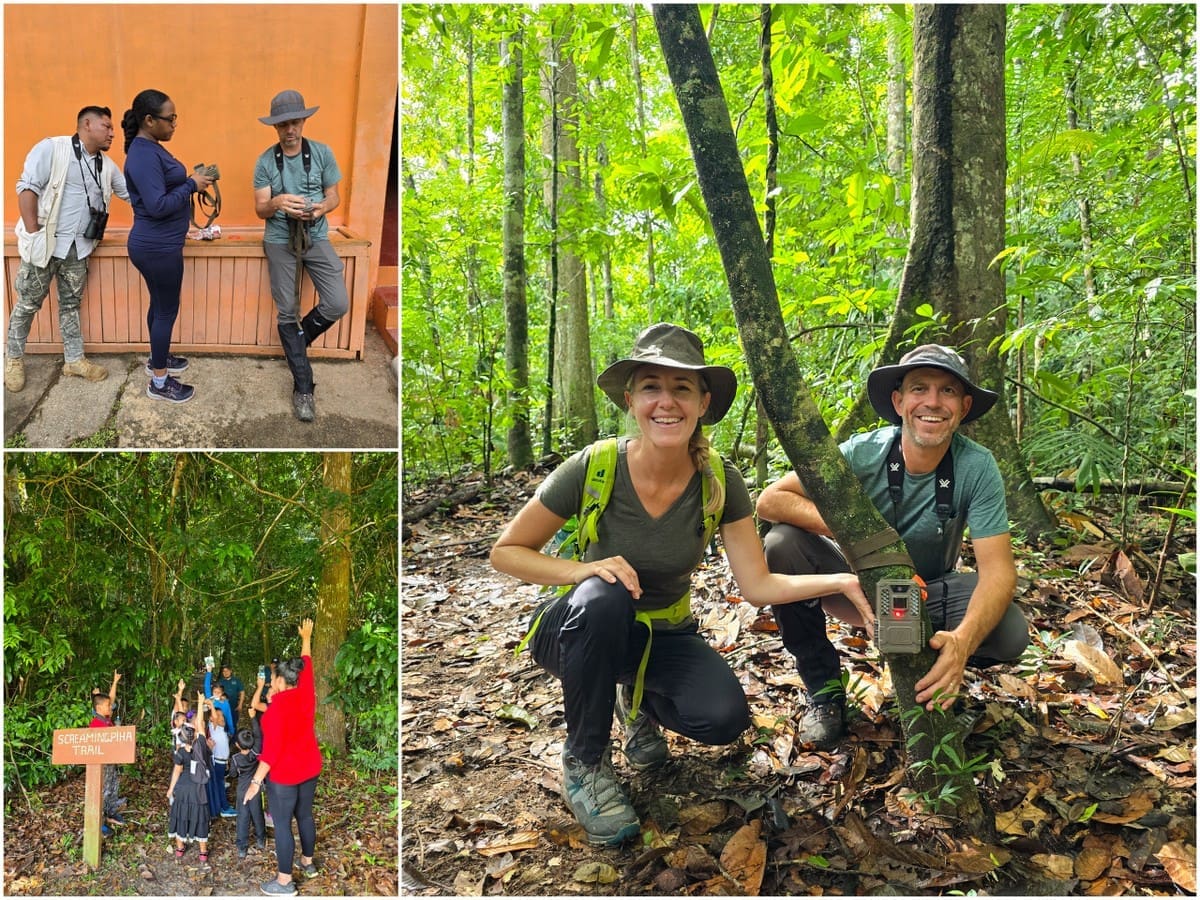
While run by the government, Iwokrama is very much about the passion of the people on the ground. We loved that the leadership team was virtually all women, including Raquel, an employee of 25 years; Rebecca, an indigenous liaison advocating for the 20 villages of the region; and Lydia, a young Afro-Guyanese biologist, helping researchers with their projects and spearheading her own. We had dinner (the food at the River Lodge is fantastic, btw) with these three ladies, and we were inspired to join them in the field the next day to set up trail cams.
Lydia taught us about the devices and the best places to set them. They had noticed foxes running across the lawn, so we followed the grass to a narrow trodden path and placed one there. Deeper in the forest, we found an awara tree with lots of nibbled fruits on the ground–another perfect place to set up a cam. Getting rainforest dirt under our fingernails and strapping cameras to trees only brought us closer to this place.
SOUTH RUPUNUNI
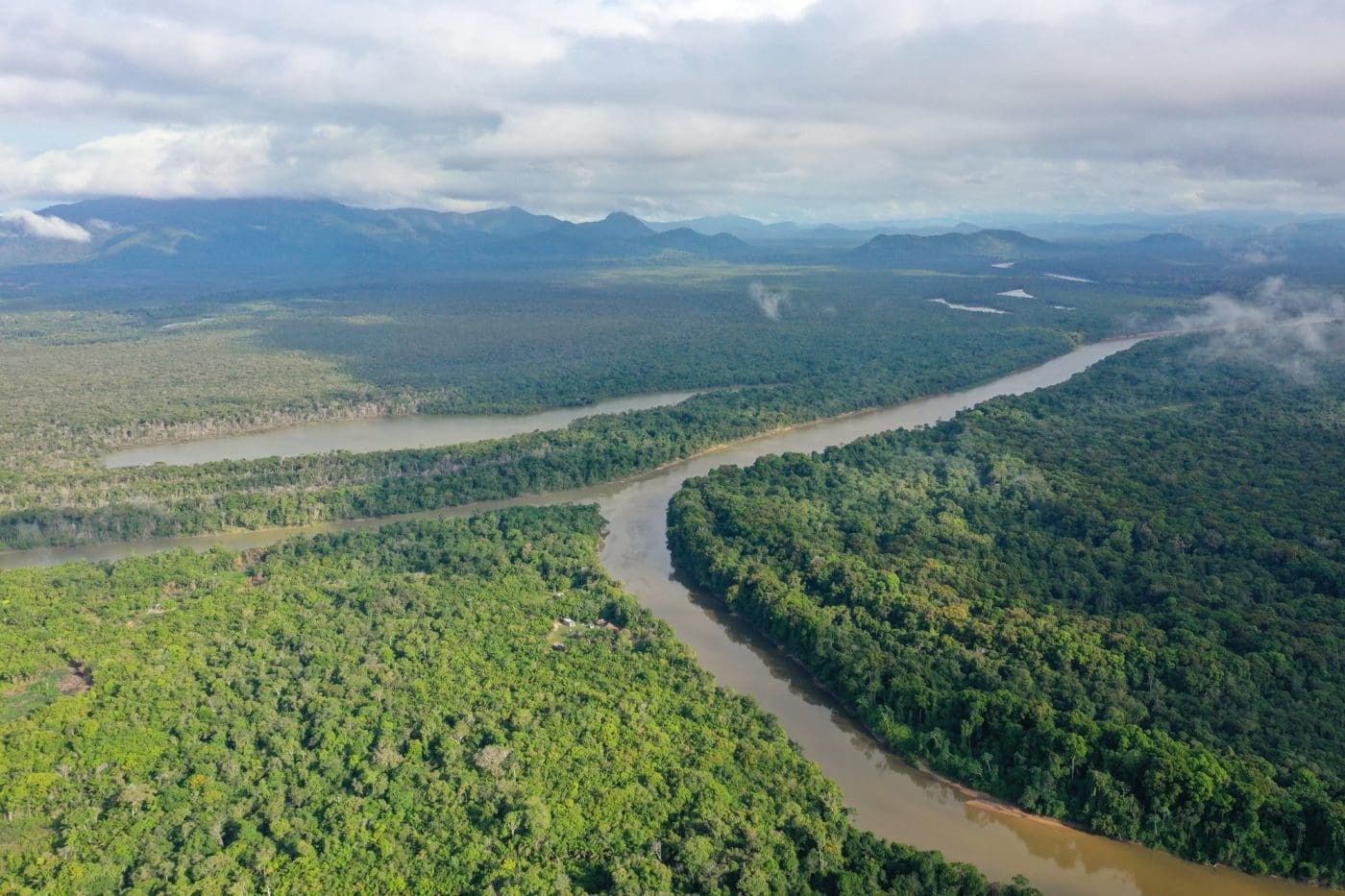
The tourism community in the Rupununi is small and very supportive of one another, so Iwokrama coordinated a pickup with our next outfitter, Rewa Eco-Lodge, for our journey into the South Rupununi. We instantly liked our Rewa guide, Vivian, especially when he said, “Do you want to make a detour to see if we can find the elusive Guianan Cock-of-the-rock?” He had us bushwhacking up a mountainside and scaling boulders, while he made bird calls…and lo and behold, we found two of these quirky orange birds with their rooster-like mohawks, darting between trees with their bright feathers on full display.
Back on the road, we watched the landscape change from dense forest to savannah with mountains in the distance. After an hour drive, we hung a left at the village of Annai and met our boat captain for the two-hour journey up the Rupununi River to one of the most remote accommodations in the country, Rewa Eco Lodge.
Rupununi River Safari
The wildlife safari began as soon as we hit the river, with giant river otters splashing about, a huge caiman crossing our path, and more swooping birds that we could count, as we moved through this gorgeous landscape. Along the way, we might have had our best bird sighting of all time…a Jarbiru stork (South America’s tallest flying bird) vs a swamp eel! The stork tried to swallow the eel, but this slippery sucker wasn’t going down without a good, long fight!
Rewa Eco-Lodge
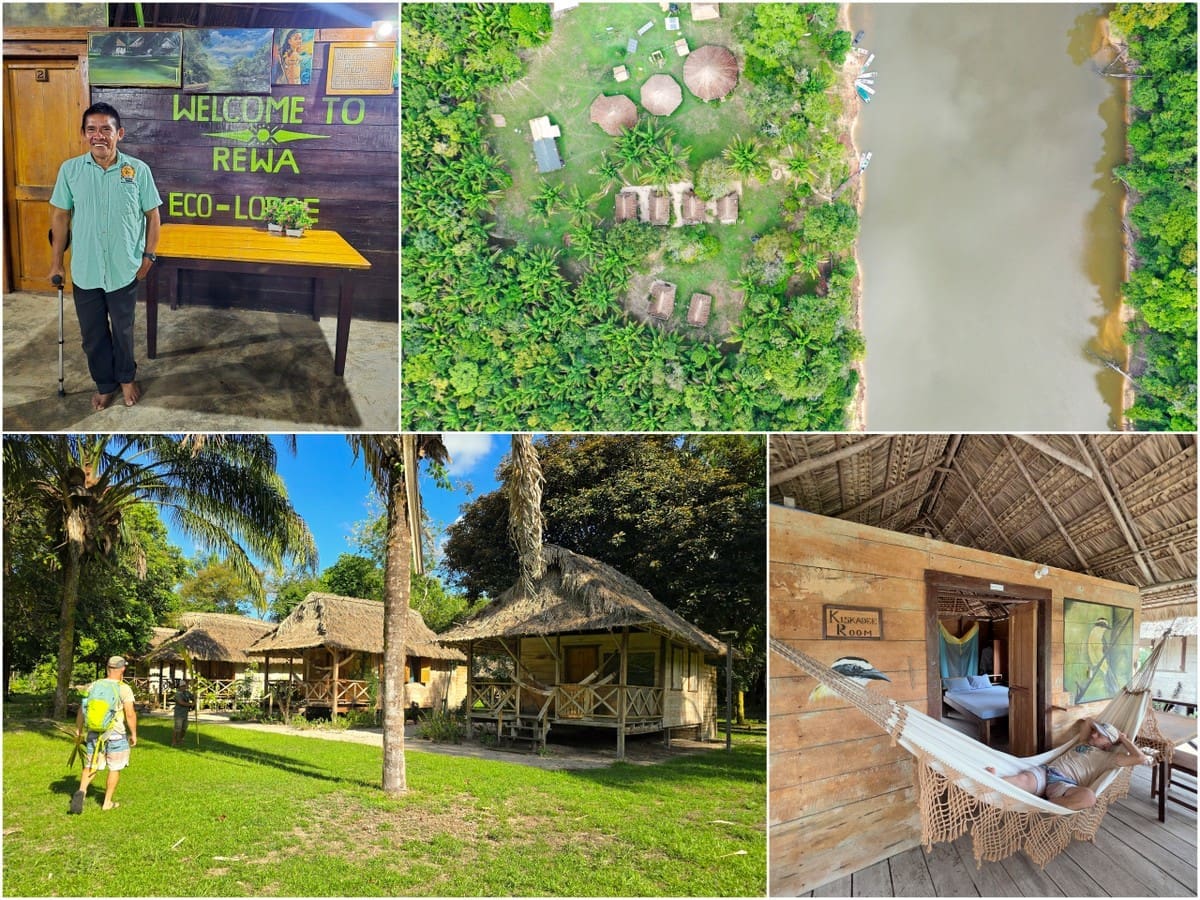
Where the Rupununi and Rewa Rivers lie, Rewa Island. We coasted toward the dock of Rewa Eco-Lodge, lovingly built and maintained by hundreds of villagers in this community-run project. Twenty years ago, South Rupununi’s wildlife population was in alarming decline…that’s when Conservation International and Rewa Village put their heads together to protect this region through regenerative tourism! We were shown to our thatched-roof cabin, with hammocks on the porch, a breezy bedroom with mosquito-net canopy, and a large open-air bathroom. Virtually everyone in the village–from teenagers to grandmas–had a hand in building the lodge and in keeping it a success, with 75% of village adults still working here.
We met the co-founder and now village chief Dickie Alvin, who told us stories of the early days of Rewa Eco-Lodge. Before they had the internet, they would canoe two days to the nearest town, just to check their email for potential reservations. Dickie and countless other villagers volunteered for years before Rewa became successful, and today the lodge has been featured everywhere from Outside Magazine to National Geographic, and we knew we were going to love it, too.
Rewa Village Tour
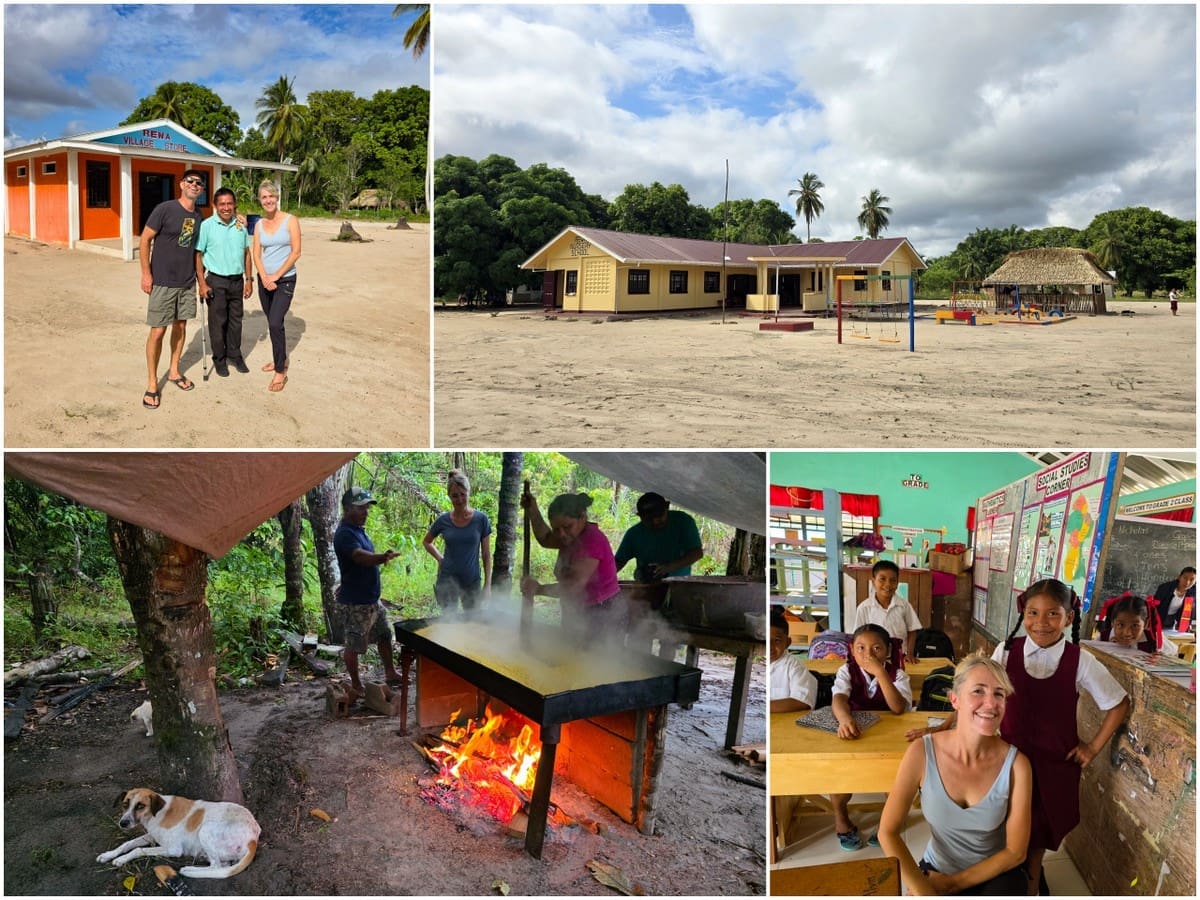
After a hearty lunch, Dickie and Vivian took us to explore the town. All the buildings were colorful and kept in pristine condition. Not just random businesses, each one had a role in the community…a health center, tech hub, sewing workshop, church, school, village shop, and community hall. We peeked into the schoolhouse, a large, open space divided into grades, with kids ages 5-12 in pressed uniforms, smiling from ear to ear. Then Vivian got a call from a family making farine and asked if we wanted to join. Heck yeah!
Cassava is the staple of the Amerindian diet, and when ground and toasted, it becomes farine, a topping for all dishes and a hearty snack. Over a wood-burning fire, a huge griddle was filled with these golden nuggets, and Sarah was stirring it back and forth with a paddle. She welcomed us in and said, “Want to try?” The pressure was on because it is a three-hour process, and even a couple of minutes without stirring can ruin a batch. Between the heat and continuous full-body movements, I quickly gained respect for Amerindian chefs. She gave tips to improve my form, all while letting me nibble on the spoils.
Awarmie Mountain: Farming, Crafting & Hiking
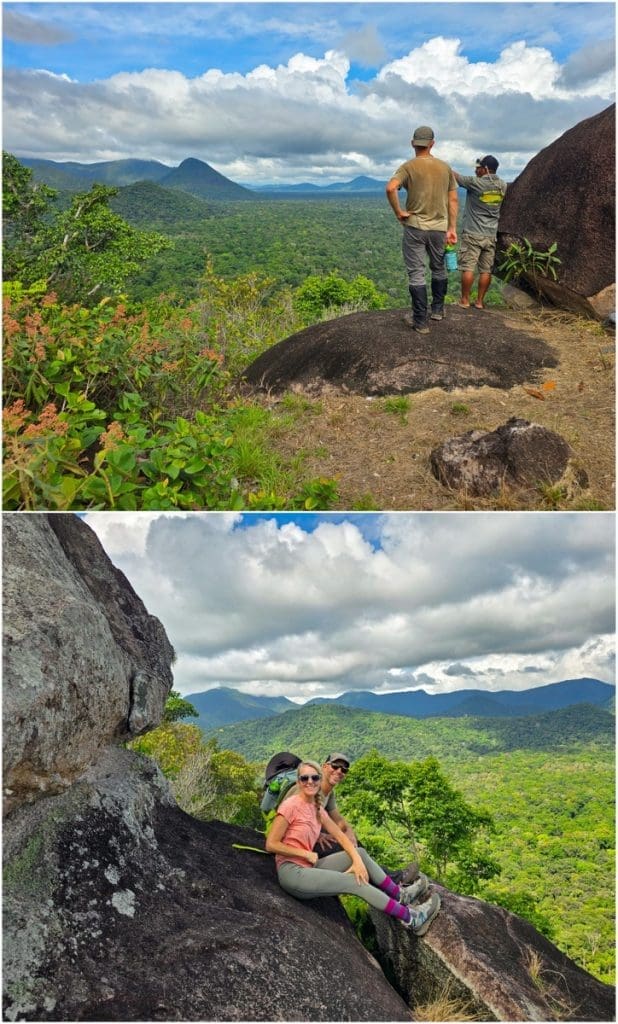
The gorgeous Awarmie Mountain (farming place in the Makushi language) is a short boat ride away from Rewa. Walking under the shade of mango trees, passing rows of corn, beans, and callaloo spinach, we reached the farmhouse of the chief’s parents, Martin & Matilda. Martin was weaving a matapi basket to strain the bitter cassava of its poisons to make cassareep (pronounced “cazrup”)–the secret sauce in Amerindian dishes.
He waved us over for an impromptu lesson (men are traditionally the basket weavers in Makushi culture). Martin has been weaving since he was a boy, so even though he’s lost most of his vision, his hands move fluidly from memory. He showed Mike the over-under pattern that would ultimately make this long conical basket.
Listening to Martin’s expert tips and stories, we realized how rare it was to have an in-depth conversation with an indigenous person in the remote rainforest. As an English-speaking country, Guyana removes the language barrier, allowing you to learn more and connect with local people. We thanked Martin for his time and wisdom, and continued up the mountain.
The 1.7km climb was steep, using roots for footholds and branches for railings at its toughest points. At the summit, the lush, pointy Pakaraima Mountains were beautiful, while the rocky boulders made for ideal perches for panoramic photos.
Grass Pond: Amazonica Lillies & Arapaima Fish
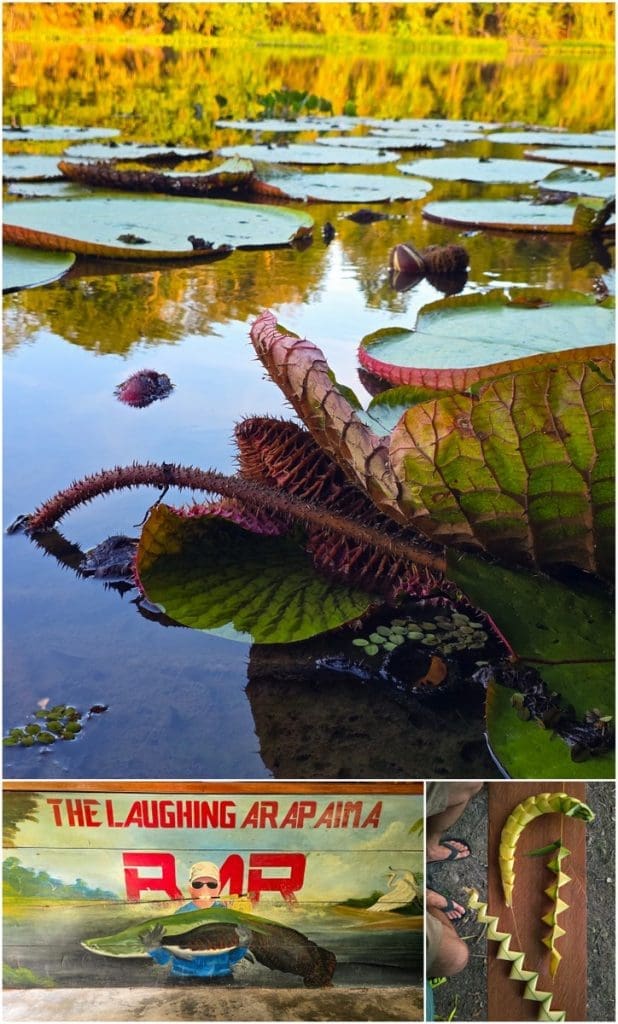
As dusk approached, it was time to head to Grass Pond to watch the Victoria amazonica lilies blossom at sunset and dozens of Arapaima fish on the hunt. It takes about an hour for the lilies to go from bud to bloom, so Vivian came prepared with special palm leaves to teach us how to make Amerindian toys to entertain ourselves. As we worked on new weaving patterns, we saw so many big splashes around the pond.
The 400-pound arapaima are an angler’s dream, and sportfishing is the reason many come to Rewa Eco-Lodge. Whoomp!… “Did you hear that?” said Vivian. “That is the sound of the airpaima sucking in their prey.” The water rippled in massive circles with each attack.
Meanwhile, the lilies were opening faster and faster. It was performance art, botany style. On its first day in bloom, the female flower’s beautiful white petals open and a strong scent attracts bugs, then closes them in for pollination. On its second day, the flower changes gender and opens into a pink bloom, releasing the pollen-covered bugs to continue the pollination cycle. After this 48-hour show, the pollinated seed sinks to the bottom, restarting the process. We felt so lucky to see this fleeting beauty in action!
Amerindian Feast: Pepperpot
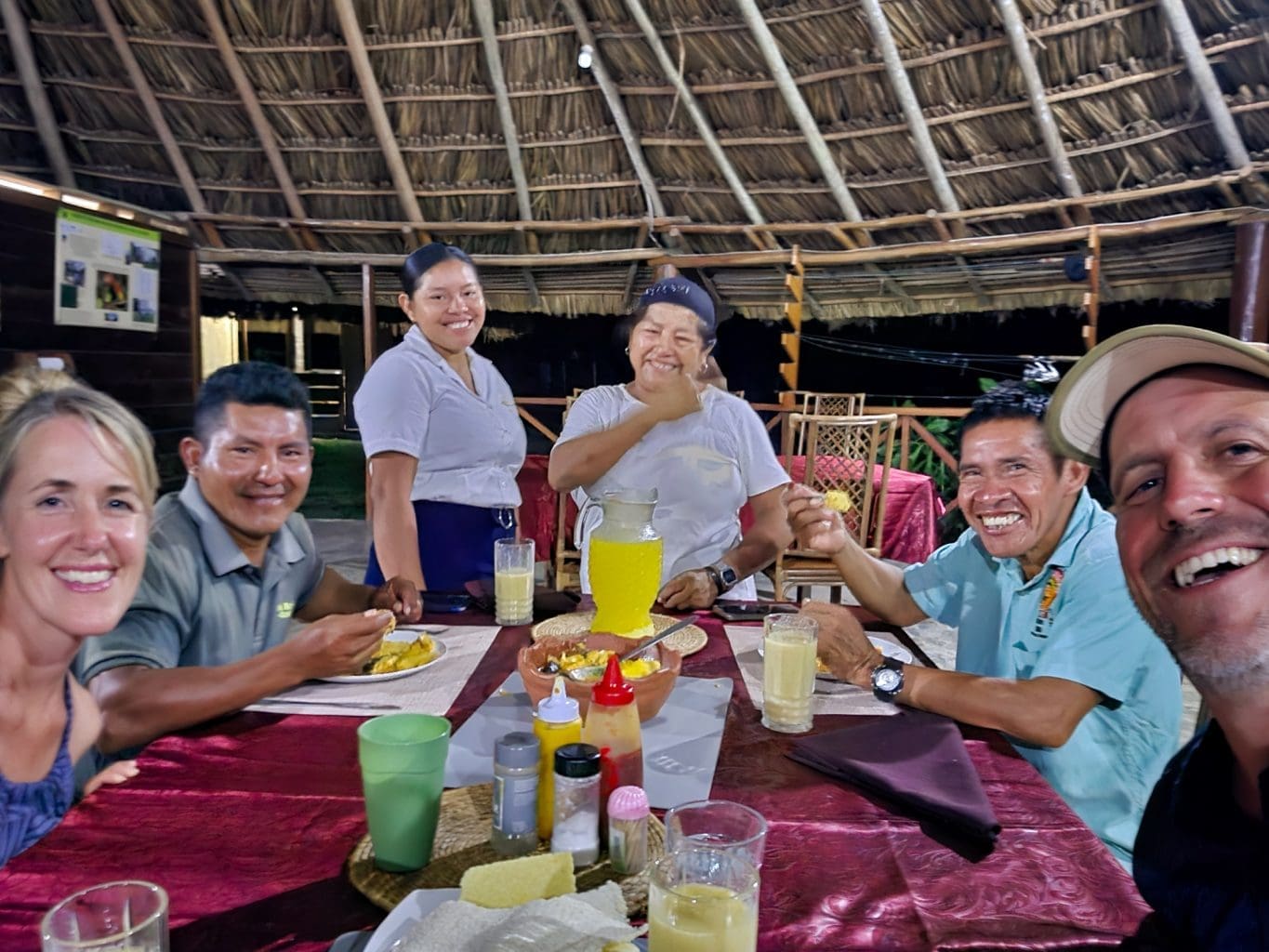
Back at the lodge, the chefs were prepping for a pepperpot feast for the Rewa chief and to take us on as apprentices. Having just learned to make a matapi basket to prepare bitter cassava, cooking with it in the national dish felt like the next best step. Most days, Vivian’s mom is the head chef, but today Agnus was at the helm. She had us chopping onions, potatoes, peppers, cassava, and wiri-wiri…the pepper that gives this dish its name.
While normally a meat-heavy dish, they added soy nuggets for protein, seasoned them with cinnamon, orange zest, and garlic, then poured the thick cassareep sauce into the pot. We brought it out to the chief, a little nervous about what he’d think…and we are happy to report that Chief Dickey loved his first vegan pepperpot!
Listening to Dickey’s stories about how far the lodge has come, how it has provided steady local employment for Rewa’s people, and how it has helped raise awareness of conservation across the Rupununi, we felt his pride and shared his joy. Where protecting nature and empowering local people intersect, that is exactly where we want to be!
Tip: If you want to work on your jungle survival skills, join Rewa Ecolodge’s 8-day camping river adventure up to the headwaters and watch the video below for our incredible Rewa experience.
DEMERARA-MAHAICA REGION
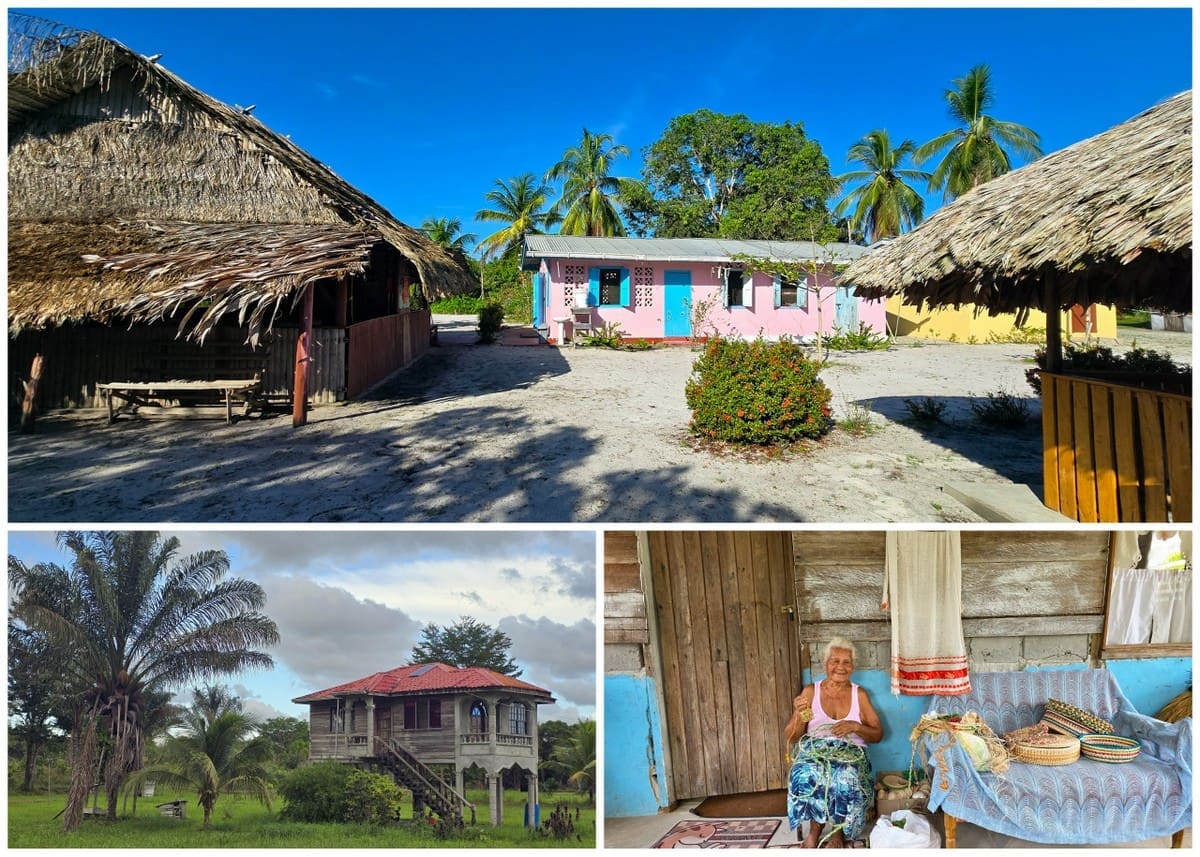
Not ready to say goodbye to Amerindian hospitality, but needing to make some headway towards the airport, we made our next stop the Awarak community of St. Cuthbert’s. Just an hour from Cheddi Jagan International, but a world away from Georgetown’s hustle and bustle, this 2,000-person village along the Mahaica River was the perfect place to end our Guyana trip. Knowing we were coming off a rough 8-hour trip up the Georgetown-Lethem road by minibus, our lodge arranged a taxi to sweep us away from the junction right to their door.
Bimichi Eco Lodge
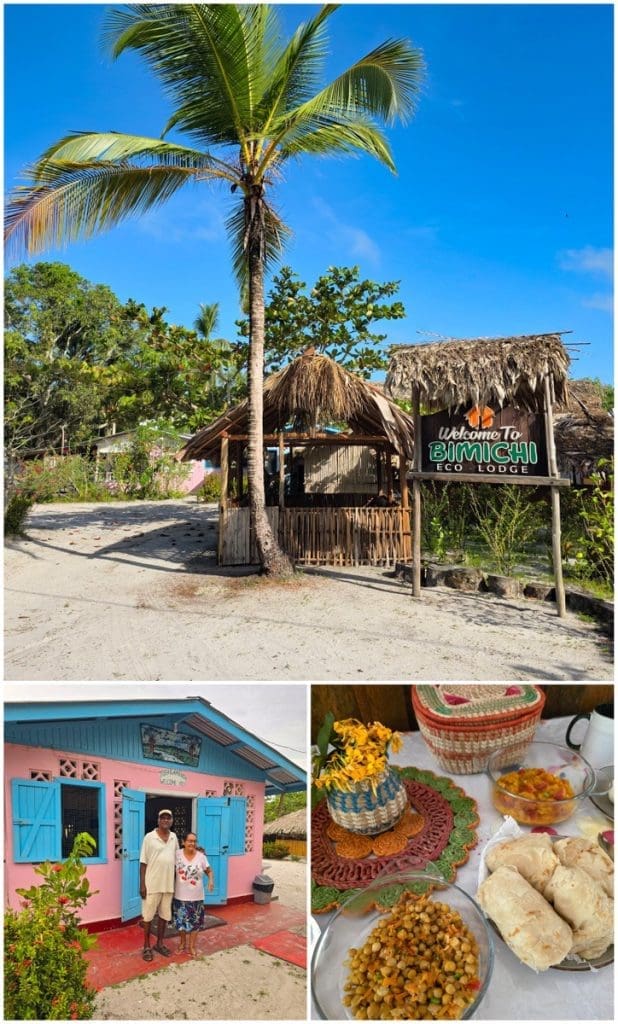
Run by the sweetest couple, Amanda and Josh, Bimichi Eco Lodge felt like coming home to family, starting with homemade cooking that spoiled us. As an Arawak-Amerindian and Indo-Guyanese duo, they have created their own fusion cuisine, which has made for some of our favorite dishes in Guyana! When we arrived at 9pm, Amanda had a late-night snack ready so we wouldn’t go to bed hungry, and our room was made up and cozy.
The Bimichi business got started with their village shop and picnic area, and they realized how much they enjoyed hosting guests. Josh, a sustainable forestry teacher at the University of Guyana, was also receiving more and more student groups to study in their forest… so, with a love of hospitality and a need for local lodging, Bichichi Eco Lodge was born.
The Teaching Forest
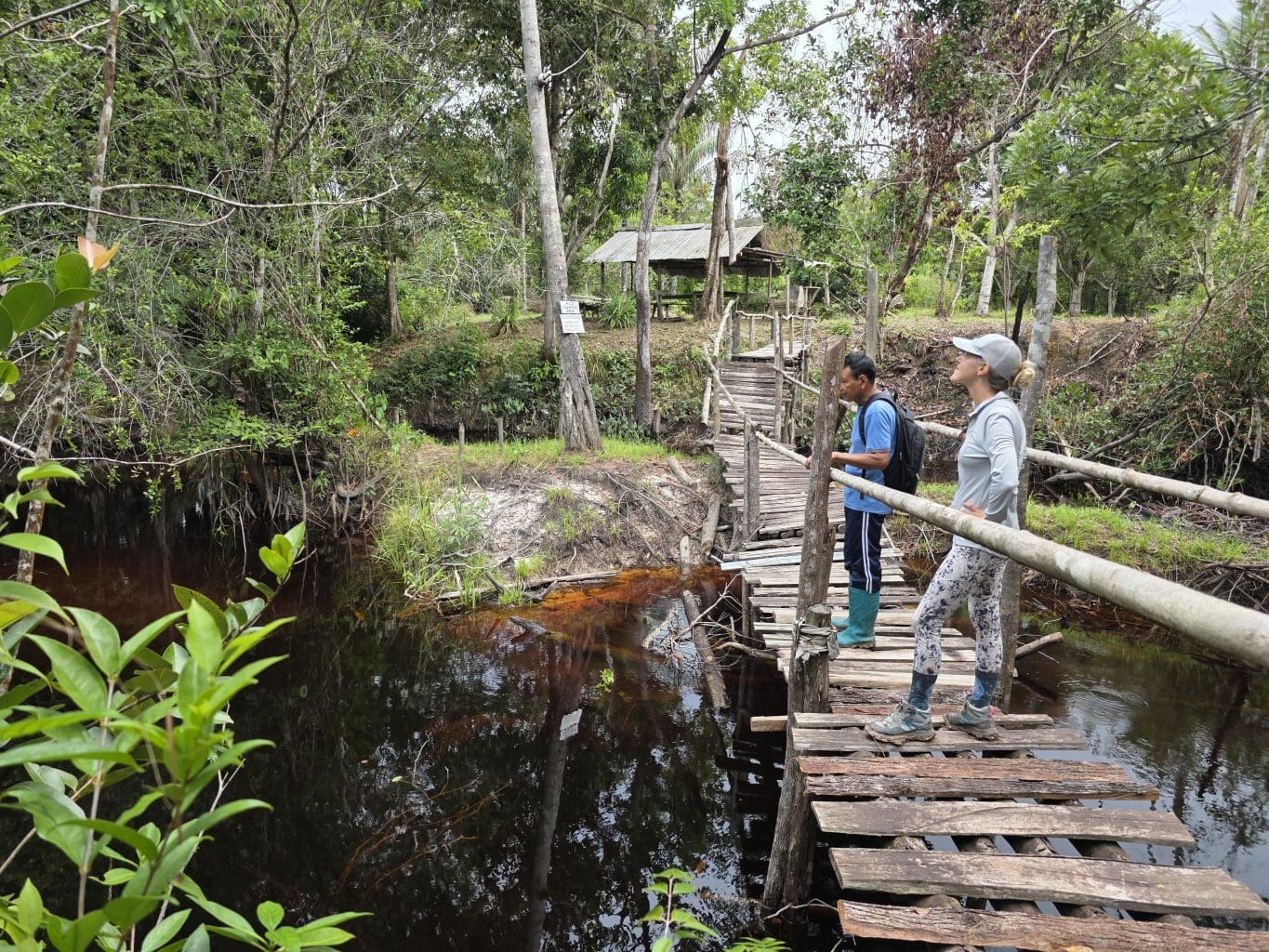
Amanda’s brother Vibert took us for a hike to Bimichi’s teaching farm and forest. As someone who has worked alongside Josh as a forestry teacher and who is Arawak-Amerindian from this rainforest, Vibert was an excellent guide, pointing out different tree species and their uses. After two bridge crossings over the winding creek, we reached the charming palapa where they host classes and feasts for guests. From here, we meandered into the orchard to pick ourselves a fruit salad of starfruit, oranges, and bananas, and filled a big basket for Amanda’s cooking.
Awarak Crafts & Games
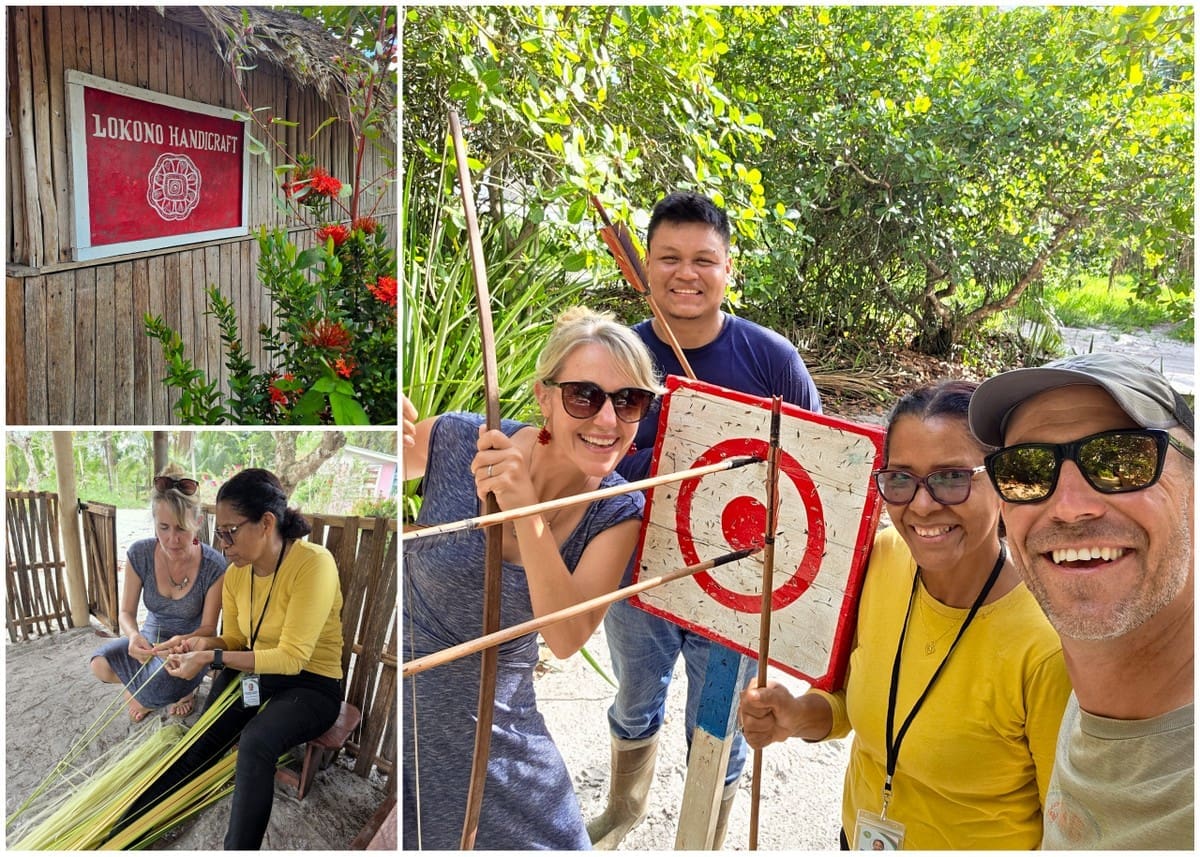
Back at the lodge, another guide, Diane, was ready to show us the many uses of the Ité palm (also called the tree of life in Guyana), from making roofs to weaving baskets. We split the strands from their outer fiber, then put them in boiling water to make them more malleable for weaving. While we set them in the sun to dry, the archery range was calling. Kevin had the bow and macaw-feather arrows in hand for a tutorial. No poison tips this time, but this weapon is how Arawaks would hunt for food and go to battle. With his great guidance, I even hit a bullseye!
Craft classes are available to guests and villagers alike, keeping the Amerindian arts alive and well. Bimichi also sells local artisans’ crafts at their shop, and Amanda gifted us handmade bracelets as a memento from our fantastic stay in St Cuthbert’s.
GUYANA TRAVEL LOGISTICS
Where is Guyana?
Guyana is a small country on the northeast coast of South America, bordered by Venezuela, Brazil, and Suriname. As a part of the Guiana Shield and geographically isolated from the rest of South America, the region is known as “The Guianas” and comprises three countries: Guyana (formerly British Guiana), Suriname (formerly Dutch Guiana), and French Guiana (an overseas territory of modern-day France). Although firmly in South America and on the Atlantic Ocean, it is socio-politically part of the Caribbean region. It’s a little confusing, but hey, that’s what makes The Guianas so fascinating!
Flying to Guyana
Direct flights to Georgetown from the US depart from NYC, Miami, and Houston, for as little as $360 round trip. While it’s entirely possible to travel independently around Guyana (as we did, taking a shared taxi from Suriname’s capital of Paramaribo to Georgetown and then an overnight minibus into the Rupununi), it is not for the faint of heart or those short on time.
Overland Travel to The Rupununi
There are a handful of companies (M&D Transportation, Greaves, Cindy’s, and P&A) that run the rugged 469-mile Georgetown-Lethem Road. It’s a flat fee (~$70) for the seat, no matter how far you travel. They leave from their respective Georgetown offices in the early evening and drive through the night until they reach the Essequibo River, where the road hits the river. There are hammocks available at a riverside guesthouse if you want to get a better nap. If you are going to Iwokrama, they are on the other side of the river and will scoop you up from there. If you are going to Rewa, you’ll stay on the bus until Annai.
On our return trip north to Georgetown, buses depart from “The Oasis” in Annai. Our bus picked up around noon so we could catch the ferry before sunset and do this 270-mile trip to the capital in one shot, arriving around 10pm. If you are staying at Bimichi Eco Lodge, have the driver stop at St. Cuthbert’s Mission junction, and the lodge will send their very nice driver to pick you up.
Internal Flights Around Guyana
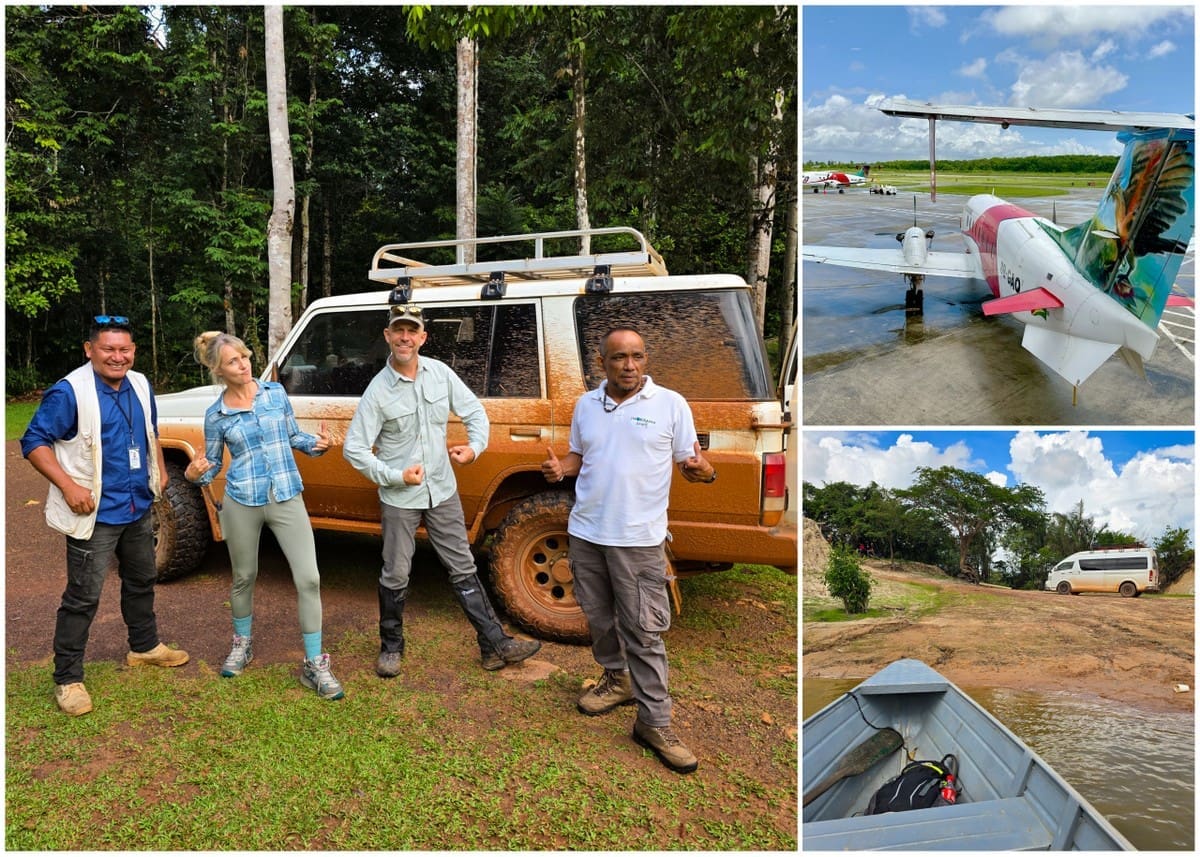
Both Iwokrama and Rewa Eco-Lodge were surprised that we had the gall to travel overland to their lodges (99% of their guests fly)–but hey, we like an adventure, and reducing our carbon footprint! If you’d rather take a plane into the Rupununi, you’ll fly to Fair View Village for Iwokrama, and if you are going directly to Rewa, you’ll land in Lethem; both lodges will pick you up from these airfields. Bimichi Eco Lodge is only 35km from the Cheddi Jagan International Airport, so we found it to be a much better option for our last night in Guyana before flying out of the country.
It’s worth noting that Guyana’s most famous attraction and the world’s largest single-drop waterfall by volume, Kaieteur Falls, is only reached by plane. It’s commonly done as a day trip, but special arrangements can be made for overnight excursions.
Best Time to Visit Guyana
Traveling to an equatorial rainforest destination means you’ll likely want to time your trip outside the rainy seasons (May-August and December-January). Arrive at the start of either dry season, and you’ll get lush scenery and plenty of sunshine. Late August or early February is ideal for seeing Kaieteur Falls raging. September is particularly festive, as it is Amerindian Heritage Month, when all the indigenous villages celebrate their arts and hold friendly competitions in everything from basket weaving to archery.
Guyana, South America: What a Trip!
We left Guyana, inspired by the diversity of its people, the breadth of its wilderness, zingy flavors, and humble beauty. Tourism may be in its nascent stages, but the Guyanese have learned from an overtouristed world who they are and what they want to become.
Many thanks to Guyana Tourism Authority and Emerging Destinations for supporting our trip and storytelling!
Explore The Three Guianas
If you’re heading to Guyana, extend your trip and meet the neighbors! We overlanded from Brazil>French Guiana>Suriname>Guyana and it was an incredible adventure and cultural immersion into the Guianas region. Discover the wonders of French Guiana and Suriname (formerly Dutch Guiana) with the posts below, and start planning your trip to South America, way off the beaten track!

Stacie Harris is a local resident and reporter of the Maple Grove area. Stacie reports on medicine and science for the Maple Grove Report.