Allina hospice workers on one-day strike as bargaining continues


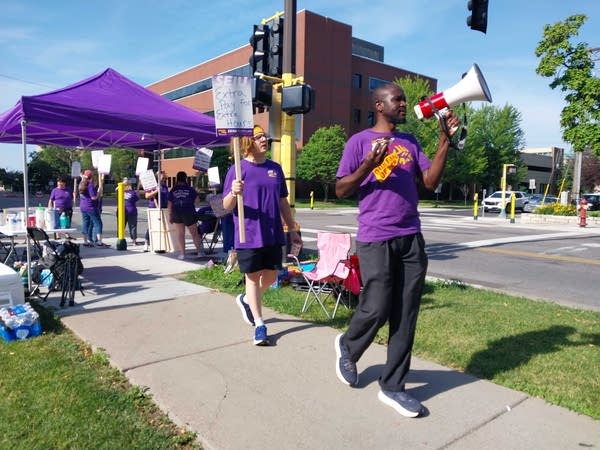
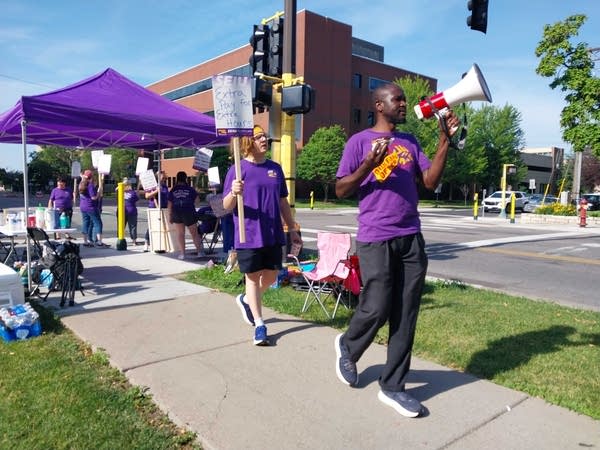
Protesters march on a picket line in purple, one holds a megaphone, another holds a sign.

Dozens of hospice nurses at Allina Health are on strike Monday, as they push for a contract and pay raises.

The group of 65 hospice nurses work in homes and nursing facilities around the Twin Cities metro area. They unionized in the spring of 2025 with SEIU Healthcare Minnesota and Iowa, and have been negotiating toward their first contract for nearly a year.

Nurses say it’s taking too long to reach a contract agreement. They’re also asking Allina to grant them pay raises during the bargaining process.

Susie Smerz — a hospice nurse and a member of the union’s bargaining team — helped lead a picket line outside the Abbott Northwestern Hospital in south Minneapolis. She says she loves her job, but the working conditions are stressful.

“We're not interested in working for free, we're not interested in being exhausted, we're not interested in being the sacrifice,” Smerz said. “It requires us to give so much of ourselves. We deserve to have management value us and try to work with us.”
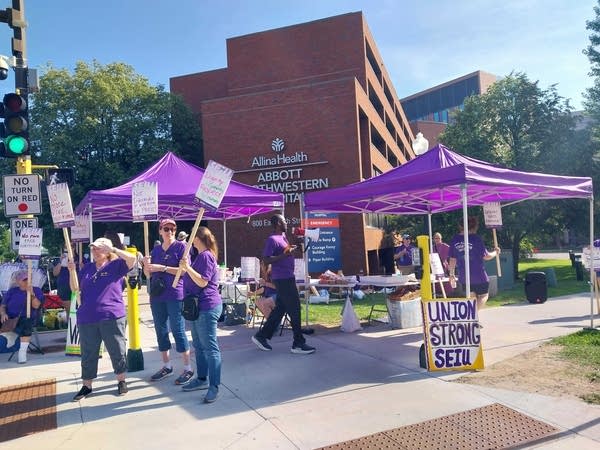
A group of protesters
Allina hospice workers on the picket line outside of Abbott Northwestern Hospital in Minneapolis on Monday, July 6, 2026.
Estelle Timar-Wilcox | MPR News

Unlike nurses who work in Allina’s hospital, she said, hospice nurses don’t get overtime or holiday pay. Smerz says hospice nurses sometimes have to work 18-hour days, with assignments sending them all over the metro area to see patients. For those long days they receive the same salary they would get for working lighter hours.

“I want to do hospice until I need hospice,” Smerz said. “We're just having a harder and harder time being able to do that because we have a work environment that's not conducive to that.”

Smerz said those problems have led to turnover. She’s seen nurses leave Allina’s hospice program for other agencies.

A spokesperson for Allina Health says they're disappointed that the union chose to strike.

“We know the bargaining table is the best place to reach an agreement,” the organization said in a statement.

The spokesperson also said Allina has plans to continue patients’ care Monday during the strike.

Nurses plan to go back to work Tuesday after the one-day strike.


Source link

Leave a Reply

Subscribe to Our Newsletter

Get our latest articles delivered straight to your inbox. No spam, we promise.

Recent Reviews


The memo also prevents companies from altering AI models being used by the military without prior approval.

Less than a week after signing an executive order that attempts to regulate the booming AI industry, President Trump has signed a National Security Presidential Memorandum that aims to put cutting edge AI tools into the hands of the US military. According to the memo signed on Friday, the Trump administration is establishing another framework that would “accelerate AI adoption” across a network of federal defense agencies and “adapt the best commercial and open-source technologies for mission use.”

“The men and women who defend our nation deserve the best, most secure and most reliable AI in the world, and our citizens deserve to know it is handled responsibly with the care and seriousness they expect,” Michael Kratsios, director of the White House Office of Science and Technology Policy, said on X.

More specifically, the memo said that the US government would do “rapid onboarding of the most advanced AI models from multiple vendors.” Along with the faster adoption, the Secretary of Defense Pete Hegseth will have to issue an updated directive on autonomous weapon systems. Lastly, the memo introduces a new restriction to AI models used by the government, where “no entity, commercial or otherwise, can disable, degrade or modify an AI system that American warfighters depend on without prior approval.”

There is one limitation on the memo, though, which detailed that the US’ network of defense agencies can’t create or release an AI model that’s designed to “censor free speech, embed ideological bias or conduct unlawful surveillance against the American people.” However, the administration is still interested in influencing “frontier models” as Trump’s executive order from earlier this week would grant the US government a 30-day window to review them before a public release.


Source link