
Airbnb launches boutique hotels, car rentals, grocery delivery and more


Airbnb may have started as a simple homesharing platform, but it’s come a long way since then.

Last year, Airbnb launched services — such as spa treatments and photography sessions — and reimagined its Experiences platform to help travelers experience destinations in more authentic ways.

Now, Airbnb has added some interesting new categories to these offerings. It’s also launched hotels — yes, actual hotels, not just vacation rentals.

“The best trips help you explore, learn, and come home a little different than when you left. That’s what we’re building at Airbnb,” said Brian Chesky, the company’s co-founder and CEO, according to a press release. “And this summer, we’re giving people even more ways to do it—from incredible places to stay and boutique hotels that feel like Airbnb, to unforgettable World Cup experiences and services that make your trip easier.”

Let’s take a look at what’s new.

Related: Renting an Airbnb this summer? Here are the best credit cards to use

New services to streamline your trip

Woman receiving groceries
DGLIMAGES/GETTY IMAGES

One key update is the addition of new categories of services, specifically those intended to streamline the travel experience — along with savings and offers for Airbnb guests. These include:

  • Rental cars: You can now book a car right in the Airbnb app, which will show vehicles near your listing and suggest the right vehicle for your group. The first time you rent a car on Airbnb, you’ll get a 20% credit back toward your next stay, experience or select services.
  • Grocery delivery: Through Airbnb’s partnership with Instacart, you can order groceries during your trip or have them waiting at your Airbnb when you arrive in over 25 U.S. cities. Plus, Airbnb guests get $0 delivery and $10 off an order of $50 or more.
  • Airport pickups: Airbnb has also partnered with Welcome Pickups, a private car service in which a driver tracks your flight and meets you curbside after you land. The service is available in over 160 cities worldwide, and Airbnb guests can save 20% on every ride.
  • Luggage storage: The Airbnb app will show you the nearest Bounce drop-off locations — over 15,000 locations in 175 cities — and Airbnb guests get 15% off.

According to a press release from Airbnb, “This is just the beginning of new services guests can book on Airbnb this year,” so more categories may be on the way.

Reward your inbox with the TPG Daily newsletter

Join over 700,000 readers for breaking news, in-depth guides and exclusive deals from TPG’s experts

More local experiences

Airbnb already offers a variety of tours, classes and other experiences that you can book during a trip or in your own backyard. The app will even recommend activities based on your group size.
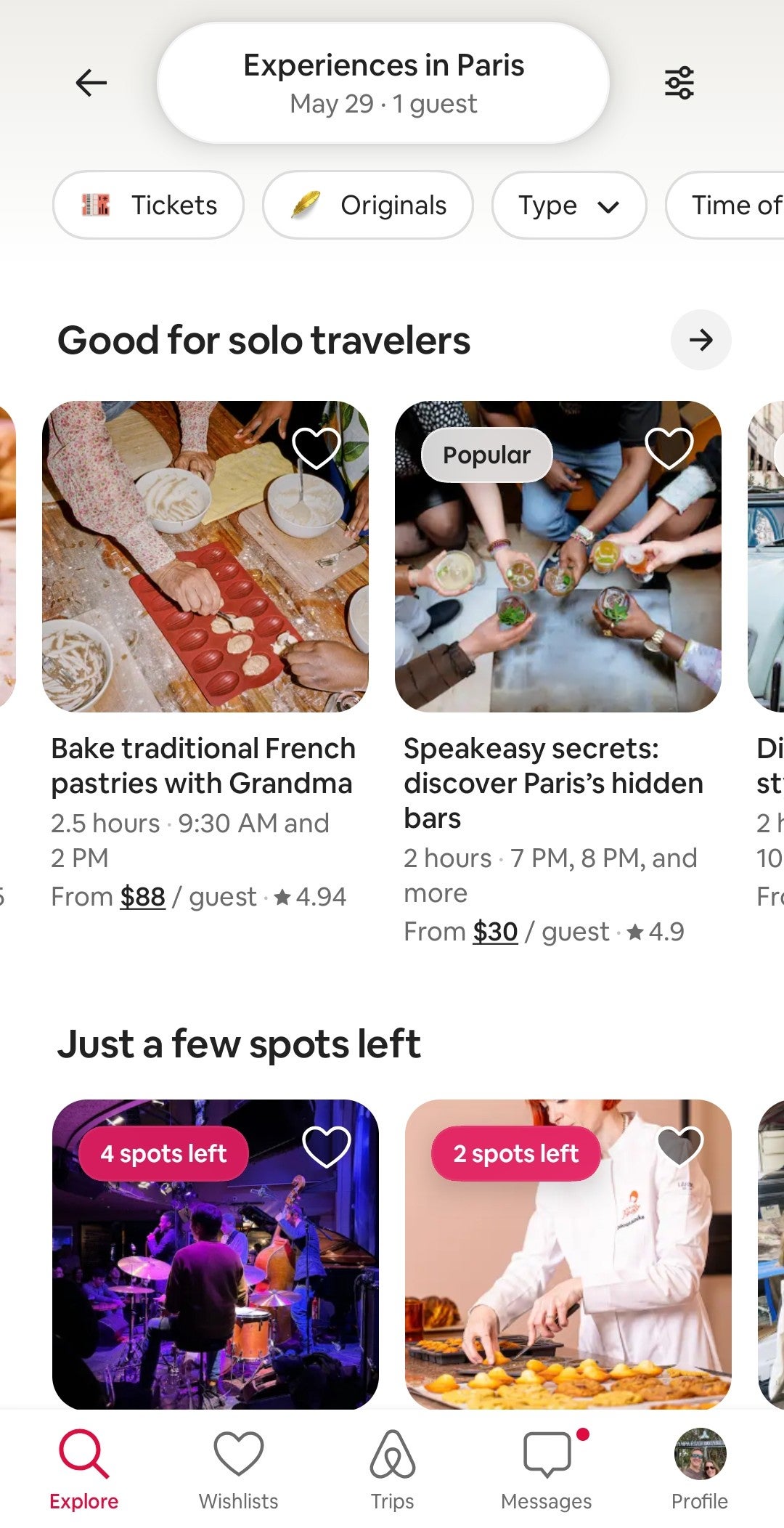
Airbnb app Paris experiences good for solo travelers
AIRBNB

This summer, the platform is adding thousands more experiences led by local experts across its most popular categories:

  • Landmarks: See iconic attractions, from the Tower of London to the Taj Mahal, with a local guide.
  • Food culture experiences: Through partnerships with Chef’s Table and Grand Central Market, you can get a behind-the-scenes glimpse of a place’s food and beverage culture, meet Michelin-starred chefs and more.
  • FIFA World Cup 2026: You can’t get tickets through Airbnb, but you can book exclusive experiences, such as a USA vs. Australia watch party with World Cup champions Abby Wambach and Julie Foudy.

While you can’t book these activities directly with points, as you can with some hotel platforms like World of Hyatt’s Find and Hilton Honors Experiences, there are some unique options available only on Airbnb.

Boutique and independent hotels

Over the better part of two decades, Airbnb has shifted from simple homesharing to a huge variety of vacation rentals, from luxurious treehouses to cozy B&Bs. The platform is taking this a step further with the introduction of boutique and independent hotels.

You can now book thousands of hotels through the platform, each handpicked for its location, design and hospitality to feel as homey as an Airbnb. These properties are currently available in 20 popular destinations around the world, such as New York, London and Singapore, with plans to add more destinations throughout the year.

Airbnb is also giving users more reasons to book boutique hotels through its platform. If you book a “featured hotel,” you can receive up to 15% credit toward your next Airbnb home. And with Airbnb’s price match guarantee, if you find a lower price for the same hotel anywhere else, you’ll get the difference as Airbnb credit.
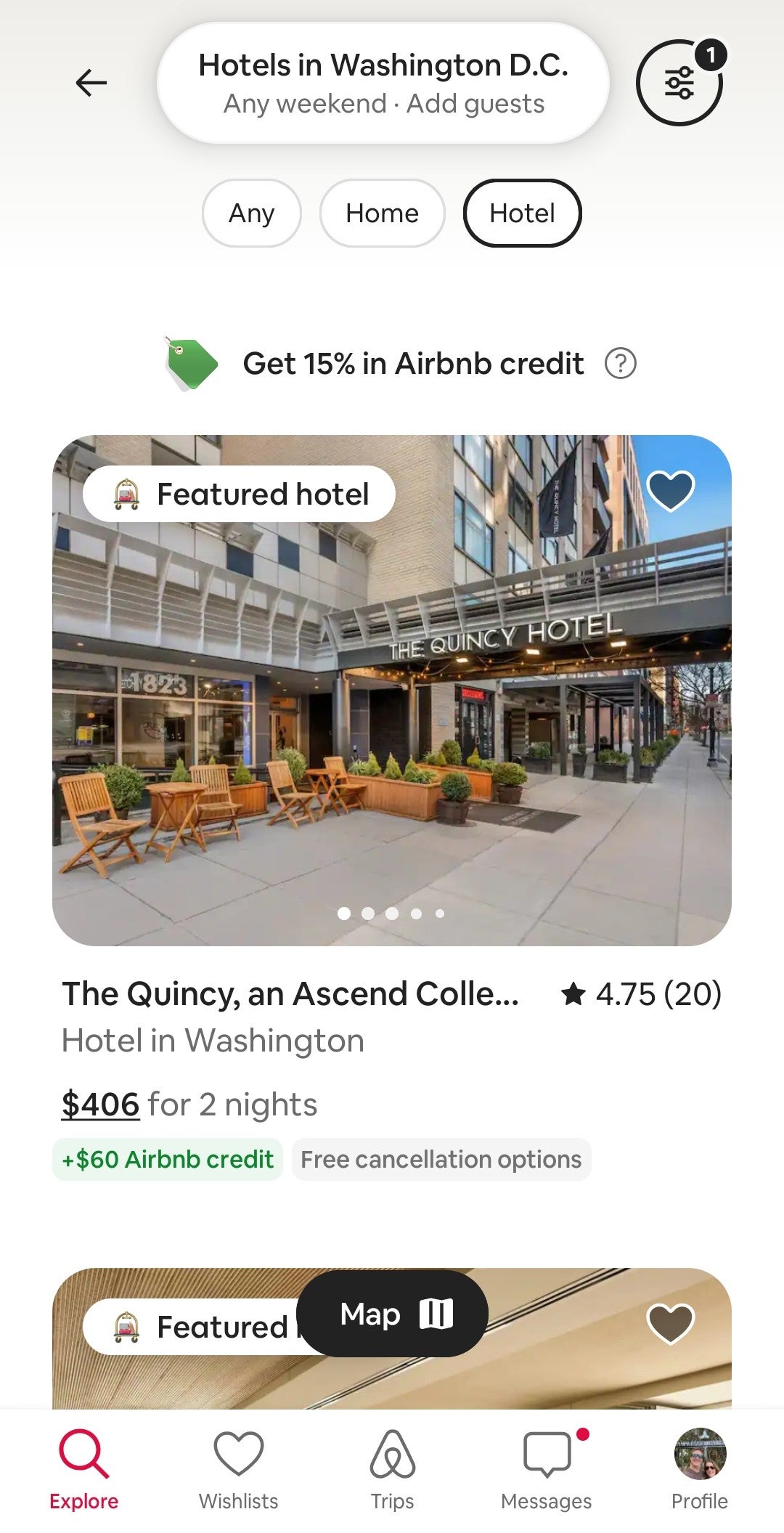
Airbnb featured hotel in Washington DC with 15% credit offer
AIRBNB

With these features, the program seems to be trying to encourage users to stay within its ecosystem — possibly the closest Airbnb has ever come to loyalty program territory.

Bottom line

Since I book through Airbnb fairly often for its unique stays — most recently, an unforgettable hobbit house near Tennessee’s Great Smoky Mountains — I’m always glad to see the platform adding new features. Being able to book other trip elements like groceries and airport pickups all in one place is convenient, and Airbnb offers some unique local experiences that you won’t find anywhere else.

However, you can often earn far more points by booking through credit card portals, which generally offer independent hotels, rental cars, tours and activities similar to Airbnb. So — in case you’re reading this, Brian Chesky — this writer is still anxiously awaiting an Airbnb loyalty program or credit card.


Source link

Leave a Reply

Subscribe to Our Newsletter

Get our latest articles delivered straight to your inbox. No spam, we promise.

Recent Reviews


What Are Selection Techniques

Selection techniques in machine learning help in reducing the noise by taking in only the relevant data after the pre-processing. The techniques have the ability to choose the relevant variables according to the type of user’s problem. In case any data comes up that is not relevant to the requirement, it tends to slow down the efficiency process of the model and also decrease the accuracy. Therefore, it is very important to have appropriate feature selection techniques for the models in order to have better outcomes and accuracy. 

The main idea of working with selection techniques is to manually extract the relevant settings from the parent set to have high-accuracy model structures.

Feature Selection in Machine learning

The techniques are divided into the category of supervised and unsupervised learning. These two categories are further divided into 4 main methods for selecting the features.

Filter Method :

There are statistical ways for selecting the features using the filter method. The features are selected in the pre-processing stage as there is no learning process involved in this. The aim of this approach is to filter out the unrequired and irrelevant features by using matrices and ranking methods. The most important advantage of using the filter method is that it does not overfit the data.

IMAGE

Wrapper Method :

In this method, a user makes different combinations that are evaluated or compared with a lot of other possible combinations. In this way, the feature selection is done. A subset of features is selected and the algorithm is trained based on the subset. The output of the algorithm then decides if the features will be added or not. This method is further based on 4 types which are:

  • Forward Selection : This process takes in an empty feature set. It keeps adding a feature to each interaction and checks the progress simultaneously as if it is improving or not. This method keeps on iterating unless there comes a feature that does not improve the progress of the model.
  • Backward Elimination : This approach is the complete opposite of the forward selection approach. The process takes in all the features of the algorithm and then keeps removing a feature one by one on each iteration. It checks the progress simultaneously as if it is improving or not. This method keeps on iterating unless there comes a feature that does not improve the progress of the model.
  • Exhaustive Feature Selection : It is the most common approach for feature selection as each feature is set as brute-force. The approach aims to try various combinations of features in order to give the best outcome.
  • Recursive Feature Elimination : This method is based on the greedy approach as its features are selected in a smaller amount. An estimator is made to test every set of features designed and thus we get an outcome of the best features.
  • IMAGE
Embedded Method :

This is a great method for feature selection as it has the advantages for both filter and wrapper methods collectively. The processing time in the embedded method is very high just like the filter method, however, they provide more accurate outcomes.

IMAGE

There are a few techniques involved with embedded methods which are:

  • Regularisation : This aims at regularising the feature selection method simply by adding a penalty if the data gets overfitted in the model. The points shrink to a value of 0 and they are eliminated from the dataset. The types of regularizations are L1, L2, L3, etc. 
  • Random Forest Importance : This technique involves a lot of tree-based approaches to select the features for an algorithm. A number of decision trees are involved in this as the ranking of nodes is performed in all the trees to get the results. After filtering out the irrelevant nodes, a subset of the most relevant nodes creates a final selection of features.
Hybrid Method :

This approach takes in features as small-sized samples. The main idea is to select the features using instance learning. The features that correspond to the instances are selected as they are relevant to the algorithm.

Want to Become a Master in Machine Learning? Then visit here to Learn Machine Learning Training

Machine Learning Training

  • Master Your Craft
  • Lifetime LMS & Faculty Access
  • 24/7 online expert support
  • Real-world & Project Based Learning

Feature Selection Models

Supervised Model :

This model is defined as the class of machine learning methodologies where the user can train with the help of continuous and well-labelled data. For instance, the data can be historical data where the user wishes to predict whether a customer will take a loan or not. Supervised algorithms tend to train over the well-structured data after the preprocessing and feature characterization of this labelled data. It is further tested on a completely new data point for the prediction of a loan defaulter. The most popular supervised learning algorithms are the k-nearest neighbour algorithm, linear regression algorithm, logistic regression, decision tree, etc.

This is further divided into 2 categories:

  • Regression: The dealing of output variables is done using regressions as it includes graphs, images, etc. For example to determine age, height, etc. 
  • Classification: it helps in classifying different objects such as yellow, orange, wrong or right, etc.
Unsupervised Model

This model is defined as a class of machine learning methodologies where the tasks are performed using the unlabelled data. Clustering is the most popular use case for unsupervised algorithms. It is defined as the process of grouping similar data points together without manual intervention. The most popular unsupervised learning algorithms are k-means, k-medoids, etc. 

This is further divided into 2 categories:

  • Clustering :This means when the machine requires an inherent group while training the data.
  • Association :This category has a set of rules which helps in the identification of massive data. For example, a list of students who could be interested in artificial intelligence as well as machine learning.
HKR Trainings Logo

Subscribe to our YouTube channel to get new updates..!

How To Choose a Feature Selection Model

It is very important for machine learning engineers as well as researchers to understand which feature selection model is most suitable for them. The most data types are known by the engineer, the easier it will be for him to choose properly and wisely. This whole concept is based on 4 main approaches which are:

  • Numerical Input, Numerical Output : There are two methods used in this technique which are Pearson’s correlation coefficient and Spearman’s Rank Coefficient.  The numerals are basically used for the prediction of regression models for continuous numerical such as int, float, etc. 
  • Numerical Input, Categorical Output : There are two methods used in this technique which are the ANOVA correlation coefficient, and Kendall’s rank coefficient. The numerals are basically used for the classification of predictive models for continuous numerical such as int, float, etc. 
  • Categorical Input, Numerical Output : This is a case of the prediction of regression models using input based on categories. The process is the same as numerical input, and categorical output but in a reverse fashion. 
  • Categorical Input, Categorical Output : This is a case of classification of predictive models using both categorical inputs as well as outputs. The main approach affiliated with this method is the Chi-squared method. Moreover, information gain can also be used with this technique.

Machine Learning Training

Weekday / Weekend Batches

Conclusion:

The process of selecting features in machine learning is a vast concept and it involves a lot of research to select the best features. However there is no hard and fast rule for making the selection, it all depends on the type of model and its algorithm and how a machine learning engineer wants to pursue it. Selection techniques in machine learning help in reducing the noise by taking in only the relevant data after the pre-processing. 

In this article, we have talked about various feature selection methods that use certain algorithms for making the best possible outcomes and why we should make this feature selection method. Along with this, we have talked about how we can finalise the best feature selection model to work with.

Related Articles:

EDA in Machine learning


Source link