Minnesota legislators debate self-driving car laws


To legally get behind the wheel in Minnesota, drivers need a license and familiarity with the rules of the road.

But what goes when a vehicle drives on its own without a human behind the wheel? What happens if it crashes, or breaks the law, or if there’s a snowstorm? That's what Minnesota lawmakers are grappling with as self-driving cars hit the streets in Minneapolis without much state regulation on the books.

Members of both parties agree legislation is needed. However, serious discussion and political division surrounds matters of safety, accessibility, weather, local regulatory authority and how rideshare drivers might be impacted.

Corbb O’Connor, the president of the National Federation of the Blind of Minnesota, said autonomous vehicles can benefit disabled people. The National Federation of the Blind has given feedback to Waymo to make their vehicles more accessible.

“A couple of years ago in San Francisco, I wanted to try a legendary sandwich, so I used Waymo with my iPhone’s built-in accessibility features to find the car and ride across the city. No driver, no guide dog discrimination and no discussion. Just dinner,” O’Connor said at a Minnesota Senate Transportation Committee hearing Wednesday.

O’Connor said driverless cars take driver bias out of the equation. Just this month, the rideshare company Lyft settled with a blind student in Minnesota who claimed drivers canceled rides on her when they realized she had a guide dog.

“We see this as an urgent issue because of that documented discrimination against passengers with disabilities, especially those using guide dogs,” O’Connor said.

Robert Wudlick, a member of the Minnesota Council on Disability, said he also wants to encourage autonomous vehicle companies to expand to Minnesota. However, Wudlick said accessibility requirements, like including wheelchair-accessible vans in each vehicle fleet, should be written into law. 

“One thing I've learned is that accessibility in our community does not come voluntarily,” he told state senators.

Accessibility is just one of many issues being discussed by lawmakers. On one end of the spectrum, some lawmakers want to prioritize making Minnesota attractive to autonomous vehicle companies.

Two people sit on a stage to talk.
MPR News politics editor Brian Bakst interviews Sen. Carla Nelson, R-Rochester, during a recording of a Politics Friday show in Rochester, Minn., on Oct. 21, 2025.
Josh Sauvageau | MPR News

“We cannot stop progress,” said Sen. Carla Nelson, R-Rochester. “But I think we should be drivers of the change that's coming, and do so in a thoughtful way.”

Proposed legislation backed by Waymo would explicitly allow self-driving cars and prevent local governments from regulating them.

Sen. Scott Dibble, DFL-Minneapolis, said while he’s willing to compromise on other issues, he will insist on preserving local authority.

"We have seen companies use their size, scale and corporate power to run roughshod over local authority, limiting the ability of cities to manage their own streets, their own right of way and public infrastructure in the public's interest," Dibble said this week.

On the other end of that spectrum, a labor-backed DFL bill would ban autonomous vehicles in Minnesota until the potential impacts to the rideshare workforce, accessibility, safety and infrastructure are studied. Even then, the bill would require human operators in the vehicles as a safety backup.

A womam stands at her desk and speaks into a mic
Sen. Erin Maye Quade speaks on the Senate floor on April 29, 2024, at the State Capitol.
Ben Hovland | MPR News

Bill sponsor Sen. Erin Maye Quade, DFL-Apple Valley, rattled off several high-profile examples of Waymo self-driving cars acting inappropriately and unsafely in other states. Maye Quade described one instance when a Waymo car briefly blocked an ambulance from responding to a mass shooting in Texas and an incident when a Waymo car drove on light rail tracks in Arizona, forcing the passenger to exit the vehicle before a train approached.

“We have a responsibility to Minnesotans to ensure that if autonomous vehicles eventually do operate in our state — and I am not opposed to that — they do so under rules informed by independent research, public input and careful consideration of the impacts,” Maye Quade said.

David Stiggers, a transit union leader and longtime bus driver, supports Maye Quade’s bill.

“We just had 15 inches of snow. Can an autonomous vehicle really greet you at the front door and help you through the snow-covered sidewalk to the vehicle safely?” Stiggers said. “I think not. People do that. Minnesotans do that.”

Sen. John Jasinski, R-Faribault, said requiring drivers in driverless vehicles “just sounds crazy to me.”

Jaskinski said that’s tantamount to legalizing cell phones but requiring them to have cords. “It just doesn't make sense.”

Waymo started testing its fleet — with human drivers for now — in Minneapolis. The company hired four lobbyists in Minnesota last year, and its representatives have been testifying at the Capitol.

Republicans and Democrats agree there should be no city buses, school buses or semi trucks operating without a driver any time soon.

“Regardless of what the legislature decides to do with taxi cabs, I think we can draw a line at commercial vehicles and make sure we have human drivers in our trucks and buses,” said Sen. Jennifer McEwen, DFL-Duluth, who sponsors a bipartisan bill that would ban large commercial driverless vehicles until 2033.

Lawmakers have until May 18 to try to get autonomous vehicle bills through the divided Legislature.




Source link

Leave a Reply

Subscribe to Our Newsletter

Get our latest articles delivered straight to your inbox. No spam, we promise.

Recent Reviews


Lost a crucial document because your system crashed before you could save it? Worry no more! Microsoft Word has introduced an automatic save option that regularly backs up your work, so you’ll never lose your progress again.

Users will now be able to manage their Word documents without thinking about saving them manually. The new Microsoft Word update allows users to automatically save their documents to the cloud as soon as they start documenting any content piece.

Raul Munoz, the Senior Product Manager at Microsoft, has stated about the new feature, “We are modernizing the way files are created and stored in Word for Windows! Now you don’t have to worry about saving your documents: Anything new you create will be saved automatically to OneDrive or your preferred cloud destination.

Microsoft additionally hints at introducing similar features for Windows Excel and PowerPoint, which are now live.

How Does the Auto-save Feature Work?

The auto-save option can be accessed and used effectively with the compatible Word for Windows version. Let’s understand how the process works-

Primarily, users need to create a fresh document in Word and switch the AutoSave option on. Unlike the previous default document name- DocumentN, the autosave feature saves the files with the date.

Microsoft Word Update - Step 1

Source: Microsoft Tech Community

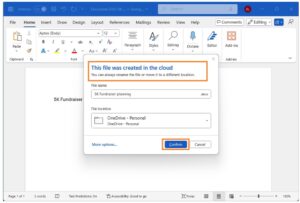
To change the name of the file and its location, users need to select Save or press Ctrl+S. After selecting the file name and location, press Confirm to save the changes.

Microsoft Word Update - Step 2

Source: Microsoft Tech Community

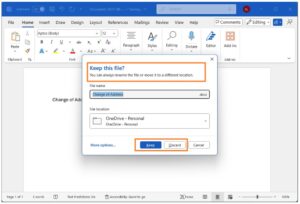
In case users try to close the file before it gets saved, a dialog displays on the screen asking whether they intend to Discard or Keep the file. If users try to close empty files, Word discards them without asking for confirmation.

Microsoft Word Update - Step 3

Source: Microsoft Tech Community

Availability of the Auto-Save Feature of Microsoft Word Update-

The AutoSave feature of Microsoft Word update is available to users with Version 2509 (Build 19221.20000) or newer. This advancement is set to enhance accessibility and address the challenge of lost files. Similar features have been introduced on Windows Excel and PowerPoint as well.

Advantages of the Latest Microsoft Word Update

Microsoft Word’s new auto-save feature will unlock several benefits for users. Alongside increased security, it offers flexible file management capabilities. Let us discuss other significant advantages-

Flexibility in File Storage and Control: Users can store and manage their files more flexibly than ever. As users are in charge of the documents, they can adjust file names and locations to save, organizing the files according to convenience.

Never Lose Your Files: The auto-save feature in Microsoft Word addresses the challenge of losing files due to not saving them manually. As soon as you start making progress in a file, it automatically gets saved.

Enhanced Security and Compliance: Files saved in your organization’s cloud servers already adhere to the set security guidelines and practices. Hence, users do not need to think about protecting the files separately.

Increased Accessibility: The auto-save feature enables enhanced accessibility of Word files. It can be accessed from diverse types of devices and platforms once shared, including Android, iOS, and web browsers. Changes made to the file will get synced on all devices and platforms.

Better Collaboration: The AutoSave feature has made collaboration within and across teams easier. Users can easily share the cloud file and initiate collaboration by making changes, adding comments, and resolving comments in real time.

Agentic AI Support: The Word files are now equipped with Copilot agentic AI support. Users can unlock AI-powered capabilities whenever they need to improve or update their documents. Nevertheless, to use Copilot in Word, a Microsoft 365 Copilot license is needed.

Additional Tips: 

  • Users will be able to easily change the location for new documents. Right-click on any cloud folder in the File section of Word, then select Set as Default Location to choose the location.
  • Users can manage how their files are created, whether in the traditional manner or automatically in the cloud, in the Save tab of Word Options, and opt in or opt out for Create new files in the cloud automatically.

Key Elements to Keep in Mind-

  • When a new Word session is started while another is running, the new file does not autosave. Hence, users need to close the previous file to enable the auto-save option for new files.
  • Users may sometimes encounter a delay in refreshing the recent files list while changing the name of a document.
  • If users disable the option for Show the Start screen when this application starts, remember that the first file they create will not autosave automatically.

Concluding Remarks!

Microsoft has been making significant advancements in its 365 Office platforms for better collaboration and enhanced productivity of diverse teams within an organization. With the integration of Copilot and flexible features, the firm is aiming to boost user experience and accessibility of the tools, including Word for Windows.

Learn about the major technological shifts and practices with KnowledgeNile!


FAQs:

1. What is the AutoSave feature in Microsoft Word?

Answer: The AutoSave feature in Microsoft Word lets users save their files automatically.

2. What is the purpose of AutoSave?

Answer: The AutoSave feature aims to reduce the challenges of data loss in unwanted circumstances, such as power shortages and device failures.

3. Where are AutoSave Word documents stored?

Answer: Automatically saved Word files are stored in cloud storage, like OneDrive.


Recommended For You:

Oracle identity cloud vs Microsoft Active Directory: Which to opt for and why?


Source link