Pooh Shiesty, Big30 Accused of Kidnapping Gucci Mane at Gunpoint: New Details Revealed | Big30, Gucci Mane, Pooh Shiesty | Celebrity News and Gossip | Entertainment, Photos and Videos


Gucci Mane (real name Radric Delantic Davis) was allegedly robbed and kidnapped by Pooh Shiesty (real name Lontrell Williams, Jr.) and Big30 (real name Rodney Lamont Wright Jr.).

The 46-year-old “I Get the Bag” rapper was allegedly robbed and kidnapped at gunpoint by the two 26-year-old rappers among other individuals at a recording studio in Dallas, Texas.

The news was reported in a press conference held by the Department of Justice.

Keep reading to find out more…

Nine people, including the rappers, kidnapped and robbed numerous people, and eight of those suspects were arrested Wednesday (April 1), according to the press conference.

A complaint issued in January claimed that three music industry professionals went to Dallas for a meeting arranged by Pooh Shiesty, signed to Gucci‘s 1017 label in 2017, to “discuss the terms of his recording contract with one of the victims.”

While in the studio, Pooh Shiesty and eight others “executed an armed takeover,” per the DOJ complaint, which says the rapper used a AK-style pistol and “forced one of the victims to sign a release from the recording contract at gunpoint.”

The other individuals reportedly pulled out guns and robbed the other victims of “Rolex watches, jewelry, cash and other high-value items,” according to the federal officials, while one person was also choked nearly unconscious.

Big30 reportedly barricaded the door to prevent them from leaving.

Police have since raided Pooh Shiesty‘s home in Memphis, Tenn., per NBC DFW.

Pooh Shiesty, who was on home detention during the alleged kidnapping, was released from jail last October after serving three years for a gun charge, after pleading guilty to conspiring to possess firearms in furtherance of crimes of violence and drug trafficking. His father Lontrell Williams Sr. allegedly helped plan the attack, per the DOJ.

As for penalties, sentencing “could range from zero to life imprisonment, depending on the individual’s criminal history and other factors,” the DOJ said in the press conference.

“One defendant committing this crime while on home confinement would be considered an aggravating factor.”

Suspects in the case posted some of the items stolen on social media, according to the DOJ. Watch the press conference above.

Pooh Shiesty rose to fame with his breakout hit “Back in Blood” in 2020 and signed to Gucci Mane‘s 1017 label, while Big30 is known for various collaborations in the rap scene, including 2021′s “Neighbors” with Pooh Shiesty.

Read the transcript inside…

I’m Ryan Rabel. I’m the U.S. Attorney for the Northern District of Texas. Thank you for coming.

This week, nine individuals, including well-known musical artists, kidnapped and robbed at gunpoint numerous victims at a music studio in Dallas, Texas. Eight of the nine were arrested yesterday in Dallas, Memphis, and Nashville.

These individuals who are charged and arrested include Lantrell Williams Jr., also known as Pooh Shiesty; Lantrell Williams Sr.; Rodney Wright Jr., also known as Big30; Kadarius Waters; Demarion Gibson; DeMarcus Glover; Corday Johnson; Darian McDaniel; and Terrence Rodgers, who has not been arrested yet but will be soon.

The complaint alleges that on January 10th of this year, three music industry professionals traveled to Dallas for a scheduled business meeting. Lantrell Williams Jr. arranged this meeting purportedly to discuss the terms of his recording contract with one of the victims.

As alleged, once these three men were inside the recording studio, Williams Jr. and eight co-conspirators, several of whom traveled from Memphis, Tennessee, executed a coordinated armed takeover. As alleged, Williams Jr. produced an AK-style pistol and forced one of the victims to sign a release from the recording contract at gunpoint.

The remaining conspirators displayed firearms and robbed the other victims of Rolex watches, jewelry, cash, and other high-value items.

One of the victims was actually choked by one of the defendants to the point of near unconsciousness. Defendant Wright barricaded the studio door with his body to prevent the victims from escaping.

The ringleader of the conspiracy, Lantrell Williams Jr., was on home confinement at the time of the offense, as alleged for a prior firearms conspiracy charge and conviction out of the Southern District of Florida. Towards the end of his prison sentence, he had been granted home detention.

Part of the terms of his home detention were that he would not commit another federal offense or possess a firearm. His father, Lantrell Williams Sr., is alleged to have helped plan and execute the federal kidnapping as charged in the complaint.

And as described further in the complaint, within hours of leaving the Dallas studio, a number of the defendants were on social media displaying some of the items that appeared to be the jewelry that had been robbed from the victims.

The charging document outlines some of the evidence establishing the defendants’ roles in the federal offense. This includes electronic monitoring data placing Williams Jr. at the offense location, which would put him in violation of his home detention conditions.

Cell phone records and license plate reader data corroborate the coordinated travel of multiple defendants from Memphis, Tennessee, to Dallas. Rental car records confirm Williams Sr. rented a vehicle that was used by the group.

There is also surveillance footage from the offense location, a nearby office supply store, and a hotel where several of the defendants stayed following the offense. Fingerprint evidence was recovered from the crime scene matching at least two of the defendants.

Social media posts by defendants display what appears to be stolen property just days following the offense. Greyhound bus records confirm the travel of multiple defendants from Dallas to Memphis the day after the offense.

In this case, individuals came to Dallas to conduct legitimate business and were met with firearms and violence, as alleged in the charging document.

This case should serve as a warning to others who believe that using violence and intimidation tactics to rob others in our community is a viable way to conduct business. I am here to say that it is not, and that if you choose to do this, we will, together with our law enforcement partners here and in the Northern District of Texas, bring you swiftly to justice.

I want to thank the FBI Dallas Violent Crimes Task Force, the FBI’s Memphis Resident Agency and Nashville Field Office, the Memphis Safe Task Force, the Dallas Police Department, the United States Attorney for the Western District of Tennessee, Michael Dunavant, and ASA Greg Wagner, the U.S. Attorney’s Office for the Eastern District of Texas, my colleague Jay Combs, and the U.S. Attorney’s Office for the Middle District of Tennessee, including Braden Buszek, for their outstanding contributions in this multi-jurisdictional investigation and prosecution.

I would also like to highlight the extraordinary work of our Assistant U.S. Attorneys. None of this happens without them, and I am proud to say we have the best in the country. That includes Robert Withers, Claire Demur, and my violent crime chief Jeremy Fugate.

This case underscores the importance of standing up for crime victims, no matter who they are or where they come from, and the incredible collaborative partnerships we have not only in the Northern District of Texas but across the country.

We are all working together to make our country safer.

Thank you for being here today. I will answer questions after my colleague speaks. I will now turn it over to Jeremy Wright, the FBI Dallas Assistant Special Agent in Charge.

Good morning. My name is Jeremy Wright, Assistant Special Agent in Charge for FBI Dallas.

As stated, we are here today to announce the arrest of several individuals in the Memphis and Nashville, Tennessee areas, as well as one here in Frisco, Texas. These arrests are the result of a violent kidnapping of three individuals in the Dallas area.

The majority of those arrested traveled from Memphis to Dallas to commit that offense.

Our office collaborated with multiple law enforcement agencies and FBI offices to carry out this investigation, which ultimately led to these arrests.

I would like to thank the Dallas Violent Crimes Task Force, Dallas Police Department, Memphis Safe Task Force, Memphis Police Department, and the Shelby County Sheriff’s Department for their assistance.

Violent crime remains a top priority for the FBI. We dedicated significant resources from Dallas, Nashville, Little Rock, Birmingham, and Atlanta FBI offices to investigate and arrest these individuals.

We remain committed to investigating violent crimes like these. No matter who you are, we will work every day alongside our partners to make our communities safer.

Thank you. We will now take questions.

Yes, sir.

It may be in the release you are sending, but can you be more specific about the victims?

It will be in the complaint, and we are happy to provide that. It is now unsealed. The incident occurred at a music studio off Dallas Parkway in Dallas, Texas. As far as the victims, we will not be identifying them at this time.

Can you describe the injuries?

One of the victims had visible abrasions on the neck and arm. There is a photograph included in the complaint.

You mentioned one suspect is still being sought.

Yes. One individual has been charged but has not yet made an initial appearance. Agents are actively working to locate and bring that person into custody.

Are you concerned going public could hinder that effort?

The complaint is already unsealed, and several defendants have had initial appearances. The information is already public. We are confident agents will locate the individual.

That person can turn themselves in at any time.

Can you explain the timeline between January and now?

Eight of the nine arrests occurred yesterday. Most were in Memphis, one in Nashville, and we are working with Georgia partners to apprehend the final suspect.

As for the timeline, building a federal case requires subpoena work, search warrants, and evidence collection. Identifying suspects and building a prosecutable case takes time. This is actually a relatively quick turnaround for a case of this magnitude.

What kind of penalties are they facing?

There is no mandatory minimum. Sentencing could range from zero to life imprisonment, depending on the individual’s criminal history and other factors. One defendant committing this crime while on home confinement would be considered an aggravating factor.

Can you share more about the victims?

At this time, we are not disclosing further information. More details may come out later, but we are not at liberty to share that now.

Can you describe how the arrests were carried out?

This required coordination across multiple jurisdictions to execute simultaneous arrests safely and without alerting others. It involved extensive planning and cooperation with local and federal partners.

Were all arrests in Memphis?

No. One arrest occurred in Frisco, Texas. The rest were in Memphis. We are actively pursuing the final suspect.

Thank you.

If there are further questions, please reach out to Catherine Miller.

Thank you.



Source link

Leave a Reply

Subscribe to Our Newsletter

Get our latest articles delivered straight to your inbox. No spam, we promise.

Recent Reviews


Have you ever visited a site that just drags? You click a link, and it takes forever to load. Images appear one by one, and the site feels like it is lagging behind your mouse. It is frustrating, right? As a website owner, that is the last impression you want to leave on your visitors.

In today’s digital world, speed is not a necessity; it is a requirement. People expect websites to load instantly. In fact, studies show that even a 2-second delay in loading a website makes people leave your site by 32%. So, it is not just about user experience. It is about keeping your visitors and growing your business.

One of the biggest causes for slowing down of websites is something called unused JavaScript. That is just extra code sitting on your site that doesn’t actually do anything useful. It is like carrying a heavy backpack full of stuff you don’t need on a long hike, it slows you down. Your browser still has to download, read, and run all that extra code, even if it is not being used. This can come from:

  • Old plugins or themes that add features you don’t use.
  • Third-party tools like social media buttons or trackers.
  • Outdated or messy code that is no longer relevant.

All of this adds weight to your site and makes it slower for users to interact with it.

Here the question arises: can you fix it easily? The answer is cleaning up unused JavaScript is totally doable, even if you are not a developer. Let’s understand how to remove the unnecessary code and give your site a serious speed boost.

What Is Unused JavaScript?

Unused JavaScript is simply extra code taking up space on your site that doesn’t really do anything helpful. When a person comes to your site, their browser loads all the code including these unneeded pieces, slowly creeping along. Imagine packing for vacation and bringing stuff you never use. It only makes everything heavier and slower.

Where Does This Extra Code Come From?

  • Themes & Plugins: WordPress themes and plugins tend to have features that you may not even need.
  • Third-Party Tools: Things such as social media buttons or analytics can introduce additional code.
  • Old Code: As your site gets larger, there will be some code that becomes outdated or obsolete.

Why Remove It?

  • Faster Website: There will be shorter loading times with less code.
  • Improved User Experience: Visitors won’t get frustrated waiting for your site to load.
  • Lower Resource Consumption: Conserves bandwidth and decreases server load.
  • Simpler Maintenance: Neat code is simpler to maintain and modify.

How to Identify Unused JavaScript?

Google PageSpeed Insights

  • Go to PageSpeed Insights
  • Enter your site URL and press “Analyze”
  • Check under “Opportunities” for “Remove unused JavaScript”
  • It will display which files are slowing you down

GTmetrix

  • Visit GTmetrix
  • Enter your site URL and perform a test
  • Check the “Waterfall” tab → “JS” section
  • You will see which JavaScript files are the biggest and when they load.

How to Remove Unused JavaScript from Your Website?

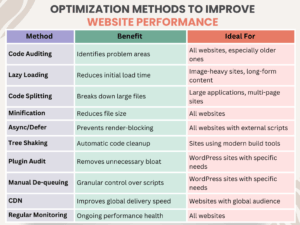
1. Identifying the Culprit: The First Step to a Speedier Site

You should know what you are working on before you can fix it. Imagine it like cleaning out your closet. You need to take everything out so that you can look at what is there and what you really use. For your site, Google PageSpeed Insights and the Chrome DevTools Coverage tab are your friends. They are free and amazingly powerful. The Coverage tab, in fact, will give you a visual representation of how much of your JavaScript is actually being executed. It color-codes your code, so you can immediately see what’s running (green) and what’s idle, taking up space (red). It is an eye-opener! Knowing precisely which scripts are the heaviest and are used the least is the initial and most important step on any optimization path.

2. Lazy Loading: A Clever Approach to Heavy Content

Suppose you are browsing a long article with several images. Do you actually need to load all your images the second the page loads? Most likely not. Lazy loading is the exact same idea but applied to your JavaScript files. Rather than loading all your scripts immediately, you can make them load only when they are used, such as when a user scrolls down to a certain section or presses a button. This is particularly helpful for such things as image galleries, video players, or comment streams that are “below the fold” (i.e., not on the first screen). It has a massive impact on the initial page load time, so your site can be snappy and responsive right out of the box.

3. Code Splitting: Disassembling the Big Bloat

Do you remember trying to push a massive piece of furniture by yourself? It is almost impossible. But if you divide it up into smaller, bite-sized chunks, the work is a whole lot simpler. The same concept can be applied to your site’s JavaScript. Code splitting is the process that divides your massive JavaScript files up into smaller, specialized “chunks.” The browser only needs to download the code it requires for the current page instead of the whole codebase. This is a game-changer for single-page applications and big sites.

For instance, on an online shop, you might have one bundle of code for the homepage, a second for the product pages, and a third for the checkout process. Then, a visitor on the homepage would not need to download the checkout code until they are about to make a purchase, resulting in their first experience being much quicker. This is one of the best ways to remove unused JavaScript from the first load.

4. Async and Defer: The Easy Solution for Smoother Loading

This is an easy but effective trick. When you insert a script into your website, the browser will normally pause everything else to download and execute that script. This is referred to as “render-blocking” and is a significant source of slow loading. The async and defer attributes are like nice requests you send to the browser.

  • Async: This instructs the browser to download the script in the background as it proceeds to load the rest of the page. The browser will suspend once the script is ready and run it. This is perfect for scripts that don’t rely on other scripts, such as an analytics tracker.
  • Defer: This also instructs the browser to download the script in the background but does not run the script until the rest of the page is loaded. This is ideal for scripts that require the rest of the page’s content to be available, such as a script that resizes the page’s layout.

One little modification to your script tag can make a huge difference.

5. Minification and Compression: Squeezing Your Code

Imagine minification and compression as two methods of packing your code tighter. Minification is the removal of all unnecessary characters from your code, such as comments, unnecessary spaces, and line breaks. They serve the developer but are entirely useless to the browser. It is similar to taking a well-written book and reducing it to the text itself, none of the formatting. Compression takes an algorithm such as Gzip or Brotli and compiles your code files into something smaller, just like you zip a folder on your machine.

When applied together, these two methods can significantly minimize the size of your JavaScript file, in some cases up to 70%, making browsers download it much quicker. This is an important step in any attempt to remove unused JavaScript and optimize your website.

6. Tree Shaking: The Digital Gardener

Suppose you have a massive library of functions, yet your website makes use of just a few of them. “Tree shaking” is a method employed by today’s build tools (such as Webpack) to automatically strip out the unused code from your final bundle. It’s similar to having a digital gardener trim out the unnecessary branches on your tree of code, so that only the healthy, working pieces are left. It’s a great way to automatically remove unused JavaScript you may not even be aware is present. It works particularly well when you’re using big third-party libraries.

7. Audit Your Plugins and Themes: Less is More

At times, the best things in life really are simple. The majority of websites, particularly those on sites such as WordPress, have themes and plugins that include a whole lot of unnecessary baggage. A plugin may contain a whole library of code for something you don’t even have implemented. Auditing your plugins and themes on a regular basis is a requirement. If you have a plugin that you no longer use, or a theme with functions you don’t want, uninstall it. You’d be amazed at how much dead weight can be cut this way. Just don’t forget to back up your site first before uninstalling anything!

8. Manual De-queuing and De-registering

For those with a bit more technical know-how, an effective means of remove unused JavaScript is to de-queue or de-register it manually. This is standard practice on sites like WordPress where plugins tend to load scripts on every single page, even though they’re only required on one. For instance, a contact form plugin might load its script on your homepage, blog, and product pages, despite the form only being present on your “Contact Us” page. With a single line of code, you can instruct your site to not load that script on alternate pages, which can save considerable bandwidth and processing.

9. Using a CDN: Getting Your Code in Front of Your Users

A Content Delivery Network, or CDN, is an array of servers dispersed throughout the globe. When someone browses to your site, the content is delivered from the nearest server. This makes your website load in a fraction of the time before. Although a CDN doesn’t explicitly remove unused JavaScript, it speeds up delivery of your website’s files so quickly that it can have the appearance of having been optimized. It’s an excellent supporting tactic to the remaining tips on this list.

10. Keep Current and Track Performance

Your website isn’t a “set it and forget it” kind of thing. The internet keeps changing, and your site should grow with it. That’s why it’s important to regularly check how well your site is performing. You can use free tools like Google Lighthouse, GTmetrix, or WebPageTest to do this. These tools give you detailed reports and helpful tips, like pointing out to remove unused JavaScript that might be slowing things down.

By making performance checks a regular part of your website maintenance, you’ll keep your site fast, clean, and ready for whatever comes next. It is like giving your site a regular health check to make sure it’s always in top shape.

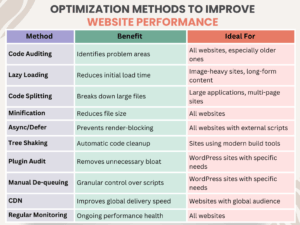
Common Optimization Methods to Improve Website Performance

Optimization Methods to Improve Website Performance 

Wrapping up!

By following these simple steps, you can remove unused JavaScript and change your website speed. You can free up your site from that clunky experience into a fast, responsive, and delightful one. A faster website will keep your visitors happy and will improve your search engine rankings. It will help you to achieve your business goals. So go ahead, give your website the spring cleaning it deserves!

To learn more, visit KnowledgeNile!


FAQs

1. What is unused JavaScript?

Answer: Unused JavaScript is an additional code on your website that actually does nothing. It simply exists on your website and slows down the speed of the site.

2. Does deleting unused JavaScript break my website?

Answer: No, removing the wrong code can create problems, but if you only delete those scripts that are not in use, it will help your site perform better and load faster.


Recommended For You:

Most Important HTML Attributes for SEO You Need to Know


Source link