Property tax bills put heat on lawmakers to ease bumps


For Amanda Hawkins, opening the envelope containing a new, higher valuation assessment on her New Brighton home was jaw-dropping news. It has, in turn, led to a big spike for the home’s 2026 property tax statement.

“It was definitely sticker shock,” Hawkins said.

Hawkins will see a 26 percent increase in her taxes this year — more than $1,000 in total. She was hit with increased taxes from the city and county, along with a huge jump in the valuation of her house. Now she’s wondering if she and her partner’s decision to buy their first home in 2024, with three young children, was a good idea.

“That’s what really hit me — that I might not be able to afford a home after all,” Hawkins said. “But at that point, it was too late to go back. It was an unexpected expense on my end.”

Stories like Hawkins’ situation are being shared on social media neighborhood groups, are being forcefully told to local government officials and are making their way to lawmakers at the Capitol in St. Paul.

The reality of last fall's property tax hikes have been dropping into Minnesota mailboxes over the last few weeks. Property owners are receiving their finalized tax bills bearing some of the largest levy hikes in years.

According to the Minnesota Department of Revenue, the combined certified property tax levies are $873 million more for 2026 than they were in 2025. That’s slightly lower than the preliminary levies that cities, counties, townships and other entities put forward last fall, but still represent a 6.8 percent increase over the prior year.

In all, property tax payments will total almost $13.8 billion this year. School districts collect the largest share of that, followed by counties, cities, townships and special taxing districts.

The average city tax levy increase is 7.7 percent, with a few cases where the year-over-year tax take will fall slightly and some where it will shoot up fast. The average county bump is 7.6 percent, with some boosting their levies by double digit percentages.

What individual property owners pay depends on multiple things, including their classification of their land, the value of the parcel and the mix of properties within those boundaries.

But the upward trajectory has legislators feeling some pressure to send some tax relief to their constituents, especially at a time where other costs — health care, gasoline and food — have already put a strain on family budgets.

“If you talk to people in Minneapolis or St. Paul or Upsala or down in Zumbrota, what you're going to hear from people is that life is too expensive,” said Rep Isaac Schultz, R-Upsala.

The state's projected $3.7 billion surplus could give legislators a means to respond.

Schultz is proposing sending the state’s positive budget balance to property owners as property tax aid.

“Minnesotans across the board should see the benefit of the budget surplus that we have in the state,” he said.

But that surplus won't last. Some lawmakers worry about creating a hole later. There is also plenty of competition for the money.

Meanwhile, other lawmakers are on a parallel search for workarounds.

“One of the top concerns, if not the top concern, that I've been hearing from constituents, is their frustration over ever-increasing property taxes,” said Sen. Michael Kreun, R-Blaine.

Kreun has a bill in the Senate that would cap local property tax hikes for counties and cities.

His cap would tie any increases to inflation and population growth; anything past that would need to be greenlit by constituents.

“Rates could be increased over that cap, but only if they are proved at the ballot box by the voters,” he said.

County leaders have pushed back. They say caps won't solve the issues they're facing, just constrain their operations more.

“The costs, the mandates from federal and state government really make up most of what we do in counties,” said Barb Weckman Brekke, a Scott County Commissioner. “So this talk right now of levy limits is really frustrating, because I don't know from a county perspective, what we could do differently."

To do that, Rep. Matt Norris argues it's time for a major reset. Norris, DFL-Blaine, said the larger property tax system hasn't been looked at closely in 25 years.

“Too often here at the Capitol, we address property taxes in a piecemeal way: Some special benefit for one type of property or exempting specific parcels,” he said.

Norris and Rep. Greg Davids, R-Preston, both introduced bills to create a working group to assess the current system and recommend adjustments. They say they’ll work together on that idea. Their effort is pending in the House Taxes Committee, which Davids co-chairs.

“This isn't something that can be done on the back of a napkin,” Norris said. “It requires serious input and study from both legislators and the people that set levies at the local level."

Minnesota taxpayers will have two big reminders of the issue in the coming year. First half property tax payments are due three days before the legislative session ends.

The second half payment for 2026 is potentially more politically problematic. That due date is Oct. 15 — just three weeks ahead of the November election.

In New Brighton, Hawkins said she feels financially stuck by this year’s tax hit. As a middle-class family, she said there’s not much wiggle room in the household budget to absorb the extra taxes. She harbors worries that it could become a trend.

“We want to pay for our roads, our schools, things like that, and keep the neighborhood as great as it is – the reason I moved there,” she said. “But I can’t afford my house if this keeps happening because this isn't something I can plan for our budget with these swings as they are.”




Source link

Leave a Reply

Subscribe to Our Newsletter

Get our latest articles delivered straight to your inbox. No spam, we promise.

Recent Reviews


Lost a crucial document because your system crashed before you could save it? Worry no more! Microsoft Word has introduced an automatic save option that regularly backs up your work, so you’ll never lose your progress again.

Users will now be able to manage their Word documents without thinking about saving them manually. The new Microsoft Word update allows users to automatically save their documents to the cloud as soon as they start documenting any content piece.

Raul Munoz, the Senior Product Manager at Microsoft, has stated about the new feature, “We are modernizing the way files are created and stored in Word for Windows! Now you don’t have to worry about saving your documents: Anything new you create will be saved automatically to OneDrive or your preferred cloud destination.

Microsoft additionally hints at introducing similar features for Windows Excel and PowerPoint, which are now live.

How Does the Auto-save Feature Work?

The auto-save option can be accessed and used effectively with the compatible Word for Windows version. Let’s understand how the process works-

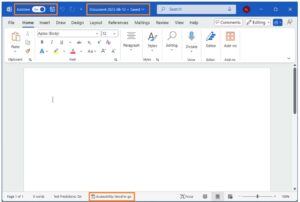
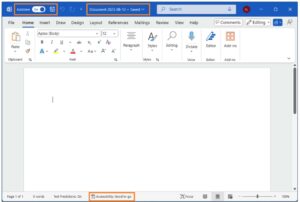
Primarily, users need to create a fresh document in Word and switch the AutoSave option on. Unlike the previous default document name- DocumentN, the autosave feature saves the files with the date.

Microsoft Word Update - Step 1

Source: Microsoft Tech Community

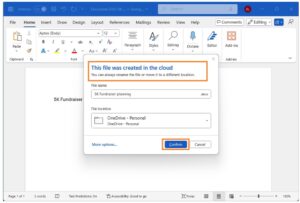
To change the name of the file and its location, users need to select Save or press Ctrl+S. After selecting the file name and location, press Confirm to save the changes.

Microsoft Word Update - Step 2

Source: Microsoft Tech Community

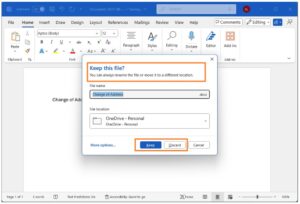
In case users try to close the file before it gets saved, a dialog displays on the screen asking whether they intend to Discard or Keep the file. If users try to close empty files, Word discards them without asking for confirmation.

Microsoft Word Update - Step 3

Source: Microsoft Tech Community

Availability of the Auto-Save Feature of Microsoft Word Update-

The AutoSave feature of Microsoft Word update is available to users with Version 2509 (Build 19221.20000) or newer. This advancement is set to enhance accessibility and address the challenge of lost files. Similar features have been introduced on Windows Excel and PowerPoint as well.

Advantages of the Latest Microsoft Word Update

Microsoft Word’s new auto-save feature will unlock several benefits for users. Alongside increased security, it offers flexible file management capabilities. Let us discuss other significant advantages-

Flexibility in File Storage and Control: Users can store and manage their files more flexibly than ever. As users are in charge of the documents, they can adjust file names and locations to save, organizing the files according to convenience.

Never Lose Your Files: The auto-save feature in Microsoft Word addresses the challenge of losing files due to not saving them manually. As soon as you start making progress in a file, it automatically gets saved.

Enhanced Security and Compliance: Files saved in your organization’s cloud servers already adhere to the set security guidelines and practices. Hence, users do not need to think about protecting the files separately.

Increased Accessibility: The auto-save feature enables enhanced accessibility of Word files. It can be accessed from diverse types of devices and platforms once shared, including Android, iOS, and web browsers. Changes made to the file will get synced on all devices and platforms.

Better Collaboration: The AutoSave feature has made collaboration within and across teams easier. Users can easily share the cloud file and initiate collaboration by making changes, adding comments, and resolving comments in real time.

Agentic AI Support: The Word files are now equipped with Copilot agentic AI support. Users can unlock AI-powered capabilities whenever they need to improve or update their documents. Nevertheless, to use Copilot in Word, a Microsoft 365 Copilot license is needed.

Additional Tips: 

  • Users will be able to easily change the location for new documents. Right-click on any cloud folder in the File section of Word, then select Set as Default Location to choose the location.
  • Users can manage how their files are created, whether in the traditional manner or automatically in the cloud, in the Save tab of Word Options, and opt in or opt out for Create new files in the cloud automatically.

Key Elements to Keep in Mind-

  • When a new Word session is started while another is running, the new file does not autosave. Hence, users need to close the previous file to enable the auto-save option for new files.
  • Users may sometimes encounter a delay in refreshing the recent files list while changing the name of a document.
  • If users disable the option for Show the Start screen when this application starts, remember that the first file they create will not autosave automatically.

Concluding Remarks!

Microsoft has been making significant advancements in its 365 Office platforms for better collaboration and enhanced productivity of diverse teams within an organization. With the integration of Copilot and flexible features, the firm is aiming to boost user experience and accessibility of the tools, including Word for Windows.

Learn about the major technological shifts and practices with KnowledgeNile!


FAQs:

1. What is the AutoSave feature in Microsoft Word?

Answer: The AutoSave feature in Microsoft Word lets users save their files automatically.

2. What is the purpose of AutoSave?

Answer: The AutoSave feature aims to reduce the challenges of data loss in unwanted circumstances, such as power shortages and device failures.

3. Where are AutoSave Word documents stored?

Answer: Automatically saved Word files are stored in cloud storage, like OneDrive.


Recommended For You:

Oracle identity cloud vs Microsoft Active Directory: Which to opt for and why?


Source link