Warrantless ICE raids challenged in new lawsuit


Six Minnesotans filed suit Thursday against U.S. Immigration and Customs Enforcement and the Department of Homeland Security after masked agents broke into their homes without judicial warrants in December and January during the Trump administration’s immigration enforcement effort.

The lead plaintiffs are Garrison Gibson and his wife, Teyana Brown. Gibson, a native of Liberia, was home with Brown and their school-age daughter and niece on Jan. 11 when ICE agents smashed their door with a battering ram.

Gibson, Brown and four other plaintiffs are asking a federal court in Washington, D.C., to block enforcement of a May 2025 memo in which Acting ICE Director Todd Lyons purports to give agents the authority to enter homes with only an administrative warrant from ICE, not a judicially approved warrant as the law has long required.

“Without any notice and comment or reasoned explanation, DHS has now abandoned its longstanding policy in favor of a new one that tramples the Fourth Amendment rights of individuals and families across the country, including noncitizens with immigration status and citizens of the United States,” attorneys with the Protect Democracy Project and ACLU of Minnesota argue in a civil complaint.

Federal agents detain a Black man
An East African man falls to the ground as Homeland Security Investigations officers detain him outside a home in south Minneapolis on Dec. 4, 2025.
Ben Hovland | MPR News

In 2009, immigration officials handed Gibson a removal order based on a minor marijuana conviction that has since been expunged. But the government has allowed Gibson, 39, to live and work in the United States as long as he checks in regularly with ICE, which he has done.

After U.S. District Judge Jeffrey Bryan ordered Gibson’s release from detention, Gibson and Brown recounted at a Jan. 17 news conference how the agents used a battering ram to smash open their door. Brown recorded video of the raid in which she can be heard repeatedly asking the agents to show her a warrant.

The paper that one of the agents produced did not include a judge’s signature. It was an administrative warrant signed by DHS Supervisory Detention and Deportation Officer Ariel Valdez. Administrative warrants only allow agents to arrest someone during an encounter in public. They do not permit entry into a person’s home without their consent.

In his memo, Lyons cites no case law or constitutional authority to enter private homes without judicial warrants, only legal guidance from the Department of Homeland Security’s general counsel.

The lawsuit references testimony from former ICE attorney and instructor Ryan Schwank, who told a Senate subcommittee on Feb. 23 that his supervisor showed him the memo “in secret” and ordered him not to discuss or take notes on it.

The plaintiffs allege that ICE leaders strictly controlled access to the memo because they recognized that it is “flagrantly unconstitutional.”

“Instruction on the Home Entry Memo itself was conducted under a veil of secrecy,” the plaintiffs’ attorneys write. “While trainees were instructed to follow the memo, none of the instructions were written down, nor was any record of what was taught maintained by the instructors.”

Immigration Enforcement Minnesota
A federal immigration officer looks through a window of a home Jan. 20 in Maplewood, Minn.
Yuki Iwamura | AP

The other plaintiffs in the lawsuit include Abdulkadir Sharif Abdi and his wife Rhoda Christenson. Abdi, a native of Somalia, was given an order of removal in 2001 but, like Gibson, immigration authorities allowed him to stay under an order of supervision that requires him to check in with ICE regularly.

Abdi was home on Dec. 1, 2025, when he answered a knock at his apartment door.

“Thinking the knock was from apartment maintenance personnel, Abdulkadir opened the door.” the lawsuit alleges. “When he saw the immigration agents, he quickly tried to close it. But before he could close the door, the agents rushed into his home.”

The agents did not have a judicial warrant, but arrested Abdi inside his home and shipped him to a county jail in Nebraska, where he was locked up for 18 days until a judge ordered that he be released. Abdi also alleges that while in federal detention, jailers denied him access to his nebulizer medication that he needs to help him breathe.

Jeyli Salguero and her father Alfredo Salguero are also suing ICE and DHS. According to the civil complaint, about 10 masked and heavily armed agents broke into their Oakdale, Minn., home without a judge’s approval on Jan. 14 in search of Jeyli’s older half-brother, who did not live there.

“Jeyli watched as her father stepped out of his bedroom into the kitchen where he was immediately confronted by masked men in military-style uniforms with assault rifles in their kitchen. The agents pointed their rifles at Alfredo and yelled at him to put his hands in the air.”

The agents arrested Alfredo Salguero, who has temporary protected status, and held him in detention for three weeks before an immigration judge ordered his release on bond. They also arrested Jeyli’s sister Astrid, who had been in the United States legally while pursuing an asylum application, and flew her to a detention facility in Texas.

“After enduring horrible conditions for several weeks and with the prospect of continuing to do so indefinitely, Astrid acquiesced to DHS’s efforts to remove her from the United States.”

MPR News requested comment on the lawsuit from ICE and DHS.


Source link

Leave a Reply

Subscribe to Our Newsletter

Get our latest articles delivered straight to your inbox. No spam, we promise.

Recent Reviews


Lost a crucial document because your system crashed before you could save it? Worry no more! Microsoft Word has introduced an automatic save option that regularly backs up your work, so you’ll never lose your progress again.

Users will now be able to manage their Word documents without thinking about saving them manually. The new Microsoft Word update allows users to automatically save their documents to the cloud as soon as they start documenting any content piece.

Raul Munoz, the Senior Product Manager at Microsoft, has stated about the new feature, “We are modernizing the way files are created and stored in Word for Windows! Now you don’t have to worry about saving your documents: Anything new you create will be saved automatically to OneDrive or your preferred cloud destination.

Microsoft additionally hints at introducing similar features for Windows Excel and PowerPoint, which are now live.

How Does the Auto-save Feature Work?

The auto-save option can be accessed and used effectively with the compatible Word for Windows version. Let’s understand how the process works-

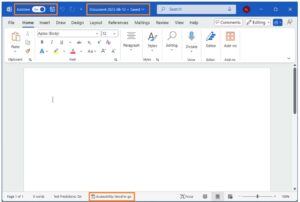
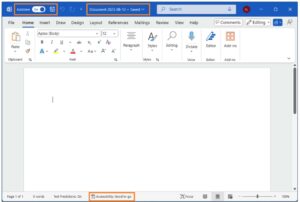
Primarily, users need to create a fresh document in Word and switch the AutoSave option on. Unlike the previous default document name- DocumentN, the autosave feature saves the files with the date.

Microsoft Word Update - Step 1

Source: Microsoft Tech Community

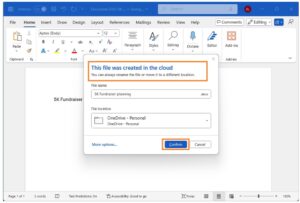
To change the name of the file and its location, users need to select Save or press Ctrl+S. After selecting the file name and location, press Confirm to save the changes.

Microsoft Word Update - Step 2

Source: Microsoft Tech Community

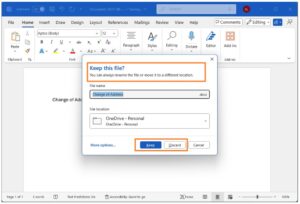
In case users try to close the file before it gets saved, a dialog displays on the screen asking whether they intend to Discard or Keep the file. If users try to close empty files, Word discards them without asking for confirmation.

Microsoft Word Update - Step 3

Source: Microsoft Tech Community

Availability of the Auto-Save Feature of Microsoft Word Update-

The AutoSave feature of Microsoft Word update is available to users with Version 2509 (Build 19221.20000) or newer. This advancement is set to enhance accessibility and address the challenge of lost files. Similar features have been introduced on Windows Excel and PowerPoint as well.

Advantages of the Latest Microsoft Word Update

Microsoft Word’s new auto-save feature will unlock several benefits for users. Alongside increased security, it offers flexible file management capabilities. Let us discuss other significant advantages-

Flexibility in File Storage and Control: Users can store and manage their files more flexibly than ever. As users are in charge of the documents, they can adjust file names and locations to save, organizing the files according to convenience.

Never Lose Your Files: The auto-save feature in Microsoft Word addresses the challenge of losing files due to not saving them manually. As soon as you start making progress in a file, it automatically gets saved.

Enhanced Security and Compliance: Files saved in your organization’s cloud servers already adhere to the set security guidelines and practices. Hence, users do not need to think about protecting the files separately.

Increased Accessibility: The auto-save feature enables enhanced accessibility of Word files. It can be accessed from diverse types of devices and platforms once shared, including Android, iOS, and web browsers. Changes made to the file will get synced on all devices and platforms.

Better Collaboration: The AutoSave feature has made collaboration within and across teams easier. Users can easily share the cloud file and initiate collaboration by making changes, adding comments, and resolving comments in real time.

Agentic AI Support: The Word files are now equipped with Copilot agentic AI support. Users can unlock AI-powered capabilities whenever they need to improve or update their documents. Nevertheless, to use Copilot in Word, a Microsoft 365 Copilot license is needed.

Additional Tips: 

  • Users will be able to easily change the location for new documents. Right-click on any cloud folder in the File section of Word, then select Set as Default Location to choose the location.
  • Users can manage how their files are created, whether in the traditional manner or automatically in the cloud, in the Save tab of Word Options, and opt in or opt out for Create new files in the cloud automatically.

Key Elements to Keep in Mind-

  • When a new Word session is started while another is running, the new file does not autosave. Hence, users need to close the previous file to enable the auto-save option for new files.
  • Users may sometimes encounter a delay in refreshing the recent files list while changing the name of a document.
  • If users disable the option for Show the Start screen when this application starts, remember that the first file they create will not autosave automatically.

Concluding Remarks!

Microsoft has been making significant advancements in its 365 Office platforms for better collaboration and enhanced productivity of diverse teams within an organization. With the integration of Copilot and flexible features, the firm is aiming to boost user experience and accessibility of the tools, including Word for Windows.

Learn about the major technological shifts and practices with KnowledgeNile!


FAQs:

1. What is the AutoSave feature in Microsoft Word?

Answer: The AutoSave feature in Microsoft Word lets users save their files automatically.

2. What is the purpose of AutoSave?

Answer: The AutoSave feature aims to reduce the challenges of data loss in unwanted circumstances, such as power shortages and device failures.

3. Where are AutoSave Word documents stored?

Answer: Automatically saved Word files are stored in cloud storage, like OneDrive.


Recommended For You:

Oracle identity cloud vs Microsoft Active Directory: Which to opt for and why?


Source link