Do you often spend time reading the article and then again need to spot a particular section that’s noteworthy? But well, that of course takes a lot of time, again to go through the entire content! But fortunately, there’s a great update for all the SEOs, publishers, and marketers.

The recent update is around “Read More” deep links in search results that are totally worth paying attention to! Google has updated it’s snippet documentation with a new section that appears in SERP snippets, allowing users to jump directly to the section that answers their query.

This isn’t a big update in Google Search; however, it matters as it changes the way people scroll through the page, how Google prioritizes section-level content emphasizes user experience, and allows users to meet their intent quickly. Keep reading the blog to understand more about the Read More deep links, its importance, the three best practices Google mentioned, and more.

What are Google “Read More” Deep Links?

According to Google, the feature is a link within a snippet that leads users to a particular section of that page. When the user clicks it, it takes them to the relevant section instead of forcing them to scroll to the top. One important point is that the Read More deep link improves user satisfaction. Let’s understand this with an example:

If you are reading a lengthy article with 10 sections, like:

  • What Is Google Search Console
  • Key Benefits
  • Limitations
  • Best Practices
  • & More

Google mentions a Read More link that lets users go directly to the Key Benefits without having to scroll to the top of the page. Going right to the section saves time and hassle. Alongside, it makes long-form content more valuable and improves the search experience.

A Read More Deep Link rewards pages that are:

  • Easy to navigate
  • Have a clear structure
  • Meets the user intent
  • Sectioned by topic

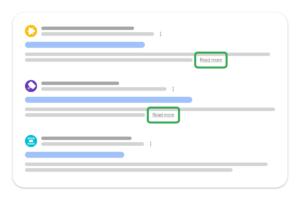
Here is how the Read More deep link appears:
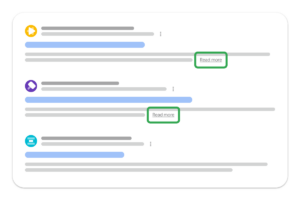
read-more-deep-link
Image Source: developers.google.com/search/docs/appearance/snippet

Google’s 3 Best Practices for “Read More” Deep Links

Google has mentioned the best three practices to increase the likelihood of appearing in the Read More links. The following are:

1. The content should be immediately visible to users and must not be hidden behind expandable sections, tabbed interfaces, or accordions, as this decreases the chances of appearing in Read More deep links.

2. Do not use JavaScript to control the user’s scrolling position at the top of the page. One example is that Google forces users to scroll to the top of the page.

For example, scripts that automatically call window.scrollTo 0, 0), or similar functions, it can break the Read More deep links. These scripts are added to the site intentionally.

However, when a user clicks on a specific section in Google Search, it takes them directly to the heading or content without taking them to the top of the page.

3. If your website pages use the History API or the updates window. location.hash when the pages load, make sure the URL’s hash fragment is preserved. Removing the same can prevent deep links from taking users to the main/intended section of the page.

Why Did Google Publish Best Practices?

Google has come up with best practices to let users know that search is moving beyond pointing to a complete page. Apart from checking whether the page is right for a particular keyword, Google wants users to land on the right section that answers their query, using Read More deep links.

This helps search results to be more helpful, efficient, and ideal for long-form content. Alongside, reduces friction and boosts user satisfaction, ultimately increasing visibility in search results. The new best practices act as a quality control process to ensure that the part of the page that meets user intent is accessible, visible, and stable upon arrival.

How to Keep Your Pages on Top of “Read More” Link Visibility?

To boost your chance of appearing in the Read More deep link search, make sure to optimize your content in the best possible way. The following are some of the points you can take into consideration:

1] Follow the proper anchor ability: It is necessary to add unique, proper IDs to important sections. They need to be consistent and readable.

Take the example given below.

<h2best-practices" > <Best Practices for Read More Deep Links</h2>

2] Follow the Right Heading Structure: Make sure to focus on the heading. Do not write common headings such as “Overview,” “Introduction,” “Key Details,” or “Important Insights.” Use descriptive headings and properly structure your content with H2 and H3.

Here are a few examples mentioned

  • How Does the Google Algorithm Work
  • Why Should Users Stay Updated with the Algorithm Changes?
  • Frequently Asked Questions

3] Test Fragment URLs: Open your URLs with a hash fragment and double-check that the page lands directly on the intended section.

4] Keep the Content Open: Do not hide the content. Make sure that when the user clicks the answer or section, the content is immediately visible, rather than prompting them to open it.

What Content Types are Most Likely to Benefit from “Read More” Feature?

The feature is not well suited for all types of content. However, here are some of the examples that benefit most are:

  • documentation pages
  • Comparison pages
  • Resource pages
  • Long-form articles
  • Publisher articles
  • FAQ informational content

What does this Update Mean for Your SEO Strategy?

The new guideline is important for SEOs, marketers, and website professionals, as it outlines everything that can increase the likelihood that a Read More deep link will appear. It rewards pages that are properly structured, meet user intent, and, most importantly, serve as a reminder that search engines reward answer architecture, not just keyword targeting.

  • Higher CTR: Searchers click on the link when they see content that meets their intent.
  • Boost in Engagement: Users spend more time reading the relevant sections.
  • Improved Visibility: Search listing with additional links delivers better results and stands out in the Search.
  • User Satisfaction: Users are satisfied when they land exactly where they need to be, improving the user experience.

Some of the Common Mistakes that Can Harm Your Deep Link Eligibility

Website teams should first check whether the section links on their pages work well on both the website and mobile. Alongside,

  • Hiding content behind the tabs
  • Removing URL fragments
  • Forcing scroll to the top
  • Pages with tabbed layout
  • Weak heading language makes it challenging for users to understand the topic.

Final Takeaway: Structure Is the New SEO!

Google’s Read More deep link practices provide valuable insights into how to develop and structure content for the changing search experience. The main aim is to create content that is easy to understand, access, properly organized, and technically compatible with anchor links.

This isn’t an update; however, it’s a way to show you how you can increase the likelihood of the “Read More” link appearing in the results and boost your search performance. The new guidelines with the three best practices mentioned are surely a win on your side if implemented correctly.

To read more such informative blog posts, visit our website now!


FAQs

1. What is deep link used for?
Answer: A deep link is a specific hyperlink that allows users to navigate to a particular section of a website or page.

2. What are the 4 types of links?
Answer: Internal links, external links, email links, and image links, are commonly used in HTML.

3. Does Google add Read more links automatically?
Answer: No, Google first generates Read More deep links on the basis of the page structure, content visibility, and structure. Publishers cannot add them directly but can work on optimization to increase the chances of being visible in the search.

4. Do Read More deep links impact SEO rankings?
Answer: Even though the links do not impact the rankings directly, it helps to improve engagement, CTR, and visibility in the search results, which in turn helps to boost overall SEO performance.


Also Read:

Top 5 WordPress SEO Plugins to Enhance Your Website’s Ranking

Search Everywhere Optimization (SEvO): SEO’s New Era Beyond Google


Source link

Leave a Reply

Subscribe to Our Newsletter

Get our latest articles delivered straight to your inbox. No spam, we promise.

Recent Reviews


What is Kotlin?

Kotlin is an object-oriented, statistically typed computer programming language and is open-sourced. Kotlin runs on Java Virtual Machine and is capable of working across a number of platforms. We define a language as statistically typed if its variable type doesn’t get to know at run time but is defined at compile time. This language is compatible with working with Java. It comprises a lot of functional features for programming as well. 

Kotlin was designed by JetBrains. The very first version of Kotlin got released on 15th Feb 2016. The main use of Kotlin is at the server-side for development. In addition to this, it also works for Client-side development as well as Android development. 

Let us see a basic program in kotlin language:

fun main() { 

  println("Welcome to python vs kotlin tutorial") 

}

The output of the python program:

                             Welcome to python v/s kotlin tutorial

What is Python?

Python is a computer programming language that was designed by Guido van Rossum. The release date of python is 1991 and is majorly used in web development, scripting systems, mathematics, and the development of software. The programmers use python language along with the software which creates workflows. We also use python for handling work-related big data and for performing complex mathematical problems. Along with this, Python comes into use for the fast prototyping and development of software.

Python works as both procedural and object-oriented language for users. It is free as well as open-source and works well with various operating systems like Mac, MS, Linux, etc. Python is always chosen because of its feature of readability as it has a lot of similarities with English with a hint of maths.

Let us see a basic program in Python language:

print("Welcome to python v/s kotlin tutorial")

The output of the python program:

                                            Welcome to python v/s kotlin tutorial

Become a Python Certified professional by learning this HKR Python Training!

Python Training Certification

  • Master Your Craft
  • Lifetime LMS & Faculty Access
  • 24/7 online expert support
  • Real-world & Project Based Learning

Comparison between Kotlin and Python

Though both these languages are great to work with, however, let us see a few points below to understand the major differences between them.

  • Description: Kotlin is known to be an object-oriented, statically typed language which means its variable type doesn’t get known at run time but is defined at compile time. However, Python is an object-oriented high-level language.
  • Development principles: The development principles for kotlin are based on behaviour-driven principles such as S.O.L.I.D however for python the development principle is based on python-zen.
  • Template language: Kotlin is dependent on HTML 5 as its template language whereas python is comfortable working with chameleon, Django Template System, and Jinja Adobe Flash Support.
  • Influences: Kotlin is influenced by Java, Godu, Scala, Pascal, C#, etc whereas python is influenced by C, Java, Pearl C#, etc.
  • Programming Paradigm: Kotlin is an object-oriented language that is functional and works with imperative programming, metaprogramming, and reactive programming. Whereas python in an object-oriented language that is functional and can only work with imperative programming. 
  • Compiler: Python doesn’t have its own compiler whereas Kotlin has. Moreover, it supports a number of other compilers as well such as eclipse, android studio, etc.

Potential reasons for using Kotlin

  • Easy code design: It is possible for the programmer to write easy code in Kotlin to accomplish the desired output. It allows the user to write the least code possible which improves the app performance.
  • Adaptability: it is very easy for the user to shift his tasks from an android app to kotlin. 
  • Functionality: Kotlin allows its users to execute the tasks efficiently in a very easy and quick manner.
  • Error and security: This language is not much prone to errors as it tends to eliminate a lot of errors related to coding itself. It also eliminates the chances of code reducibility when the user writes small code.
  • Multi-platform capacity: Kotlin supports a lot of platforms such as the android app platform, Java, Gradle, etc.
  • Full Java compatibility: Kotlin allows its users to use all the Java libraries and its framework while coding in the Kotlin language.

Potential reasons for using Python

  • Third-party modularity: There is a presence of third-party packages in python where the modules promote the communication within a few languages as well as platforms.
  • Extensive libraries: Python language consists of internet protocols, operations related to strings, interfaces in operating systems as well as web services present inside a standard library. A lot of tasks that are executed are already there in the library which is scripted hence reducing the unnecessary writing work in the programs.
  • Open source: Python is an open-source language and provides an OSI-approved licence for easy commercial use. 
  • User-friendly: Python is a user-friendly language that allows its users to design the data structures within the language quickly during the runtime process.
  • Speed: Due to its object-oriented design, python has tremendous testing capabilities in its own framework which contributes to improved productivity as well as better speed.

Features of Kotlin

Null Safety: As a developer, while developing an android app, it is a familiar fact that approximately 70% of the apps crash because of Java null pointer exception. Java is not able to provide any methods to protect this. A programmer has to take care of this on his own. However, Kotlin is known to handle nulls very nicely. There is no chance of getting a null pointer exception in Kotlin implicitly. It is because this language never allows a type variable with a null value during the compile time. 

Extinction Function: Kotlin has introduced and combined many new features such as Lambda functions, operator overloading, smart casts, etc. as it is known to be a fourth-generation language.  All functions help in increasing productivity. Kotlin has emerged as a combination of 6 other languages having the best features of all of them.

Efficiency: In most cases, the efficiency of kotlin code is very similar to the efficiency of java code. In fact, it might exceed as well depending on the type of development application.

Acquire Deep Learning with Python certification by enrolling in the HKR Deep Learning with Python Training program in Hyderabad!

Big Data Analytics, python-v-s-kotlin-description-0, Big Data Analytics, python-v-s-kotlin-description-1

Subscribe to our YouTube channel to get new updates..!

Features of Python

Advanced Language: Python is an advanced language having data structures, lambda functions, list slicing, and a lot more. It has a lot of advanced features making it a dynamic language.

Python transportable language: It is very easy to write a python code and run it anywhere. A user doesn’t need to re-write the code like other languages if he has to run it on a different platform.

Python Integrated Language: Python is an interpreted language hence it will execute the code line by line. A user does not need to compile python code every single time which makes the error debugging in python very easy and quick.

Free and open-source: It is free for its developers and provides an open-source platform.

Advantages of Kotlin

  • This language allows its users to write less code as compared to other languages.
  • IT solves major challenges faced by programmers.
  • There is no overtime issue while compilation is kotlin.
  • It supports multi development environment along with safety and security
  • It is very compatible with the java language.

Disadvantages of Kotlin

  • Kotlin has minimum opportunities for learning. Even when a lot of programmers are switching to kotlin for their development work, it has a limited set of tools to provide to its users. 
  • The compile-time speed for kotlin is not great. Kotlin is no doubt faster than java when it comes to the development part, but java still provides better building.
  • There are very few programmers who are working and developing with kotlin. Hence, when we talk about recruitment opportunities in kotlin, they are very less as compared to other languages.

Advantages of Python

  • As we say kotlin is statistically typed, while Python is dynamically typed which is a major advantage for this language.
  • Python is considered to be one of the highest level languages which are very easy to learn, write and read.
  • Python follows interpretation which means python executes its code line by line.
  • It is free for its developers and provides an open-source platform.
  • Python provides an amazing opportunity to its developers where a code written runs can be executed anywhere. Like C, C# a user does not need to change the code again and again.

Disadvantages of Python

  • As we discussed that python is an interpreted language hence it will execute the code line by line. But this whole process reduces the execution speed of the python program.
  • Each python program when stored consumes a large amount of memory in the storage. This becomes a major drawback while developing large-scale applications in python.
  • As we have discussed earlier also that python is a dynamically typed language, which means the variables can get changed anytime. This can cause a lot of run-time errors during the development phase in python. 

Is kotlin better than python?

If a user is well versed with a language like a python which has all the abilities, then no wonder why a programmer would need kotlin. Python is one of the most loved languages by the users and is great to work with for the developers. However, there are some cases where python fails to satisfy the desired output.

Python is an efficient as well as a dynamic language however it is of no harm to learn a language that is statistically typed. Where there is a demand for large-scale projects, Kotlin is the one language that provides the right platform with no disadvantages. The disadvantage could be verbose syntax. Kotlin language gives the user the ability to perform better while coding. Where python is not appropriate to write small programs, kotlin satisfies this need for its end users efficiently and also provides an adequate solution.

When we compare Kotlin and Python, Kotlin definitely is more loved by the programmer. It consists of all the small factors which are indefinitely not covered by Python. Hence, we can conclude by saying that Python is a great language, but Kotlin covers the additional base factors which are missed in Python for programming. Hence, kotlin helps in targeting more solutions according to the desirability.

    Top 30 frequently asked Python Interview Questions!

Python Training Certification

Weekday / Weekend Batches

Conclusion

If a user is comfortable programming in python and he still wants to learn a language that is in high demand in the market these days, then kotlin is not just great but the best contender in that field. In this article, we have discussed both Python as well as kotlin, where python is more of an object-oriented language whereas kotlin is more of a statically typed language. You will also understand the potential of both these languages along with the advantages, disadvantages, and features.

Related Articles:

1. Alteryx VS Python

2. Kotlin tutorial


Source link