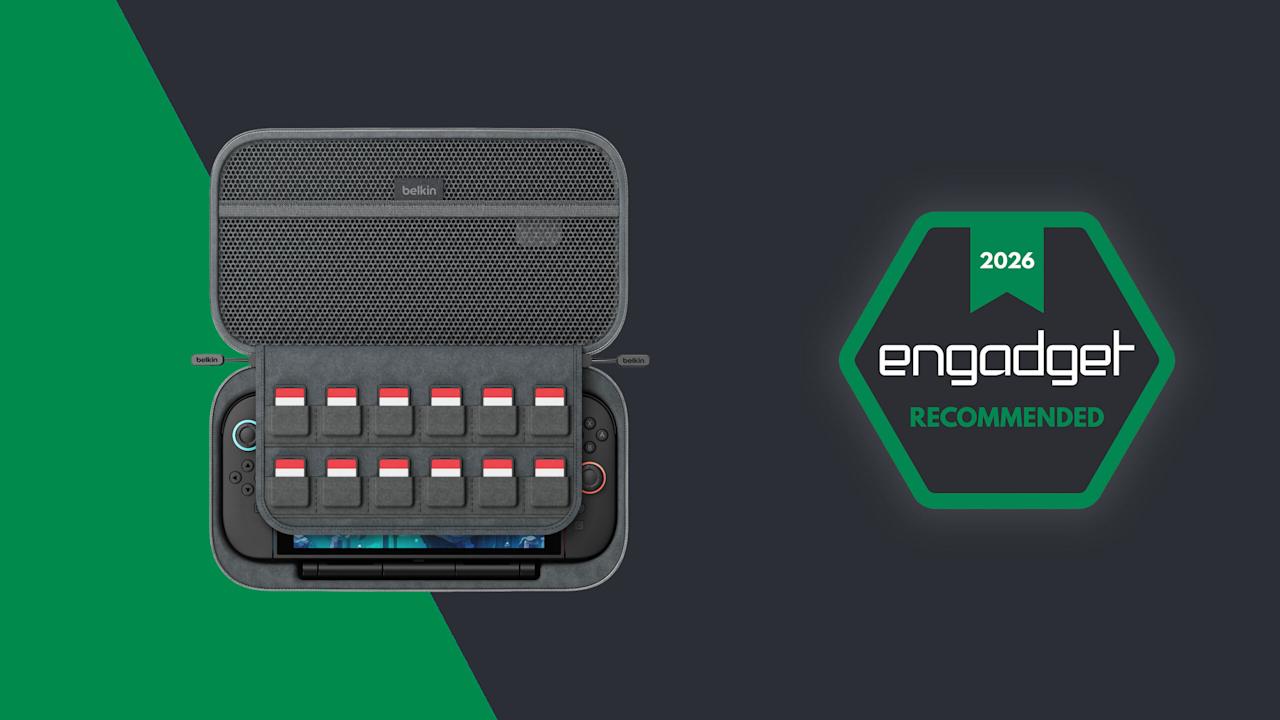
Belkin Charging Case Pro for Switch 2 review: A more elegant solution


Last year, Belkin released a couple of cases for the Nintendo Switch 2 just in time for launch, including one that came with a handy battery pack. That one was simple and effective, but it felt a bit crude because it wasn’t much more than a basic travel pouch with a generic power cell tossed inside. Now, Belkin is back with a Pro version of its Charging Case for the Nintendo Switch 2, featuring a more sophisticated battery pack along with a higher price tag ($100 vs. $70). So here’s the question for any Switch 2 owners still looking for a way to protect their console while keeping it topped off: Is a more elegant charging solution really worth the extra money?

Image for the large product module

Belkin / Engadget

The pro version of Belkin’s Switch 2 charging case is a more sophisticated and versatile power solution. But it’s also more expensive, so unless you’re comfortable shelling out an extra $30 for the same basic features, you’re probably better off sticking with the non-pro option.

Pros

  • Included 10,000mAh battery pack
  • Battery pack also doubles as a stand
  • Built-in game storage
  • Solid construction
  • Hidden AirTag pouch
Cons

  • Costs more than the non-Pro version
  • A touch bigger and heavier too
  • No included USB-C cable

Case design

At 11.7 x 6.1 x 2.5 inches and weighing 1 pound 12 ounces, the Pro Charging Case is a touch larger and heavier than its non-pro sibling. It also features a very similar design with the same color options and materials, including a tough polyester outer shell that’s balanced by a softer, velvet-like material and cutouts for your Switch 2 on the inside.

The Pro Charging Case (bottom) is a touch bigger and heavier than the previous model, but aside from that its sports a nearly identical design.

The Pro Charging Case (bottom) is a touch bigger and heavier than the previous model, but aside from that its sports a nearly identical design. (Sam Rutherford for Engadget)

Once again, Belkin has done a good job of providing a snug cabin to store your console while still making it easy to take it in and out. That said, if your system also has an extra-thick protector or hardshell case like the Killswitch from Dbrand, it may not fit. There’s also a padded flap that swings down to protect your Switch 2’s screen that also pulls double duty as a place to stash up to 12 game cartridges, which is a very thoughtful touch.

However, the biggest change to the Pro Charging Case’s exterior design is a new cutout on the front edge, which allows you to top off other gadgets (or a Switch) by plugging a USB-C cable into Belkin’s included battery pack. Unfortunately, the case doesn’t come with a cord, which seems a bit odd until you take a closer look at the power pack’s layout. That’s because once you open up the case, you’ll see a second port designed to fit right into the bottom power jack on the Switch 2 without the need for a cable.

The inside of the Pro Charging Case features a handy mesh pocket, 12 slots for game carts and a hidden AirTag pouch.

The inside of the Pro Charging Case features a handy mesh pocket, 12 slots for game carts and a hidden AirTag pouch. (Sam Rutherford for Engadget)

Other small touches on Belkin’s Pro Charging Case include a mesh pocket for storing things like cables, Joy-Con straps or cleaning cloths, which is very handy. However, my favorite thing might be the AirTag pouch that’s also hidden inside that pocket, which could give you a fighting chance of recovering your system if it’s ever lost or stolen (though I wouldn’t count on it).

Battery pack

The arrangement of the included 10,000mAh battery pack and the placement of its internal USB-C port makes it a cinch to recharge your Switch 2 every time you put it in the case.

The arrangement of the included 10,000mAh battery pack and the placement of its internal USB-C port makes it a cinch to recharge your Switch 2 every time you put it in the case. (Sam Rutherford for Engadget)

Despite the increased size of the Pro Charging Case’s included battery, it has the same 10,000mAh capacity as what you get from its less expensive sibling. That means you’ll typically have enough juice for a little more than 1.5 recharges for your Switch 2 and its onboard 5,220mAh cell. Instead of relying on a simple external power pack like before, Belkin’s bundled battery comes with a second USB-C port and a kickstand. This makes it super easy to plug in your Switch 2 every time you put it in the case. This way, you know the next time you turn it on, it’ll be at 100 percent.

Here's what the battery pack looks like when you take it out of the case. As you can see, its size and shape means it's not a great standalone external power pack any more.

Here’s what the battery pack looks like when you take it out of the case. As you can see, its size and shape means it’s not a great standalone external power pack any more. (Sam Rutherford for Engadget)

Alternatively, you can raise the kickstand to prop up the Switch 2 and game on it while it stays nestled inside the case. This might seem a bit redundant as Nintendo’s console already has its own kickstand, but Belkin’s allows you to continue charging the system while you’re playing without needing a cord. There’s even a handy display on the side of the battery, so it’s super easy to see how much juice is left, even when the case is closed. Furthermore, when you need to recharge the power pack, you can do so without removing it from the case or disconnecting your Switch thanks to that bonus USB-C port on the outside. Compared to the previous model, this is certainly a more elegant solution that provides some subtle quality of life improvements. The one downside is that the battery pack is somewhat awkwardly shaped, so you won’t really want to use it on its own.

Wrap-up

There’s no doubt the Pro Charging Case’s new battery pack is a more premium solution that’s easier to use and manage. When you need to recharge it, you can do so from the outside without opening the pouch. It also lets you charge a Switch 2 without ever needing a cable. The built-in kickstand is another bonus that helps elevate the whole kit from a simple case to something closer to a tiny all-in-one gaming booth.

One of the neat things about giving the battery a kickstand is that it turns the case into a mini all-in-one. This makes me wish Belkin gave the included power pack some sort of docking functionality for connecting the Switch 2 to an external display.

One of the neat things about giving the battery a kickstand is that it turns the case into a mini all-in-one. This makes me wish Belkin gave the included power pack some sort of docking functionality for connecting the Switch 2 to an external display. (Sam Rutherford for Engadget)

That said, after using it for a couple of weeks, I’m still not sure the added convenience is worth an extra $30 over the original. Due to the battery packs’ new shape, it’s less useful as a standalone power cell, and the rest of the case’s design is largely unchanged. Of course, it’s always nice to have options, and if you’re the kind of person who doesn’t mind spending a little extra for a more streamlined and convenient kit, Belkin’s Pro Charging Case for the Switch 2 is still very much worth consideration.


Source link

Leave a Reply

Subscribe to Our Newsletter

Get our latest articles delivered straight to your inbox. No spam, we promise.

Recent Reviews


Last updated on
Jan 19, 2024

Cyber Security VS Software Engineering – Table of Content

What is Cyber Security?

The cyber security industry is a fascinating field in the IT sector and apt for those who are ready to accept the challenges. The term cyber security can be defined as it is a type of IT application that designs and implements secure network solutions specially designed to act as a shield against hackers, persistence attacks, and any cyber-attacks.

Cyber security engineers are those who involve in designing and implementing security solutions to defend against various threats, cyber-attacks, and malware attacks. They are also involved in testing and monitoring the system devices to make us assure that all the system devices are up-to-date and ready to defend against any type of attack.

Wish to make a career in the world of Cyber Security? Start with Cyber Security Training!

What is Software Engineering?

Software engineering is also known as a Software architect or programming engineer, which involves analyzing the specific needs and creating the tools that are required to build software-related applications as per your or your client’s requirement.  The software engineer should have knowledge of software design, computer programming skills, such as python, Java, JS, Ruby, and other operating system knowledge like UNIX, and LINUX.  

Software developers are those who create software applications from already existing software applications whereas Software engineers are those who create the frameworks on the new software product which you are going to build.

Cyber Security Training

  • Master Your Craft
  • Lifetime LMS & Faculty Access
  • 24/7 online expert support
  • Real-world & Project Based Learning

Cyber security VS Software Engineering:

In this section, we explain the major differences between cyber security and software engineer as per a few categories. Let’s start;

1. Cyber security VS software engineering: Roles and responsibilities

 First, start with knowing the roles and responsibilities of aby cyber security engineer:

  •   Cyber security engineers or we can call them cyber security analysts they involve in implementing and creating plans, security portals to protect the computer network integrity, mobile devices from any kind of malware attacks or ransom attacks.
  • They are responsible for creating software and updating the computer hardware devices to implement security-related plans.
  • The information security analyst must involve in the constant monitoring of the networking devices to have a security breach.
  • They must involve in creating security incident responses to help minimize the damage caused by any type of malware attack.
  • Experienced cyber security professionals involved in communicating the plans or protocols to work enough to detect the intruders.
Software engineering roles and responsibilities:
  • Software engineers are responsible for building, maintaining, evaluating, and testing the new software.
  • They should have a deep understanding of information systems,  information technology, and programming. 
  • Sometimes they involve in developing the applications and should have a piece of knowledge in mathematics, and algorithms.

2. Cyber security and software engineering skills and qualifications:

Cyber Security Skills and qualifications:

  • Candidates must hold a bachelor’s degree in computer science, and IT system engineering.
  • They should possess a minimum of two years of work experience in cybersecurity-related roles such as incident detection, responses, and forensics. 
  • Should have experience with the functionalities, operations, and maintenance of firewalls and various forms of endpoint system device security.
  • Must have proficiency in languages and tools such as C++, Java, Node, Python, Go, Power shells, and Go.
  • They should have the ability to work in fast-paced work environments, often under some work pressure.
  • Posses the right eye for details and must have outstanding problem-solving skills.
  • Must have a piece of up-to-date knowledge of cyber security industries, trends, and hacker tactics.
Software engineers skills and qualifications:
  • Strong knowledge in engineering, computer science, and mathematics.
  • Should have strong experience in software development.
  • Should have proven programming experience (various programming language skills).
  • Experience in using different kinds of tools and techniques the software development.
  • Creative and adaptive at problem-solving.
  • Deep knowledge of concepts and algorithms.
  • Strong coding knowledge is a plus.

3. Cyber security and software engineers salary:

Cyber security engineer salary:

According to ziprecruiters.com, an average salary for any cyber security engineer earns $49, 750 and a software security architect earns $135,800.

Software engineer salary:

According to indeed.com, an average salary for any software engineer earns $50, 000 and an experienced software architect earns $111, 430.

If you have any doubts on Cyber Security, then get them clarified from Industry experts on our Cyber Security Tutorial !

HKR Trainings Logo

Subscribe to our YouTube channel to get new updates..!

4. Cyber security and software engineers: career path

Cyber Security Career path

In the cyber security field, you will get to see various kinds of specializations. Let us know them;

  • Cyber security analyst: should have a piece of strong knowledge of analytical and thinking. They must be creative problem solvers.
  • Cyber security engineers: they should have experience in different operating systems and strong experience in various database platforms.
  • Cyber security managers or administrators: should have a strong experience with firewalls, and a basic understanding of proxy servers, packet shapers, and load balancers.\
  • Cyber security consultants: must have an in-depth knowledge of IT security measures and protocols, and methods to detect intruders. Must have experience in finding and repairing the damages. 
  • Information security Analyst: Experience in providing IT support, and have an organized or in-depth knowledge of intrusion detection systems. Effective problem solver, organized, and detail-oriented.
Software engineer career path:

Below are the few niches where you can get specialized;

  • System engineers: should have a basic understanding of principles and techniques. They must be able to use databases and MYSQL.
  • Full-stack engineer: must have a strong coding knowledge, able to manage both front-end and back-end development tasks. Understanding of system protocols and techniques. 
  • Software engineers: a deep understanding of the developments, coding, building, and deploying applications. Should be proficient with various and multiple coding knowledge. Must have hands-on experience in software-oriented architecture. Able to work independently and must involve in team building. 
  • IT security specialists: must have an in-depth knowledge of IT security tools, anti-virus software management, content filtering, and firewalls. Should have experience with coding, and be able to identify any malicious attacks.
  • Cloud engineers: able to create roadmaps that take you into the storage capacity, and should be a problem solver. Should be able to communicate with all the levels of employees.
  • Take your career to next level in Cyber Security. Enroll now to get Cyber Security Training In London!

5. Cyber security and software engineers: Certification lists

Cyber security engineer certification lists:

Below is the list of major cyber security engineer certifications:

  • COBIT 5 control objectives for information and related technologies.
  • COBIT 5 Professional certification.
  • CompTIA security+certification -SYO-601.
  • CISA certification and training
  • CND – certified network defender
  • CHFI – Computer hacking forensic investigator certification
    CISSP certification
Software engineer certification lists:

Below is the list of major software engineer certification lists:

  • Certified secure software lifecycle professionals.
  • Certified software development professionals
  • Certified software engineer
  • CIW web development professionals
  • C programmer certification
  • C++ certified associate
  • MYSQL Oracle certification
  • Microsoft fundamental certifications 
  • aws associate certification
  • Salesforce fundamental certifications

Which career is best for you?

Here we are going to list out a few reasons to choose the best career;

You should consider cyber security if;

  • You intend to get a 4-years of degree
  • You can handle anxiety or work pressure
  • You can communicate verbally and orally.
  • You enjoy solving puzzles
  • You can multi-task 

You should consider software engineer if;

  • You like to learn things hands-on (real-time).
  • You have a genuine interest in programs or coding
  • You are a self-learner 
  • You are a good team handler 
  • You are unique, creative, and innovative.

frequently asked Cyber security Interview questions and Answers !!

Cyber Security Training

Weekday / Weekend Batches

Final words:

It is very difficult to say which one is the best without determining the parameters for that. If you are someone who has a desire to get a college degree, then we must say the cyber security profession is the easy choice for you. Suppose if you are more interested in self-learning, then cyber security would be a difficult field for you. If you are someone who has a desire to learn to code, then you can choose the software engineering field. But both careers require mathematical knowledge, and how the algorithm works. So our advice is to choose the right profession based on your priority, and educational background. We must say it’s a wise decision to take! In this Cybersecurity VS software engineer post, we have mentioned important differentiations based on a few parameters. Hope you found this information helpful.

Related Articles:

  1. 1.Cyber Security VS Data Science
  2. 2.Cyber security Technologies
  3. Quickbooks Interview Questions


Source link