Minnesota is home to only inland shrimp hatchery. Its future is now uncertain


NINA MOINI: The country’s only inland shrimp hatchery, which happens to be in Minnesota, is asking for help to stay afloat. Minnesota Shrimp got its start five years ago and they had just started to see profitability when they ran into two big setbacks: the bankruptcy of a major customer and a faulty order of shrimp. It put them on the brink of closure just as things were getting going.

Barbara Frank and Paul Damhof are the owners of Minnesota Shrimp. They’re both here to talk more about the situation and shrimp farming. Thanks so much for your time today. Barb, just to set the background for folks, can you describe what an inland hatchery is and then what you do? It sounds like you’re raising baby shrimps and then you’re selling them to others?

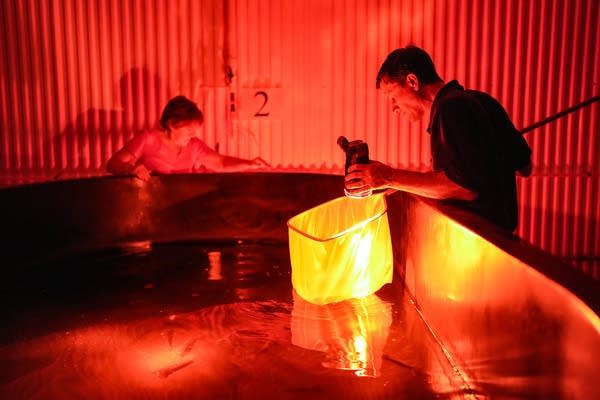
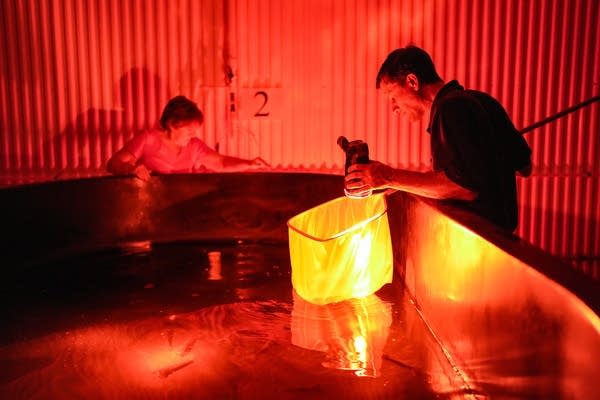
BARBARA FRANK: Yes, that is correct. What inland is different from what the other hatcheries have been in the United States is they’re on the coast and they’re using seawater as the base. So the whole thing runs a little different because we have no access to seawater and we can control diseases much better. We start with well water and clean it and clean it and clean it, and turn it into salt water and reuse on manufactured seawater. So that’s the big difference between the typical hatchery and the inland hatchery.

NINA MOINI: It’s so cool to learn about this. I did not know much about this. To who or to where do you sell your shrimp?

BARBARA FRANK: So prior to COVID, there was 865 shrimp-growing operations in the United States. It was a particularly hard-hit industry in COVID. And by a year and a half ago, there was only 85 left in the United States. The number is even lower now.

But where it works really well right now is existing farms that have a building that they could turn into a growing operation. So right now, our customers, other than the one that you mentioned that had gone out of business, which was not a farm, it was a bigger operation, we have five farmers in Iowa who have put in growing operations on their farm. We have one in Wisconsin. There’s one in– there’s a couple in Minnesota that are very small, and one in Montana. And they’re all people who have set this up as a business, some that sell directly to the consumer. So you could go buy fresh shrimp like you do when you’re on vacation in any places where these are. But some of the Iowa ones also have a business plan that they’re selling wholesale to grocery chains.

NINA MOINI: OK. So there’s this GoFundMe that’s been started to help raise money to keep Minnesota Shrimp going. Paul, can you tell us more about what led to the situation that you are facing?

PAUL DAMHOF: Well, it all started that led to this situation– we get broodstock in roughly or approximately every four months. We get broodstock coming in and Barb and I, it takes us up four to six weeks to get them primed up, to get them conditioned to breeding age. And the batch that we had got in, we had some tough shipping. But again, Barb and I, it takes four to six weeks to find out, or it took us four to six weeks to realize that we had a problem in shipping.

We got on the phone immediately to get another batch of broodstock coming in. But again, now it’s going to take us another six weeks to get these conditioned, to get them primed up before we get babies. And then once they do start mating, it roughly takes another 21 days before they’re up to a saleable size and off to other farmers. So it’s something that just takes time. When you’ve had a challenge or had a mistake, it’s something that can’t be fixed immediately. It just takes time to work through.

NINA MOINI: And Barb, how did you and Paul meet and decide to go into this business?

BARBARA FRANK: Both of us were livestock farmers, didn’t know each other. I was in the poultry industry. Paul in the dairy industry. Both going out of business somewhat, mine not completely, but some buildings for different reasons. His for both family reasons and the dairy industry reason. And we have these buildings. This is really part of what my belief is in this, is we can revive rural areas that have these empty livestock buildings if we work on this industry.

So I had one building empty already that’s 40 feet wide and 320 feet long. Paul had calf growing barns empty that could turn into it. So both of us built a growing operation. But you couldn’t get babies anymore. There is no hatcheries dedicated to the United States. There was, most of the hatcheries that were here were dedicated to the Asia market and some of those foreign markets. So the vast majority would go there in Minnesota– or United States growers only got the leftovers, which meant some times of the year you couldn’t get any. And this was prior to this COVID issue and everything else.

So you can’t run a business if you can’t get seeds all the time. If you were a farmer and two years out of three you didn’t get a seed, you’re not a farmer anymore. So we decided we had to fix this problem. So we gutted Paul’s growing operation and built Minnesota shrimp. It’s been a high learning curve.

NINA MOINI: Sure, yeah. Paul, what would it mean for the industry? I don’t have a sense for how developed the industry is here, but I mean, if you’re the only inland one, what would it mean if you all went out of business do you think for the larger industry here?

PAUL DAMHOF: It would be total devastation. And here in the United States, we import between 88% to 90% of the shrimp that we consume here in the United States. And by having an inland hatchery here in the state of Minnesota, it’s not– Barb and I, we’re affecting many other growers and that’s what really hurts, is that through this struggle, we’re also hurting other families and other businesses too, anyways. So, yeah, yep.

NINA MOINI: Well, Barb, are there any other kind of local or maybe state or even federal level support that you can turn to as you’re navigating this?

BARBARA FRANK: So we really tried to get help from the state, from our representatives, tried to get people out to look at what was going on. Paul made calls all over the place, but there’s a lot of problems in Minnesota right now. And the legislators are pretty overwhelmed. Since this GoFundMe came out, we have received calls and they’re hoping to come out now. But prior to that, they just didn’t have any more actual time to come and see what’s here and what the problem is.

NINA MOINI: So you are hopeful that there might be some more movement and now there’s a little bit more awareness around it. Just lastly, Paul, before we have to go, what keeps you both going or what keeps you going despite the challenges that you faced in this industry?

PAUL DAMHOF: I’m so thankful to have Barb, we share the same values, visions, morals, and it’s about helping people out, sustainable, and having a high quality meat product. Our shrimp meat or the babies that we sell and the other farmers that are raising it, it’s the quality of the meat. And we like to help people out, and the consumers are always front and forward in our book.

NINA MOINI: All right. Barbara and Paul, thank you both so much for your time and I’m wishing you both the best. Thank you.

PAUL DAMHOF: And we appreciate it.

BARBARA FRANK: Thank you.

NINA MOINI: Thank you. Barbara Frank and Paul Damhof are behind Minnesota Shrimp.


Source link

Leave a Reply

Subscribe to Our Newsletter

Get our latest articles delivered straight to your inbox. No spam, we promise.

Recent Reviews


What is a Mapplet?

A Mapplet is an object that can be reused. It will be created in the Mapplet Designer. It includes a set of transformations and allows us to reuse transformation logic in more than one Mapping. Let us understand Mapplets with an example. Consider you have some fact tables which need a series of dimension keys. We can create a Mapplet with a series of Lookup transformations to find every dimension key. We can use this Mapplet in every fact table Mapping instead of recreating the same search logic in every Mapping. As a reusable transformation, any changes to the Mapplet are inherited from every instance of the Mapplet. A Reusable transformation refers to any rule or transition logic defined on the data that will be transformed from source to destination via Mapping, and it can be provided more than once with various methods and logic. it can be used for other transformations.

Mapplet is applicable to mapped data. The source object and the target object will be defined and stored in the database. A logic to be transformed is defined by offering a Mapplet Input that transmits the data from Mapping to Mapplet. After that, a desired Mapplet output transform transmits the Mapplet data to Mapping. So the Input-Output transformations will evolve into cyclic Mapping, transaction logic and reused data without any impact on the data.

Become a Informatica Certified professional by learning this HKR Informatica Training  !

Why Mapplets?

The Mapplets are created to serve two primary purposes:

Whenever we load new data into a table, some space occurs in the source system, and whenever a new transformation is required to be configured on each Mapping. Mapplets are created to prevent this repetition of the creation of the transformation expressions and to end the unwanted space that is formed in the source system. 
On each workflow that is running in the system, a batch id will be formed according to the timestamp of the session using a Mapplet.

Become a Informatica Certified professional by learning this HKR Informatica Training In Hyderabad  !

Informatica Certification Training

  • Master Your Craft
  • Lifetime LMS & Faculty Access
  • 24/7 online expert support
  • Real-world & Project Based Learning

Informatica Mapplet features: 

  • A Mapplet is used to define key data source definitions as well as a source qualifier for providing the data for Mapping.
  • A Mapplet may not have the source definition of the data. Mapplet may accept this data as well from a mapping process via Mapplet input ports.
  • A Mapplet may have several transformations. 
  • The data may be transformed into several pipelines. A Mapplet may include several groups of output ports/groups which may be connected to one another via various pipelines in the Mapping.


Mapplet Components:

For using a Mapplet in Mapping, we must configure the Mapplet for input and output. Apart from the transformation logic we are configuring, a Mapplet includes the following components:

  • Mapplet ports
  • Mapplet input
  • Mapplet output 
Mapplet Ports:

It will be available only in the Mapping Designer. The Mapplet ports comprise the input ports of the input transformations and the output ports of the output transformations.

Mapplet Input:

The Mapplet input may come from the source definition or from the Input transformation within the Mapplet. Several pipelines can be created in a Mapplet. Utilize several source definitions as well as the input transformations or source qualifiers. Alternatively, you can use a mixture of input transformations and source definitions.

Mapplet Output:

The Mapplet output consists of transformation for passing the data through the Mapplet into the Mapping. At Least one output transformation is included in the Mapplet that includes at least one connected port in the Mapplet. Every port connected in the output transformation displays as a Mapplet output port in the Mapping. Every output transformation in the Mapplet is displayed as the output group in the Mapping. The output group may transmit data to several pipelines within the Mapping.

Want to gain knowledge in Informatica BDM? Then visit here to learn Informatica BDM Training!

HKR Trainings Logo

Subscribe to our YouTube channel to get new updates..!

Creation of a Mapplet in Informatica:

The creation of Mapplets involves three steps.

  • First, we must add, connect and then configure the transformations using a transformation logic.
  • Then we need to save the Mapplet using a unique name.
  • Now we can use this Mapplet in the Mapping.
     

When dealing with the Mapplets, mistakes can be avoided by:

  • One of the best ways to avoid mistakes in Mapplets is to comment on every input as well as output transformation that is made in Mapplets so that they will remind us why we have made them.
  • Avoid making modifications to source data datatype, data accuracy or select ports that are connected in the I/O transformation, from the passive to active Mapplet.
     

Follow the rule and guidelines while adding transformations to the Mapplet:

  • When you are using the sequence generator transformation, you should use the reusable sequence generator transformation.
  • When you are using the stored procedure transformation, you should configure the stored procedure Type as Normal.
  • The PowerMart, 3.5 style LOOKUP functions, cannot be included in a Mapplet.
     

Following are the objects that cannot be included in a Mapplet:

  • COBOL sources
  • Normalizer transformations
  • Other Mapplets
  • Target definitions
  • XML sources
  • XML source qualifier transformations
  • Pre and post-session stored procedures
  • Non-reusable sequence generator transformation
     

While reusable shortcuts and transformations in the Mapplet can be used, for protecting the Mapplet validity, use a copy of the transformation rather. Reusable transformations or shortcuts inherit modifications to their original transformations. This could disable the Mapplet and Mapping, which utilizes the Mapplet.

Top 30 frequently asked Informatica Interview Questions !

Informatica Certification Training

Weekday / Weekend Batches

Conclusion:

In this blog, we have learned about Mapplets, why we use Mapplets, Mapplets features, components of a Mapplet and how to create a Mapplet. We hope you found this information helpful!. For more blogs like this, stay tuned to HKR Trainings. 

Related Articles:


Source link