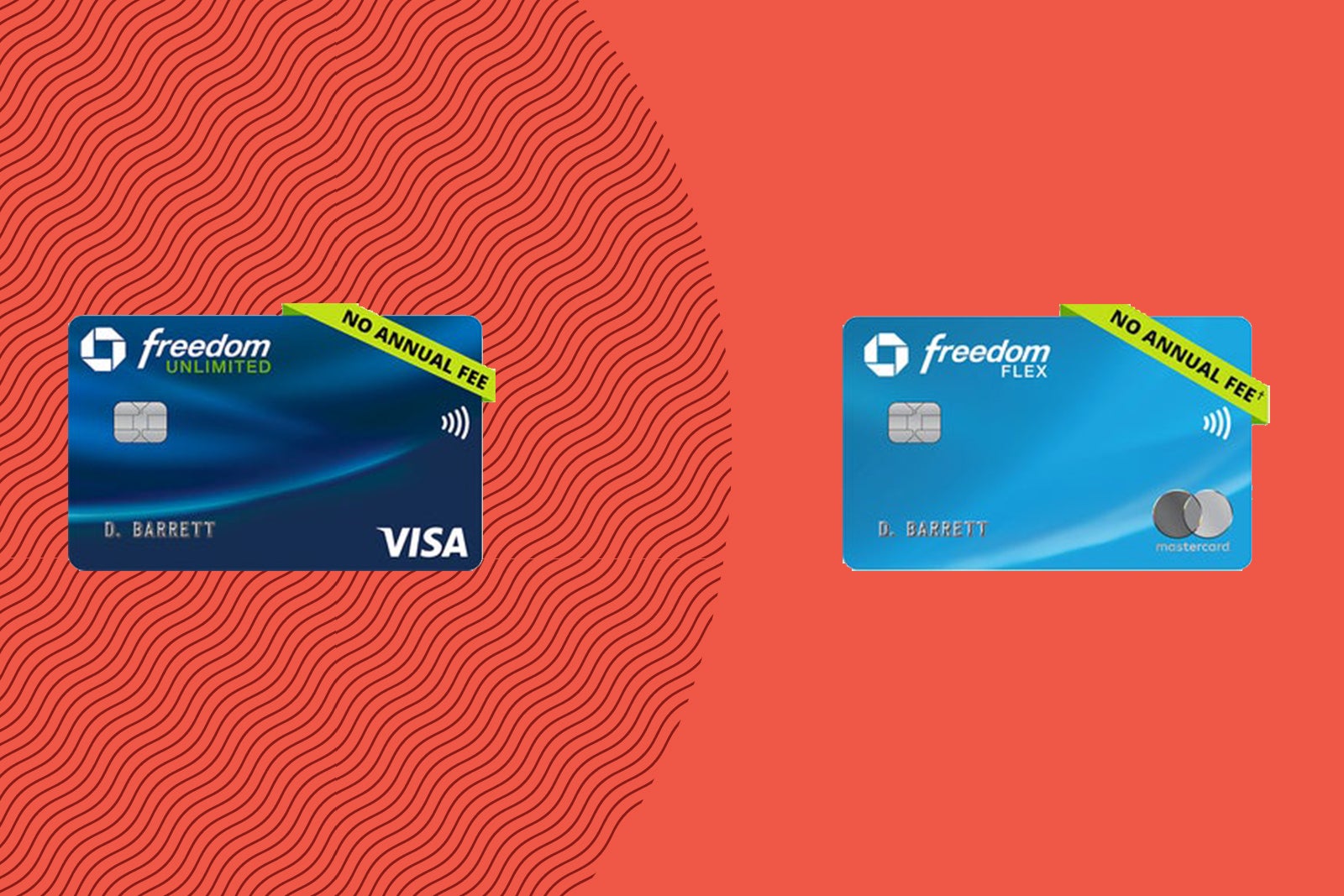
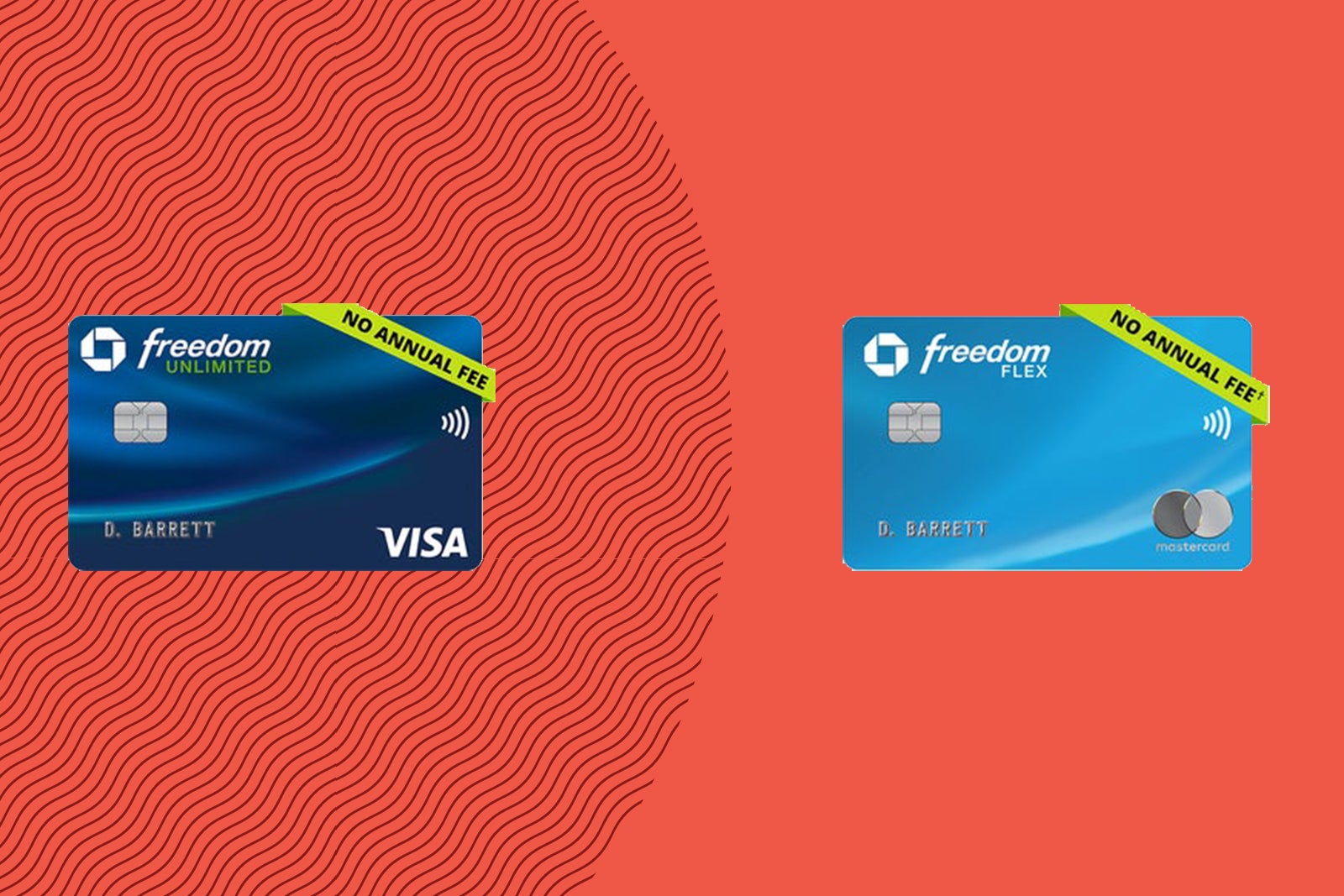
Chase Freedom Flex vs. Chase Freedom Unlimited comparison


Chase’s array of personal credit card products ranges from the ultrapremium Chase Sapphire Reserve® (see rates and fees) to no-annual-fee cash-back cards. With so many options, picking the right card can be difficult if you aren’t sure what you want.

Thanks to Chase’s 5/24 rule, which means you might automatically be rejected for most Chase cards if you’ve opened five or more cards in the last 24 months, it’s crucial to have a clear strategy for which Chase cards you want to add to your wallet.

In this showdown, we’re looking at two of Chase’s most popular no-annual-fee credit cards: the Chase Freedom Flex® (see rates and fees) and the Chase Freedom Unlimited® (see rates and fees).

By themselves, both earn cash-back rewards. However, you can pair either card with a premium card in the Chase Ultimate Rewards ecosystem, such as the Chase Sapphire Preferred® Card (see rates and fees), to turn those rewards into Ultimate Rewards points.

Then, you can transfer those points to travel partners for maximum value.

Let’s review each card’s details to see which makes more sense for you.

Chase Freedom Flex vs. Chase Freedom Unlimited comparison

Card Chase Freedom Flex Chase Freedom Unlimited

None

None

Earn $200 cash back after spending $500 on purchases in the first three months from account opening.

Earn a $250 bonus after spending $500 on purchases in the first three months from account opening.

  • 5% cash back on up to $1,500 in combined purchases in bonus categories each quarter you activate
  • 5% cash on travel booked through Chase Travel℠
  • 3% cash back on dining (including takeout and eligible delivery services)
  • 3% cash back at drugstores
  • 1% cash back on all noncategory bonus purchases

  • 5% cash on travel booked through Chase Travel
  • 3% cash back on dining (including takeout and eligible delivery services)
  • 3% cash back at drugstores
  • 1.5% cash back on all noncategory bonus purchases

  • Trip cancellation/interruption insurance
  • Auto rental collision damage waiver
  • Extended warranty protection
  • Travel and emergency and assistance services
  • Purchase protection
  • Cellphone protection

  • Trip cancellation/interruption insurance
  • Auto rental collision damage waiver
  • Extended warranty protection
  • Travel and emergency and assistance services
  • Purchase protection

Chase Freedom Flex vs. Chase Freedom Unlimited welcome bonus

The Freedom Flex offers a welcome bonus of $200 cash back after spending $500 on purchases in the first three months after account opening.

At face value, this bonus is worth $200; however, according to TPG’s April 2026 valuations, if you also hold a premium Chase card and transfer your points, they can be worth $410.
THE POINTS GUY

Right now, new Freedom Unlimited cardholders can earn a $250 bonus after spending $500 on purchases in the first three months from account opening.

Reward your inbox with the TPG Daily newsletter

Join over 700,000 readers for breaking news, in-depth guides and exclusive deals from TPG’s experts

If you hold an eligible Chase card, this bonus can be worth $513 with the help of transfer partners, according to TPG’s valuations.

Winner: Chase Freedom Unlimited. Its bonus is worth more, even if you don’t hold a premium Chase card.

Chase Freedom Flex vs. Chase Freedom Unlimited benefits

The Freedom Flex and the Freedom Unlimited offer nearly identical travel and purchase protections.

However, cellphone protection is where they differ. With the Freedom Flex — which is a Mastercard — you can get up to $800 per claim and $1,000 per year in cellphone coverage (cardholders can file a maximum of two claims in a 12-month period, and a $50 deductible cap applies per claim). You’re eligible for this coverage when you pay your monthly phone bill with your Freedom Flex.

Woman using her phone
D3SIGN/GETTY IMAGES

Given that these two no-annual-fee cards come from the same card family and are issued by the same bank, it isn’t surprising that they don’t differ drastically.

That said, the inclusion of cellphone insurance could tip the scales in favor of the Freedom Flex if you don’t have another card that offers this protection.

Winner: Freedom Flex. Its cellphone protection benefit is useful for cardholders in the event of damage or theft.

Related: The best cards for trip cancellation and interruption insurance — and what it actually covers

Earning cash back with the Chase Freedom Flex vs. the Chase Freedom Unlimited

These credit cards are cash-back-earning cards by default. They both offer 5% cash back on travel booked through Chase Travel, 3% cash back on dining (including takeout and eligible delivery services) and 3% cash back at drugstores.

A woman putting away her bag in the overhead compartment
RUDI_SUARDI/GETTY IMAGES

Where they diverge is that while the Freedom Unlimited has a flat 1.5% earning rate on all nonbonus spending (compared to just 1% with the Freedom Flex), the latter offers 5% cash back on up to $1,500 in rotating quarterly bonus categories, which include a variety of merchants and purchase categories throughout the year (activation required). The Freedom Unlimited does not offer this benefit.

Winner: Tie. It depends on whether you want to work to keep up with quarterly rotating bonus categories with the Freedom Flex or opt for a simple flat rate with the Freedom Unlimited.

Related: Best Chase credit cards

Redeeming cash back with the Chase Freedom Flex vs. the Chase Freedom Unlimited

Redeeming your hard-earned cash back with either credit card is quite simple. The traditional options are to redeem for a statement credit or receive a direct deposit into most U.S. checking and savings accounts. You can also redeem your rewards for gift cards.

Smiling Young Man Wearing a Brown Turtleneck Sweater Paying his Bills on his Laptop Computer (Side View)
FRESHSPLASH/GETTY IMAGES

Another redemption option is to book travel through Chase Travel to cover airfare, hotel stays and rental cars by paying entirely with rewards or a combination of rewards and cash. You can also redeem points toward purchases made through The Shops at Chase, which includes products from brands such as Apple, Breitling and Tumi. Both of these redemptions process at a rate of 1 cent per point.

If you have an eligible premium Chase card, you’ll be able to redeem your rewards through Points Boost.

Winner: Tie. Both cards have identical redemption options.

Related: Chase Ultimate Rewards points: How to redeem for maximum value

Transferring cash back with the Chase Freedom Flex vs. the Chase Freedom Unlimited

A better way to use your rewards from either the Freedom Flex or the Freedom Unlimited is to transfer them to one of Chase’s premium travel cards, something we call the Chase Trifecta.

These premium Chase cards include the Chase Sapphire Preferred Card, the Ink Business Preferred® Credit Card (see rates and fees) and the Chase Sapphire Reserve.

HYATT

You can transfer these combined points to any of Chase’s 14 transfer partners for even more value. The value you can gain from your points when transferring to travel partners is unlimited.

TPG credit cards editor Olivia Mittak typically uses her Ultimate Rewards points for Hyatt stays. In 2025, she spent 10 nights at Hyatt hotels across Germany without paying anything out of pocket, thanks to Chase points. She was able to do this by transferring her Ultimate Rewards points to World of Hyatt.

Winner: Tie. Both cards share the same transfer partners if paired with a premium card.

Related: The most award-friendly hotel program: Everything you need to know about World of Hyatt

Should I get the Chase Freedom Flex or the Chase Freedom Unlimited?

Due to its rotating quarterly bonus categories, the Freedom Flex is more beneficial if your spending habits change throughout the year (activation required). Cellphone protection is also a helpful perk, especially for a no-annual-fee card.

Conversely, the Freedom Unlimited is ideal for those who prefer simplicity and want guaranteed rewards without the need to track or activate bonus categories, making it a great choice for beginners.

Of course, you can always opt for both cards. Olivia holds both the Freedom Flex and the Freedom Unlimited; together, these cards form an important part of her card strategy.

Related: 4 reasons why I recommend the Chase Freedom Flex to beginners

How to switch from the Chase Freedom Flex to the Chase Freedom Unlimited?

Both the Freedom Flex and the Freedom Unlimited fall within the same family of Chase’s cash-back cards; therefore, you can easily switch between the two.

Switching cards is as simple as calling the customer service phone number found on the back of the card and requesting a product change to either card.

Young casually clothed woman online shopping from her domestic kitchen
PEKIC/GETTY IMAGES

When switching from one card to another, you forgo earning the welcome bonus on the card. This is an important aspect to keep in mind, as you’ll miss out on a chunk of cash-back rewards.

Bottom line

Whether you opt for the Freedom Flex or the Freedom Unlimited, these cards fit nicely into just about every type of credit card strategy.

If you’re new to the world of points and miles and have a more limited credit history, these cards are often easier to get approved for than premium cards such as the Chase Sapphire Reserve.

They can also help you build a strong relationship with Chase while earning valuable rewards — but resist the temptation to redeem them for cash back until you get an eligible premium Chase card later.

Even if you’re a more advanced award traveler, you can get a lot of value from these cards.

To learn more, read our full reviews of the Freedom Unlimited and the Freedom Flex.


Apply here: Chase Freedom Unlimited
Apply here: Chase Freedom Flex


Source link

Leave a Reply

Subscribe to Our Newsletter

Get our latest articles delivered straight to your inbox. No spam, we promise.

Recent Reviews


PeopleSoft HRMS is used to manage employee and human resource functions like recruitment, payroll management, administration, and many more. It stores critical information like work locations, salary, attendance, hiring, etc. It maintains data accuracy and integrity. There is a high demand for skilled resources of PeopleSoft HRMS in the IT market.

In this post, we have put together the best 13 interview questions on PeopleSoft HRMS that will help you prepare for your interview. Go through the below frequently asked PeopleSoft interview questions and answers that enable you to stay one step ahead to grasp your dream job.

Most Frequently asked Peoplesoft HRMS Interview Questions

What are the terminal rules of an element?

Ans: Below are the three main rules of an element.

Actual Termination – It is used for a nonrecurring element. The entries will get closed when the pay date ends.
Final Close – This will be used when the entries need to be opened beyond the leave period of an employee.
Standard Process – It refers to the day that the employee is relieved of his employment.

Name the components for setting a SmartHire template?

Ans: The following components are used for setting a SmartHire template.

  • Template Creation (HR_TBH_CREATION)
  • Template Section (HR_TBH_SECDEFN)
  • Template Record/Field (HR_TBH_RECDEFN)
  • Copy Template (HR_TBH_COPY)
  • Template Category Table (HR_TBH_CTG_TBL)

What are the types of organizational relationships in PeopleSoft HRMS?

Ans: Below are the types of organizational relationships available in PeopleSoft HRMS.

  • Employee – An employee is a permanent staff member who will be paid through company payroll. When a new employee is hired, all the employee information like location, department, pay group, etc., are stored in a job table. 
  • Contingent – A person who works as a contractor for an assignment in a company. The details of the contingent worker will be stored in the database, but they won’t come under the company’s payroll. 
  • POI (Person of Interest) – The people who are connected to the company for some business purpose. The types of POIs are external trainee, external instructor, board member, or pension payee.

Define global assignments.

Ans: An employee can be assigned to a global assignment to monitor, track, dependants, etc., which will be helpful for companies who have branches in different geographical locations. The employee’s resident location will be the home location. The location where the employee moves will be the host location. The company can set international security through some options.

Peoplesoft HRMS Training

  • Master Your Craft
  • Lifetime LMS & Faculty Access
  • 24/7 online expert support
  • Real-world & Project Based Learning


What are checklists and how to create a checklist?

Ans: A checklist is a list of items that the HR uses to track the employee’s tasks that have to be accomplished and noted. To create a checklist, go to ‘Setup HRMS’, and select ‘Common Definitions’. Open ‘Checklists’, select ‘Checklist’, and select the type of checklist.

Want to Become a Master in Peoplesoft HRMS? Then visit here to Learn Peoplesoft HRMS Training.

[ Related Article : Oracle HRSM Training ]

Explain the types of tables in PeopleSoft HRMS.

Ans: PeopleSoft HRMS has three types of tables where data is stored.

Control tables – The accounting structure and processing rules of a transaction will be stored in a control table.
Transaction tables – The transactions or the day-to-day activities will be stored in these tables.
Prompt tables – The data that appears on the PeopleSoft application pages are retrieved from the prompt tables.

How to auto calculate standard hour and FTE?

Ans: Standard hours can be defined by adding a standard hour rule setup through the installation table in Setup HRMS. The minimum, maximum hours, and default hours can be defined by admin for the HR system. When an employee job details are added with a job code, the standard hours and FTE will auto-calculate.

What are the available job level defaults in Peoplesoft HRMS?

Ans: The following are the job level defaults available in PeopleSoft HRMS.

  • Job Labor
  • Payroll
  • Work
  • Job Information
  • Compensation
  • Employment Information
  • Salary Plan
  • Benefit Program Participation
  • Earnings Distribution
HKR Trainings Logo

Subscribe to our YouTube channel to get new updates..!


Define data permission security, and for what can we control data permission security?

Ans: The data permission security controls who has access to the rows of a table. The following types can be controlled with data permission security.

  • Employees
  • People
  • Departments
  • Contingent workers
  • Recruiting job openings
  • People of interest (POIs) with jobs
  • People of interest (POIs) without jobs

. Can a person hold multiple jobs?

Ans: Yes, a person can hold multiple jobs in one of the below two situations.

  • If more than one contingent worker or active employment instance exists.
  • If a substantive job is not suspended and an additional assignment exists.

If you have any doubts on PeopleSoft HRMS, then get them clarified from PeopleSoft HRMS Industry experts on our Peoplesoft HRMS community!

. What are the methods available to update worker’s compensation packages?

Ans: These are the methods available to update worker’s compensation packages.

  • Grade Advance increases
  • Automated step increases
  • Amount increases
  • Seniority Pay increases
  • Percentage increases
  • Step increases using review bands

. Explain about Frequency IDs.

Ans: Frequency IDs are used to define periods in which people are paid, compensation is quoted, etc. These frequency IDs are defined in the Frequency Table component (FREQUENCY_TBL). Each frequency ID is associated with a frequency type and an associated annualization factor that determines the number of times that the period occurs in a year.

. What is the job family in PeopleSoft HRMS?

Ans: Each job in PeopleSoft HRMS is associated with a job code through which it will be identified. The job code will have set standard hours and a default salary grade. A job family is a collection of multiple jobs. The job families are stored in the Job Family Table component (JOB_FAMILY).

Peoplesoft HRMS Training

Weekday / Weekend Batches

 Conclusion

AXA Group,  Anthem Inc., and some government organizations are using PeopleSoft HRMS. PeopleSoft HRMS has customers from almost all the industry verticals. It is one of the widely used tools among most of the companies to track and manage tasks from hire to retire. That means a ton of opportunities are available for the candidates looking for open jobs. 

About Author

author-image

As a Senior Writer for HKR Trainings, Sai Manikanth has a great understanding of today’s data-driven environment, which includes key aspects such as Business Intelligence and data management. He manages the task of creating great content in the areas of Digital Marketing, Content Management, Project Management & Methodologies, Product Lifecycle Management Tools. Connect with him on LinkedIn and Twitter.

Upcoming Peoplesoft HRMS Training Online classes

Batch starts on
22nd Apr 2026
Mon & Tue (5 Days)
Weekday
Timings – 08:30 AM IST
Batch starts on
26th Apr 2026
Mon – Fri (18 Days)
Weekend
Timings – 10:30 AM IST
Batch starts on
30th Apr 2026
Mon & Tue (5 Days)
Weekday
Timings – 08:30 AM IST


Source link