
Trump says Iran ‘doing a very poor job’ in reopening the Strait of Hormuz


First responders search under the rubble at the site of an Israeli airstrike in the village of Habbouch, southern Lebanon on April 10, 2026.
First responders search under the rubble at the site of an Israeli airstrike in the village of Habbouch, southern Lebanon on Friday.
ABBAS FAKIH | AFP via Getty Images

President Trump accused Tehran on Thursday of falling short of a days-old ceasefire agreement between the United States, Iran and Israel. The reopening of the strait was the main U.S. condition to suspend the 40-day bombing of Iran and followed Trump's threats of wide-scale destruction.

"Iran is doing a very poor job, dishonorable some would say, of allowing Oil to go through the Strait of Hormuz," Trump wrote in Truth Social. "That is not the agreement we have!"

The ceasefire has so far had minimal impact on the movement of hundreds of vessels that have been stuck in the region since the start of the war in late February.

Despite the tri-lateral agreement, Iranian officials closed the strait on Wednesday, saying a massive Israeli air assault on Beirut violated the terms of the deal. The strikes killed more than 300 people.

As of Friday morning, only 7 percent of the normal average traffic had been restored, according to Hormuzstraitmonitor.com, a site that aggregates maritime data.

Casting further doubt on the endurance of the truce were continued Israeli strikes on southern Lebanon on Friday and attacks by Iran-backed militant group Hezbollah.

The Gulf also saw continued strikes, with drone attacks against Kuwait's "vital facilities" on Thursday night. Kuwait's foreign ministry condemned "the heinous attacks" launched by Iran and its proxies, adding that they undermined the ceasefire agreement. Iran's Revolutionary Guard denied it was behind the attacks.

High-level talks between the U.S. and Iran are slated to start on Saturday in Islamabad, with the mediation of Pakistani Prime Minister Shehbaz Sharif. Pakistan's government acted as an intermediary between Washington and Tehran to secure the two-week ceasefire.

The U.S. delegation will be led by Vice President Vance. Iran has yet to announce who will be its lead negotiator.

Israel and Lebanon are set to begin direct talks next week, according to the U.S. Department of State. But Israeli Prime Minister Benjamin Netanyahu said Thursday his country would continue to fight Hezbollah despite the U.S.-Iran ceasefire.

Here's more news on Day 42 of the Iran war:

Strait of Hormuz | Israel-Hezbollah strikes | Ukraine Shahed drones

A poster is pasted on a motorbike windshield with graphic depicting Iran's Supreme Leader Ayatollah Mojtaba Khamenei as government supporters gather to mark the 40th day since the killing of his father, Supreme Leader Ayatollah Ali Khamenei, in Tehran, Iran, Thursday, April 9, 2026.
A poster is pasted on a motorbike windshield with graphic depicting Iran's Supreme Leader Ayatollah Mojtaba Khamenei as government supporters gather to mark the 40th day since the killing of his father, Supreme Leader Ayatollah Ali Khamenei, in Tehran, Iran, Thursday.
Vahid Salemi | AP

Iran’s grip on the Strait of Hormuz draws broad condemnation

Iran's blockade of the vital waterway has made it difficult to track the exact number of ships that have traversed since the start of the war, but it's clear that passage has slowed to a trickle. Hormuzstraitmonitor.com, a site that aggregates maritime data, reported that seven vessels have sailed through in the last 24 hours. Another five appeared to be in transit as of Friday 6 a.m. Eastern Time.

Lloyds List, which tracks maritime intelligence data, reported on Thursday that more than 600 vessels are stuck in the Middle East Gulf region. The near-total stoppage has set back operations to such a degree that "even if traffic returned to pre-conflict levels tomorrow, it would still take more than 10 days to move all vessels out of the gulf," the London-based shipping news journal estimated.

Since the war began, Iran has been issuing warnings to idling ships telling them they risk attack if they attempt to travel through the strait without permission and, in some cases, hefty payment of $1 million or more. The threats have left operators confused and frozen, unwilling to attempt passage, due to safety fears and uncertainty about Iran's new fee system. Questions about who to pay, in what currency, and the legitimacy of a new toll process remain unclear.

Before the war broke out, Iran had no control over the strait. An average of 120 to 150 ships sailed through unimpeded every day, and it was a toll-free international waterway.

Iran's chokehold in the Strait of Hormuz was also condemned by Gulf and European countries. Sultan Ahmed Al Jabar, the United Arab Emirates minister of industry and advanced technology, criticized Iran's tight grip on the channel, in a LinkedIn post on Thursday. "This moment requires clarity. So let's be clear: the Strait of Hormuz is not open. Access is being restricted, conditioned and controlled," he said.

"Iran has made clear – through both its statements and actions– that passage is subject to permission, conditions and political leverage… That is coercion," Jabar added.

He noted that the strait, which lies between Iran, Oman and the UAE, is a natural passageway — meaning it was not built or financed by any state — that is governed by the United Nations Convention on the Law of the Sea. Under that framework, transit is guaranteed "as a matter of right; not a privilege to be granted, withheld or weaponized."

Trump, however, appeared to support the idea of a new toll system early Thursday morning, hours before walking back his stance. He told ABC News that he was "thinking of doing it as a joint venture" with Iran and called it "a beautiful thing."

He added: "It's a way of securing it — also securing it from lots of other people."

Later in the day, the president lashed out at Iran over the idea that Iran had already begun collecting fees. "There are reports that Iran is charging fees to tankers going through the Hormuz Strait — They better not be and, if they are, they better stop now!" Trump wrote in a social media post.

It's unclear if the president now opposes the toll system altogether or if he's unhappy that the U.S. seems to have been carved out of a potential revenue stream. The post came hours after European and Gulf-region allies explicitly stated they are against any tolls or restrictions on the shipping route.

"There is no international agreement where tolls can be introduced for transiting international straits. Any such toll will set a dangerous precedent," a ‌spokesperson ⁠for the U.N.'s International Maritime Organization told Reuters on Thursday.

Italian Prime Minister Giorgia Meloni also weighed in, saying, "Full restoration of freedom of movement in the Strait of Hormuz is needed, and it must not be subject to any restrictions."


Israel and Lebanon to meet in Washington as Israel and Hezbollah trade fire

A family picture sits in the rubble at the site of a destroyed building that was hit a day ahead in an Israeli airstrike in central Beirut, Lebanon, Thursday, April 9, 2026.
A family picture sits in the rubble at the site of a destroyed building that was hit a day ahead in an Israeli airstrike in central Beirut, Lebanon, Thursday.
Hussein Malla | AP

Multiple Israeli airstrikes were reported by Lebanese local media early Friday in and around Tyre, a big city on the Mediterranean coast that's south of Litani River, the zone where Israel has said it wants to take Lebanese territory. Lebanese state media also said there have been airstrikes & artillery attacks in border villages, where Israeli troops are holding positions. The Iran-backed Lebanese militant group Hezbollah said it fired RPGs at various Israeli positions inside Lebanon.

The strikes followed Israeli Prime Minister Benjamin Netanyahu's vow on Thursday to continue attacks against Hezbollah, but also to begin direct talks with Lebanon's government.

"Following repeated requests from the Lebanese government to open peace negotiations with us, last night I instructed the Cabinet to begin direct negotiations with Lebanon to achieve two goals: First, the disarming of Hezbollah. Second, a historic, sustainable peace agreement between Israel and Lebanon," Netanyahu said in a video address Thursday.

The U.S. State Department confirmed it will host a meeting next week to discuss ongoing ceasefire negotiations with Israel and Lebanon.

There has been disagreement among the countries involved in the ceasefire as to whether attacks on Lebanon are a part of the agreement. Hezbollah and its backer Iran, as well as mediating country Pakistan, say the agreement does include Lebanon. But Israel and the U.S. have disputed that.

President Trump said he asked Netanyahu in a phone call Wednesday to reduce his country's attacks on Lebanon. "I spoke with Bibi and he's going to low-key it. I just think we have to be sort of a little more low-key," Trump told NBC.

Vice President Vance, who will lead a delegation to Pakistan for Saturday peace talks with Iran, said earlier that the Israelis were looking "to check themselves a little bit in Lebanon, because they want to make sure that our negotiation is successful." He added: "That's not because that is part of the ceasefire. I think that's the Israelis trying to set us up for success."

Lebanese Prime Minister Nawaf Salam has pledged to restrict weapons to "legitimate forces only." Lebanese President Joseph Aoun says he wants a ceasefire first, followed by direct negotiations.

Israel and Lebanon have fought several wars. They do not have diplomatic relations and treat each other as enemy states. Direct negotiations between the two countries would be historic.

Lebanon, meanwhile, is still reeling from the Israeli strike on Wednesday. Emergency teams continued to pull victims from rubble on Friday, as families shared pictures of missing loved ones on social media and authorities tried to match lists of missing people with bodies. A Lebanese NGO published instructions for what people should do if they find a parentless child. Hospitals called for blood donations as they rushed to treat over 1,000 people injured in the strikes.


Ukraine’s Zelenskyy says its forces helped shoot down Iranian drones

Ukraine's President Volodymyr Zelenskyy confirmed Friday that Ukrainian teams sent to several Gulf countries have helped take down Iranian attack drones.

Ukraine has sent more than 200 anti-drone experts to the Middle East to help defend countries from Iranian strikes in retaliation for the U.S.-Israel war on Iran.

Zelenskyy said he had seen video footage from the Gulf of Ukrainian weapons taking down Iranian Shahed drones, which have struck several sites, including U.S. bases in the Middle East over the last month.

He did not say in which Gulf countries the Ukrainian teams shot down these drones, citing security reasons.

In the last couple of weeks, Zelenskyy has visited the region and signed defense deals with Saudi Arabia, Qatar and the United Arab Emirates.

Smoke rises from the site of an Israeli airstrike that targeted the outskirts of the southern Lebanese village of al-Taybeh, on April 10, 2026. Pakistan was poised on April 10, 2026, to host Iranian and US delegations for negotiations in its capital, although Tehran's participation remained uncertain after deadly Israeli strikes on Lebanon threatened this week's temporary truce.
Smoke rises from the site of an Israeli airstrike that targeted the outskirts of the southern Lebanese village of al-Taybeh, on Friday. Pakistan was poised on Friday to host Iranian and US delegations for negotiations in its capital, although Tehran's participation remained uncertain after deadly Israeli strikes on Lebanon threatened this week's temporary truce.
ABBAS FAKIH | AFP via Getty Images

Russia has been using Shahed drones to strike Ukrainian cities nearly every night since its invasion of Ukraine began in February 2022. Ukraine has developed expertise to destroy them through electronic jamming as well as using small, cheap interceptor drones to blow up the Shahed drones.

Lauren Frayer in Beirut, Lebanon, Aya Batrawy in Dubai, United Arab Emirates, Joanna Kakissis in Kyiv, Ukraine, Jackie Northam in Maine, Danielle Kurtzleben, Michele Kelemen and Tina Kraja in Washington, and Vanessa Romo in Los Angeles contributed to this report.

Copyright 2026, NPR


Source link

Leave a Reply

Subscribe to Our Newsletter

Get our latest articles delivered straight to your inbox. No spam, we promise.

Recent Reviews


Alteryx Tools – Table of Content

What is Power BI?  

Power BI is referred to as a Software as a service (SaaS) platform, a Business Intelligence tool that helps analyze organizational data and also helps in creating real-time and interactive dashboards. The Power BI business intelligence tool can be installed on any desktop, mobile or can be used online as well. It also helps in collaborating with every peer in the organization. Power BI is a data visualization tool that helps in developing dashboards and BI reports with business intelligence capabilities. Apart from data visualization, it also allows to perform data exploration, helps in establishing reliable and secure connections to the cloud data sources.

Power BI is used by many organizations because of its amazing features like visualization creation. Some of the visualization formats are column charts, area plots, bar charts, line plots, scatter plots, pie charts, treemaps, scatter plots, etc. It also includes a navigation pane that helps in navigating to the dashboards and reports, associated applications, recent work, etc. The Power BI tool also includes inbuilt functions called DAX functions that can be used for data analysis. These are predefined functions that are available in the library. In Power BI, the data can be imported either from a single or multiple data sources. Power BI is also capable of providing extensive support to both structured and unstructured data. It also includes pre-built templates for dashboard creation. You can also create customized dashboards. 

What is Python?

Python is referred to as a high-level, general-purpose, interpreted programming language that includes a set of pre-built functions and libraries which helps in performing complex operations and calculations. It is easy to learn and is used in most fields like data analytics, artificial intelligence, machine learning, etc. 

Python includes two libraries called Matplotlib and Pandas. Matplotlib library consists of the predefined functions that help in plotting the data visualizations while the pandas library also includes the predefined functions that help in working with the data available.

Become a Power BI Certified professional by learning this HKR Power BI Training !

Power BI Training

  • Master Your Craft
  • Lifetime LMS & Faculty Access
  • 24/7 online expert support
  • Real-world & Project Based Learning

Prerequisites for Power BI Python Integration:

Below is the list of the prerequisites required for Power BI Python Integration to take place.

  1. Python runtime installation: The python runtime installation includes the installation of the execution run time through which the Python script operations can be performed.
  2. Libraries installation: It is essential that some of the important libraries have to be installed which increases the robustness of Power BI. Some of the important libraries are Seaborn and Pandas.
  3. Installation of Visual Studio Code: The installation of Visual Studio code is optional. You can also install any other code editor for writing your python scripts. You can also make use of the Power BI script editor to write the scripts.
  4. Power BI settings update: The final step is to update the settings so that you can work efficiently with Python in Power BI. Through this, you can perform the scripting in Power BI. All you need to do is open up the Power BI desktop, click on the file option. Then click on options followed by settings, then navigate to the opportunities which open a new dialogue box in Power BI. Then you can click on the Python scripting, select the path from the directories and IDE of Python. Once done, you will need to click on the OK button.

Understanding the need for Python Integration in Power BI:

By now, you all might have got an idea of what Power BI and Python is for. Yes, Python is referred to as the powerful tool that helps in creating visualizations while Power BI is for creating well-versed dashboards. These dashboards include all the information which helps in providing a complete view of the organization growth, metrics, KPIs, etc. Hence, if Python and Power BI are integrated, it will be a plus for us to utilize the capabilities that Power BI and Python hold.

Apart from the above, Python and Power BI integration includes several other benefits listed below.

  • The users are allowed to run the python scripts directly within the Power BI
  • Through the integration, libraries like Matplotlib and Seaborn can be used in Power BI for data visualization.
  • Python has become a leading technology and all the machine learning frameworks and data science libraries are written in Python. Through the integration, it allows to create of the data analysis scripts using Power BI
  • To perform precise calculations and clear the complexities, some of the enriched libraries like NumPy and Pandas can be used.

Click here to learn Power BI Tutorial

Power BI Python Integration:

In order to solve complex problems in an organization, it requires data and analytics. It also requires future predictions which gives us future insights and helps us clear the bypass of the issues. Through the business intelligence tools, all these predictions and data visualizations are represented in different forms for a better understanding and analysis. With the amazing capabilities that Power BI and Python hold, organizations are being successful with their integration attaining benefits.

Any idea on how the Power BI Python Integration is performed? Well, I will help with the step by step process to perform the Power BI Python integration.

  • Setup the Integrated Environment:

The primary step is to set up an integrated environment ready for the integration process to begin. You will need to have a distribution of Python readily installed in your machine/desktop. I preferred Anaconda for coding related tasks and the base distribution of Python. Sometimes, trying to integrate Anaconda with Power BI is a difficult task.

After the installation process is completed, you will need to install four python packages, each one has its own significance. They are :

Pandas – for data analysis and data manipulation

Matplotlib and seaborn – for plotting purposes

NumPy – for performing scientific calculations

The pip command in the command line tool is used for installing these packages into the machine.

pip install pandas

pip install matplotlib

pip install NumPy

pip install seaborn

Once the above packages are installed, the python scripting needs to be enabled in Power BI. If you want to check, you can open the Power BI and detect whether the python distribution is automatically detected or not. You will need to go to the files, followed by options and settings, then click on options. You will be able to view the home directory for Python under python scripting that is installed in the machine.

Setup the Integrated Environment

Acquire Vagrant certification by enrolling in the HKR Vagrant Training program in Hyderabad!

  • HKR Trainings Logo

    Subscribe to our YouTube channel to get new updates..!

  • Data Importing using the Python script:

It is time for you to check whether Python is working within Power BI by running a sample test. The primary step to perform this function is to import a small dataset using the Python script in Power BI.

To perform this, you will need to navigate to the Home ribbon, then move to the GetData option and click on the other option. Through this, you will be able to import the data from a different set of sources available. Some of the sources are Spark, Hadoop distributed file system, (HDFS), Web, etc. In the below image, I am going to import the Churn Prediction system that is available in my system.

Data Importing using the Python

Once you click on the connect option, you will see a section that allows you to write the Python script.

Python script

You will need to click on the OK button which will further ask you to select the churn data. Once done, you will need to click on the Load option. You can also perform a check whether the data has been loaded or not through the data view option. With this, you are now ready to make use of the power query in order to perform the data transformations.

Using Power Query To Transform the data:

All the individuals who have learned Python would know that data transformation is no longer a single task-based activity.

By using the Power Query editor, the user can shape and transform the data as required with just a single click. The Power BI is also capable of keeping the record of all the transformations and operations that take place or happen during the process of transformation. We will now show you how to use the Power query to understand and know the data transformation capabilities.

Once the data is loaded in the Power BI, you will need to click on the transform data option which is available under the Home tab in order to open the query editor.

Once the query editor is opened up, you will see multiple options to perform the operations like clean, reshape and transform the data.

Power Query To Transform

We will now convert the customer_nw_category variable into a text field because these fields represent the worth category. Also, you need to know that it would not be a continuous variable.

To perform the same, you will need to select the column -> Go to the Data Type, and change the data type to a text format. All the steps will be recorded by the Power query under the applied steps section. You can also rename these steps for a better recall or reference. I will rename this step as nw_cat Text. The next step is to transform the churn column into a logical variable. True here represents for churned (1), whereas False here represents not churned (2). The step can be renamed as Churn True/False.

customer_nw_category

Once the above operation is performed, you will need to click on the close and apply option which will be available on the top left corner so that all the transformations made will be applied.

Using Python’s Statistical within Power BI:

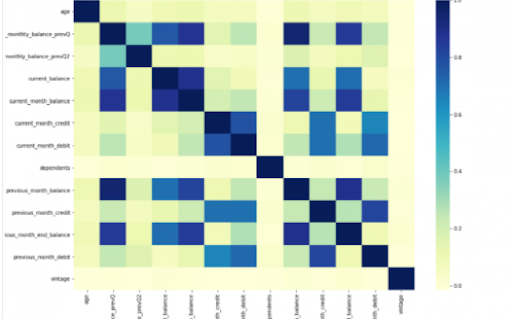
Power BI is considered a library of visualization. Correlation matrix heatmap is an integral component in the data analysis reports.

We will guide you on how to create a correlation matrix heatmap by making use of the Python correlation function. The created heatmap will be available in the reports section in Power BI.

You will need to navigate to the Report section that is available in the Power BI. Then click on the Py symbol which denotes Python visual which is available under the visualizations section. On the left side, you will see an empty Py along with a Python script editor popping up at the bottom of the screen. By this, you might have understood that Power BI is providing an option to create the visualizations with the scripts.

All the value fields will be empty firstly. For correlation heatmap illustration, all the continuous variables will be brought into the value fields, like the age current, previous month balance, monthly balance items, etc. This is considered one of the most essential steps during the integration process. If you forget to perform this step, the Power BI will not be able to recognize the variables.

As the variables are moved into the values fields, the python script will be automatically populated with the below codes.

Let us also write the code for correlation heatmap creation in Python by using the seaborn package.

# import the charting libraries matplotlib and seaborn

import matplotlib.pyplot as plt

import seaborn as sns

# create the correlation matrix on the dataset

corr = dataset.corr()

# create a heatmap of the correlation matrix

sns.heatmap(corr, cmap="YlGnBu")

# show plot

plt.show()

You can now use the run script button and run the script, which will produce a correlation matrix heatmap.

Python’s Statistical within Power BI

Generating analytical reports:

After the heatmap is generated, we can analyze the heatmap and will come to a conclusion.

With the above heatmap, below are the set of conclusions made:

  1. There is no correlation with the other variables for the number of dependents and age.
  2. There is a moderate correlation observed for the average monthly balance in the time span of the last two quarters.
  3. There is a high correlation between the average monthly balance with the previous month balance and the current month balance in the last quarter.
    It is possible to generate a heatmap for the customers who have churned and you can also compare with the customers that do not have. You can apply the filter of churn = False or True so that the heatmap can be observed. Through the analysis, it helps in deriving useful insights from data analysis to the prediction of the behavior.
  4. Power BI Training

    Weekday / Weekend Batches

Conclusion:

Through this article, you have got a clear idea of the process of integration of Python with Power BI. I hope the above information helps you. To get a clear understanding and in-depth knowledge on the subject, you can get trained and certified in Power BI through the Power BI training. The integrated environment will definitely help the organizations to handle and play with the data as and when needed. It focuses on enhancing the power and capitalizing on the benefits that are available in both tools.

related articles 


Source link