
The best ways to travel to Hawaii with points and miles


The Aloha State offers something for everyone, from the bustling city of Honolulu on Oahu to the quiet black-sand beaches of the Big Island, Kauai’s lush rainforests and Maui’s volcanic Haleakala National Park. Of course, a destination this dreamy doesn’t come cheap, and Hawaii has garnered a reputation for being almost as pricey as it is beautiful.

Thankfully, a few savvy rewards strategies can help you plan your dream Hawaiian vacation without breaking the bank — whether that means booking flights with airline miles, redeeming points toward hotel rooms, maximizing rewards on your purchases or all the above.

If Hawaii is on your travel wish list for 2026, read on to learn the best ways to save money on your trip with points and miles.

Related: Hawaii storm update: What to do if you have a trip planned to the islands

Best ways to book flights to Hawaii using points and miles

sunset hawaii beach
M SWIET PRODUCTIONS/GETTY IMAGES

With so many islands — Hawaii has four major islands and over 100 smaller ones — which airport should you fly into?

Daniel K. Inouye International Airport (HNL) in the state’s capital offers the most options. This is a good approach if you want to visit multiple islands, because you can spend some time on Oahu before hopping on a short-haul flight to another island.

On the other hand, if you’d like to base yourself on Maui, Kauai or Hawaii (aka the Big Island), several major U.S. carriers offer direct flights from the West Coast to Maui’s Kahului Airport (OGG), Kauai’s Lihue Airport (LIH) and Kona International Airport (KOA).

As you might expect, the cheapest flights to Hawaii depart from West Coast hubs. In some cases, you may not pay much more in miles to fly from an airport farther east; in others, you may want to look into a positioning flight.

Now, let’s dive into the best ways to redeem miles for flights to Hawaii.

Reward your inbox with the TPG Daily newsletter

Join over 700,000 readers for breaking news, in-depth guides and exclusive deals from TPG’s experts

Book partner flights through Atmos Rewards

An Alaska Airlines plane taxis at Los Angeles International Airport (LAX). AARONP BAUER GRIFFIN/GC IMAGES VIA GETTY IMAGES
AARONP BAUER GRIFFIN/GC IMAGES/GETTY IMAGES

The first carrier that comes to mind for a trip to the Aloha State is Hawaiian Airlines, part of Alaska Airlines’ Atmos Rewards program.

Based on Alaska’s award chart, Hawaiian Airlines flights from the West Coast to Hawaii start at 10,000 or 12,500 points each way in economy, depending on the airports and the distance between them, plus minimal taxes and fees.
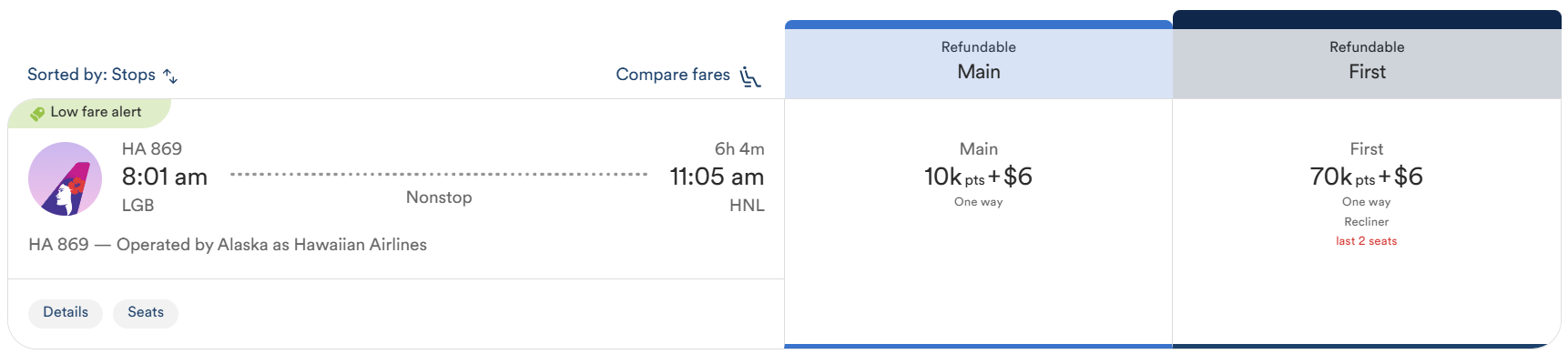
Atmos LGB-HNL 10k econ 4-21
ALASKA AIRLINES

But Hawaiian Airlines isn’t the only partner on which Alaska offers great award rates. You can also find some sweet deals on American Airlines flights, like this nonstop one from Los Angeles to Kauai for 35,000 Atmos Rewards points and $19 in first class.

Atmos LAX-LIH 35k biz 8-29
ALASKA AIRLINES

Booking this exact same flight through American Airlines would cost you much more: 22,000 AAdvantage miles in economy or 55,000 in first class.

AA LAX-LIH 22k econ 55k biz
AMERICAN AIRLINES

To earn more Atmos Rewards points, consider one of these cards:

Or you may want to add a Bilt credit card to your wallet, since Bilt Points transfer to Atmos Rewards at a 1:1 ratio.

Related: How to save hundreds on flights with the Alaska and Hawaiian Companion Fare

Redeem Southwest Airlines Rapid Rewards points

southwest plane
ZACH GRIFF/THE POINTS GUY

Southwest offers direct flights to HNL, OGG, LIH and KOA from various California airports and Phoenix Sky Harbor International Airport (PHX). The carrier also plans to launch a new route from Las Vegas to Hilo International Airport (ITO) on the Big Island in August.

Since Southwest Rapid Rewards implemented variable award pricing, it’s harder to predict how many points you’ll need for an award flight. Southwest’s Low Fare Calendar is usually the best way to check out your options and pinpoint the best rates.

For example, you can fly nonstop from Oakland San Francisco Bay Airport (OAK) to Honolulu in the Choice fare class (a step above basic economy) for as few as 16,500 Rapid Rewards points and $5.60 one-way.

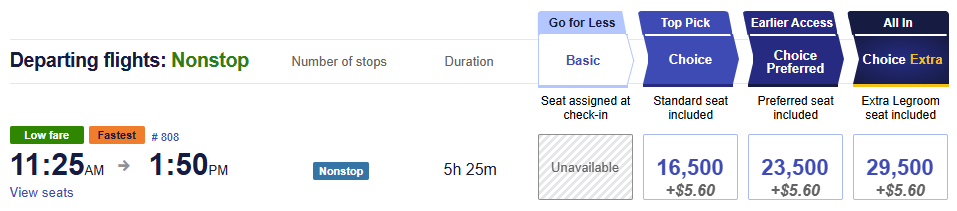
Southwest points calendar OAK-HNL Sept 2026
SOUTHWEST
Southwest OAK-HNL 16.5k 9-16
SOUTHWEST

The following cobranded cards can help you earn Rapid Rewards points faster while providing travel perks like free checked bags, seat selection and even extra-legroom upgrades:

Alternatively, you may prefer a card that earns Bilt points or Chase Ultimate Rewards points, which transfer to Southwest on a 1:1 basis.

Related: How to earn and use the Southwest Companion Pass

Book United Airlines flights with Avianca Lifemiles

ZACH GRIFF/THE POINTS GUY

United MileagePlus has some reasonable redemptions to Hawaii for under 25,000 miles one-way in economy, and you can save more if you have a United credit card. But you can usually find better deals on United flights if you book through Avianca Lifemiles.

Avianca SFO-OGG 15k econ
LIFEMILES

Take this flight from San Francisco to Maui, for example. Avianca’s price is just 15,000 miles and $17 one-way. Meanwhile, United charges 24,000 miles and $5.60 for the same nonstop flight, or 22,500 miles for a connecting flight on a partner airline.
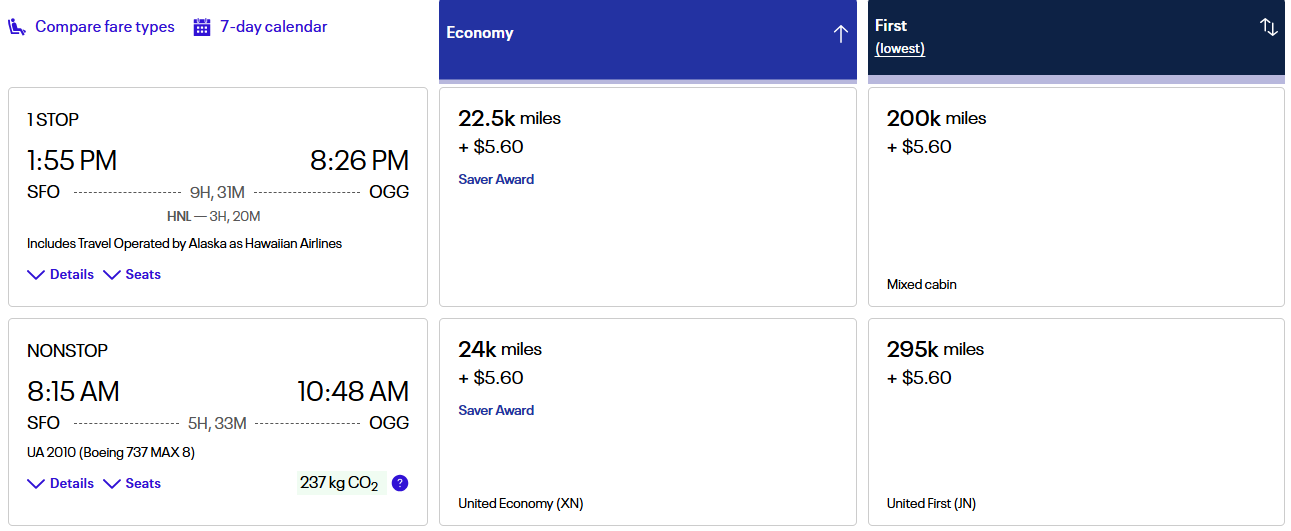
UA SFO-OGG United vs partner flight
UNITED

You can save thousands of miles by booking through Avianca, without paying much more in taxes and fees.

Even better, Avianca miles are incredibly easy to earn because Lifemiles is a 1:1 transfer partner of several major credit card programs: American Express Membership Rewards, Bilt, Capital One miles, Citi ThankYou Rewards and Wells Fargo Rewards. Here are some of our favorite cards for earning these valuable transferable rewards:

Thanks to Avianca’s partnership with Cardless, U.S.-based travelers can also earn Lifemiles on one of two cobranded credit cards.

Related: Award chart sweet spots that can save you money on domestic flights

Redeem Delta Air Lines SkyMiles

Delta plane
ZACH GRIFF/THE POINTS GUY

Delta may not have as many West Coast hubs as other carriers on this list, but there are still good deals to be found — especially if you hold a credit card with the TakeOff 15 perk, which provides 15% savings on Delta-operated award flights.

Since Delta doesn’t publish an award chart, rates can vary widely. I recommend using Seats.aero or the calendar search function on Delta’s site to find the lowest prices.

For instance, Delta has good availability on this direct flight from Seattle to Honolulu for just 16,300 SkyMiles one-way (19,200 miles without the cardholder discount).

Delta SEA-HNL miles calendar Sept
DELTA

The following credit cards not only give you 15% off award flights, but can also help you earn SkyMiles quickly:

Related: Which Delta credit card is right for you?

Best points hotels in Hawaii

CLINT HENDERSON/THE POINTS GUY

Beyond the powder-soft sand and endless sunshine, another thing Hawaii has going for it is a plethora of points hotels. No matter what kind of rewards you have at your disposal, there is almost certainly something you can redeem them for.

I like to start my search with Rooms.aero, where I can see (most of) my options on each island and search by my preferred hotel loyalty program. Here are a few properties I found where you can get maximum value from your points.

Points hotels on Oahu

Points hotels on Maui

GRAND WAILEA MAUI, A WALDORF ASTORIA RESORT/FACEBOOK

Points hotels on Kauai

Points hotels on Hawaii

  • Mauna Kea Beach Hotel, Autograph Collection: All rooms have a private lanai — and a price tag to match — at this luxurious Big Island resort. With rates starting at around $1,200 or 94,000 points per night, you can get great value for your Marriott points here.
  • Grand Naniloa Hotel Hilo: This DoubleTree by Hilton offers the brand’s famous welcome cookies, plus views of Mauna Kea volcano, snorkeling equipment for rent and more. You can book it for as low as $240 or 50,000 points per night.

For more inspiration, check out our roundups of the best hotels on Oahu and the most family-friendly resorts in Hawaii.

Related: Why you need a credit card with your favorite hotel loyalty program

Credit cards to bring to Hawaii

Hyatt Regency Maui
CLINT HENDERSON/THE POINTS GUY

Even if you book your flights and lodging with points and miles, you’re bound to have additional expenses during your Hawaii trip. For anything you pay for with cash, be sure to use the right credit card to maximize your rewards. I would suggest:

With the right card, you can enjoy that after-dinner shave ice or beachfront massage knowing you’re getting that much closer to your next free vacation.

Bottom line

It’s no secret that Hawaii is a pricey destination. But points and miles can help put a Hawaii getaway within reach for budget-conscious travelers, whether you’re planning your first redemption or eyeing first-class flights and top-tier beachfront resorts (or both).

There are plenty of ways to book flights and hotels with points and miles, especially if you have a credit card that earns transferable rewards at your disposal. Before transferring your points, be sure to confirm award availability on the airline or hotel’s website — and check out our list of credit card transfer bonuses to see if you can get an even better deal.


Source link

Leave a Reply

Subscribe to Our Newsletter

Get our latest articles delivered straight to your inbox. No spam, we promise.

Recent Reviews


Normalization in SQL Server – Table of Content

What is Normalization?

Normalization is the organization of data using a set of rules called normal forms while designing a database. It helps improve data accuracy and integrity while reducing data redundancy and inconsistent dependency. It was developed by IBM researcher Edgar Frank Codd in the 1970s to increase data and relational clarity in a database. The process includes organizing data in tabular formats and defining relationships among them. Codd proposed the relational model of databases and introduced the Normal Forms. Most practical applications of database organization can be achieved using the Third Normal Form. But still, some dependencies could exist so in 1974, he was joined by Raymond F. Boyce to develop a stronger version of 3NF, the Boyce-Codd Normal Form.

Types of Normalization

The set of rules used to create a database are called ‘forms’, these help in measuring the level of normalization of an entity. The different types of Normalization Forms are as follows:

1. First Normal Form (1NF):

1NF divides the database into logical units called ‘tables’ consisting of unique values in each related field making it easy to search, filter, and sort the information. While normalizing a database for 1NF a Primary key i.e. a single column is allotted to each data category. It helps in the redevelopment of the raw database into a manageable record. The primary key may consist of a combination of columns and the set is known as Composite Key.

2. Second Normal Form (2NF):

 2NF is the schema of further breaking down the tables based on the partial dependency of data on the primary key. The specific units have a full functional dependency that applies to a single column of Primary key. The entity must completely comply with relationship rules of 1NF to be considered for 2NF and there shouldn’t be any partial dependency. A table with a Composite Primary Key must be split into 2 to generate a foreign key. The foreign key will be the column that references the Primary Key of the other table.

3. Third Normal Form (3NF):

 The objective of entities eligible for 3NF is to eliminate non-dependent data while addressing the update anomaly. The inconsistency of the database following an update is called transitive dependency. Removal of these transitive dependencies leads to normalization from 2NF to 3NF. This is the ideal form of normalization of almost all tables.

4. Boyce Code Normal Form (BCNF):

Redundancies arising from functional dependencies are resolved by 3NF but any anomalies arising from additional constraints are handled through BCNF, also known as 3.5NF. A 3NF table or relation without a transitive dependency is in BCNF.

5. Fourth Normal Form (4NF):

At the 4NF level there are no non-trivial multivalued dependencies other than a candidate key. A relation from a table in the BCNF, without multi-value dependency, only can be in the 4NF.

6. Fifth Normal Form (5NF):

5NF is also known as project-join normal form (PJ/NF). It reduces redundancy in relational databases by isolating semantically related multiple relationships. For a table to be in 5NF its non-trivial join dependency should be implied by candidate keys.

7. Domain/Key Normal Form (DKNF):

DKNF is a stricter normal form than 5NF and it removes any additional type of dependencies and constraints. The main requirements for a 5NF to qualify for DKNF are that each constraint on the table should be a logical consequence and non-existence of all constraints other than domain and keys. Also, there shouldn’t be any insert or delete anomalies in the database. Specifying general integrity constraints is tough so the practical use of DKNF relation is limited.

8. Sixth Normal Form (6NF):

6th normal form is not a standardized form but a table eligible for 5NF only can qualify for 6NF. To be in the 6NF a relation should not contain any non-trivial join dependencies. It is stricter and less redundant that DKNF. The relational variables of entities in this form become irreducible components.

  Become a MSBI Certified professional  by learning this HKR MSBI Training !

MSBI Training

  • Master Your Craft
  • Lifetime LMS & Faculty Access
  • 24/7 online expert support
  • Real-world & Project Based Learning

Importance of Database Normalization

Normalization of operational data stores (ODSs) and data warehouses (DWs) helps in the following ways:

1. Consistency: As all information is stored in a single place, any chances of inconsistency are ruled out.

2. Object-to-data mapping: Normalized data schemas help with object-oriented goals.

3. Flexibility: Data values can be easily added to rows.

4. Accessibility:  Normalized data can be easily accessed, processed, and understood.

5. Uniqueness: Data redundancy is minimized.

Advantages of Normalization

Database Normalization is used to design an organized and managed database to maintain accuracy and enhance productivity. The main advantages of normalizing a database are:

  • Organization of the database through normalization improves data accuracy and reduces redundant data.
  • Data consistency and flexibility improves the logical usage of data.
  • Enhanced database security.
  • All necessary functional dependencies are handled during the normalization process.
  • Makes Index searching easier as the indexes tend to be narrow and short.

What is TSQL?

TSQL is an abbreviation for Transact-SQL or T-SQL. It is a set of proprietary extensions to SQL (Structured Query Language) created by Sybase and owned by Microsoft since 1987. This procedural language expands the Microsoft SQL Server standard with extra features such as declared variables, transaction control, stored procedures, error and exception handling, triggers, string operations, etc. TSQL is used to operate SQL server-based relational databases. It is easier to understand and Turing complete. All interactions with a SQL Server through an application are carried out by T-SQL.

The dominant features of TSQL are:

1. It is a procedural programming language used to create applications.

2. Generates compact and readable codes that are less vulnerable.

3. Support functions for string processing, date and time processing, and mathematics operations.

4. Availability of user-defined custom functions.

5. Offers developers flexible control over the application flow through local variables.

TSQL Functions

Functions can be defined using TSQL beyond the built-in functions of SQL Server.

There are four types of T-SQL functions:

Aggregate functions: 

These deterministic functions operate on a collection of values to calculate one summary value. The values of multiple rows are submitted as input to obtain a more significant value.

Ranking functions:

These are nondeterministic functions that return a ranking value for every row in a partition. The ranks for rows with the same values will be the same.  

Rowset functions:

These nondeterministic functions return an object that can be used as a view or table reference in SQL statements. Their results may vary against the same set of input values.

Scalar functions:

These user-defined functions operate on a single value and return a single value. It helps in simplifying a code but cannot be used to update data.

Analytical functions:

These functions support TSQL to perform complex tasks and enable expression of common analysis such as ranking, percentiles, moving averages, and cumulative sums in a single SQL statement.

 Want to know more about MSBI,visit here MSBI Tutorial.

HKR Trainings Logo

Subscribe to our YouTube channel to get new updates..!

Differences between SQL and T-SQL

The differences between SQL and T-SQL are:

  • SQL is an open-format programming language that works for various data providers and TSQL is its proprietary extension designed specifically for Microsoft SQL Server.
  • SQL is used for implementing reporting techniques while TSQL is useful for the installation of Microsoft SQL servers using applications.
  • SQL is a data-oriented language as it operates over data sets while TSQL is a transactional language.
  • SQL can process basic queries but TSQL can be used to create applications and add services to them.
  • At a given time only a single statement can be processed using SQL while a load of statements can be processed using different control and iteration structures of T-SQL.
  • SQL can be embedded into TSQL but the vice versa isn’t possible.
  • Unlike SQL, TSQL is Turing complete and more robust.
  • Unlike SQL, T-SQL offers easy integration with Microsoft Business Intelligence tools like PowerBI.

Advantages of TSQL

TSQL helps in fast-paced development through better interaction with the SQL Server. The advantages of using TSQL are:   

  • TSQL offers modular programming and its extensions enhance its programmability.
  • Increased reliability and proprietary security of the server.
  • Efficient handling of sensitive data to reduce security threats.
  • Minimizes traffic over the server while easily managing complex tasks.
  • Allows incorporation of programming logic into the database.
  • Provides better control over the database instance.

Click here to get latest MSBI Interview Questions and Answers for 2022

MSBI Training

Weekday / Weekend Batches

 Conclusion

Normalization aids in the easy organization of a database and TSQL assists in writing compact codes. Using these two concepts together makes the database and codes more readable and less vulnerable. The main areas of focus while using these will be designing tables as per the database architecture, reviewing and optimizing Query performance, and scaling the database by implementing it on the cloud. Using these in combination will help developers integrate Microsoft Business Intelligence for business analytics.

Other Related Articles:

1. SSIS Interview Questions

2. MSBI Interview Questions

3. Jaspersoft Training


Source link