We test lots of routers at CNET HQ — mesh and otherwise — so we’re constantly updating our rundowns of the top systems on the market. I’ll note any new mesh systems we test here as we go, along with a quick summary of my takeaways. Please note that this list includes several systems that were tested at my home instead of our latest test setup.
Arris Surfboard Max AX6600: A high-powered Wi-Fi 6 system with an upright, cylindrical design, the Surfboard Max Pro was able to deliver fast speeds to other Wi-Fi 6 devices in my tests, but the performance was inconsistent with earlier-gen Wi-Fi 5 devices. I also didn’t like the Ethernet jacks on the bottom of the device, which force you to bend your cables to the extreme in order to plug the router in.
Asus ZenWifi XD6: The middle child from the Asus family of Wi-Fi 6 mesh routers, the ZenWifi XD6 is a dual-band mesh system. It won’t give you the tri-band build of the ZenWifi XT8, nor will you get that system’s multi-gig Ethernet jack. Still, the system performed as well as any dual-band mesh router I had ever tested when I first reviewed it, so it isn’t a bad pick by any stretch. Available for around $150, it’s a reasonable price for a high-performance system.
Asus ZenWifi XT8: One of the most powerful ZenWifi systems, the tri-band XT8 performed well in our speed tests, and was among the first mesh routers to include multi-gig Ethernet WAN ports on each device. Available in a two-pack for $260, the former CNET Innovation Award winner is a reasonable alternative, but it isn’t quite as good a value as the Netgear Orbi 870 or Eero 7.
Eero 6: Amazon’s first Wi-Fi 6 mesh router, the Eero 6 hit the market back in 2020, but it didn’t blow us away during our tests. Eero systems that followed it did a lot better in my speed tests and they offer the same smart home perks, such as built-in radios for Zigbee and Thread.
The Eero Pro 6E is a great pick for gigabit networks, but most homes would be better off upgrading to the Eero 7.
Ry Crist/CNET
Eero Pro 6E: The Eero Pro 6E did an excellent job in our speed tests, finishing toward the top in just about every category while also delivering a noticeable speed bump to Wi-Fi 6E devices that can connect over the 6GHz band. The Eero 7 is the better value for most households, but if you’re a Wi-Fi 6E power user with gigabit speeds at home, then upgrading to the Eero Pro 6E merits strong consideration.
Eero Max 7: It’s Amazon’s newest, largest and priciest Eero mesh system, and it adds in support for Wi-Fi 7, the new Wi-Fi standard that promises to build upon Wi-Fi 6E’s foray into the 6GHz band. In our speed tests, the Max 7 was capable of hitting blazing-fast speeds, but at more than $1,000 for a two-pack, you’re better off spending less for the Orbi 870.
Linksys Velop MX2000: Available in a two-pack for $150, the Linksys Velop MX2000, also known as the Velop Atlas 6, is decent enough as baseline Wi-Fi 6 mesh routers go, but you’ll find better value and faster speeds if you shop around.
Nest Wifi Pro: The Nest Wifi Pro mesh router reworks the original Nest Wifi pitch by ditching the built-in Google Assistant smart speakers and adding in access to the 6GHz band via Wi-Fi 6E support. With a built-in Thread radio and robust smart home controls via the Google Home app, it’s a decent pick for smart home enthusiasts, and it was as stable a performer as I’ve seen in my speed tests. Still, those speeds were a bit lackluster, and the system also lacked backward compatibility with previous Nest Wifi and Google Wifi hardware. At $400 for a three-pack, it’s a bit expensive for such middle-of-the-road performance.
Netgear Orbi AX6000: Originally released as the Netgear Orbi 850 series, and recently updated to the 860 Series, both generations of Netgear’s flagship AX6000 mesh router offer strong performance, but I wasn’t as impressed with the system’s speeds on a gigabit network, where several systems that cost less have managed to outperform it in my tests. Even so, this is one of the most consistent mesh routers I’ve tested, with reliable speeds from test to test. If that type of steady performance is what you’re after, then it belongs high on your list.
TP-Link Deco X4300 Pro: The Deco X4300 Pro is an impressive system that features some of the best Wi-Fi 6 speeds we’ve seen, plus multi-gig Ethernet jacks on each device. The Deco W7200 still seems like the better value for most homes, but if you’re looking for a step up from that system, put the X4300 Pro on your radar.
TP-Link Deco X55 Pro: The X55 Pro earned CNET’s lab award for the fastest Wi-Fi 6 router, and it’s worth considering as a mesh system, too. It shares a lot of similarities with the Eero 6 Plus — support for Wi-Fi 6, far-reaching range, gigabit Ethernet jacks — and at $175, the X55 Pro is a solid value for a three-piece mesh system.
TP-Link XE75: TP-Link’s first Wi-Fi 6E mesh router, the XE75 did a decent job in our initial tests, though the system’s average upload speeds were lower than I’d expected. It’s a clear value pick and currently available in a two-pack for $173, so give it a look if you’re curious about Wi-Fi 6E but fearful about overspending. I’ll update this page once we’ve retested it in our lab, so stay tuned for that.
TP-Link Deco X90: With a multi-gig WAN port and a faster speed rating, the Deco X90 is a midrange upgrade pick over the Deco W7200, and it costs $259 for a two-pack. It performed well in my tests, but not enough that I’d recommend it over the Eero 7
Vlocity (Salesforce Sectors) provides pre-built Salesforce solutions to meet the needs of specific industries which require CRMs that are significantly customized beyond Salesforce’s out-of-the-box state. Vlocity, which was founded in 2014, swiftly established itself as an “industrial cloud” pioneer, receiving 3 Forbes Cloud 100 honors in 2017, 2018, & 2019. What factors aided them in achieving such quick success?
Vlocity applications (based on the Salesforce platform) provide multichannel sales, advertising, servicing, and CPQ solutions to specific industries like Communications, Health coverage, Energy and Utilities, Financial Services, Multimedia, Healthcare, and Public Sector. The secret to success is straightforward. Companies profit from pre-built flows and procedures that would otherwise take several months (& millions) to construct custom. Salesforce purchased Vlocity in 2020. Salesforce has been able to include Vlocity’s industry-specific CRM systems in its current Salesforce Industries offerings as a result of the acquisition. Vlocity’s creator David Schmaier maintained his position as CEO of Salesforce Enterprises, a corporate unit in charge of establishing clouds for new verticals, following the rebranding.
What is Salesforce Industries, and what does it do?
Salesforce had a step up on the latest vertical solutions after acquiring Vlocity. In general, the 12 existing industry clouds are making progress inside the Vlocity apps. These add to Salesforce’s existing data model and give out-of-the-box services which reflect their industry’s language.
Two often used “clouds” are, for example:
Organizations gain all the tools and apps they need to develop subscription services, handle orders, quotations, and contracts in an agile manner with Media and Communications Clouds.
Financial Services Cloud: Provides a consolidated system with a unified customer’s perspective of their policy, financial information, and claims to support the banking, financial advisory, and insurance markets.
Marketing, sales, commercial agility, and also operating efficiency, are all enhanced by these clouds, which reduce time to value.
What is Salesforce Vlocity, and how does it work?
Salesforce Vlocity is the hottest innovation on the Salesforce platform, which is the industry’s leading provider of industry-specific solutions and software. It stands out as a worldwide forerunner in Customer Relationship Marketing, transforming the total customer experience (CX) (CRM). Vlocity also aids in the comprehension of the CMT, healthcare, and insurance realms. Salesforce Vlocity also has a lot more to offer, such as Lightning Web Omnichannel processes, Integration processes, Vlocity Actions, Tracking services, Data Migration, and so on. Salesforce Vlocity also improves CPQ and guided selling. Salesforce Vlocity is a trailblazer, enabling a slew of top and up-and-coming businesses to achieve their goals through its Omnichannel processes.
What are the different Salesforce Vlocity components?
Vlocity Insurance– To process all components of the insurance, Vlocity employs Microservice Architecture. Financial Service Cloud is intended to function with Vlocity Insurance.
Vlocity Media& Entertainment– This section contains a comprehensive industry solution for ad sales and subscriber sales in order to strengthen consumer and owner relationships.
Industry Cloud for Communications in Vlocity Communications aids in providing a consistent and individualized client experience.
Vlocity Health– Companies could use a Vlocity specialized device called Vlocity Health to run all of the sections relating to the health industry.
Vlocity Energy & Utilities is responsible for a number of industry-specific apps that allow the sale & service of a wide range of commodities and non-commodities.
Vlocity Benefits Salesforce in What Ways?
As a result of this collaboration, industry-specific solutions have become a key component of the platform’s capabilities. Salesforce has improved its adaptability over time, seeking to meet any industry issue. Nonetheless, one stumbling block remains unsolved: IT complexity. Consider a company with a complex IT stack, including some in-house applications. It will take a long time and a lot of money to replace it with a centralized platform. To enable end-to-end business processes, consultants and developers must customize the system, align, and merge apps.
This is where Vlocity comes in. Vlocity adds enterprise product catalogs (EPCs), customer relationship management (CRM), order processing, and digital commerce to Salesforce, and also pre-built methods and new models. The software is developed in strict accordance with industry standards established by organizations such as the TM Forum as well as the MAF. As a result, businesses are able to go live more quickly. They teach their employees and may eventually be self-sufficient, saving money on consultants and developers.
Subscribe to our YouTube channel to get new updates..!
Overview of OmniStudio
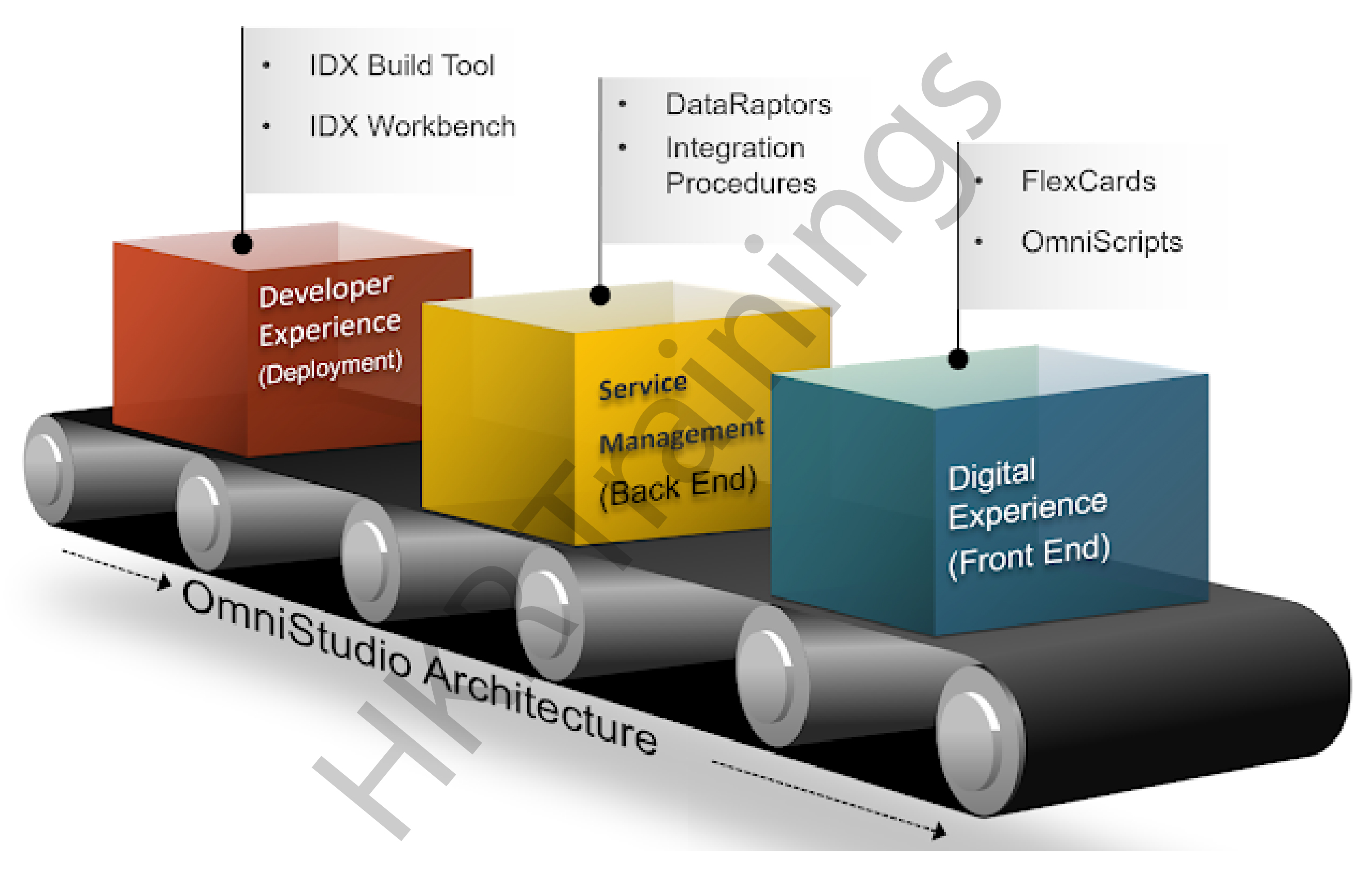
OmniStudio is a modular framework that allows you to easily develop Salesforce flows and solutions using standard click-based components.
The architecture of OmniStudio is made up of three layers:
Digital Experimentation :
This is the User Interface Engine. It contains all of the user interface elements that can be selected and dragged toward the action area. We must choose the appropriate component depending on business requirements. The back-end layer’s entry point is this layer. To conduct any operation, simply connect the back-end components to the components. This UI Engine gets separated into two categories once more:
FlexCards :
Flexcard is an alternative if you really want to display multiple data in less space. Flex cards have been used to display data at a glance. This is a drag-and-drop tool that allows you to quickly configure, preview, and troubleshoot a screen. FlexCards present and summarise contextual information and actions from Salesforce and third-party platforms.
Omniscripts :
OmniScript is being used to give users a guided path through the business processes. That implies you can show multiple screens in a row. We may create pages quickly and effortlessly with the assistance of OmniScript, which is a drag-and-drop application. This is also entirely programmable, allowing it to be tailored to specific requirements. Another omniscript can be called from one omniscript. You may use OmniScripts to create sales, service pathways, and other business operations.
Service Management :
Backend logic & data are handled by this layer. By using integrations, Service Management may read and write data via Salesforce and other external sources.
It is divided into two sections:
1. OmniStudio Dataraptors :
DataRaptors are used to retrieve, transform, and update information. They are used to perform data-related operations such as reading, writing, and transforming data from external sources. There are four parts to Dataraptors
DataRaptor Turbo Extract: As the name implies, this program is used to extract information from a data object. This component has the most efficient data retrieval speed. This option should be used if the need on your page would be to return just a single item.
DataRaptor Extract: Most of the time, we need to work with several objects on a page; in this situation, vlocity gives us this alternative. Use DataRaptor Extract to return many objects.
DataRaptor Load: This component is used to update the information in Salesforce.
DataRaptor Transform: Whenever your data isn’t solely in Salesforce and you’d like to retrieve it and display it in Omniscript/flex cards, use DataRaptor Transform.
2. OmniStudio Integration Procedures :
To carry out such tasks, this instrument is quick and dependable. You can use Integration Procedures to retrieve data from third-party services.
Developer Experience :
OmniStudio Data packs can be managed with the IDX Build Tool. IDX Workbench seems to be a desktop program for transferring Salesforce information and Data packs. In conclusion, like custom programming, OmniStudio provides simple shortcuts and greater reuse chances for adapting the industry-oriented solution to your specific needs.
However, there are several disadvantages to be aware of right now:
Many clouds are combined within one common functionality by industries. As a result, it’s difficult to tell if a certain feature is part of the current implementation.
Since all clouds & APIs receive information in one bundle, updates do not even have a defined structure.
Errors and platform constraints have limited support.
Vlocity’s data model and functionalities are best suited for enterprises at the enterprise level. Some argue that it’s inappropriate again for the SMB market, because not only does it need a greater budget, but it also leaves small-medium firms with capabilities they don’t want and won’t utilize.
Do you want to learn more about Salesforce Vlocity? Watch this Demo video now:
What are FlexCard Actions?
FlexCard Actions can be used to start or modify an OmniScript, connect to a website page or app, show a flyout, launch an event, or change the values of data fields. FlexCards can do the following actions:
Card — Load, modify data source, or erase cards at the card level.
Event Custom — To alert the main FlexCard of an occurrence, fire a Custom Event. PubSub — To alert another element on a website or app of an event, fire a PubSub Event.
Flyout – In a modal or popover, show extra details from such a child card, OmniScript, as well as a custom Lightning web component (LWC).
Navigate — Choose a targeted URL or a PageReference type that allows you to navigate inside Lightning Experience, across Communities, to another website.
OmniScript — Use the FlexCard to launch an OmniScript.
Update OmniScript – Update an OmniScript from a FlexCard incorporated as a customized Lightning web component inside an OmniScript.
OmniScript Action – Update any OmniScript from a FlexCard integrated as a customized Lightning web component in an OmniScript A reusable OmniStudio Action can be used to launch OmniScripts, elements, websites, or external programs. The same OmniScript can be launched from numerous FlexCards using an OmniStudio Action.
Salesforce Vlocity Training
Weekday / Weekend Batches
Conclusion
To summarise, Vlocity achieved a breakthrough by offering businesses such an architectural foundation tailored to their industry. Salesforce’s acquisition signaled the company’s transition to industry-specific products that are easier to tailor and onboard users. For such a quicker digital transformation journey, firms can use the current Salesforce Industry clouds, which offer a configurable data model and a reliable version with reusable solutions.
To provide the best experiences, we use technologies like cookies to store and/or access device information. Consenting to these technologies will allow us to process data such as browsing behavior or unique IDs on this site. Not consenting or withdrawing consent, may adversely affect certain features and functions.
Functional
Always active
The technical storage or access is strictly necessary for the legitimate purpose of enabling the use of a specific service explicitly requested by the subscriber or user, or for the sole purpose of carrying out the transmission of a communication over an electronic communications network.
Preferences
The technical storage or access is necessary for the legitimate purpose of storing preferences that are not requested by the subscriber or user.
Statistics
The technical storage or access that is used exclusively for statistical purposes.The technical storage or access that is used exclusively for anonymous statistical purposes. Without a subpoena, voluntary compliance on the part of your Internet Service Provider, or additional records from a third party, information stored or retrieved for this purpose alone cannot usually be used to identify you.
Marketing
The technical storage or access is required to create user profiles to send advertising, or to track the user on a website or across several websites for similar marketing purposes.